
Daily Current Affairs 15-December-2025

Share this Post

STRENGTHENING INDIA–ETHIOPIA RELATIONS

TOPIC: (GS2) INTERNATIONAL RELATIONS: THE HINDU

India–Ethiopia relations have gained renewed momentum after the meeting between Prime Minister Narendra Modi and Ethiopian Prime Minister Abiy Ahmed Ali at the G-20 Summit in Johannesburg.

Strategic Importance of Ethiopia

  • Ethiopia is Africa’s second-most populous country and one of its fastest-growing economies.
  • Its location in the Horn of Africa, strong military, and role as host of the African Union (AU) make it a key regional power.
  • Despite internal challenges, Ethiopia is viewed as a stabilising force in a conflict-prone region.

Geopolitical and Economic Significance

  • Ethiopia is a potential renewable energy hub, especially in hydropower, with export potential.
  • Though landlocked, it seeks diversified sea access beyond Djibouti, showing a push for strategic autonomy.
  • The country is rebuilding after internal conflict, creating a window for new international partnerships, including with India.

Strong Educational and People-to-People Ties

  • India–Ethiopia ties are over a century old, especially in education.
  • Indian teachers played a major role in Ethiopia’s academic system.
  • Ethiopia was the pilot country for India’s Pan-African e-Network project.
  • Large numbers of Ethiopian students study in India, including the highest number of African PhD scholars.
  • Future scope lies in digital education, skill development, and university partnerships.

Investment and Economic Cooperation

  • Indian investments crossed $4 billion, supported by Indian Lines of Credit since 2006.
  • While agriculture-led investments faced challenges earlier, new opportunities exist in:
    • Mining (gold, rare earths, critical minerals)
    • Pharmaceuticals and agro-processing
    • Light manufacturing
  • Mining cooperation can support India’s renewable energy and semiconductor industries.

Defence and Security Partnership

  • Ethiopia has a long history of defence ties with India, starting in 1956.
  • Indian defence teams have trained Ethiopian forces since 2009.
  • Ethiopia needs modern equipment to replace outdated systems.
  • India’s affordable and tested defence platforms offer a strong match.
  • A new Defence MoU and Joint Defence Committee provide an institutional push.

Future Potential and Multilateral Cooperation

  • Ethiopia’s BRICS membership and AfCFTA participation enhance its global role.
  • India can update DTAA and investment treaties to boost private investment.
  • Ethiopia must improve foreign exchange access, regulatory clarity, and investor confidence.
  • Indian diaspora and India’s duty-free tariff preference scheme further strengthen ties.

Conclusion

India–Ethiopia relations are entering a new strategic phase. With reforms, investment facilitation, and political commitment, the partnership can become a model India–Africa relationship in the next decade.

A PEOPLE-LED CLIMATE INTELLIGENCE MOVEMENT

TOPIC: (GS3) ENVIRONMENT: THE HINDU

Tamil Nadu has launched a community-based Monitoring, Reporting and Verification (CbMRV) system to include local communities in climate data generation. The initiative supports India’s climate commitments under the Paris Agreement and recent COP emphasis on transparency and adaptation.

Climate Transparency and MRV

  • Under the Paris Agreement, countries must measure: Greenhouse gas emissions, Adaptation progress, Climate finance flows
  • COP discussions highlighted tools like Global Implementation Tracker and Global Goal on Adaptation.
  • India supports strong domestic MRV but stresses the need for finance, technology and capacity-building for developing nations.

Need for Community Involvement

  • Present MRV systems mainly depend on: Satellite imagery, Government records, External experts
  • These methods often miss local-level climate impacts.
  • Frontline communities face climate change first and should lead monitoring, fund use and adaptation actions.

What is CbMRV?

  • CbMRV is a community-driven climate data system developed by Tamil Nadu.
  • It allows villages to generate scientific and reliable environmental information.
  • Combines Traditional ecological knowledge and Field data on rainfall, temperature, soil, water, crops, fisheries, biodiversity and carbon
  • Data is uploaded to a digital dashboard for use at village, district and State levels.
  • Shifts climate governance from top-down to participatory.

Pilot Implementation

  • Started in 2023 under the UK PACT programme.
  • Implemented with Keystone Foundation and research partners.
  • Three pilot areas:
    • Nilgiris (Aracode) – forest and tribal ecosystems
    • Erode (Vellode) – agriculture and wetlands
    • Cuddalore (Killai) – coastal and mangrove systems
  • Carbon studies assessed scope for community-based carbon projects.

Community Climate Stewards

  • 35 trained community members act as climate stewards.
  • Include farmers, fishers, women, youth and tribal elders.
  • Roles: Collect and analyse climate data, Identify local trends, Support local planning and adaptation decisions

Governance Impact and Future Scope

  • Supports: Gram Panchayat Development Plans, Climate-resilient villages and disaster preparedness
  • Aims to create a long-term green workforce through skill institutions. Model can be scaled to other regions.

Community-Involved Climate Resilience Initiatives in India

  • Joint Forest Management (JFM): Local communities protect and manage forests along with the Forest Department.
  • Self-Help Groups (SHGs): Women-led SHGs promote climate-resilient livelihoods like organic farming and micro-enterprises.
  • Watershed Development Programmes: Villagers conserve soil and water through check dams, contour bunds, and rainwater harvesting.
  • MGNREGA for Climate Assets: Community labour creates ponds, plantations, and drought-proofing assets.
  • Coastal Community Management: Fisherfolk participate in mangrove restoration and cyclone preparedness.

Conclusion

CbMRV shows that community-led climate intelligence strengthens democracy and resilience. Sharing scientific tools at the grassroots improves effective climate action.

ARE METHANE EMISSIONS IN INDIA BEING MISSED?

TOPIC: (GS3) ENVIRONMENT: THE HINDU

Recent satellite studies have revealed that methane emissions from major Indian landfills may be far higher than official estimates. This has raised concerns about gaps in India’s waste-sector climate data and the need for better monitoring systems.

Methane, A Major Climate Threat

  • Methane is 84 times more powerful than carbon dioxide over a 20-year period.
  • It is produced when organic waste decomposes without oxygen, especially in landfills.
  • Landfill fires are often fuelled by methane buildup.
  • About 15% of India’s methane emissions come from the waste sector.

Why the Waste Sector Matters

  • Unlike agriculture or energy, waste management offers quick climate gains.
  • National schemes like the Swachh Bharat Mission already provide policy support.
  • Controlling landfill methane improves air quality, public health, and climate action.

Limitations of Current Estimation Methods

  • India mainly uses model-based estimates, calculated from waste volumes and assumptions.
  • These models depend on: Accurate and updated waste data, Regular reporting by local bodies
  • In reality, data are old, aggregated, and incomplete, making hotspot identification difficult.
  • Ground-based monitoring is expensive and difficult to scale in large cities.

Role of Satellite Monitoring

  • Satellites offer a new solution to track methane emissions.
  • Two types of satellite data: Regional-level data – useful for national trends, High-resolution data – identifies exact emission sources
  • ISRO’s 2023 satellite-based study identified major emitters such as: Pirana (Ahmedabad), Deonar and Kanjurmarg (Mumbai)
  • The National Green Tribunal ordered ground verification based on these findings.

Mismatch Between Official and Satellite Data

  • Satellite studies suggest landfill emissions can be much higher than official models.
  • Examples:
    • Delhi: Two landfills alone emit almost as much methane as the entire sector’s estimate.
    • Mumbai: Kanjurmarg landfill emissions are nearly 10 times higher than model estimates.
    • Ahmedabad: Pirana landfill emissions equal or exceed State-wide estimates.
  • This shows a serious information gap in India’s climate data.

Need for Satellite to Ground Coordination

  • Satellite data have limits due to clouds and weather conditions.
  • Ground-level inspections are essential to: Identify gas leaks, Detect poor waste cover or illegal dumping
  • Combining both creates a feedback loop for accurate action.

Way Forward

  • Expand satellite monitoring to all major landfills.
  • Set up ground validation teams in metro cities.
  • Create standardised data-sharing systems between urban bodies and pollution boards.
  • Integrate methane targets into Swachh Bharat Mission and Gobardhan Scheme.

WHAT IS METHANE?

Methane (CH₄) is a colourless, odourless gas. It is a powerful greenhouse gas present naturally in the atmosphere.

  • It is the main component of natural gas used as fuel.
  • Though it stays in the atmosphere for a shorter time than CO₂, its warming effect is much stronger.

Why is Methane Harmful to the Environment?

  • Strong Greenhouse Gas: Methane traps about 28–34 times more heat than carbon dioxide over 100 years.
  • Accelerates Global Warming: Contributes significantly to climate change and rising temperatures.
  • Harms Air Quality: Reacts in the atmosphere to form ground-level ozone, which is harmful to human health and crops.
  • Impacts Ecosystems: Leads to heat stress, changing rainfall patterns, floods, and droughts.

Major Sources of Methane

Natural Sources

  • Wetlands: Largest natural source due to decomposition of organic matter.
  • Termites: Release methane during digestion.
  • Oceans and Permafrost: Release methane naturally, especially as temperatures rise.

Human-made (Anthropogenic) Sources

  • Agriculture (Largest Human Source): Livestock (cows, buffaloes, sheep) through digestion (enteric fermentation). Rice paddies due to flooded conditions.
  • Fossil Fuels: Leakage during oil and natural gas extraction, transport, and storage. Coal mining.
  • Waste Sector: Landfills where organic waste decomposes. Sewage and wastewater treatment.

Conclusion

Better data can turn methane from a hidden threat into a clean energy opportunity. With coordinated monitoring and policy action, waste management can become a smart climate solution.

THE ATOMIC ENERGY BILL, 2025 (SHANTI BILL)

TOPIC: (GS3) ECONOMY: THE HINDU

The Union government has cleared the Atomic Energy Amendment Bill, 2025, renamed the SHANTI Bill, to reform India’s nuclear power framework. The Bill aims to allow private and foreign participation in civil nuclear energy to support energy security and climate goals.

Why Nuclear Reforms Are Needed

  • India’s renewable energy capacity is rising fast, but energy storage remains limited, causing grid instability.
  • Coal-based power faces environmental limits and slowing expansion.
  • Nuclear energy provides reliable baseload power with low carbon emissions.
  • The main challenge is capital availability, not technological capability.

Need for Opening the Nuclear Sector

  • Large nuclear projects require huge long-term investments.
  • India is seeking funds from private players and foreign investors, including sovereign wealth funds.
  • The reforms also aim to revive the Indo–US Civil Nuclear Deal, whose commercial benefits remain largely unrealised.

Features of the SHANTI Bill, 2025

  • Private participation: Indian private companies allowed up to 49% equity in nuclear projects.
  • Foreign involvement: Entry through partnerships with Indian firms and global funds.
  • Expanded activities for private sector:
    • Mining and exploration of atomic minerals
    • Fuel and equipment manufacturing
    • Select plant operations
    • Research and development in civil nuclear technologies
  • Focus on Small Modular Reactors (SMRs) for future growth.

India’s Nuclear Capacity Expansion Plan

  • Current nuclear capacity: about 8 GWe.
  • Target: 100 GWe by 2047.
  • For comparison: USA (~100 GWe), France (~65 GWe), China (~58 GWe).
  • Nuclear Energy Mission: ₹20,000 crore for SMR research, At least 5 indigenous SMRs by 2033
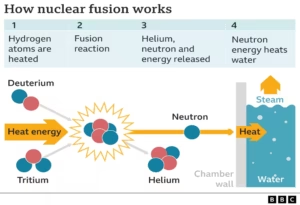
The Atomic Energy Bill, 2025

Private Sector Role and Model

  • Interested firms: Reliance, Tata Power, Adani, JSW, Hindalco, Jindal Group.
  • NPCIL will own and operate plants.
  • Private players will finance projects and receive assured long-term power supply.

Nuclear Liability Issue

  • The Civil Liability for Nuclear Damage Act, 2010 allows operator’s right of recourse against suppliers.
  • Foreign companies view this as a major risk.
  • Possible solutions: Cap supplier liability, Create government-backed insurance pools, Align with international liability norms

Challenges and Way Forward

  • Address safety concerns through strong independent regulation.
  • Ensure fair risk-sharing and commercial clarity.
  • Balance national sovereignty, safety, and openness.
  • Integrate nuclear power into India’s net-zero strategy.

SMALL MODULAR REACTORS (SMRS)

Small Modular Reactions (SMRS)

Advantages:

    • Smaller size and factory-based construction
    • Faster deployment and lower upfront cost
    • Suitable for industries like steel, cement, data centres
  • Indigenous SMR designs by BARC:
    • BSR (220 MWe) – PHWR-based
    • BSMR (200 MWe) – Light Water Reactor
    • SMR-55 (55 MWe) – LWR-based

Conclusion

The SHANTI Bill signals a major shift in India’s nuclear policy. If implemented carefully, it can strengthen energy security, attract investment, and support climate commitments.

ICMR MODEL FOR NATIONAL SNAKEBITE PREVENTION STRATEGY

TOPIC: (GS2) GOVERNANCE: THE HINDU

The Indian Council of Medical Research (ICMR) has approved a ₹13.5 crore, four-year research project to develop a national model for preventing snakebite deaths. The initiative is based on Assam’s Demow Model, a successful community-led approach to snakebite management.

Snakebite: A Serious Public Health Challenge

  • Snakebite envenoming is a neglected but preventable health issue.
  • India records nearly 58,000 snakebite deaths every year, the highest globally.
  • Most victims are from: Rural and agricultural communities, Tribal and forest-dependent populations
  • High-burden States include Assam, West Bengal, Odisha, Maharashtra, and Jharkhand.

ICMR’s National Snakebite Research Initiative

  • Project name: Zero Snakebite Death Initiative.
  • Focus: Develop a scientifically tested, community-based national model.
  • Duration: 4 years; Budget: ₹13.5 crore.
  • Implementation across seven States: Assam, West Bengal, Odisha, Kerala, Himachal Pradesh, Maharashtra, Jharkhand
  • Coordinated under SARPA (Snakebite Awareness, Response, Prevention & Action).
  • Research to start in January 2026.

Objectives of the Project

  • Create a replicable national strategy for snakebite prevention.
  • Improve community awareness and health worker capacity.
  • Strengthen early treatment and referral systems.
  • Develop a digital dashboard for surveillance and policy support.

Problems in Snakebite Management

  • Delay in reaching healthcare facilities
  • Poor awareness of safe practices and first aid
  • Weak referral and transport systems
  • Limited pre-hospital care
  • Lack of real-time monitoring and data collection
  • These gaps lead to avoidable deaths, despite available treatment.

The Demow Model: Assam’s Grassroots Success

  • Developed in Sivasagar district, Assam.
  • Emphasises community ownership and quick response.
  • Key features:
    • Local volunteers as first responders
    • Fast referral to hospitals within the “golden hour”
    • Awareness programmes on prevention and first aid
    • Training of ASHA workers, teachers, and village leaders
    • Strong coordination with local hospitals
  • Proven results led to its selection for national scaling.

Integration of Best Practices from Other States

  • ICMR will build a composite national model by combining:
    • Maharashtra: Distribution of gumboots and protective gear
    • Himachal Pradesh: Anti-Snake Venom (ASV) given in ambulances
    • Kerala: Digital platforms for real-time case tracking and referrals

Public Health Significance

  • Snakebite is listed by the WHO as a high-priority neglected tropical disease.
  • A national strategy can: Reduce preventable deaths, Strengthen rural healthcare systems

NEW RAMSAR SITES IN INDIA

TOPIC: (GS3) ENVIRONMENT: THE HINDU

India has added two more wetlands to the Ramsar List with the designation of Siliserh Lake (Rajasthan) and Kopra Jalashay (Chhattisgarh). This step strengthens India’s commitment to wetland conservation under the Ramsar Convention.

Ramsar Convention

  • An international treaty signed in 1971 in Ramsar, Iran.
  • Aims to conserve and ensure wise use of wetlands.
  • India is one of the leading countries in terms of the number of Ramsar sites.

Siliserh Lake – Rajasthan

Location and Background

  • Situated in Alwar district, Rajasthan.
  • Lies within the buffer zone of Sariska Tiger Reserve.
  • A man-made lake, constructed in 1845 by Maharaja Vinay Singh.
  • Originally built to supply drinking water to Alwar town.
  • Located in a semi-arid region, making it ecologically important.

Ecological Importance

  • Acts as a key water source in a dry landscape.
  • Supports rich biodiversity despite low rainfall conditions.

Flora and Fauna

  • Home to 149 species of birds and 17 species of mammals.
  • Important species include: Vulnerable River Tern, Endangered Tiger
  • Supports more than 1% of the global biogeographic population of Black Stork (Ciconia nigra), meeting Ramsar criteria.

Kopra Jalashay – Chhattisgarh

Location and Physical Features

  • Located near Bilaspur district, Chhattisgarh.
  • A reservoir in the upper catchment of the Mahanadi River.
  • Has strong hydrological and ecological connectivity with surrounding habitats.

Ecological Significance

  • Creates diverse wetland habitats supporting aquatic and bird life.
  • Serves as a critical nesting, feeding and stopover site for migratory birds.

Faunal Diversity

  • Supports over 60 species of migratory birds.
  • Key species include: Vulnerable Greater Spotted Eagle (Aquila clanga), Endangered Egyptian Vulture (Neophron percnopteru

New Ramsar Sites in India                                  

Significance of New Ramsar Designations

  • Enhances protection of freshwater ecosystems.
  • Promotes sustainable use of wetlands.
  • Supports India’s commitments to biodiversity conservation and climate resilience.

PAX SILICA INITIATIVE

TOPIC: (GS2) INTERNATIONAL RELATIONS: THE HINDU

The Pax Silica Initiative came into focus after political debate in India over the country not being included in the U.S.-led framework. The issue has highlighted concerns related to India–US relations and global semiconductor and AI supply chains.

What is the Pax Silica Initiative?

  • Pax Silica is a strategic initiative led by the United States.
  • Its goal is to build a secure and trusted silicon-based supply chain.
  • The initiative covers the entire value chain: Critical minerals, Semiconductor manufacturing, Artificial Intelligence (AI) infrastructure
  • It aims to ensure long-term technological stability and economic security among partner countries.

Meaning of the Term ‘Pax Silica’

  • ‘Pax’ is a Latin word meaning peace, stability and prosperity.
  • ‘Silica’ refers to the raw material refined into silicon.
  • Silicon is essential for computer chips, semiconductors and AI technologies.
  • Together, the term symbolises stability through control over key digital technologies.

Objectives of the Initiative

  • Reduce dependence on coercive or unreliable suppliers.
  • Safeguard materials and technologies critical for AI and advanced computing.
  • Enable partner nations to develop and deploy emerging technologies at scale.
  • Strengthen resilience in global technology and semiconductor supply chains.
  • Member Countries: Countries participating in Pax Silica include: Japan, South Korea, Singapore, Netherlands, United Kingdom, Israel, United Arab Emirates, Australia
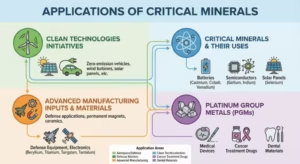
Apllications of Critcal Minerals

Areas of Cooperation

Participating countries have agreed to:

  • Work jointly on critical minerals and semiconductor supply chains to Promote joint ventures and strategic investments.
  • Collaborate in: Chip design, fabrication and packaging, AI computing infrastructure, Energy grids and power generation
  • Protect sensitive technologies and infrastructure from hostile control.
  • Build trusted digital ecosystems, including data centres, fibre-optic networks and AI models.

Strategic Significance

  • Strengthens collective technological security among allied nations.
  • Shapes the future of AI governance and digital geopolitics.
  • Highlights growing competition in semiconductors and emerging technologies.

APAAR ID (AUTOMATED PERMANENT ACADEMIC ACCOUNT REGISTRY)

TOPIC: (GS2) INDIAN POLITY: THE HINDU

The Orissa High Court has asked state and central education authorities to revise the consent form for generating APAAR IDs. The court directed that students must be clearly given an opt-out choice, strengthening the principle of informed consent.

Apaar ID                                     

What is APAAR ID?

  • APAAR stands for Automated Permanent Academic Account Registry.
  • It is an initiative of the Ministry of Education, Government of India.
  • It comes under the “One Nation, One Student ID” framework of the National Education Policy (NEP) 2020.
  • The system creates a permanent academic identity for every student.

Features of APAAR

  • Each student is issued a unique 12-digit APAAR ID.
  • The ID remains the same throughout the student’s educational journey, from school to higher education.
  • It digitally records: Academic qualifications, Degrees and diplomas, Scholarships and awards, Academic credits and certifications
  • The ID acts as a lifelong academic passport.

Digital Integration

  • APAAR ID is linked with Aadhaar for verification purposes.
  • Academic records are stored in DigiLocker, allowing secure online access.
  • Students can retrieve certificates anytime without depending on physical documents.

How APAAR Helps Students

  • Single Academic Identity: Eliminates the need for multiple IDs or paper certificates.
  • Easy Mobility: Enables smooth movement between schools, colleges and universities.
  • Credit Transfer: Supports transfer of academic credits under the Academic Bank of Credits (ABC) system.
  • Simplified Applications: Helps in admissions, skill courses and job applications by sharing verified digital records.

Benefits for the Education System

  • Reduces duplication and errors in student records.
  • Improves transparency and efficiency in academic data management.
  • Supports digital governance in education.

Concerns Highlighted by the Court

  • Need for clear consent and voluntary participation.
  • Importance of giving students and parents a right to opt out.

Write a Review

Your email address will not be published. Required fields are marked *