
India’s space programme is in focus after recent landmark missions like Chandrayaan‑3 and the rollout of the Indian Space Policy 2025. The sector is shifting from being mission‑centric to a citizen‑oriented ecosystem, supporting governance, economy, and global leadership.
Evolution of India’s Space Journey
- Foundational Vision: Built indigenous launch vehicles and satellites, ensuring self‑reliance and strategic autonomy.
- Public Engagement: Missions like Chandrayaan inspired mass participation and strengthened scientific curiosity among citizens.
- Technological Depth: Achieved precision landing, rover operations, and docking capabilities, moving beyond symbolic achievements.
- Societal Integration: Space assets now serve everyday governance, disaster management, and citizen services.
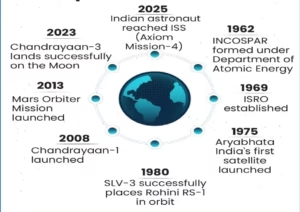
Key Milestones
- Chandrayaan‑1: Discovered water molecules on the Moon, reshaping lunar science.
- Chandrayaan‑2: Provided high‑resolution lunar data despite partial setbacks.
- Chandrayaan‑3: First soft landing near lunar south pole, placing India among elite space powers.
- Gaganyaan: Human spaceflight programme with crew module recovery and test missions.
- Aditya‑L1 & SPADEX: Advanced solar observation and in‑orbit docking, paving way for future space stations.
Space as a Development Tool
- Disaster Management: Early warning systems, damage assessment, and real‑time coordination.
- Agriculture & Fisheries: Crop estimation, drought monitoring, and marine advisories.
- Infrastructure & Transport: Railway safety, urban planning, and power grid monitoring.
- Democratisation: Space data made accessible to citizens, states, and institutions.
Policy Reforms and Economic Impact
- Indian Space Policy 2025: Encourages private sector participation in launches, satellites, and downstream services.
- Commercial Growth: Startups in satellite manufacturing, launch vehicles, and analytics.
- Economic Expansion: Sector valuation rose from ₹5,615 crore (2013‑14) to ₹24,116 crore (2025‑26).
- Employment: High‑skill jobs in aerospace, AI, robotics, and materials science.
Youth, Education, and Innovation
- Capacity Building: Over 60,000 students engaged annually through Olympiads and space challenges.
- Innovation Platforms: Hackathons and competitions link academia with applied research.
- Startup Ecosystem: More than 350 startups active in satellite systems and applications.
- Future Workforce: Strengthening STEM education aligned with emerging space technologies.
Global Leadership Role
- Climate Monitoring: Satellites track global environmental changes.
- International Collaboration: Partnerships with NASA, ESA, CNES, and others.
- Normative Leadership: Promotes cooperative space use under Vasudhaiva Kutumbakam.
- South‑South Outreach: Provides satellite services and training to developing nations.
Conclusion
India’s space programme has transformed from a symbol of aspiration into a pillar of national development and strategic capability. By linking space technology with governance, economy, innovation, and global cooperation, India is building a citizen‑centric and globally integrated space ecosystem aligned with the vision of Amrit Kaal.
The Supreme Court recently froze new mining leases in the Aravalli Hills until a sustainable mining plan is prepared. The Court allowed exceptions for critical and strategic minerals, sparking debate on whether such exemptions weaken environmental safeguards.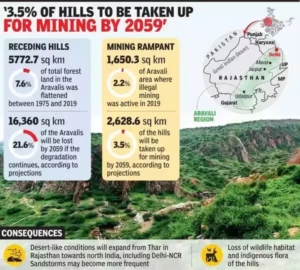
Background of the Issue
- On November 20, 2025, the Supreme Court adopted a uniform definition of “Aravalli Hills and Ranges” for mining regulation.
- Mining was prohibited in core and inviolate areas, but exemptions were made for minerals linked to national defence and strategic needs.
- Later, the Court placed this definition in abeyance and set up a new committee to re-examine the issue.
Concerns with Strategic Exemptions
- India often resolves conflicts between climate commitments and industrial demand through executive discretion rather than clear rules.
- The Environment Ministry has diluted environmental clearance norms to promote ease of business, making exemptions easier to misuse.
- The EIA framework allows projects linked to “national defence” or “strategic considerations” to bypass public consultation, creating opacity.
- Such exemptions risk turning “national interest” into a vague and arbitrary justification.
Government and Court Actions
- Since 2014, clearance processes have been softened to reduce friction for industries.
- In May 2025, the Supreme Court ruled that ex post facto clearances were invalid, but in November 2025, it reopened the space for post facto approvals.
- In September 2025, the Environment Ministry exempted critical mineral mining projects from public consultations under the EIA Notification 2006.
- The Forest (Conservation) Amendment Act 2023 widened exemptions for land near borders, roads, and security infrastructure, enabling easier exploration.
Environmental Importance of Aravalli Hills
- The Aravallis are vital for groundwater recharge and preventing desertification.
- They provide ecosystem services linked to SDGs such as clean air, water security, and sustainable living.
- The region is believed to hold strategic minerals like tungsten, lithium, and rare earths, crucial for defence and green energy transition.
- Weakening safeguards risks irreversible ecological damage.
Way Forward
- Establish a clear framework for when strategic exemptions are justified.
- Conduct landscape-level cumulative impact and groundwater assessments before granting leases.
- Ensure public disclosure of alternatives like imports, recycling, or sourcing from less sensitive areas.
- Balance climate action and economic growth through transparent rules rather than ad hoc exemptions.
Conclusion
The Aravalli Hills controversy highlights India’s challenge of reconciling climate commitments with industrial demand. Without transparent criteria, “strategic exemptions” risk undermining environmental law and weakening democratic accountability in resource governance.
In Indore, Madhya Pradesh, contaminated piped water led to the death of at least four people (unofficial toll higher) and illness in over 2,000 residents. The incident highlights the urgent need to monitor water quality at the delivery point and strengthen India’s water management systems.
Background
- Indore, known as India’s cleanest city, faced a major public health crisis due to unsafe municipal water.
- Over 200 people were hospitalised, with 32 in ICU.
- This is the second water-related incident in Madhya Pradesh in two months, following jaundice cases at a university near Bhopal.
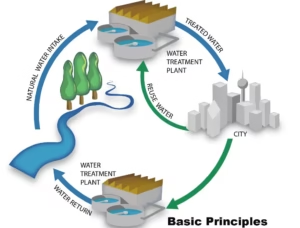
Current Situation in India
- Despite progress under Swachh Bharat Mission and Jal Jeevan Mission, water safety remains a challenge.
- NFHS data: 96% of households use “improved sources” of drinking water, but contamination risks persist.
- Municipal supply is assumed safe, yet lack of monitoring and enforcement undermines trust.
Key Issues
- Infrastructure gaps: Old pipelines and poor maintenance increase contamination risks.
- Weak enforcement: Guidelines and environmental laws are not strictly implemented.
- Public health burden: India’s large population (147 crore) faces high incidence of water-borne diseases.
- Administrative lapses: Authorities often engage in blame games instead of preventive action.
Way Forward
- Regular testing: Water quality must be checked at the delivery point, not just at source.
- Infrastructure upgrade: Replace and repair ageing pipelines to prevent leaks and contamination.
- Strict enforcement: Stronger monitoring of water safety standards across states.
- Awareness campaigns: Educate citizens about risks and safe practices.
- Integrated approach: Combine water safety with broader public health measures to reduce disease burden.
Conclusion
The Indore tragedy is a wake-up call for India’s urban and rural water management. Access alone is not enough—quality assurance is critical. Without strict monitoring, enforcement, and infrastructure upgrades, unsafe drinking water could become as dangerous as air pollution, threatening the health and lives of millions.
In 2025, copper prices crossed USD 12,000 per tonne, the highest ever recorded. The surge is due to global supply disruptions, US tariff uncertainty, and rising demand from AI infrastructure, clean energy, and electric vehicles.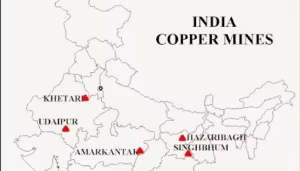
Key Characteristics of Copper
- Chemical Properties:
- Symbol: Cu, Atomic weight: 546 amu.
- Resistant to corrosion and oxidation.
- Forms alloys like brass (Cu+Zn) and bronze (Cu+Sn).
- Physical Properties:
- Excellent electrical and thermal conductivity.
- Highly ductile and malleable, easy to shape and wire.
- Distinct reddish-brown colour, one of the few naturally coloured metals.
- Unique Traits:
- 100% recyclable without loss of quality.
- Antimicrobial, useful in healthcare.
- Improves energy efficiency and reduces CO₂ emissions across product lifecycles.
Applications of Copper
- Energy & Power: Transmission lines, transformers, renewable energy systems, battery storage.
- Electric Vehicles: Motors, batteries, inverters, charging stations (EVs use twice as much copper as conventional cars).
- Digital & AI Infrastructure: Data centres, cooling systems, power grids.
- Construction & Manufacturing: Plumbing, roofing, machinery, electronics.
- Defence & Healthcare: Defence electronics, ammunition, antimicrobial medical equipment.
India and Copper
- India has classified copper as a critical mineral.
- Heavy import dependence (over 90%) for copper concentrate.
- Demand expected to rise sharply due to EV adoption, renewable energy expansion, and digital infrastructure growth.
Global Producers
- Major copper-producing nations: Chile, Peru, Democratic Republic of Congo, China, and USA.
Conclusion
Copper is central to the energy transition and digital economy. For India, reducing import dependence and securing supply chains will be vital to meet future industrial and strategic needs.