
EDUCATIONAL COSTS IN INDIA
TOPIC: (GS2) SOCIAL JUSTICE: THE HINDU
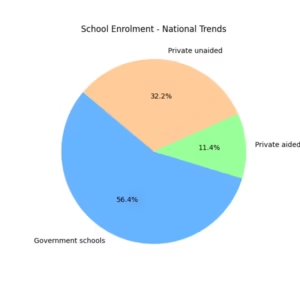
The NSS 80th Round (2025) survey on education highlights the rising financial burden on families despite the constitutional promise of free schooling.
Right to Education vs. Actual Costs
- Article 21A (86th Amendment) mandates free and compulsory education for children aged 6–14.
- NEP 2020 expands this aim to ages 3–18, targeting universal schooling up to Class 12 by 2030.
- However, private school enrolment and private coaching remain widespread, pushing up household spending on basic education.
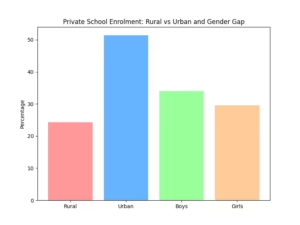
Rural vs Urban
- Rural private enrolment: 24.3%
- Urban private enrolment: 51.4%
- Gender gap is minimal — 34% boys, 29.5% girls in private schools.
Level-wise Enrolment
- Rural private enrolment: 28% (pre-primary) → 25.8% (higher secondary).
- Urban private enrolment: 62.9% (pre-primary) → 42.3% (higher secondary).
- Private enrolment increases across most levels compared to the 2017–18 NSS 75th Round.
Private Coaching Trends
- Incidence: Rural: 25.5% students, Urban: 30.7% students, Coaching increases with class level — highest in secondary & higher secondary.
- Coaching Expenditure: Rural: ₹7,066 average, Urban: ₹13,026 average, Costs rise sharply from lower to higher classes.
Reasons
- Higher-income and better-educated families show greater demand for coaching.
- Low-paid and underqualified private school teachers push students towards external tutoring.
- Coaching is increasingly seen as a status symbol or marker of social prestige.
Key Concerns
- Rising private schooling and coaching costs weaken the idea of free and equitable education.
- Poor households face heavy financial strain due to tuition expenses.
- Learning gaps widen as wealthier children access both private schools and private tutoring.
- Declining government school enrolment fuels deeper educational inequality.
Way Forward
- Improve teaching quality, school infrastructure, and learning outcomes in government schools.
- Increase public investment in foundational literacy, numeracy, and teacher training.
- Reduce dependence on coaching by strengthening classroom support and remedial learning.
- Ensure equitable access so education remains a right and not a market-driven commodity.
Conclusion
A strong public education system is essential to reduce dependence on costly private coaching.
Equity in learning can be achieved only when quality schooling is accessible to every child, irrespective of income.
JUDICIAL APPOINTMENTS IN MADRAS HIGH COURT
TOPIC: (GS2) INDIAN POLITY: THE HINDU
A dispute has emerged in the Madras High Court after the Tamil Nadu government sought clarification on whether the High Court Collegium was properly constituted during recent recommendations for judicial appointments.
How High Court Judge Appointments Work
- High Court judges are appointed under Article 217.
- The High Court Collegium includes the Chief Justice + two seniormost judges.
- State government may raise objections or ask for clarifications but must accept the Collegium’s final decision if reiterated.
- The process is governed by the Memorandum of Procedure (MoP).
What Triggered the Present Issue?
- On 9 November 2025, the Madras High Court Collegium recommended six district judges for elevation.
- Tamil Nadu government did not question their merit but raised a doubt about who formed the Collegium.
- Justice J. Nisha Banu, the second seniormost judge, was transferred to the Kerala High Court (as 9th in seniority) through a notification dated 14 October 2025.
- However, she did not take charge in Kerala and continues to serve at Madras High Court.
- Despite this, she was not included in the Collegium. Instead, Justice M.S. Ramesh, the next in seniority, was included.
- The State government sought an explanation for this deviation.
Core Constitutional Concerns
- If a judge still holds office in the High Court, she remains eligible to be part of the Collegium.
- Excluding a sitting senior judge without written justification raises questions about legality and transparency.
- A Collegium must follow the MoP strictly; otherwise, its recommendations may lack legitimacy.
- The situation creates uncertainty between the executive (State government) and the judiciary about who is authorised to make recommendations.
Why Procedure Matters
- In judicial appointments, procedure = substance, not a formality.
- The Collegium system is based on Supreme Court judgments (Three Judges Cases); hence it must adhere to legal norms.
- If the composition of the Collegium is incorrect, all decisions taken by it become open to challenge.
- This raises concerns about a constitutional conflict between two branches of governance.
Broader Criticisms of the Collegium System
- Lack of transparency in decision-making.
- Possibility of favouritism or ideological influence.
- Under-representation of deserving groups.
- Limited accountability in rejecting or selecting names.
What Needs to Be Done
- The Madras High Court should provide a clear explanation based on law and procedure about the exclusion of Justice Nisha Banu.
- The Supreme Court must consider reforming the Collegium system to set clearer rules on: Collegium composition, Reasons for deviations, Greater transparency.
What is the Collegium System?
- It is a system in India where judges appoint judges to the Supreme Court and High Courts.
- The government cannot appoint judges on its own; it only approves or returns recommendations.
- It ensures judicial independence by keeping political influence away from appointments.
Supreme Court Collegium
- Chief Justice of India (CJI)
- Four senior-most Supreme Court judges
- This body recommends appointments and transfers of:
- Supreme Court judges
- High Court Chief Justices
- High Court judges
High Court Collegium
- Chief Justice of the High Court
- Two senior-most judges of the same High Court
- They recommend:
- New judges for the High Court
- Transfer requests (which go to SC Collegium)
WHEN WAS THE COLLEGIUM SYSTEM FORMED?
The system evolved through three important Supreme Court judgments, known as the Three Judges Cases:
First Judges Case (1981)
- Said the government has the final say in judicial appointments.
Second Judges Case (1993) – Birth of Collegium
- Reversed the earlier view.
- Said the Chief Justice of India and senior judges must have the main role in appointments.
- This created the Collegium System.
Third Judges Case (1998) – Expanded the Collegium
- Increased the size of the SC Collegium to five members (CJI + 4 senior-most judges).
- Clarified procedures and strengthened judicial control over appointments.
Conclusion:
The Madras High Court Collegium controversy shows that even small procedural lapses can create major constitutional uncertainty in judicial appointments.
IS FALLING RUPEE A CONCERN
TOPIC: (GS3) ECONOMY: THE HINDU
The Indian rupee recently slid past ₹90 per U.S. dollar, raising political debate and economic concerns. Analysts are examining whether this depreciation is temporary or a signal of deeper stress in the economy.
The Rupee’s Decline
- Widening Trade and Current Account Gaps: Imports are growing faster than exports, leading to a higher trade deficit. A larger current account deficit increases demand for foreign currency, weakening the rupee.
- Portfolio Investment Outflows: Foreign investors have been withdrawing funds due to better short-term returns in other markets. This increases demand for dollars and pushes the rupee down.
- Tariff-Related Uncertaint: Delay in a tariff agreement with the U.S. has created uncertainty, influencing investor sentiment. Markets tend to react negatively to policy unpredictability.
- Limited RBI Intervention: The RBI is allowing the market to determine the exchange rate and intervenes only to curb excess volatility. As a result, depreciation has been gradual but sustained.
Does the Fall Mean the Economy Is Weak?
- Growth Indicators Are Strong: India’s GDP growth in recent quarters has been robust. Core economic activity remains healthy.
- External Buffers Are Adequate: Forex reserves cover nearly 11 months of imports, indicating solid external stability.
- Depreciation Driven by Sentiment, Not Structure: he fall is due to short-term conditions rather than structural weakness. Inflation is under control and fiscal consolidation is on track.
Possible Benefits of a Weaker Rupee
- Boost to Export Competitiveness: Indian goods and services become cheaper globally. Helps offset tariff pressures in key markets.
- Higher Earnings for Service Exporters: IT and service firms earn more rupees per dollar, improving profitability. May support job bonuses, consumption, and domestic demand.
Challenges and Concerns
- Rising Import Costs: India imports fuel, machinery, fertilizers etc., making them costlier. Companies may face higher input expenses.
- Mild Imported Inflation: A steady 5% depreciation can add 0.3–0.4% to inflation, but still manageable.
- Business Uncertainty: Volatile currency complicates planning for exporters and importers.
How Trade Affects Currency Value
When a country imports more → Currency becomes weaker
- If India buys a lot of goods from foreign countries (imports), India needs more dollars to pay for them.
- Higher demand for dollars = Rupee falls.
Example:
India imports crude oil. When oil prices rise, India needs more dollars to buy the same amount of oil → Rupee weakens.
When a country exports more → Currency becomes stronger
- If more foreign countries buy Indian goods, they must pay in rupees.
- Higher demand for rupees = Rupee strengthens.
Example:
If India’s software exports increase, foreign companies pay Indian firms in rupees → rupee gains value.
Trade Deficit → Rupee tends to depreciate
- Trade deficit = Imports > Exports.
- India spends more on foreign goods than it earns → higher dollar demand → rupee weakens.
Example:
If India’s import bill rises due to gold or oil, the trade deficit widens → rupee drops.
Trade Surplus → Rupee tends to appreciate
- Trade surplus = Exports > Imports.
- Foreign buyers need more rupees → rupee strengthens.
Example:
If Indian pharma exports shoot up, foreign companies buy more rupees → rupee appreciates.
Global factors in trade also influence rupee
- If world demand slows (recession in US/EU), India’s exports fall → rupee weakens.
- If global markets prefer safer currencies (like USD), rupee can weaken even if exports are stable.
Conclusion:
The rupee’s recent fall is mainly driven by short-term market factors rather than any deep economic weakness. Overall fundamentals remain strong, so the situation requires monitoring but not alarm.
WORLD INEQUALITY REPORT 2026
TOPIC: (GS3) ECONOMY: THE HINDU
The World Inequality Report 2026, released by the World Inequality Lab, presents new evidence of rising income, wealth, gender, and climate inequalities in India and globally.
Background of the Report
- This is the third edition, following the 2018 and 2022 reports.
- It compiles global and national-level inequality data using taxation records, surveys, and national accounts.
- The report highlights widening gaps between the richest groups and the majority of the population in many countries, including India.
Inequality Trends in India
Income Inequality
- Average per capita income: ~6,200 euros (PPP).
- The top 10% earn 58% of national income, up from 57% (2022).
- The bottom 50% receive only 15%, up marginally from 13%.
Wealth Inequality
- India’s top 10% own 65% of total wealth.
- The top 1% alone hold 40% of the nation’s wealth.
- Wealth inequality is rising faster than income inequality.
Global Inequality Patterns
- The top 0.001% (~60,000 richest individuals) hold wealth three times the bottom 50% of humanity.
- Global top 10% own 75% of world wealth, while the poorest 50% own only 2%.
- The top 1% control 37% of global wealth, more than 18× that of the bottom half.
Shifts in Global Distribution (1980–2025)
- China: Significant upward movement; large numbers entering the global middle class.
- India: Relative decline — most of its population now falls in the bottom 50% of global distribution.
- Sub-Saharan Africa: Continues to remain concentrated in the lowest tier.
Gender Inequality
- India: Female labour force participation remains very low at 15.7%.
- Globally: Women earn 61% of men’s hourly income, and only 32% when unpaid care work is counted.
- Women hold 25% of global labour income, stagnant since 1990.
- Regional share of women’s labour income:
- Sub-Saharan Africa: 28%
- East Asia: 34%
- Europe & North America: ~40%
Climate Inequality
- Bottom 50% contribute only 3% of emissions linked to private capital.
- Top 10% produce 77% of such emissions.
- Top 1% alone are responsible for 41%.
Structural Causes of Inequality
- Low female workforce involvement. Weak global cooperation on taxation and redistribution.
- Rising concentration of wealth among ultra-rich groups.
- Tax loopholes and ineffective public revenue systems.
Recommendations & Way Forward
- Progressive Taxation: Wealth taxes on billionaires. Remove tax havens and loopholes; improve compliance.
- Tackling Gender Gaps: Recognise unpaid care work. Increase women’s participation through childcare support, skilling and flexible work.
- Strengthening Social Protection: Expand cash transfers, pensions and unemployment support. Protect vulnerable households.
- Climate Justice: Hold high emitters accountable. Promote green technologies and sustainable consumption.
- Investing in Human Capital: Universal healthcare, quality education, nutrition and early-life support.
Conclusion:
The World Inequality Report 2026 shows that both India and the world are experiencing historically high levels of income, wealth, gender, and climate inequality.
AUSTRALIA’S UNDER-16 SOCIAL MEDIA BAN
TOPIC: (GS2) GOVERNANCE: THE HINDU
Australia has enforced a nationwide ban on social media use for children below 16 years, becoming the first country to introduce such a strict rule.
Background of the Issue
- Australia passed the Online Safety Amendment (Social Media Minimum Age) Act, mandating platforms to stop children under 16 from accessing major social media sites.
- The policy was introduced amid rising concerns over cyberbullying, mental-health problems, and unsafe content targeting minors.
Key Features of the New Australian Law
- Mandatory Age Enforcement: Platforms must confirm the age of users. All accounts belonging to children under 16 must be removed. New sign-ups by under-16 users must be blocked.
- Preventing Circumvention: Companies must stop fake birthdays, identity manipulation or loopholes used to enter platforms. Mandatory grievance process for mistakes (e.g., wrongly blocking an adult).
- Responsibility Shift to Tech Companies: Verification and enforcement must be managed by platforms — a first-of-its-kind legal requirement globally.
Exemptions from the Ban
- Dating apps, gaming platforms, and AI chatbots are not covered.
- Critics argue that these spaces also expose minors to inappropriate interactions, making the exemption controversial.
Why Australia Introduced the Ban
- Mental Health Concerns: Excessive screen time, addictive features, and harmful trends affect emotional well-being.
- Exposure to Harmful Content: Children frequently encounter unsafe or disturbing material online.
- High Cyberbullying Levels: Over half of Australian youngsters report online harassment.
- Ineffective Self-Regulation: Governments argue that platforms failed to enforce their own age policies.
Regulatory Impact on Big Tech
- Meta, Google, TikTok and others must redesign verification systems.
- Platforms face fines up to AUD 33 million for non-compliance.
- Children themselves face no penalty — only platforms are liable.
Major Concerns and Criticisms
- Rights-Based Concerns: May curb young people’s freedom of expression. Risk of pushing minors to unregulated or risky online spaces.
- Practical Challenges: Teens often bypass bans via VPNs, fake profiles, or alternative apps. Difficult to enforce on a decentralised internet.
- Fear of State Overreach: Similar “child-safety” laws in countries like Turkey, Brazil, and India have been misused to censor political criticism.
Public and Global Reactions
- Parents and child-safety groups mostly support the ban.
- Tech companies warn it may be invasive, unrealistic, and may compromise user privacy.
- Other countries are studying the model as a potential regulatory blueprint.
Comparison With India’s Approach
India
- No age ban on social media.
- The Digital Personal Data Protection Act, 2023 emphasises:
- Parental consent for users under 18.
- Protection from harmful data practices.
- No targeted advertising or tracking of children.
Difference
- Australia = access restriction
- India = data-protection approach
Conclusion:
Australia’s under-16 social media ban marks a bold attempt to protect children online, but its success will depend on effective enforcement and responsible tech cooperation.
HUMAN-RATING AND GAGANYAAN
TOPIC: (GS3) SCIENCE AND TECHNOLOGY: THE HINDU
India is preparing for its first human spaceflight mission, Gaganyaan, and ISRO is in the final phase of human-rating its LVM-3 rocket. Human-rating ensures the launch vehicle meets the strict safety standards needed to carry astronauts.
What is Human-Rating?
- Human-rating is the engineering and certification process that ensures a spacecraft and launch vehicle are safe enough to carry people.
- It requires the system to operate within very low risk levels, with strong backup systems and safety features.
- Includes redundant computers, fault-tolerant designs, abort/escape systems, and reliable life-support for astronauts.
Why is Human-Rating Difficult?
- Rockets face extreme stress, including intense vibration, high acceleration, and very strong atmospheric pressure during launch.
- They reach orbital speeds (~28,000 km/hr) in 8–10 minutes, making even minor failures dangerous.
- Unlike aircraft, rockets cannot glide or divert, so they need near-perfect reliability.
- Therefore, safety demands heavy testing, strong design margins, and multiple backup systems.
Which Rockets Are Human-Rated Globally?
- Russia: Soyuz-2
- China: Long March 2F
- USA: SpaceX Falcon 9 (Crew Dragon)
- Other rockets like Atlas V (Starliner) and NASA’s SLS are human-rated but not yet used for frequent crew rotation.
Who Certifies Human-Rating?
- NASA certifies rockets carrying U.S. astronauts.
- FAA oversees launch safety but doesn’t certify crew systems.
- China Manned Space Agency and Roscosmos (Russia) certify their respective vehicles.
Why All Rockets Are Not Human-Rated?
- Adding safety systems increases cost, weight, and complexity.
- Cargo missions don’t require extreme safety standards, so human-rating would make them unnecessarily expensive.
- Human-rating may also reduce rocket payload capacity.
Human-Rating for Gaganyaan: ISRO’s HLVM-3
- ISRO is modifying the LVM-3 to create the HLVM-3, India’s first human-rated launch vehicle.
- Upgrades include: Stronger engines and structures, Duplicate/backup systems, Greater reliability of all critical subsystems, A Crew Escape System for emergency rescue during launch
- LVM-3 was selected due to its excellent launch history, indigenous engines, and proven performance in missions like Chandrayaan-3.
Conclusion
Human-rating is essential to ensure astronauts’ safety during India’s first human space mission. By upgrading the LVM-3, ISRO is building a reliable and fully indigenous launch system for Gaganyaan.
DEEPAVALI ADDED TO UNESCO INTANGIBLE CULTURAL HERITAGE LIST
TOPIC: (GS1) INDIAN ART AND CULTURE: THE HINDU
Deepavali has been officially included in UNESCO’s Representative List of the Intangible Cultural Heritage of Humanity during the 20th session held at New Delhi’s Red Fort.
Background of the Development
- UNESCO’s Intangible Cultural Heritage (ICH) list honours living cultural expressions, such as festivals, rituals, craftsmanship, and performing arts.
- Deepavali’s entry acknowledges the festival as a practice that is continuously recreated across communities and regions, strengthening social bonds and preserving cultural identity.
- With this, Deepavali becomes the 16th cultural tradition from India to receive global recognition for its living heritage value.
- India submitted the Deepavali nomination for the 2024–25 cycle, leading to its inscription.
What the UNESCO Intangible Heritage List Represents
- Purpose of the List: Protect living traditions rather than monuments or isolated artefacts. Promote community participation and cultural continuity.
- Encourage safeguarding measures for practices threatened by globalisation or conflict.
- Categories Covered: Oral traditions and expressions, Performing arts, Rituals and festive events, Social practices.
Criteria for Inscription
- The tradition must be community-driven, widely practised, and culturally meaningful.
- It should reflect shared identity, values, or social customs.
- States must submit a detailed nomination dossier, describing safeguarding plans and community involvement.
- Each country can propose one element every two years for the Representative List.
Significance of Deepavali’s Inclusion
- Cultural Impact: Recognises Deepavali as an enduring festival celebrated across faiths, regions, and communities. Highlights its role in promoting unity, renewal, and social harmony.
- Diplomatic and Global Impact: Strengthens India’s cultural diplomacy and soft power. Enhances international awareness of India’s living traditions.
- Support for Communities: Helps artisans, performers, and local groups associated with lamps, rangoli, sweets, handicrafts, and rituals.
India’s Existing Intangible Heritage Elements
- Festivals & Rituals: Durga Puja (2021), Kumbh Mela (2017), Nowruz (2016), Ramman (2009).
- Performing Arts: Chhau dance, Kalbelia dance, Mudiyettu, Kutiyattam, Ramlila.
- Oral & Spiritual Traditions: Vedic chanting, Buddhist chanting of Ladakh.
- Craftsmanship: Thatheras’ brass and copper utensil-making.
Global Additions to the ICH List (2025)
- Performing Arts: Cuarteto (Argentina), Cuban Son, Joropo (Venezuela).
- Festivals: Gifaataa (Ethiopia), Festivity of Virgen of Guadalupe (Bolivia), Deepavali (India).
- Crafts: Tangail saree weaving (Bangladesh), Behzad-style miniature art (Afghanistan).
- Community Practices: Family circus (Chile), zaffa wedding traditions (Arab region).
- Culinary Traditions: Commandaria wine (Cyprus), Koshary (Egypt).
NEWSPACE INDIA LIMITED (NSIL)
TOPIC: (GS3) SCIENCE AND TECHNOLOGY: THE HINDU
NewSpace India Limited (NSIL) has recently signed 70 Technology Transfer Agreements, enabling Indian industries to access and commercialise technologies developed by ISRO, boosting the private space sector.
NewSpace India Limited (NSIL)
- Incorporation: 6 March 2019 under the Companies Act, 2013.
- Ownership: Fully owned by the Government of India.
- Administrative Control: Department of Space (DOS).
- Role: Commercial arm of ISRO, linking space research with industry.
Primary Responsibilities
- Facilitate Indian industries to undertake high-tech space projects.
- Promote commercial use of ISRO products and services.
- Enable technology transfer from ISRO to the private sector.
- Market spin-off technologies derived from space research.
Major Business Areas
- Launch Vehicles Production: Production of PSLV and SSLV through industry partnerships.
- Space-Based Services: Provision of launch services and space applications, including transponder leasing, remote sensing, and mission support.
- Satellite Development: Manufacture of communication and Earth observation satellites as per user needs.
- Technology Transfer: Facilitate transfer of ISRO-developed technologies to industries for commercial use.
- Consultancy Services: Provide expert guidance on space projects, applications, and commercial ventures.
Significance
- Boosts private sector participation in India’s space programme.
- Encourages Make in India initiatives in space technology.
- Strengthens India’s self-reliance in satellite production, launches, and applications.
- Expands commercial opportunities from ISRO innovations for societal and industrial use.
Conclusion
NSIL bridges the gap between space research and industry, promoting commercialisation of ISRO technologies. It plays a pivotal role in developing a competitive, self-reliant Indian space ecosystem.