

Why in News?
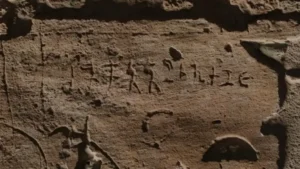
Recent research has identified nearly 30 Tamil-Brahmi inscriptions in tombs at the Valley of the Kings (Egypt), dating to the 1st–3rd centuries CE. The inscriptions, written in Tamil-Brahmi, Prakrit, and Sanskrit, provide fresh archaeological evidence of direct trade and cultural contacts between South India and Roman Egypt.
About Tamil-Brahmi Script (Static Background)
- Tamil-Brahmi is an early form of the Brahmi script adapted to write the Tamil language.
- Dates from around 3rd century BCE to 3rd century CE.
- Found in:
- Tamil Nadu (Adichanallur, Keeladi, Mangulam)
- Sri Lanka
- Kerala
- Used primarily for:
- Trade-related inscriptions
- Cave donations
- Pottery graffiti
- Demonstrates early literacy and urbanization in Sangam Age (300 BCE–300 CE) Tamilakam.
Key Findings from Egypt
Location
- Found in tombs in the Valley of the Kings (Upper Egypt).
- Inscriptions appear alongside Greek graffiti, suggesting multicultural presence.
Nature of Inscriptions
- Short inscriptions and visitor graffiti.
- Names like:
- Cikan Korran (Sikan Korran)
- Korran
- Catan
- Kiran
- Written in Tamil-Brahmi, with some in Prakrit and Sanskrit.
Evidence Supporting Trade Links
- Archaeological Evidence
- Roman coins found in Tamil Nadu.
- Amphorae and Roman pottery at Arikamedu.
- Tamil-Brahmi pottery in Red Sea region.
- Literary Evidence
- Periplus of the Erythraean Sea (1st century CE).
- Sangam literature (e.g., Pattinappalai).
- Roman accounts by Pliny and Strabo.
- Epigraphic Evidence
- Newly discovered Tamil-Brahmi inscriptions in Egypt strengthen earlier assumptions of maritime connectivity.
Significance of the Discovery
1. Direct Physical Presence
- Shows Indians were not merely trading indirectly but physically present in Egypt.
2. Multilingual Interaction
- Presence of Tamil, Prakrit, Sanskrit alongside Greek indicates cosmopolitan trade networks.
3. Cultural Exchange
- Graffiti inside tombs suggests participation in local customs of leaving names.
- Reflects early globalization.
4. Reassessment of Trade Scale
- Indicates sustained and organized trade networks.
- Strengthens role of Tamilakam as a maritime power.
Why in News?
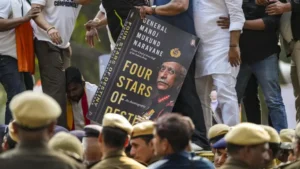
The Defence Ministry is planning a structured framework to regulate publication of books and memoirs by serving and retired armed forces personnel. The move follows controversy surrounding the unpublished memoir of former Army Chief M.M. Naravane, raising concerns over disclosure of sensitive information.
Present Legal Position
Currently, there is no single consolidated law specifically governing book-writing by retired Army officers. However, multiple legal and service frameworks apply.
1. Official Secrets Act (OSA), 1923
- Applies for life, even after retirement.
- Criminalizes disclosure of:
- Classified information
- Sensitive operational details
- Intelligence inputs
- Information prejudicial to national security
- Even fictional works may face scrutiny if they resemble real operations.
2. Service Rules (for Serving Personnel)
- Serving officers must seek prior written permission before:
- Publishing books
- Engaging in literary, political, or remunerative activity
- Manuscripts involving operational matters must be vetted through the chain of command.
3. Retired Personnel
- No longer governed by Army Act service discipline.
- However, statutory laws like OSA and national security provisions still apply.
Proposed New Framework
The Centre plans to introduce clear procedural guidelines before any manuscript is sanctioned.
Key Features Likely:
- Mandatory submission of manuscripts to the Ministry of Defence (MoD) if content relates to:
- National security
- Defence operations
- Intelligence matters
- Foreign relations
- Vetting and cross-verification by relevant departments.
- Pre-publication clearance mechanism.
- Clarification on what constitutes public domain vs classified information.
What is Allowed vs Prohibited
Category | Position |
Personal opinions on politics or national security | Generally allowed (if not revealing secrets) |
Public domain information | Can be discussed |
Classified operations & intelligence | Strictly prohibited |
Internal procedures & capabilities | Restricted |
Identifiable operational details | Prohibited |
Retired Lt. Gen. D.P. Pandey noted that post-retirement, judgment and maturity are essential, but OSA restrictions continue.
Constitutional & Legal Context
Provision | Relevance |
Article 19(1)(a) | Freedom of speech & expression |
Article 19(2) | Reasonable restrictions in interest of security of State |
OSA, 1923 | Protects classified information |
Army Act, 1950 | Governs service conduct |
Civil Services Conduct Rules (2021 amendment) | Similar restrictions for retired intelligence/security officials |
Significance of the Guidelines
- Brings clarity and uniformity.
- Prevents inadvertent security breaches.
- Balances free speech with national security.
- Aligns armed forces with civil service publication norms.
Countries like the USA and UK require former intelligence and defence officials to undergo pre-publication review for sensitive works. |
Way Forward
- Clearly define classification categories.
- Establish time-bound review process.
- Ensure transparency to avoid arbitrary denial.
- Promote redaction instead of blanket bans.
- Develop archival mechanisms for historical value.
Why in News?
The Union Budget has approved setting up the National Large Solar Telescope to strengthen India’s capabilities in solar and space-weather research.

National Large Solar Telescope (NLST)
The National Large Solar Telescope (NLST) is a major upcoming ground-based solar observatory planned in the Merak area near Pangong Tso Lake, Ladakh.
Key Technical Features
- Aperture Size: 2-metre mirror, enabling high-resolution solar imaging.
- Operates in visible and near-infrared wavelengths of the electromagnetic spectrum.
- Advanced instruments for spectroscopy and polarimetry.
- High-altitude location ensures clear skies and minimal atmospheric disturbance.
Objectives
- Study solar magnetism and plasma dynamics.
- Observe solar flares, sunspots, and coronal mass ejections.
- Understand mechanisms behind space weather phenomena.
- Support early warning systems for solar storms that impact Earth.
Scientific Importance
- Space weather influences:
- Satellite operations
- Navigation systems
- Power transmission networks
- Space missions
- NLST data will improve India’s capability to predict solar disturbances.
- Strengthens research in heliophysics.
Institutional Context
NLST will be India’s third ground-based solar observatory, after:
- Kodaikanal Solar Observatory (Tamil Nadu) – one of Asia’s oldest solar observatories.
- Udaipur Solar Observatory (Rajasthan) – known for precision solar observations.
Strategic Significance
- Enhances space security by protecting space assets.
- Supports ISRO missions.
- Positions India as a contributor to global solar research networks.
Why in News?
The union Health minister has launched the Annual Nationwide Mass Drug Administration (MDA) campaign to eliminate Lymphatic Filariasis.
Lymphatic Filariasis
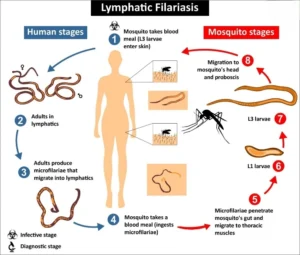
Lymphatic Filariasis (LF), often called elephantiasis, is a neglected tropical disease (NTD) that damages the lymphatic system. It is spread by mosquitoes and can lead to permanent disability and social stigma if not treated.
Cause of the Disease
LF is caused by thread-like parasitic worms (filarial nematodes) belonging to the family Filarioidea.
Major species involved:
- Wuchereria bancrofti – causes about 90% of global cases
- Brugia malayi
- Brugia timori
Mode of Transmission
- Spread through the bite of infected female mosquitoes, mainly Culex species in India.
- When mosquitoes bite an infected person, they ingest microfilariae.
- These develop inside the mosquito and are transmitted to another person during subsequent bites.
Disease Mechanism
- Adult worms reside in the lymphatic vessels.
- They obstruct lymph flow, leading to swelling and immune damage.
- Worms release millions of microfilariae into the bloodstream.
Symptoms
Most infected individuals show no symptoms initially, but long-term infection may cause:
- Lymphoedema – swelling of limbs
- Elephantiasis – thickened skin and tissues
- Hydrocele – swelling of the scrotum in men
- Secondary infections and disability
Prevention and Treatment
Mass Drug Administration (MDA)
- Core WHO-recommended strategy.
- Annual administration of:
- Diethylcarbamazine (DEC)
- Albendazole
- Sometimes Ivermectin (triple drug therapy in some areas)
Other Measures
- Mosquito control
- Improved sanitation
- Personal protection (nets, repellents)
India’s Elimination Strategy
- Target: Elimination of LF as a public health problem.
- Door-to-door drug distribution.
- Focus on endemic districts.
- Integration with National Health Mission.
Why in News?
Scientists at ISRO Space Applications Centre have identified Mons Mouton as a potential landing site for Chandrayaan-4.
Mons Mouton
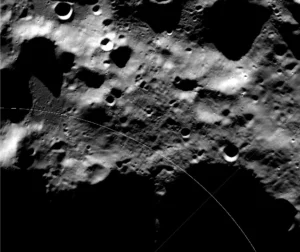
- Mons Mouton is a prominent lunar mountain located in the south polar region of the Moon. Rising to about 6 km in height, it lies in a scientifically rich and strategically suitable zone for India’s upcoming lunar sample return mission.
Location and Physical Features
- Situated in the South Circumpolar Region (SCR) of the Moon.
- Believed to be located along the rim of the South Pole-Aitken Basin, one of the largest and oldest impact basins in the solar system.
- The summit area is relatively flat, which improves landing safety.
- Receives long durations of sunlight, essential for solar-powered missions.
Naming Significance
- Officially named after Melba Roy Mouton, a pioneering NASA mathematician and programmer.
- Reflects international recognition of contributions to space science.
Scientific Importance
1. Water-Ice Exploration
- Located near permanently shadowed craters that may contain frozen water.
- Water resources are vital for:
- Future human missions
- Fuel production
- Life-support systems
2. Understanding Lunar Evolution
- Rocks from this region may reveal:
- Early Moon formation
- Impact history
- Crust composition
3. Space Weathering Studies
- Exposure to extreme conditions helps study surface alteration processes.