
Table of Contents
ToggleRECORD VOTER TURNOUT IN ASSAM, PUDUCHERRY AND KERALA
TOPIC: (GS2) POLITY: THE HINDU
Assembly elections witnessed historic voter participation with Assam (85.91%) and Puducherry (89.87%) recording their highest-ever turnout, while Kerala also reported near-record levels.
Voter turnout figures
- Assam: 85.91% turnout, surpassing 2016 record of 84.67%.
- Puducherry: 89.87% turnout, breaking 2011 record of 86.19%.
- Kerala: 78.27% turnout, may cross 1987 record of 80.54%.
- Bypolls: Karnataka (68.6%), Nagaland (82.2%), Tripura (80%).
Election Details
- Polling held for 300 Assembly constituencies (Assam, Kerala, Puducherry + bypolls).
- Electorate: Over 5.31 crore voters. Counting scheduled for May 4.
- Special Intensive Revision (SIR) of electoral rolls conducted in Assam and Puducherry.
Initiatives to Boost Voter Turnout
- SVEEP Programme: Awareness campaigns through media, schools, and community outreach. Focus on youth, women, urban voters, and marginalized groups.
- Turnout Implementation Plan (TIP): Special drives in low-turnout areas. Correcting electoral rolls and reducing gender gaps in enrolment.
- Technology & Accessibility: Voter Helpline App, candidate photos on EVMs, redesigned voter slips. Facilities for senior citizens, persons with disabilities, and regional language campaigns.
- Local-Level Drives: Conferences with officials to address turnout issues. Community-based interventions to motivate first-time and urban voters.
Importance of Higher Voter Turnout
- Strengthens Democracy: High participation ensures governments reflect the true will of the people.
- Inclusive Representation: SVEEP campaigns increased participation among first-time voters and marginalized groups.
- Reduces Malpractices: Large voter participation weakens the impact of money power, coercion, or proxy voting.
- Promotes National Unity: Voting unites diverse communities in a common democratic exercise. Example: Assam’s record turnout reflected unity beyond caste and language divisions.
Election Commission Initiatives
- Over 2.5 lakh polling staff deployed.
- New voter-friendly measures:
- Candidate photos on EVM ballot papers.
- Mobile deposit facilities.
- Redesigned voter slips for easy readability.
- Limit of 1,200 electors per polling station.
Conclusion
With counting set for May 4, these elections are seen as crucial for shaping political futures in the respective States and Union Territory.
LAND INEQUALITY IN INDIA
TOPIC: (GS2) POLITY: THE HINDU
A recent World Inequality Lab study revealed sharp land concentration in rural India, with the top 10% households owning nearly half of all land, while almost half of rural households remain landless.
Background of Land Distribution
- Land ownership in India shaped by colonial systems, caste hierarchies, and agrarian structures.
- Despite post-independence land reforms, inequality persists.
- Land remains a key rural asset for income, social status, and access to credit.
Patterns of Landholding
- Large landholders control significant agricultural land.
- Small & marginal farmers own limited plots.
- Landless households depend on wage labour.
- Land inequality measured through Gini coefficient and share concentration.
Key Findings of Study
- Top 10% households own 44% of land; top 1% own 18%.
- 46% of rural households are landless.
- State variations:
- Bihar shows highest concentration (20.1% by top household).
- Punjab has highest landlessness (73%).
- Kerala records highest inequality (Gini ~90).
- Average landholding among owners: 6.2 hectares.
- In 3.8% villages, a single landlord controls over half the land.
Factors Behind Land Inequality in India
- Agricultural Suitability & Market Access: Areas with fertile soil and better access to markets often see a few households controlling most of the land, leading to higher concentration.
- Social Factors: Regions with larger Scheduled Caste (SC) populations tend to have more landless families, which increases inequality.
- Infrastructure Proximity: Villages closer to towns, highways, or railway stations often show greater inequality because land near development hubs is more valuable and gets concentrated in fewer hands.
- Historical Legacy: Areas that were under the old zamindari system still show high inequality, while former princely states generally have lower inequality because landlessness was less severe there.
Implications
- Reinforces rural poverty and limits upward mobility.
- Leads to fragmented holdings, reducing productivity.
- Deepens caste-based disparities and social tensions.
- Landlessness restricts access to credit and government benefits.
Way Forward
- Revitalise land reforms and protect tenancy rights to ensure fair distribution and safeguard small cultivators.
- Digitise and modernise land records to bring transparency, reduce disputes, and improve citizen access.
- Encourage cooperative farming and land pooling to overcome fragmentation and enhance efficiency in agriculture.
- Expand affordable credit, timely inputs, and institutional support to empower small and marginal farmers.
- Design targeted policies for vulnerable groups such as Scheduled Castes, Scheduled Tribes, and landless labourers to promote equity and inclusion.
Conclusion
Land inequality in India remains a structural challenge, Addressing it requires multi-pronged reforms that combine equity, productivity, and institutional transparency to ensure inclusive rural development.
ELECTIONS IN INDIA RISING COSTS AND PLUTOCRATIC CONCERNS
TOPIC: (GS2) POLITY: THE HINDU
Recent debates highlight that elections in India are becoming increasingly expensive, raising concerns that money power is limiting opportunities for smaller parties and independent candidates.
Rising Cost of Elections
- Official spending limit: ₹95 lakh for Lok Sabha candidates, ₹40 lakh for Assembly candidates.
- In reality, candidates spend tens of crores, often unaccounted.
- Party expenditure has no cap, creating an uneven playing field.
- Estimates suggest actual spending in the 2024 general election was close to ₹1 lakh crore, far higher than official disclosures.
Impact on Democracy
- Money as a necessity: Winning requires heavy spending, though money alone does not guarantee success.
- Exclusion of smaller players: Independent candidates and small parties struggle to compete with resource-rich national and regional parties.
- Unequal access to power: Nearly 93% of MPs are crorepatis, showing concentration of wealth in politics.
Role of Election Commission
- Observers monitor spending only during nomination to polling days, limiting oversight.
- Much of the expenditure occurs in cash, outside official records.
- Current limits push candidates towards black money usage.
Electoral Bonds & Transparency
- Supreme Court Verdict: The Supreme Court struck down the electoral bond scheme for violating transparency norms. It held that anonymous donations undermine citizens’ right to know about political funding.
- Corporate-Political Nexus Exposed: Disclosure of donor details revealed the close link between big corporations and political parties.
- Debate on Corporate Funding: Ongoing debate on whether companies should be allowed to fund elections, since they do not vote.
- Role of Civil Society & Media: citizens sometimes knowingly support candidates with wealth or criminal backgrounds, complicating reform efforts.
Way forward
- Increase spending limits: Allow more transparent use of white money.
- Cap party expenditure: Similar to the U.K. model, linking spending to number of candidates.
- Transparency over limits: Focus on accurate reporting rather than strict caps.
- Ban government-funded advertisements six months before elections to reduce misuse of public funds.
- Explore proportional representation to give smaller parties fairer chances.
Conclusion
Ensuring transparency, accountability, and equitable access is crucial to preserve democratic integrity and prevent exclusion of smaller parties and ordinary citizens from the political process.
GAGANYAAN MISSION AND SAFE RETURN OF ASTRONAUTS
TOPIC: (GS3) SCIENCE AND TECHNOLOGY: THE HINDU
India’s upcoming Gaganyaan human spaceflight mission has raised questions about how astronauts will safely return to Earth.
Re-entry and Speed Reduction
- The crew module will orbit Earth at 7,800 m/s.
- On re-entry, atmospheric drag (aerobraking) removes most of the kinetic energy.
- This slows the module before the parachute system is deployed.
Role of Parachutes
- A multi-stage parachute system opens below 12 km altitude.
- Parachutes alone cannot reduce speed to safe levels for land touchdown (1–2 m/s).
- Sea landings tolerate higher speeds (7–9 m/s) since water absorbs impact energy.
- Very large parachutes would be impractical due to weight, volume, and risk of tangling.
Landing Zone Characteristics
- The landing footprint is elliptical, not a precise point.
- Hypersonic re-entry causes overshoot/undershoot due to atmospheric variations.
- Lateral deviations are minimal, but along-track errors can be hundreds of kilometres.
Sea Recovery Process
- Gaganyaan will splash down in the Bay of Bengal.
- After splashdown: Parachutes detach to avoid entanglement. Flotation bags inflate automatically.
- The module transmits GPS signals, homing beacons, fluorescent dye, and strobe lights for easy location.
- Painted international orange for visibility against sea water.
Role of Indian Navy
- Recovery led by the Indian Navy, supported by other agencies.
- Divers secure the module with flotation collars and towing gear.
- Module winched onto ship deck for safe crew extraction.
Conclusion
The Gaganyaan mission’s safe return strategy ensures astronauts land securely, marking a crucial step in India’s human spaceflight capability.
FOOD SAFETY AND STANDARDS AUTHORITY OF INDIA (FSSAI)
TOPIC: (GS2) POLITY: THE HINDU
Recently, official sources reported that the FSSAI carried out nearly 4 lakh inspections across food establishments in 2025–26 to strengthen food safety compliance.
Background
- Established under the Food Safety and Standards Act, 2006.
- Functions under the Ministry of Health and Family Welfare.
- Mandate: Ensure safe, hygienic, and wholesome food for human consumption by regulating manufacture, storage, distribution, sale, and import.
Functions of FSSAI
- Formulation of Standards: Sets benchmarks for food products to ensure safety and quality.
- Food Safety Management: Issues guidelines for businesses to adopt effective safety practices.
- Licensing & Registration: Provides licenses to food businesses and monitors compliance.
- Surveillance & Monitoring: Conducts inspections, audits, and sampling to check adherence to standards.
- Consumer Awareness: Runs campaigns to educate citizens about hygiene, nutrition, and safe food habits.
- Accreditation: Authorises and monitors food testing laboratories across India.
Latest Developments
- Nearly 4 lakh inspections conducted in 2025–26 to strengthen enforcement.
- Focus on restaurants, food processing units, and retail outlets.
- Aim: Reduce violations, improve hygiene, and ensure consumer confidence.
Importance of FSSAI
- Protects public health by preventing unsafe food practices.
- Builds consumer trust in packaged and processed food.
- Supports India’s food industry in meeting global standards.
- Plays a crucial role in nutrition awareness and tackling adulteration.
Way Forward
- Strengthen digital monitoring systems for real-time compliance.
- Expand training and capacity building for food business operators.
- Increase consumer participation through reporting mechanisms.
- Enhance coordination with State food authorities for uniform enforcement.
Conclusion
FSSAI With large-scale inspections and awareness drives, it ensures that food reaching consumers is safe, hygienic, and of high quality, thereby protecting public health and supporting sustainable growth of the food industry.
AROGYA VAN INITIATIVE
TOPIC: (GS3) ENVIRONMENT: THE HINDU
The National Highways Authority of India (NHAI) has recently launched the Arogya Van initiative to develop medicinal tree plantations along National Highways.
About the Initiative
- Concept: The project will create thematic medicinal tree plantations on unused land parcels along highways.
- Objective: Enhance biodiversity, support pollinators, birds, and microfauna, and strengthen ecosystem resilience.
- Nodal Ministry: Ministry of Road Transport & Highways.
Implementation Plan
- Phase I Coverage: 17 land parcels identified across states including Madhya Pradesh, Haryana, Delhi-NCR, Andhra Pradesh, Gujarat, Karnataka, Odisha, Tamil Nadu, Rajasthan, Maharashtra, and Chhattisgarh.
- Medicinal Species: Trees with proven medicinal properties will be planted according to agro-climatic suitability.
- Priority Areas: Toll plazas, wayside amenities, interchanges, cloverleaf junctions, and other prominent stretches along highways.
Significance
- Environmental Benefits: Improves biodiversity and ecological balance along highways.
- Health & Wellness: Promotes awareness of medicinal plants and their uses.
- Sustainability: Utilises vacant land effectively, contributing to green infrastructure.
- Community Impact: Creates green spaces that can serve as educational and awareness hubs for local communities.
Way Forward
- Expand the initiative to more highway stretches across India.
- Integrate with eco-tourism and public awareness programmes.
- Ensure scientific monitoring of plantations for long-term survival and ecological impact.
- Encourage community participation in maintaining and protecting these green zones.
Conclusion
The Arogya Van initiative is a step towards combining infrastructure development with ecological sustainability. By planting medicinal trees along highways, India aims to create healthier ecosystems, promote biodiversity, and foster public awareness about traditional medicinal resources.
NATIONAL QUANTUM MISSION (NQM)
TOPIC: (GS3) SCIENCE AND TECHNOLOGY: THE HINDU
India has recently achieved a 1,000-km quantum communication network demonstration under the National Quantum Mission, marking a breakthrough in secure communication technology.
About the Mission
- Launched by the Department of Science & Technology (DST).
- Outlay: ₹6003 crore for the period 2023–24 to 2030–31.
- Aim: To seed, nurture, and scale up R&D in quantum technologies and build a strong innovation ecosystem.
- Part of nine initiatives under the Prime Minister’s Science Technology Innovation Advisory Council (PM-STIAC).
Implementation Strategy
- Four Thematic Hubs (T-Hubs) established in leading institutions.
- Each hub follows a Hub-Spoke-Spike model to connect research centres and industry.
Focus Areas
- Quantum Computing: Led by IISc Bengaluru.
- Quantum Communication: Coordinated by IIT Madras with C-DOT, New Delhi.
- Quantum Sensing & Metrology: Spearheaded by IIT Bombay.
- Quantum Materials & Devices: Managed by IIT Delhi.
Significance
- Enhances India’s capacity in secure communication, advanced computing, and precision measurement.
- Strengthens national security through unbreakable quantum communication channels.
- Positions India among global leaders in emerging quantum technologies.
- Supports industrial applications in healthcare, defence, and advanced manufacturing.
Conclusion
The National Quantum Mission is a strategic investment in frontier science, aiming to make India self-reliant in quantum technologies. The recent success in quantum communication demonstrates India’s growing capability in building a secure and innovative digital future.
INDIA ACHIEVES RECORD WIND ENERGY GROWTH
TOPIC: (GS3) ECONOMY: THE HINDU
India added a record 6.05 GW of wind power capacity in FY 2025–26, marking a 46% rise over the previous year and strengthening its position as the 4th largest wind energy market globally.
Key Highlights
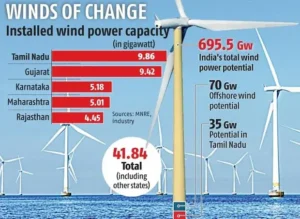
- Total Capacity: India’s cumulative installed wind power capacity has crossed 56 GW.
- Global Ranking: India is ranked 4th worldwide, after China, the U.S., and Germany.
- Leading States: Gujarat, Karnataka, and Maharashtra contributed the most, aided by wind-solar hybrid projects and Green Energy Open Access.
Policy Support
- Concessional customs duty for wind energy equipment.
- Waiver of Inter-State Transmission System (ISTS) charges till June 2028.
- Competitive bidding mechanisms to attract investment.
- Wind Renewable Consumption Obligation (WRCO) framework to ensure demand.
- Institutional support from the National Institute of Wind Energy (NIWE) for project execution and monitoring.
Future Potential
- India’s wind energy programme began in the early 1990s, creating a strong ecosystem.
- Current utilisation is only 4.5% of the estimated 1,164 GW potential.
- Target: Achieve 107 GW of wind capacity by 2030.
- Expansion is crucial for India’s broader goal of 500 GW non-fossil fuel energy capacity.
Significance
- Strengthens India’s renewable energy mix and reduces dependence on fossil fuels.
- Supports climate commitments under the Paris Agreement.
- Promotes sustainable development and green job creation.
- Enhances energy security by diversifying sources.
Conclusion
India’s record growth in wind energy reflects strong policy support, improved project execution, and rising investor confidence. With vast untapped potential, wind power will play a critical role in meeting India’s 2030 renewable energy targets and advancing towards a low-carbon future.