Table of Contents
ToggleThe natural world is not a chaotic collection of organisms; it is a highly organized system. Ecological hierarchy refers to the arrangement of biological organisms into various levels of complexity. For a civil services aspirant, understanding this ecosystem hierarchy is the first step in analyzing environmental issues like biodiversity loss, habitat fragmentation, and climate change.
Definition of Ecological Hierarchy
Ecological hierarchy is the classification of biological entities into a nested arrangement where each level is composed of the units from the level below it. It represents the levels of organization ecology uses to study the distribution and abundance of organisms and their interactions with the environment.
Levels of Ecological Organization
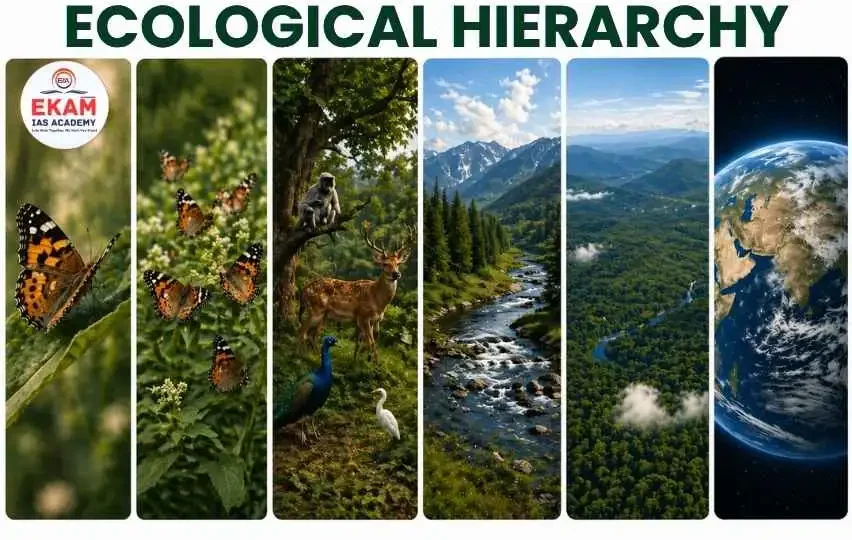
The hierarchy is traditionally divided into six major levels. Below is a detailed explanation of each level with examples:
Individual (Organism)
- Definition: The basic unit of the hierarchy; a single living being that has the ability to act or function independently.
- Characteristics: It is the level where natural selection primarily acts.
- Example: A single Bengal Tiger in the Ranthambore National Park.
Population
- Definition: A group of individuals of the same species living in a specific geographical area at a given time.
- Characteristics: Key parameters include birth rate (natality), death rate (mortality), and population density.
- Example: All the Tigers living within the boundaries of the Sundarbans.
Community
- Definition: An association of populations of different species inhabiting a common environment and interacting with each other.
- Characteristics: Focuses on inter-species interactions like predation, competition, and mutualism.
- Example: Tigers, spotted deer, monkeys, and various trees interacting in a forest.
Ecosystem
- Definition: A functional unit where the biotic community (living) and the abiotic environment (non-living like soil, water, air) interact.
- Characteristics: Defined by energy flow (food chains) and nutrient cycling.
- Example: A Wetland ecosystem like Chilika Lake.
Biome
- Definition: A large regional unit characterized by a specific climate, soil type, and vegetation.
- Characteristics: Biomes are often defined by their plant structures and climatic conditions.
- Example: The Tropical Rainforest or the Tundra.
Biosphere
- Definition: The global sum of all ecosystems; the zone of life on Earth.
- Characteristics: It includes the lithosphere, hydrosphere, and atmosphere where life exists.
- Example: The entire Earth as a living system.
Relationship Between Levels
The ecological hierarchy is “nested,” meaning:
- Interdependence: Changes in one level (e.g., a drop in a prey population) ripple through the higher levels (e.g., the predator community and the overall ecosystem health).
- Emergent Properties: Each level has characteristics that the lower level does not possess (e.g., a population has a “birth rate,” but an individual does only has a “birth”).
Importance of Ecological Hierarchy
Understanding these levels is crucial for:
Conservation Planning: Deciding whether to protect a single species (individual level) or an entire landscape.
Environmental Impact Assessment (EIA): Evaluating how a project affects local communities and broader ecosystems.
Climate Policy: Analyzing global changes at the biosphere level.
Conclusion
The ecological hierarchy UPSC syllabus emphasizes is a roadmap to understanding nature. From the individual Organism to the vast Biosphere, every level is interconnected. Mastery of these levels of organization ecology ensures a strong conceptual foundation for both Prelims and Mains.
UPSC Prelims: PYQs & Practice Questions
Previous Year Questions (Prelims)
Q: Which of the following is the correct sequence of ecological hierarchy from smallest to largest?
(a) Organism → Population → Community → Ecosystem → Biosphere
(b) Ecosystem → Community → Population → Organism → Biosphere
(c) Population → Community → Organism → Biosphere → Ecosystem
(d) Organism → Community → Population → Ecosystem → Biosphere
Answer: (a)
Explanation:
The hierarchy represents levels of organization from simplest to most complex. It starts with the individual organism, followed by a population, then a community, then an ecosystem, and finally the biosphere.
Q: Which one of the following terms describes not only the physical space occupied by an organism, but also its functional role in the community of organisms?
(a) Ecotone
(b) Ecological niche
(c) Habitat
(d) Home range
Answer: (b)
Explanation:
This pertains to the community level of ecological hierarchy. While a habitat is an organism’s “address,” the ecological niche is its “profession” or functional role within that level of organization.
Practice Questions
Q: In the context of Ecosystem Hierarchy, which level is the first to include abiotic factors like soil, water, and sunlight in its study?
(a) Population
(b) Community
(c) Ecosystem
(d) Biome
Answer: (c) Ecosystem
Explanation:
While organisms, populations, and communities focus mainly on biotic interactions, the ecosystem level is the functional unit where living communities interact with their non-living environment.
Q: Consider the following statements regarding the Biosphere:
1. It is the global sum of all ecosystems and represents the zone of life on Earth.
2. It is a completely closed system with regard to both energy and matter.
Which of the statements given above is/are correct?
(a) 1 only
(b) 2 only
(c) Both 1 and 2
(d) Neither 1 nor 2
Answer: (a) 1 only
Explanation:
Statement 1 is correct. Statement 2 is incorrect because the biosphere is an open system with regard to energy, as it receives solar radiation, but is largely a closed system with regard to matter.
UPSC Mains – Previous Year & Practice Questions
Mains Previous Year Questions
Question: What is an ecosystem? Describe the various services provided by an ecosystem. (Mains 2017)
Question: Each year a large amount of plant material, hemicellulose, and lignin is produced by photosynthesis. Explain the mechanism of their decomposition. (Mains 2022)
Question: What is wetland? Explain the Ramsar concept of 'wise use' in the context of wetland conservation in India. (Mains 2018)
Question: The Himalayan region is poor in mineral resources. Discuss. (Mains 2013)
Question: How does biodiversity vary in India? How is the Biological Diversity Act, 2002 helpful in conservation of flora and fauna? (Mains 2020)
Mains Practice Questions
[10 Marks | 150 Words]
Question: Explain the concept of 'Emergent Properties' in the context of ecological hierarchy. How does a population possess characteristics that an individual organism does not?
[15 Marks | 250 Words]
Question: With the increasing threats of climate change, why is it necessary for conservation policies to shift focus from the 'Individual' level to the 'Landscape' level?
[15 Marks | 250 Words]
Question: Discuss the role of the Biosphere as the ultimate regulator of global chemical cycles. How does human interference at the ecosystem level disrupt these cycles?



Ecological Hierarchy-FAQs
At which level of the hierarchy does 'Natural Selection' occur?
Natural selection acts on the Individual (Organism), but its effects—evolution—are measured at the Population level.
What is the difference between a Community and an Ecosystem?
A Community consists only of the living (biotic) populations of different species in an area. An Ecosystem includes that community plus the non-living (abiotic) environment they interact with.
Why is the 'Population' level important for conservationists?
Because it helps determine the minimum viable population needed to prevent extinction and tracks growth rates and density, which are vital for managing endangered species.
How do 'Biomes' differ from 'Ecosystems'?
A Biome is a much larger regional unit (like the Tundra or Savanna) characterized by a specific climate and major vegetation types. An ecosystem is a specific functional unit (like a pond or a specific forest patch) within or across those biomes.
Is the hierarchy strictly linear?
While taught linearly for clarity, these levels are highly interdependent. Changes in the Biosphere (global warming) directly impact individuals and populations at the bottom of the hierarchy.