Table of Contents
ToggleEnvironmentalism is not a monolith; it is driven by different philosophical underpinnings. While one approach seeks to fix environmental issues to ensure human survival, the other calls for a radical shift in how we perceive our place in the universe. These two perspectives are known as Shallow Ecology and Deep Ecology.
Definition of Shallow Ecology
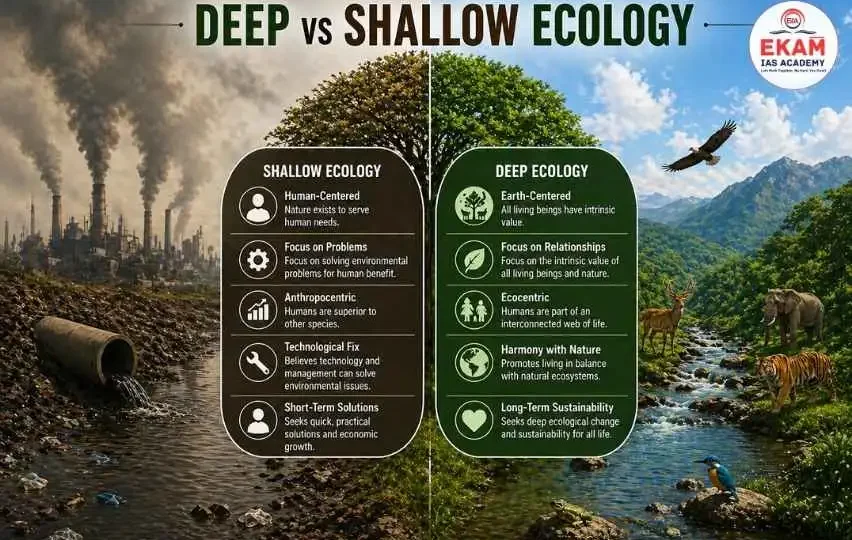
Shallow Ecology refers to a “resource-oriented” or anthropocentric (human-centered) approach to environmentalism. It views the environment as a set of resources that must be managed sustainably to ensure the continued well-being and prosperity of human beings.
Key Features of Shallow Ecology
- Human-Centric: It prioritizes human interests and views nature as a tool for human progress.
- Technological Optimism: It believes that environmental problems like pollution or resource depletion can be solved through technological innovation and better management.
- Reformist Nature: It works within the existing socio-political and economic structures (like capitalism) to bring about incremental “green” changes.
- Focus: Primarily concerned with fighting pollution and resource depletion in developed countries to maintain a high standard of living.
Definition of Deep Ecology
Deep Ecology is an ecocentric (nature-centered) philosophy that claims that all living things have an intrinsic value, regardless of their utility to human needs. The deep ecology meaning implies a “deeper” questioning of our lifestyle and the values that drive our civilization.
Key Features of Deep Ecology
- Biocentric Equality: It posits that all species have an equal right to live and blossom.
- Intrinsic Value: Nature has value in itself, independent of whether humans can use it for food, timber, or medicine.
- Radical Shift: It calls for a fundamental change in our economic, technological, and ideological structures.
- Population Control: It often argues that a substantial decrease in the human population is necessary for the flourishing of other life forms.
Difference Between Deep and Shallow Ecology
| Feature | Shallow Ecology | Deep Ecology |
| Central Focus | Anthropocentric (Human-centered) | Ecocentric (Earth-centered) |
| Value of Nature | Instrumental (Utility to humans) | Intrinsic (Value in itself) |
| Approach | Reformist; fixes the system | Radical; changes the system |
| Solution | Technology and “Green” taxes | Reducing consumption and population |
| Philosophy | Nature is a resource. | Humans are just one part of nature. |
Thinkers and Origin
The distinction between these two was first introduced by the Norwegian philosopher Arne Naess in 1973.
- Arne Naess: Argued that shallow ecology only treats the symptoms of the environmental crisis, whereas deep ecology treats the cause.
- Other Thinkers: Bill Devall and George Sessions expanded on these ideas, creating the “Deep Ecology Platform.”
Criticism of Both Approaches
- Criticism of Shallow Ecology: Critics argue it is superficial and fails to address the root cause of the crisis—limitless economic growth.
- Criticism of Deep Ecology: It is often labeled as “anti-human” or “eco-fascist” for suggesting that human populations should be reduced. It is also criticized for being too mystical or impractical for modern governance.
Relevance and Application in Policymaking
In environment ethics UPSC contexts, these theories influence how we draft laws:
Shallow Ecology in Policy: Seen in the Carbon Credit system, EV subsidies, and “Sustainable Development” goals. It aims to make growth less damaging.
Deep Ecology in Policy: Seen in the “Rights of Nature” movements (e.g., granting legal personhood to rivers like the Ganga or Yamuna) and the creation of strict No-Go Zones in forests where human entry is completely barred.
Conclusion
While Shallow Ecology offers pragmatic, immediate solutions to environmental degradation, Deep Ecology challenges us to rethink our fundamental relationship with the planet. For a UPSC aspirant, the middle path—Sustainable Development—often acts as a bridge, utilizing shallow ecology’s tools while acknowledging the deep ecological truth of our interdependence with nature.
UPSC Prelims: PYQs & Practice Questions
Previous Year Questions (Prelims)
Q: The concept of 'Deep Ecology' was coined by:
(a) Rachel Carson
(b) Arne Naess
(c) Gro Harlem Brundtland
(d) E.P. Odum
Answer: (b) Arne Naess
Explanation:
The term Deep Ecology was first introduced by the Norwegian philosopher Arne Naess in 1973. He distinguished it from Shallow Ecology, which focuses mainly on surface-level environmental problems.
Q: Consider the following:
1. Photosynthesis
2. Respiration
3. Decay of organic matter
4. Volcanic action
Which of the above add carbon dioxide to the carbon cycle on Earth?
(a) 1 and 4 only
(b) 2 and 3 only
(c) 2, 3, and 4 only
(d) 1, 2, 3, and 4
Answer: (c) 2, 3, and 4 only
Explanation:
Respiration, decay of organic matter, and volcanic action add carbon dioxide to the atmosphere. Photosynthesis removes carbon dioxide from the atmosphere by converting it into organic matter.
Practice Questions
Q: Which of the following statements best reflects the philosophy of Deep Ecology?
(a) Nature should be conserved because it provides medicinal plants for human health.
(b) All living beings have an inherent right to exist, regardless of their utility to human beings.
(c) Technology is the primary tool for solving environmental crises like global warming.
(d) Sustainable development is the only way to balance economic growth and nature.
Answer: (b)
Explanation:
Statement (b) reflects ecocentrism and intrinsic value, which are the pillars of Deep Ecology. Statements (a), (c), and (d) reflect Shallow Ecology or anthropocentric thinking.
Q: In the context of environmental ethics, Shallow Ecology is often criticized for being:
(a) Too radical in its approach to population control.
(b) Anti-development and against industrial progress.
(c) Reformist, as it seeks to solve ecological problems within the existing socio-economic framework.
(d) Mystical, as it treats the Earth as a spiritual entity.
Answer: (c)
Explanation:
Shallow Ecology is described as reformist because it attempts to “green” the current system through measures like carbon taxes, electric vehicles, or pollution control, without challenging the deeper model of unlimited economic growth.
UPSC Mains – Previous Year & Practice Questions
Mains Previous Year Questions
Question: The environmental crisis is a crisis of values. Discuss. (Mains 2022 - Ethics)
Question: Coastal regions of India are vulnerable to various climate change impacts. Discuss. (Mains 2019)
Question: Explain the term 'Environmental Ethics'. Why is it significant in the modern world? (Mains 2018 - Ethics)
Question: Sustainable development can be raised only through an integrated approach. Discuss. (Mains 2015)
Question: What do you understand by 'ethical human conduct'? In what way is it important to be ethical in our relationship with the environment? (Mains 2013 - Ethics)
Mains Practice Questions
[15 Marks | 250 Words]
Question: Compare and contrast the anthropocentric and ecocentric approaches to conservation. Which one is more suitable for a developing nation like India? Give reasons.
[10 Marks | 150 Words]
Question: The 'Rights of Nature' movement, which grants legal personhood to rivers and forests, is an application of Deep Ecology. Analyze its feasibility in modern jurisprudence.
[15 Marks | 250 Words]
Question: Critically examine the view that Shallow Ecology is merely a tool to prolong industrial capitalism under the guise of 'Sustainability'.
Shallow vs Deep Ecology-FAQs
Is 'Sustainable Development' a Deep or Shallow Ecology concept?
It is primarily a Shallow Ecology concept. It focuses on “development” (human progress) while ensuring that environmental degradation does not stop that progress. It treats nature as a resource to be sustained for future human generations.
What is 'Biocentric Equality' in Deep Ecology?
It is the belief that all items in the biosphere (humans, animals, plants, ecosystems) have an equal right to live and blossom. No species has a superior right to exploit another.
Why is Deep Ecology sometimes called 'Eco-centrism'?
Because it places the Ecosystem (Eco) at the center of its value system, whereas Shallow Ecology (Anthropocentrism) places the Human (Anthro) at the center.
Can Shallow Ecology solve the climate crisis?
Shallow ecologists believe technology and policy reforms (like the Paris Agreement) can. Deep ecologists argue that unless we reduce our consumption and population, “green” technology will only delay the inevitable.
Give an example of a 'Deep Ecology' policy in India.
The decision by the Uttarakhand High Court (later stayed by the Supreme Court) to grant the Ganges and Yamuna rivers the status of “living human entities” is a reflection of Deep Ecology principles.