Table of Contents
ToggleNature is in a constant state of flux. When a new piece of land is formed (like a volcanic island) or a forest is destroyed by fire, the process of life returning and evolving follows a specific, orderly sequence. This process is known as Ecological Succession. For a UPSC aspirant, understanding this is key to grasping biodiversity patterns and conservation strategies.
Definition of Ecological Succession
Ecological succession is the natural, gradual, and predictable change in the species structure of an ecological community over time. It is the process by which an area is colonized by a series of plant and animal communities until a stable, self-perpetuating climax community is established.
Types of Ecological Succession
Succession is broadly classified into two categories based on the starting conditions:
1. Primary Succession
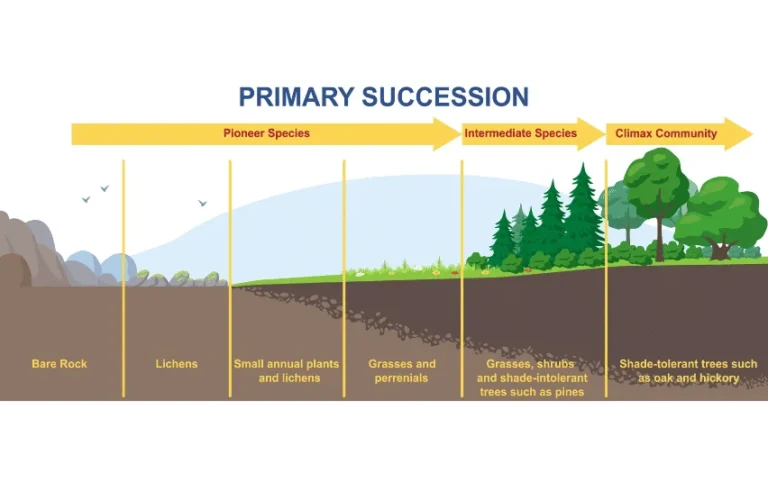
- Definition: Occurs in an area that was previously uninhabited and lacks soil, such as bare rock, a newly cooled lava flow, or a retreated glacier.
- Pioneer Species: The first organisms to colonize these areas are usually lichens and mosses. They help break down rocks to form the first layer of soil.
- Speed: This process is extremely slow, often taking hundreds to thousands of years to build fertile soil.
2. Secondary Succession
- Definition: Occurs in areas where a biological community has existed but was destroyed by a disturbance like forest fires, floods, or human activities like deforestation.
- Starting Point: Unlike primary succession, soil is already present here.
- Speed: This process is much faster than primary succession because the soil and some seeds/nutrients are already available.
Stages of Ecological Succession
The progression toward a stable community involves several stages of ecological succession:
Nudation: The creation of a bare area without any life (due to volcanic eruption, erosion, etc.).
Invasion (Migration & Ecesis):
- Migration: Seeds or spores reach the bare area via wind, water, or animals.
- Ecesis: The successful establishment of these species in the new area.
3.Competition and Coaction: As the population grows, species compete for space, light, and nutrients.
4.Reaction: The living organisms modify their environment (e.g., adding organic matter to soil), making it suitable for new species and unsuitable for themselves.
5 .Stabilization (Climax Community): The final, stable stage where the community is in equilibrium with the local climate.
Key Characteristics of Succession
- Increased Complexity: The community shifts from simple to complex structures.
- Biodiversity Growth: Total species diversity and biomass increase as succession progresses.
- Niche Specialization: Organisms move from generalist roles to highly specialized ecological niches.
- Stability: The system becomes more resistant to environmental fluctuations over time.
Factors Influencing Succession
- Climate: Temperature and rainfall dictate the type of climax community (e.g., desert vs. rainforest).
- Topography: The slope and altitude of the land affect seed dispersal and soil retention.
- Biotic Factors: The presence of pollinators, decomposers, and seed-dispersing animals.
- Disturbances: Frequent fires or human intervention can stall or reset the succession process.
Importance of Ecological Succession
- Restoration Ecology: Helps in rehabilitating degraded lands and abandoned mines.
- Forest Management: Understanding primary and secondary succession helps foresters predict timber yields and manage biodiversity.
- Agriculture: Crop rotation and fallowing are human-managed forms of ensuring soil “succession” to maintain fertility.
- Climate Regulation: Mature climax communities act as significant carbon sinks.
Conclusion
Ecological succession UPSC preparation requires a clear distinction between primary and secondary types and an understanding of the terminal climax community. It is a testament to nature’s resilience and its ability to heal itself over time. For the exam, always relate these stages to real-world examples like the regrowth of forests in the Western Ghats after shifting cultivation.
UPSC Prelims: PYQs & Practice Questions
Previous Year Questions (Prelims)
Q: In the context of ecosystem productivity, marine upwelling zones are important as they increase marine productivity by bringing the:
1. Decomposer microorganisms to the surface.
2. Nutrients to the surface.
3. Bottom-dwelling organisms to the surface.
Which of the statements given above is/are correct?
(a) 1 and 2
(b) 2 only
(c) 2 and 3
(d) 3 only
Answer: (b) 2 only
Explanation:
Marine upwelling brings nutrient-rich waters to the surface. This increases marine productivity and can trigger a sequence of biological colonization, increasing biomass and complexity in the marine community.
Q: The final stable community in an ecological succession is called the:
(a) Pioneer community
(b) Seral community
(c) Climax community
(d) Ecotone
Answer: (c) Climax community
Explanation:
The climax community is the final stage of ecological succession. It is a stable, self-perpetuating community that remains in equilibrium with the prevailing climate and environmental conditions of the region.
Practice Questions
Q: Consider the following statements regarding Secondary Succession:
1. It occurs in areas where no living organisms ever existed.
2. It is significantly faster than primary succession because soil is already present.
3. Abandoned farmlands and burnt forests are classic examples of where this occurs.
Which of the statements given above are correct?
(a) 1 and 2 only
(b) 2 and 3 only
(c) 1 and 3 only
(d) 1, 2, and 3
Answer: (b) 2 and 3 only
Explanation:
Statement 1 is incorrect because it describes Primary Succession. Secondary succession occurs where a previous community was destroyed but soil remains. Hence, it is faster and commonly occurs in abandoned farmlands and burnt forests.
Q: During the stages of ecological succession, which of the following typically increases?
1. Total Biomass
2. Niche Specialization
3. Net Community Production
4. Species Diversity
Select the correct code:
(a) 1, 2, and 4 only
(b) 1, 3, and 4 only
(c) 2 and 3 only
(d) 1, 2, 3, and 4
Answer: (a) 1, 2, and 4 only
Explanation:
As succession progresses, biomass, niche specialization, and species diversity increase. However, Net Community Production decreases because mature climax communities use more energy for respiration and maintenance.
UPSC Mains – Previous Year & Practice Questions
Mains Previous Year Questions
Question: Explain the purpose of the 'Green Grid Initiative' announced at COP26 of the UNFCCC. When was this idea first floated? (Mains 2021)
Question: What is an ecosystem? Describe the various services provided by an ecosystem. (Mains 2017)
Question: What is a wetland? Explain the Ramsar concept of 'wise use' in the context of wetland conservation in India. (Mains 2018)
Question: How does biodiversity vary in India? How is the Biological Diversity Act, 2002 helpful in conservation of flora and fauna? (Mains 2020)
Question: Enumerate the indirect services provided by an ecosystem. How do these help in sustainable development? (Mains 2014)
Mains Practice Questions
[15 Marks | 250 Words]
Question: Explain the concept of Ecological Succession. How does the knowledge of primary and secondary succession help in the Restoration Ecology of abandoned mining sites in India?
[10 Marks | 150 Words]
Question: The 'Climax Community' is said to be in equilibrium with the environment. Discuss the impact of climate change on the stability of climax communities in the Himalayan region.
[15 Marks | 250 Words]
Question: Differentiate between Autogenic and Allogenic succession. How do human activities act as an allogenic factor in resetting the successional clock of urban ecosystems?



Ecological Succession-FAQs
What is a 'Pioneer Species'?
These are the first species to colonize a bare area (e.g., lichens on bare rock). They are hardy, grow rapidly, and are responsible for initiating soil formation.
What is the difference between a Sere and a Seral Stage?
A Sere is the entire sequence of communities that replace one another in a given area. A Seral Stage refers to any individual transitional community within that sequence.
Can succession be reversed?
Yes. Natural disasters (floods, fires) or human interference (deforestation) can “reset” an ecosystem to an earlier seral stage. This is often followed by secondary succession.
Does ecological succession ever stop?
It reaches a point of relative stability called the Climax Community. However, at a geological timescale, even climax communities change as global climates or tectonic plates shift.
What is 'Nudation' in the context of UPSC?
It is the first stage of succession where a bare area is created, devoid of any life form, providing a “blank canvas” for primary succession to begin.