Table of Contents
ToggleUPSC History - Ancient History - Post Mauryan Period
The Post-Mauryan Period (c. 200 BCE – 300 CE) is often described as a “Dark Age” by older historians due to political fragmentation, but modern historiography views it as a Golden Age of Trade, Culture, and Social Assimilation. It was an era of intense interaction between India and Central Asia, the birth of Mahayana Buddhism, and the peak of Indo-Roman trade.
This comprehensive blog post provides a deep dive into the political, economic, and cultural landscape of Post-Mauryan India, structured for UPSC Mains and Prelims.
I. Political Landscape: The Rise of Regional Powers
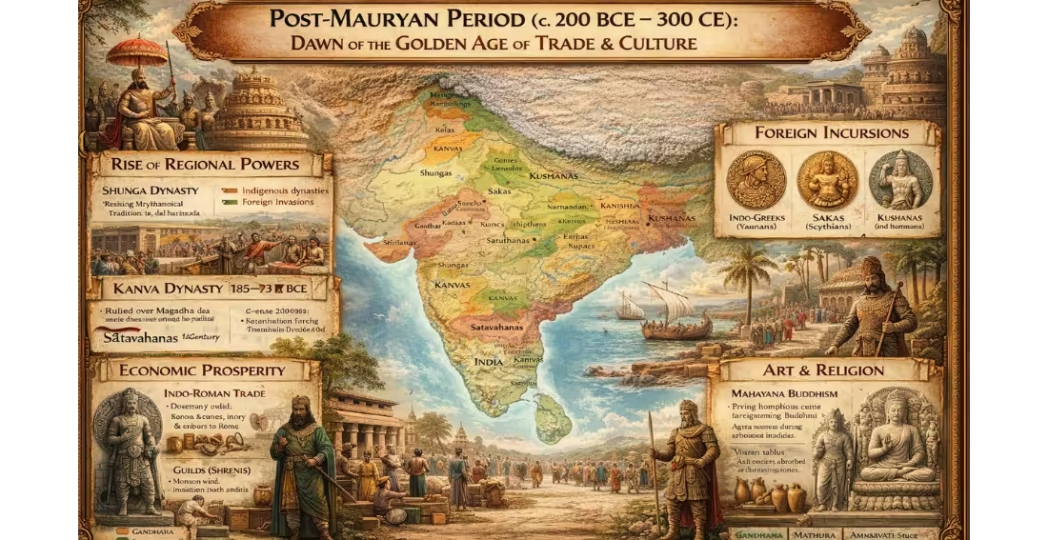
After the decline of the Mauryas, India saw the emergence of indigenous dynasties in the heartland and foreign invaders in the Northwest.
1. Indigenous Dynasties
- The Shunga Dynasty (185–73 BCE): Founded by Pushyamitra Shunga, a Brahmin general who assassinated the last Mauryan ruler, Brihadratha.
- Significance: Revived Brahmanical traditions and Vedic sacrifices (Ashvamedha).
- Culture: Despite claims of Buddhist persecution in the Divyavadana, archaeological evidence from the Bharhut and Sanchi stupas shows that Buddhist art flourished under their reign.
- The Kanva Dynasty (73–28 BCE): Established by Vasudeva Kanva after overthrowing the last Shunga king. They ruled primarily over Magadha until they were deposed by the Satavahanas.
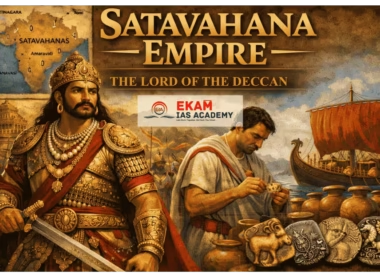
- The Satavahanas (1st Century BCE – 3rd Century CE): Also known as the Andhras, they were the dominant power in the Deccan.
- Key Ruler: Gautamiputra Satakarni, who described himself as the “Sole Brahmin” (Ekabrahmana) and defeated the Sakas and Indo-Greeks.
- Innovation: They were the first to initiate land grants to Brahmins and Buddhist monks, a practice that laid the foundation for Indian feudalism.
2. Foreign Incursions (The Central Asian Contacts)
- Indo-Greeks (Yavanas): The first to cross the Hindukush. Menander (Milinda) is the most famous king, known for his dialogues with the monk Nagasena recorded in the Milindapanho.
- The Sakas (Scythians): They entered India through the Bolan Pass. Rudradaman I is celebrated for his Junagarh Inscription, the first long inscription in “Chaste Sanskrit,” which mentions the repair of the Sudarshana Lake.
- The Kushanas: A branch of the Yuechi tribe from Central Asia. Kanishka was their greatest ruler, extending the empire from Central Asia to the Gangetic plains. He convened the Fourth Buddhist Council in Kashmir.
II. Economic Prosperity: Trade and Urbanization
The Post-Mauryan period marked the zenith of ancient Indian commerce, fueled by the Silk Route and maritime links with the Roman Empire.
1. Indo-Roman Trade
- Monsoon Discovery: The discovery of monsoon winds by Hippalus (c. 45 CE) revolutionized sea trade, allowing ships to cross the Arabian Sea directly from the Red Sea to Indian ports like Bharukachchha (Broach) and Muziris.
- Exports: Spices (especially pepper, known as Yavanapriya), muslin, ivory, and jewels.
- Imports: The Romans exported massive amounts of gold and silver coins to India, leading to a “drain of gold” from Rome lamented by Pliny the Elder.
2. Guilds (Shrenis)
Artisans and merchants were organized into powerful guilds that acted as banks, accepted deposits, and regulated quality and prices. The Milindapanho mentions 75 types of occupations, highlighting the high degree of craft specialization.
III. Art and Architecture: Three Great Schools
This era saw the transition from symbolic representation of Buddha (Stupa, Bodhi tree) to anthropomorphic (human) form.
| Feature | Gandhara School | Mathura School | Amaravati School |
|---|---|---|---|
| Region | NW Frontier (Peshawar) | Mathura (UP) | Andhra (Guntur) |
| Patronage | Kushanas | Kushanas | Satavahanas |
| Material | Grey Schist/Sandstone | Red Sandstone | White Limestone |
| Influence | Greco-Roman (Hellenistic) | Indigenous | Indigenous/Narrative |
| Theme | Mainly Buddhist | Buddhist, Jain, Hindu | Narrative (Jataka tales) |
IV. Religion and Society
1. Emergence of Mahayana Buddhism
During Kanishka’s reign, Buddhism split into Hinayana and Mahayana.
- Mahayana (The Greater Vehicle): Introduced idol worship of Buddha as a God and the concept of Bodhisattvas (beings who delay their own nirvana to help others).
- Literature: Scholars like Ashvaghosha (Buddhacharita) and Nagarjuna (Madhyamika philosophy) flourished under Kushan patronage.
2. Social Assimilation and the Varna System
The influx of foreigners (Sakas, Yavanas, Kushanas) posed a challenge to the Varna system. They were eventually absorbed into Indian society as Vratya Kshatriyas (Degraded Kshatriyas).
- Status of Women: The Manusmriti (compiled in this era) reflected a transition toward a more patriarchal structure, emphasizing female dependency and pre-puberty marriages. However, Satavahana inscriptions show that women were prominent donors and some kings used metronymics (e.g., Gautamiputra), suggesting a complex social reality.
UPSC Prelims: PYQs & Practice Questions
Previous Year Questions (PYQs) – Ancient India (Invaders & Coins)
PYQ 1 (2006)
Q: With reference to the invaders in ancient India, which one of the following is the correct chronological order?
Options:
(a) Greeks – Sakas – Kushanas ✅
(b) Greeks – Kushanas – Sakas
(c) Sakas – Greeks – Kushanas
(d) Sakas – Kushanas – Greeks
Answer: (a) Greeks – Sakas – Kushanas
Explanation: The Indo-Greeks (Yavanas) came first, followed by the Sakas (Scythians), and then the Kushanas.
PYQ 2 (2000)
Q: The practice of military governorship was first introduced in India by the:
Options:
(a) Greeks ✅
(b) Sakas
(c) Parthians
(d) Mughals
Answer: (a) Greeks
Explanation: Indo-Greeks introduced military governorship by appointing officers (strategos) to administer conquered regions.
PYQ 3
Q: Which of the following dynasties were the first to issue gold coins in India?
Options:
(a) Mauryas
(b) Indo-Greeks ✅
(c) Kushanas
(d) Guptas
Answer: (b) Indo-Greeks
Explanation: Kushanas issued gold coins on a large scale later, but the earliest introduction of gold coinage is attributed to the Indo-Greeks.
Practice Questions (Prelims)
Question 1
Q: Consider the following statements regarding the Satavahanas:
- They were the first to initiate land grants to Brahmins and Buddhist monks.
- They issued a large number of gold coins to facilitate Indo-Roman trade.
Options:
(a) 1 only ✅
(b) 2 only
(c) Both 1 and 2
(d) Neither 1 nor 2
Answer: (a) 1 only
Explanation: The Satavahanas initiated the practice of Agraharas (land grants). However, their coinage mainly consisted of lead, copper, and potin—not gold.
Question 2
Q: Which school of art is also known as the “Greco-Buddhist” school of art?
Options:
(a) Mathura School
(b) Amaravati School
(c) Gandhara School ✅
(d) Shunga School
Answer: (c) Gandhara School
Explanation: The Gandhara School combined Greek (Hellenistic) artistic features with Buddhist themes, hence known as the Greco-Buddhist school.
UPSC Mains: Previous Year & Practice Questions
Previous Year Mains Questions – Post-Mauryan India
Post-Mauryan Cultural Synthesis
Question: “The Post-Mauryan period was an age of great cultural synthesis.” Elaborate. (Ref. UPSC pattern)
Kushana Empire
Question: Examine the significance of the Kushana Empire in the history of the Silk Road and the spread of Buddhism.
Satavahanas and State Formation
Question: How did the Satavahanas contribute to the transition from a tribal to a state society in the Deccan?
Schools of Art
Question: Analyze the features of the Gandhara and Mathura schools of art. How did they differ in their representation of the Buddha?
Indo-Roman Trade
Question: Discuss the impact of Indo-Roman trade on the urban economy of Post-Mauryan India.
Mains Practice Questions
Guilds (Shrenis)
Question: Evaluate the role of Guilds (Shrenis) in the economic and social stability of the Post-Mauryan era.
Land Grants and Feudalism
Question: “The practice of land grants by the Satavahanas sowed the seeds of Indian Feudalism.” Critically analyze.
Mahayana Buddhism
Question: How did the emergence of Mahayana Buddhism reflect the changing socio-political needs of the Post-Mauryan period?
Post Mauryan Period - FAQs
Why is the Post-Mauryan period called a "Dark Age" by some, and why is this view rejected?
Early historians called it “Dark” due to political fragmentation. However, it is now viewed as a Golden Age of trade, craft specialization, and artistic flourishing (like the Gandhara and Amaravati schools).
What was the "Milindapanho"?
It is a Buddhist text containing the philosophical dialogue between the Indo-Greek King Menander (Milinda) and the monk Nagasena, leading to the king’s conversion to Buddhism.
Who was the "Sole Brahmin" (Ekabrahmana)?
This title was assumed by the Satavahana ruler Gautamiputra Satakarni, who claimed to have destroyed the pride of the Kshatriyas and protected the Varna system.
What is the significance of the Junagarh Inscription?
It was issued by the Saka ruler Rudradaman I. It is the first major inscription in Chaste Sanskrit and records the repair of the Sudarshana Lake.
How did the Kushanas influence Indian culture?
They facilitated the Fourth Buddhist Council, patronized Mahayana Buddhism, and introduced Central Asian clothing (like long coats and boots) to India.