Table of Contents
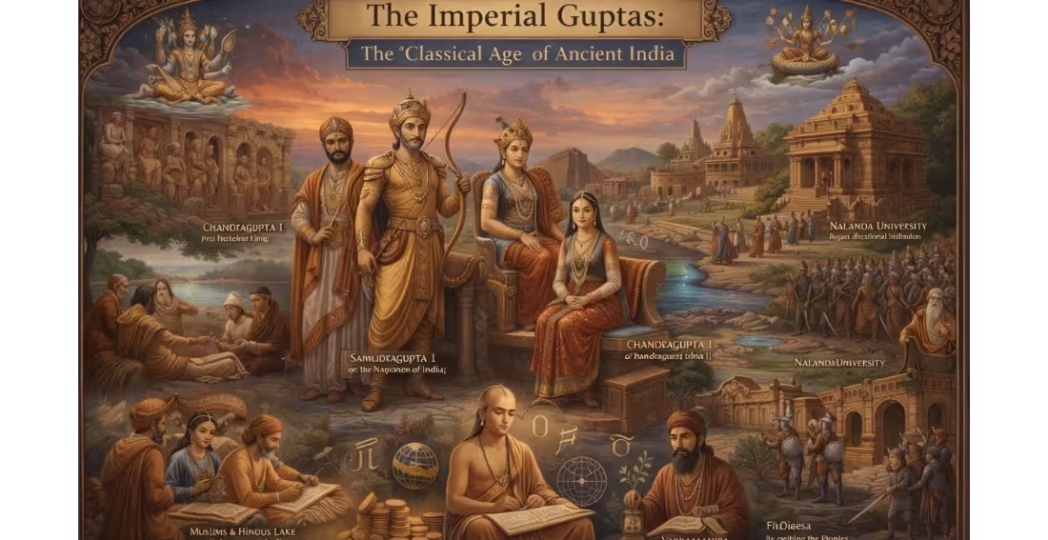
ToggleThe Gupta Period (c. 319–550 CE) is often hailed as the “Golden Age” of Indian history. After the political fragmentation following the Kushanas and Satavahanas, the Guptas established a centralized empire that fostered unparalleled achievements in art, science, and literature while witnessing the crystallization of Puranic Hinduism.
I. Political History: Expansion and Consolidation
The Guptas emerged from the Magadha region, initially as feudatories of the Kushanas.
1. Chandragupta I (319–335 CE):
- The Foundation: He was the first to assume the title Maharajadhiraja (King of Kings).
- Matrimonial Alliance: His marriage to the Lichchhavi princess, Kumaradevi, was a strategic masterstroke that enhanced the Guptas’ prestige and expanded their territorial influence.
- Gupta Era: He is credited with starting the Gupta Era in 319–320 CE.
2. Samudragupta (335–375 CE) – The "Napoleon of India":
- The Allahabad Pillar (Prayag Prashasti): Composed by his court poet Harisena, this inscription provides an exhaustive list of his conquests.
- Policy of Conquest:
- Aryavarta (North India): He pursued a policy of “Digvijaya” (complete conquest), uprooting nine kings and incorporating their territories directly.
- Dakshinapatha (South India): He defeated twelve kings but followed “Dharma Vijaya”—he captured them and then released them, accepting their suzerainty and tribute.
- Personal Interests: He was a great patron of art and was depicted on coins playing the Veena.
3. Chandragupta II (375–415 CE) – Vikramaditya:
- Defeat of the Sakas: His greatest achievement was the destruction of the Shaka power in Western India, which gave the Guptas access to the lucrative Western sea trade through ports like Broach.
- Navaratnas: His court was adorned by nine gems, including the legendary poet Kalidasa.
- Fa-Hien’s Visit: The Chinese pilgrim Fa-Hien visited during his reign, recording a peaceful and prosperous society.
- Kumaragupta I and Skandagupta:
- Kumaragupta founded the Nalanda University, which became an international center of learning.
- Skandagupta faced the first major threat from the Hunas (White Huns) and successfully repelled them, though at a great cost to the imperial treasury.
II. Administration: Decentralized Centralism
Unlike the highly centralized Mauryan administration, the Gupta system was more decentralized and dependent on local administration.
- Titles: The kings took high-sounding titles like Paramesvara and Maharajadhiraja, suggesting a divine association with kingship.
- Administrative Units:
- Bhuktis: Provinces, governed by Uparikas.
- Vishayas: Districts, governed by Vishayapatis.
- Vithis: Sub-districts.
- Gramas: Villages, headed by the Gramika.
- The Council: Ministers like the Sandhivigrahika (Minister of War and Peace) were crucial. Interestingly, many administrative posts became hereditary during this period.
III. Social and Economic Life
1. Economy and Land Grants
The Gupta period saw the proliferation of land grants (Agraharas) to Brahmins and temples, exempting them from taxes.
- Agriculture: State-sponsored irrigation (e.g., Sudarshana Lake repair) was vital.
- Trade: While internal trade flourished, some historians argue that long-distance trade with Rome declined after the 3rd century, though trade with Southeast Asia increased.
- Currency: The Guptas issued the largest number of gold coins (Dinars), though they were not as pure as those of the Kushanas.
2. Social Structure
- Caste Rigidity: The caste system became more rigid, and the number of sub-castes increased.
- Untouchability: The practice of untouchability intensified; Fa-Hien mentions that Chandalas had to strike a piece of wood when entering a city to warn others of their presence.
- Status of Women: The period saw a decline in the status of women, with the first archaeological evidence of Sati appearing in the Eran inscription (510 CE).
IV. Religion and Culture: The "Golden Age" Synthesis
1. Religious Transition
- Rise of Puranic Hinduism: The Guptas were devotees of Vishnu (Bhagavatism), but they were remarkably tolerant of Buddhism and Jainism.
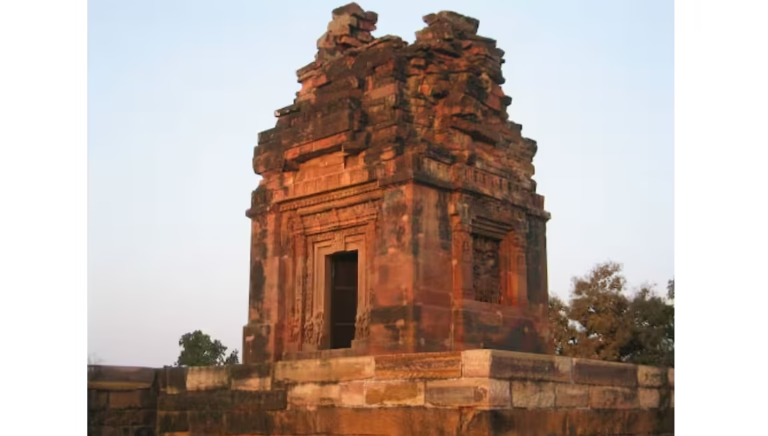
- Temple Architecture: This era marked the birth of the Hindu temple. Early temples like the Dashavatara Temple at Deogarh (UP) show the transition from flat roofs to the Shikhara (tower) style.
2. Art and Literature
- Sculpture: The Sarnath school of sculpture reached its peak, characterized by spiritual calmness and “wet drapery”.
- Paintings: The world-famous frescoes of Ajanta (Buddhist) and Bagh (secular themes) caves were largely executed during this period.
- Literature:
- Kalidasa: Wrote Abhijnanashakuntalam and Meghadutam.
- Dhanvantari: Known for his contributions to Ayurveda.
- Varahamihira: Wrote Brihat Samhita.
- Aryabhatta: Invented the concept of zero and correctly calculated the value of Pi and the earth’s circumference in his work Aryabhattiya.
V. Decline of the Empire
The empire began to crumble in the late 5th century due to several factors:
- Huna Invasions: Repeated attacks drained the treasury and weakened the military.
- Feudalization: The practice of land grants created powerful local chieftains who eventually declared independence (e.g., the Maitrakas of Valabhi).
- Economic Shift: The decline of Indo-Roman trade and the shifting of guild power weakened the central authority’s financial base.
UPSC Prelims: PYQs & Practice Questions
Previous Year Questions (PYQs)
Question 1 (2020)
Q: Which of the following phrases defines the nature of the 'Hundi' generally referred to in the sources of the post-Harsha period?
Options:
(a) An advisory issued by the king to his subordinates
(b) A diary to be maintained for daily accounts
(c) A bill of exchange
(d) An order from the feudal lord to his vassals
Answer: (c)
Explanation: While this refers to the post-Harsha period, the Gupta economy laid the foundation for such instruments. A 'Hundi' was a bill of exchange used by merchants in ancient and medieval India.
Question 2 (2019)
Q: With reference to the forced labor (Vishti) in India during the Gupta period, which one of the following statements is correct?
Options:
(a) It was considered a source of income for the State, a sort of tax paid by the people.
(b) It was totally absent in the Madhya Pradesh and Kathiawar regions of the Gupta Empire.
(c) The forced laborer was entitled to weekly wages.
(d) The eldest son of the laborer was sent as the forced laborer.
Answer: (a)
Explanation: Vishti or forced labor became a common feature of the Gupta period. It was viewed as a form of tax (Bhaga) paid by the subjects to the state in the form of labor.
Question 3 (2017)
Q: Which one of the following was a very important seaport in the Kakatiya kingdom?
Options:
(a) Kakinada
(b) Motupalli
(c) Machilipatnam
(d) Nelluru
Answer: (b)
Context: Understanding ports like Tamralipti (Gupta period) and Motupalli is essential for mapping ancient trade routes.
Practice Questions (Prelims)
Question 1
Q: Identify the Gupta King based on the following statements:
- He assumed the title 'Vikramaditya'.
- He was the first Gupta ruler to issue silver coins after defeating the Western Kshatrapas.
- His court was adorned by the 'Navaratnas'.
Options:
(a) Samudragupta
(b) Chandragupta I
(c) Chandragupta II
(d) Skandagupta
Answer: (c)
Question 2
Q: Consider the following statements regarding Gupta administration:
- The provinces were known as 'Bhuktis' and were governed by 'Uparikas'.
- The administrative posts were strictly non-hereditary.
Options:
(a) 1 only
(b) 2 only
(c) Both 1 and 2
(d) Neither 1 nor 2
Answer: (a)
Explanation: Statement 2 is incorrect because, during the Gupta period, many high-ranking posts (like Harisena’s position) became hereditary.
UPSC Mains: Previous Year & Practice Questions
Previous Year Mains Questions – Gupta Period
Gupta Period as the Golden Age
Question: “The Gupta period is often described as the ‘Golden Age’ of Indian history.” Critically examine this statement with reference to art and literature. (2014)
Science and Technology
Question: Discuss the development of Science and Technology during the Gupta Period.
Status of Women
Question: How far do you agree that the Gupta Period witnessed a decline in the status of women? Provide evidence from contemporary texts.
Samudragupta
Question: Evaluate the contribution of Samudragupta towards the political unification of India.
Land Grants and Economy
Question: Examine the socio-economic impact of land grants (Agraharas) during the Gupta era.
Mains Practice Questions (Add-ons) – Gupta Period
Gupta Administration
Question: “The decentralized nature of the Gupta administration was both its strength and its eventual cause of decline.” Discuss.
Trade Patterns
Question: Compare the trade patterns of the Gupta Empire with those of the Mauryan Empire.
Temple Architecture
Question: Analyze the evolution of temple architecture during the Gupta period from the flat-roofed style to the Shikhara style.
The Imperial Guptas: The “Classical Age” of Ancient India - FAQs
What is the 'Prayag Prashasti' and why is it important?
It is an inscription on the Allahabad Pillar composed by Harisena. It is the primary source for the military conquests of Samudragupta, listing the various kings and regions he defeated.
Who were the 'Navaratnas'?
They were the nine intellectual “gems” in the court of Chandragupta II. Notable members included Kalidasa (Literature), Varahamihira (Astronomy), and Dhanvantari (Medicine).
Did the Guptas have a centralized government like the Mauryas?
No. The Gupta administration was significantly more decentralized. They relied on a hierarchy of feudal lords and allowed many conquered kings to rule their territories as feudatories after paying tribute.
What was the primary currency of the Gupta Empire?
The Guptas issued a large number of gold coins known as Dinars. However, they also issued silver coins (started by Chandragupta II) and copper coins.
Why did the Gupta Empire decline?
The decline was caused by Huna invasions, the rising power of feudatories like the Maitrakas, and the internal depletion of the treasury due to continuous wars and land grants.