Table of Contents
ToggleThe Pandyas represent one of the oldest and most resilient dynasties in Indian history. Their legacy is defined by the patronage of the Tamil Sangams, an unparalleled maritime trade network that reached Rome and China, and a unique architectural style that culminated in the massive Gopurams of South India.
I. Historical Evolution: From Sangam to Empire
The history of the Pandyas is typically divided into three distinct phases:
1. The Early Pandyas (Sangam Era: 3rd BCE – 3rd CE)
The Pandyas find mention in the Ashokan Edicts and the writings of Megasthenes, who noted that their kingdom was ruled by a woman (referencing the legend of Meenakshi/Pandai) and was famous for pearls.
- Capital: Initially Korkai (a port), later shifted to Madurai.
- Greatest Ruler: Nedunchezhiyan, the victor of the Battle of Talaiyalanganam. He is celebrated in the Maduraikkanchi for defeating a coalition of Cheras, Cholas, and five other chieftains.
2. The First Pandya Empire (6th – 10th Century CE)
After the “Dark Age” of the Kalabhras, the Pandyas were revived by Kadungon (c. 590 CE).
- Arikesari Maravarman: A contemporary of the Pallava Mahendravarman I. He was converted from Jainism to Shaivism by the saint Sambandar.
- The Velvikkudi Grant: A crucial copper-plate inscription belonging to the reign of Nedunjadayan Varaguna I, which records the restoration of land grants to Brahmins.
3. The Second Pandya Empire (13th – 14th Century CE)
This was the “Golden Age” of the Pandyas, following the decline of the Cholas.
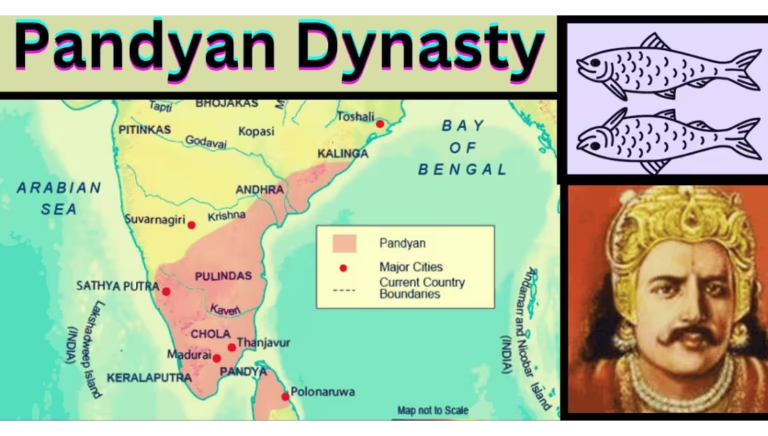
- Jatavarman Sundara Pandyan I: Known as the “Second Ashoka,” he brought almost all of South India under his rule, from the Nellore district to Sri Lanka.
- Marco Polo’s Account: The Venetian traveler visited the Pandya kingdom (at Kayal) in 1288 and 1293, describing it as the “richest and most splendid province in the world.”
II. Administration: The Centralized Monarchy
The Pandya administration was sophisticated, blending traditional Tamil customs with evolving Dharmashastric principles.
- King and Council: The king was assisted by a body of officials known as Aimperungulu (Five-member council) and Enperayam (Eight-member group).
- Territorial Units:
- Pandyalam: The entire empire.
- Valanadus: Provinces.
- Nadus: Districts.
- Urs: Villages.
- Village Governance: Similar to the Cholas, the Pandyas maintained autonomous village assemblies (Sabhas). The Manur Inscription (800 CE) provides a detailed account of the rules and qualifications for the village assembly, showing a highly democratic process for the time.
III. Economy: Pearls, Horses, and Spices
The Pandya economy was primarily agrarian but heavily bolstered by international trade.
1. The Pearl Fishery
The Gulf of Mannar was the world’s leading source of high-quality pearls. The port of Korkai was the center of this industry. These pearls were in high demand in the Roman Empire, leading to a massive influx of Roman gold.
2. Maritime Trade
- Ports: Korkai, Kayal, and Alagankulam.
- Imports: The most significant import was Arabic Horses. The Pandyas spent huge sums of gold to import thousands of horses annually from Arabia and Persia to strengthen their cavalry.
- Exports: Spices, pearls, ivory, and fine cotton textiles.
3. Irrigation
- Ports: Korkai, Kayal, and Alagankulam.
- Imports: The most significant import was Arabic Horses. The Pandyas spent huge sums of gold to import thousands of horses annually from Arabia and Persia to strengthen their cavalry.
- Exports: Spices, pearls, ivory, and fine cotton textiles.
IV. Religion and Culture: The Heart of Tamil Literature
1. Patronage of Sangams
The Pandyas are legendary for establishing the Sangams (Academies of Tamil poets). According to tradition, the First and Second Sangams were held in “Old Madurai” and “Kapatapuram” (now submerged), while the Third Sangam was held in modern Madurai.
2. The Bhakti Movement
The Pandyas were key patrons of the Nayanmars and Alwars.
- Manikkavasagar: The famous Shaivite saint and author of Tiruvasagam served as a minister to a Pandya king.
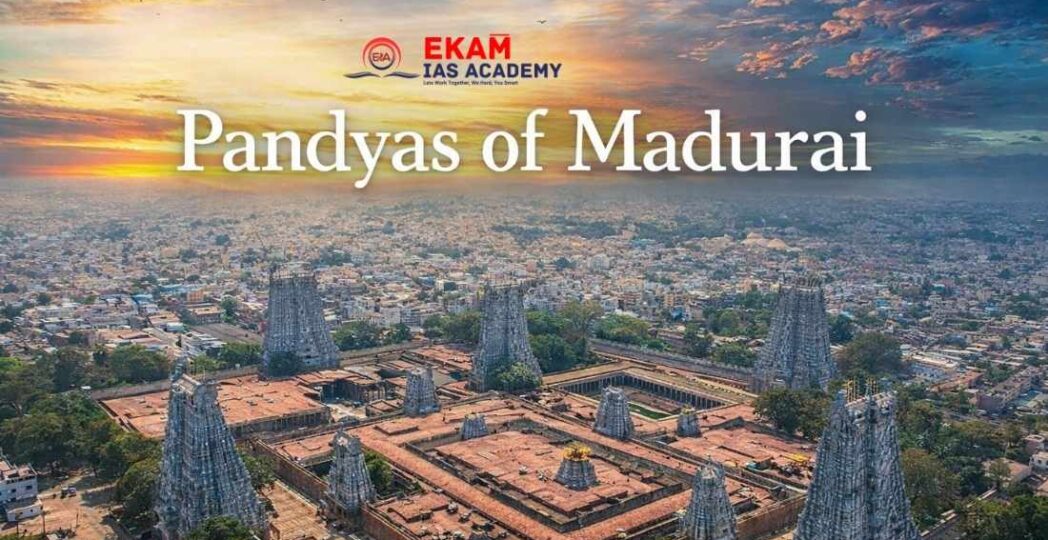
- Temples: While the Cholas focused on the Vimana (the tower over the sanctum), the Pandyas shifted focus to the Gopuram (the gateway tower).
V. Art and Architecture
Pandyan architecture is the “middle path” between the Pallavas and the Cholas.
- Cave Temples: Early Pandyas carved exquisite cave temples at Pillayarpatti, Tirupparankundram, and Sittannavasal.
- Sittannavasal Paintings: These 7th-century frescoes are the Jain equivalent of Ajanta, depicting a lotus pond, dancing figures, and natural life with vibrant vegetable dyes.
- Vettuvan Koil: Located in Kalugumalai, this is a monolithic rock-cut temple often called the “Ellora of the South.”
VI. Decline of the Pandyas
The empire began to crumble in the early 14th century due to:
- War of Succession: A civil war between Sundara Pandya and Vira Pandya.
- Malik Kafur’s Invasion (1311 CE): Taking advantage of the civil war, Alauddin Khalji’s general, Malik Kafur, plundered Madurai and carried away immense wealth.
- Madurai Sultanate: The establishment of a short-lived Sultanate in Madurai eventually paved the way for the integration of the region into the Vijayanagara Empire.
UPSC Prelims: PYQs & Practice Questions
Previous Year Questions (PYQs)
Question 1
Q: Which of the following ports was famous for pearl fisheries during the early Pandya period? (Based on historical patterns)
Options:
(a) Musiri
(b) Puhar
(c) Korkai
(d) Arikamedu
Answer: (c)
Explanation: Korkai was the early capital and a major port of the Pandyas, specifically famous for its pearl diving industry.
Question 2
Q: The 'Manur Inscription' provides information about the local administration of which dynasty?
Options:
(a) Cholas
(b) Pandyas
(c) Pallavas
(d) Cheras
Answer: (b)
Explanation: The Manur Inscription (800 CE) is a critical source for understanding the village administration and assembly rules of the Pandyas.
Practice Questions (Prelims)
Question 1
Q: Who was the Venetian traveler who visited the Pandya kingdom in the late 13th century and described its wealth?
Options:
(a) Megasthenes
(b) Hiuen Tsang
(c) Marco Polo
(d) Nicolo Conti
Answer: (c)
Explanation: Marco Polo visited the port of Kayal during the reign of Maravarman Kulasekara Pandyan I and left a vivid account of the kingdom's prosperity.
Question 2
Q: The battle in which Nedunchezhiyan defeated a coalition of the Cheras and Cholas is:
Options:
(a) Battle of Takkolam
(b) Battle of Pullalur
(c) Battle of Talaiyalanganam
(d) Battle of Venni
Answer: (c)
UPSC Mains: Previous Year & Practice Questions
Previous Year Mains Themes
Sangam Literature
Question: Discuss the contribution of the Pandyas to the development of Tamil literature through the Sangam academies.
Pearl Trade
Question: Evaluate the socio-economic significance of the pearl trade in the early history of the Far South.
Pandya Architecture
Question: Analyze the features of Pandya architecture, specifically the transition from rock-cut caves to structural temples.
Manur Inscription
Question: Examine the administrative reforms mentioned in the Manur Inscription.
Pandya–Chola Rivalry
Question: How did the rivalry between the Pandyas and the Cholas shape the political landscape of South India?
Mains Practice Questions (Add-ons)
Tamil Bhakti Movement
Question: “The Pandyas of Madurai were the primary patrons of the Tamil Bhakti movement.” Comment.
Village Administration
Question: Compare and contrast the village administration systems of the Cholas and the Pandyas.
Malik Kafur’s Invasion
Question: Discuss the impact of Malik Kafur’s invasion on the decline of the Second Pandya Empire.
The Pandyas of Madurai - FAQs
What was the emblem of the Pandya dynasty?
The emblem of the Pandyas was the Fish (Kayal).
Who were the 'Velvikkudi' grants given to?
The Velvikkudi copper plates record the restoration of a village grant to a Brahmin family by the Pandya king Nedunjadayan.
Which Pandya ruler is mentioned in the 'Silappathikaram'?
Nedunchezhiyan (the one who died of remorse after realizing he had wrongly executed Kovalan) is a central historical-literary figure in the epic.
What are 'Gopurams' in the context of Pandya architecture?
The Pandyas are credited with giving prominence to the Gopuram (monumental gateway tower) of the temple, making it larger and more ornate than the central Vimana.
What was the capital of the Pandyas during their imperial phase?
Madurai remained the primary capital and the center of cultural and political life.