
Table of Contents
ToggleThe Rashtrakutas were arguably the most powerful empire in 8th and 9th century India. At their peak, they controlled a territory stretching from the Ganga-Yamuna Doab in the north to the Kaveri in the south. Their era is marked by military brilliance, the peak of rock-cut architecture (Ellora), and the birth of Kannada literature.
I. Origin and Political History
The Rashtrakutas claimed descent from the Yadavas. Originally, they were feudatories of the Badami Chalukyas.
1. Dantidurga (The Founder)
In 753 CE, Dantidurga overthrew the last Chalukyan king, Kirtivarman II. He performed the Hiranyagarbha (Golden Womb) sacrifice at Ujjain to proclaim his Kshatriya status, despite his humble origins.
2. Krishna I (756–774 CE)
A great conqueror who unified the Deccan under Rashtrakuta rule. However, his most enduring legacy is the construction of the monolithic Kailasa Temple at Ellora, an architectural feat that remains unparalleled in world history.
3. The Tripartite Struggle: Dhruva and Govinda III
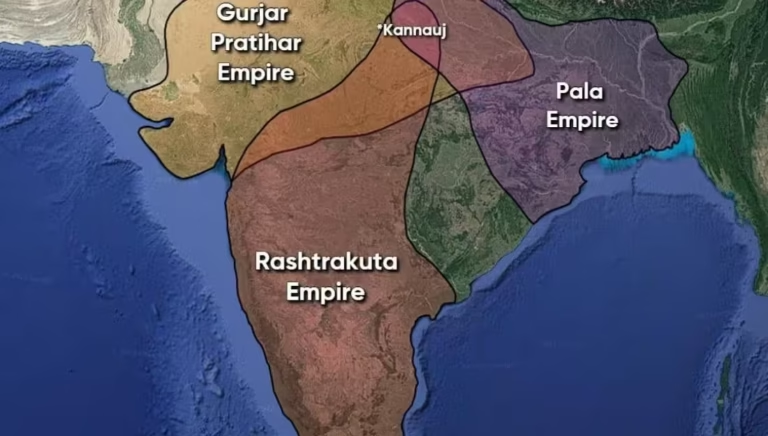
Under Dhruva Dharavarsha, the Rashtrakutas entered the Tripartite Struggle for the control of Kanauj, the symbol of imperial sovereignty. He successfully defeated the Pratihara king Vatsaraja and the Pala king Dharmapala. His son, Govinda III, repeated these feats, making the Rashtrakutas the “arbiters of North India.”
4. Amoghavarsha I (814–878 CE): The "Ashoka of the South"
The longest-reigning monarch of the dynasty, Amoghavarsha, shifted the capital to Manyakheta (Malkhed).
- Literature: He was a scholar-king who wrote Kavirajamarga (the first Kannada work on poetics) and Prashnottara Ratnamalika in Sanskrit.
- Religion: Originally a devotee of Mahalakshmi, he later became a devout Jain under the influence of the monk Jinasena.
5. Indra III and Krishna III
The last great rulers. Indra III sacked Kanauj in 915 CE, while Krishna III defeated the Cholas at the Battle of Takkolam (949 CE) and marched as far south as Rameswaram, where he built a pillar of victory.
II. Administration: The Feudal Hierarchy
The Rashtrakuta administration was a mix of centralized control and a highly organized feudal hierarchy.
- The King: Held titles like Maharajadhiraja and Paramesvara. The succession was hereditary, but the king was often assisted by a Yuvaraja (crown prince).
- Administrative Divisions:
- Rashtras: Provinces, governed by a Rashtrapati.
- Vishayas: Districts, governed by a Vishayapati.
- Bhuktis: Sub-districts (usually 50-70 villages), governed by a Bhogapati.
- Village Governance: The village was the basic unit. The Headman (Gramapatih) and the village accountant played key roles. Interestingly, the Rashtrakuta inscriptions mention Village Committees that looked after schools and temples, similar to the southern models.
III. Economy and Trade
The Rashtrakutas maintained extensive trade links, particularly with the Arab world.
- The Arab Link: Arab travelers like Al-Masudi and Suleiman visited the Rashtrakuta court. They referred to the Rashtrakuta king as ‘Balhara’ (a corruption of Vallabharaja).
- Trade Goods: Major exports included cotton textiles, spices, incense, and indigo. The Rashtrakutas imported high-quality Arabian horses to strengthen their cavalry.
- Currency: The gold and silver coins were known as Drammas.
IV. Art and Architecture: The Glory of Ellora and Elephanta
The Rashtrakuta period represents the final and most magnificent stage of rock-cut architecture in India.
1. The Kailasa Temple (Ellora, Cave 16)
Unlike other temples built from the ground up, the Kailasa temple was excavated top-down from a single basalt cliff. It represents Mount Kailasa, the abode of Shiva.
- Architecture: It combines Nagara (Northern) and Dravida (Southern) elements, though it is predominantly Dravidian.
- Sculpture: The relief showing Ravana Shaking Mount Kailasa is considered a masterpiece of Indian art.
2. Elephanta Caves
Located on an island near Mumbai, these caves contain the famous Trimurti (three-faced Shiva) sculpture, representing Shiva as Creator, Preserver, and Destroyer.
V. Religious and Literary Life
- Religious Pluralism: The Rashtrakutas patronized Hinduism, Jainism, and Buddhism. They allowed Arab traders to build mosques and practice Islam, reflecting a high degree of tolerance.
- Kannada Literature: This era is known as the “Golden Age of Kannada.” The “Three Gems of Kannada Literature”—Pampa, Ponna, and Ranna—flourished during or shortly after this period. Pampa wrote the Vikramarjuna Vijaya.
Sanskrit Scholarship: Famous scholars like Jinasena (Adipurana) and Mahaviracharya (Ganitasarasangraha) received imperial patronage.
VI. UPSC Key Takeaways (Prelims Focus)
- Capital: Manyakheta (Malkhed).
- Royal Emblem: The Golden Eagle (Garuda).
- Tripartite Struggle: Involved Rashtrakutas, Gurjara-Pratiharas, and Palas over Kanauj.
- Important Inscriptions: Sanjan Copper Plate, Karhad Plates.
- Arab Connection: Suleiman called the Rashtrakuta Empire one of the four great empires of the world.
UPSC Prelims: PYQs & Practice Questions
Previous Year Questions (PYQs)
Question 1
Q: Which of the following was the capital of the Rashtrakutas? (Based on historical patterns)
Options:
(a) Vatapi
(b) Manyakheta
(c) Kanchipuram
(d) Madurai
Answer: (b)
Explanation: Originally based in Lattalur, Amoghavarsha I shifted the capital to Manyakheta (modern Malkhed in Karnataka) to better administer his vast empire.
Question 2
Q: The monolithic Kailasa temple at Ellora was built by which Rashtrakuta king?
Options:
(a) Dantidurga
(b) Krishna I
(c) Govinda III
(d) Amoghavarsha I
Answer: (b)
Explanation: Krishna I (756–774 CE) commissioned the excavation of the Kailasa temple (Cave 16) at Ellora, which is a masterpiece of rock-cut architecture.
Practice Questions (Prelims)
Question 1
Q: Consider the following statements regarding Rashtrakuta administration:
Statements:
1. The empire was divided into 'Rashtras' governed by 'Rashtrapatis'.
2. Village headmen were known as 'Gramapatih' or 'Prabhu Gavunda'.
Options:
(a) 1 only
(b) 2 only
(c) Both 1 and 2
(d) Neither 1 nor 2
Answer: (c)
Explanation: The administrative hierarchy included Rashtras (provinces), Vishayas (districts), and Bhuktis (sub-districts), with village heads managing local affairs.
Question 2
Q: The 'Kavirajamarga', the earliest available work on Kannada poetics, was written by:
Options:
(a) Pampa
(b) Ponna
(c) Ranna
(d) Amoghavarsha I
Answer: (d)
UPSC Mains: Previous Year & Practice Questions
Previous Year Mains Themes
Art and Architecture
Question: Evaluate the contribution of the Rashtrakutas to the development of Indian art and architecture with special reference to Ellora and Elephanta.
Tripartite Struggle
Question: Analyze the role of the Rashtrakutas in the Tripartite Struggle and its impact on their imperial status.
Socio-Economic Conditions
Question: Discuss the socio-economic conditions during the Rashtrakuta period based on the accounts of Arab travelers.
Religious Pluralism
Question: Examine the religious pluralism practiced by the Rashtrakuta monarchs.
Kannada Literature
Question: How did the Rashtrakutas facilitate the growth of Kannada literature?
Mains Practice Questions (Add-ons)
Rashtrakuta Administration
Question: “The Rashtrakuta administration was a precursor to the decentralized feudal structures of the medieval period.” Critically analyze.
Capital City
Question: Discuss the strategic importance of the capital Manyakheta in maintaining the Rashtrakuta hegemony over the Deccan.
Jain Patronage
Question: Evaluate the influence of Rashtrakuta patronage on the spread of Jainism in South India.
The Rashtrakutas - FAQs
Who was the founder of the Rashtrakuta Dynasty?
Dantidurga founded the dynasty in 753 CE after overthrowing the last Badami Chalukyan king, Kirtivarman II.
What was the 'Tripartite Struggle'?
It was a long-drawn conflict between the Rashtrakutas, the Gurjara-Pratiharas, and the Palas for the control of Kanauj, which was the symbol of political supremacy in North India.
Which Arab traveler described the Rashtrakuta king as the most powerful in India?
The Arab traveler Suleiman (9th century) referred to the Rashtrakuta king as the ‘Balhara’ and placed him among the four greatest contemporary emperors of the world.
What is unique about the Kailasa Temple at Ellora?
It is a monolithic structural temple excavated top-down from a single rock cliff, combining Dravidian and Nagara styles.
Who were the 'Three Gems' of Kannada literature?
They were Pampa, Ponna, and Ranna, who received patronage from later Rashtrakuta and early Chalukyan rulers, marking a golden age for the Kannada language.