Table of Contents
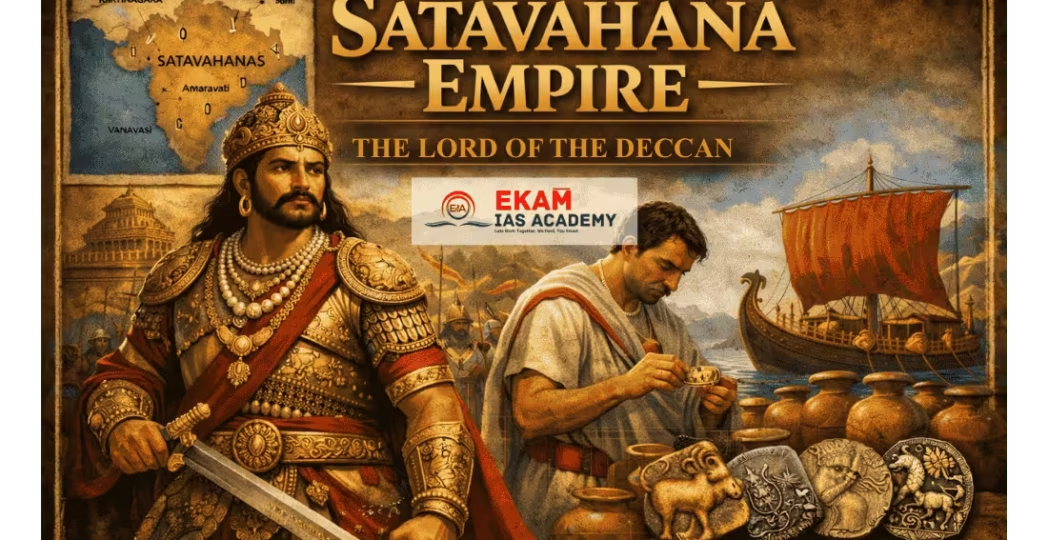
ToggleThe Satavahanas (also known as the Andhras in the Puranas) were the first major power to build a trans-continental empire in the Deccan and Central India following the decline of the Mauryas. Ruling for nearly 450 years (c. 1st Century BCE to 3rd Century CE), they acted as a bridge between North and South India, facilitating cultural and economic exchange.
I. Political History and Great Rulers
The Satavahanas rose to power in the wake of the Mauryan retreat from the Deccan. Their rule was centered around the Godavari and Krishna river valleys, with capitals at Pratishthana (modern Paithan) and later Amaravati.
1. Simuka (The Founder):
He is credited with establishing the dynasty by destroying the Kanva power and consolidating regional tribes.
2. Satakarni I:
- The first great ruler who expanded the empire to Malwa and Narmada.
- He performed the Ashvamedha (horse sacrifice) to proclaim his imperial status, reflecting the revival of Vedic rituals.
3. Hala (The Scholar-King):
- Famous for his literary contribution, he composed the Gathasaptasati (700 erotic poems) in Prakrit.
4. Gautamiputra Satakarni (c. 106–130 CE) – The Zenith:
- Known as the “Greatest Satavahana,” he defeated the Shaka king Nahapana and recovered lost territories.
- In the Nasik inscription, he is described as the “Sole Brahmin” (Ekabrahmana) and the “Destroyer of the pride of Kshatriyas”.
- He claimed his horses drank the water of the three seas (Arabian Sea, Bay of Bengal, and Indian Ocean).
5. Vashishtiputra Pulumayi & Yajna Sri Satakarni:
- They continued the struggle against the Western Kshatrapas (Sakas).
- Yajna Sri Satakarni was the last great king; his coins featuring ships indicate the dynasty’s maritime prowess and interest in naval trade.
II. Administration: The Birth of Indian Feudalism
The Satavahana administration was largely modeled on the Mauryan system but introduced features that led to the feudalization of the Indian polity.
- Political Structure: The empire was divided into Aharas (districts), governed by Amatyas and Mahamatras.
- Military Administration: The rural areas were placed under the control of Gaulmikas, who headed a small military contingent. This ensured local law and order but also gave rise to local power centers.
- Land Grants (Agraharas): The Satavahanas were the first to grant land to Brahmins and Buddhist monks.
- These grants were accompanied by the surrender of administrative and fiscal rights by the state to the donee.
- This practice weakened the central authority over time and laid the foundation for the feudal structure of the Middle Ages.
III. Socio-Economic Prosperity
1. Economy and Trade
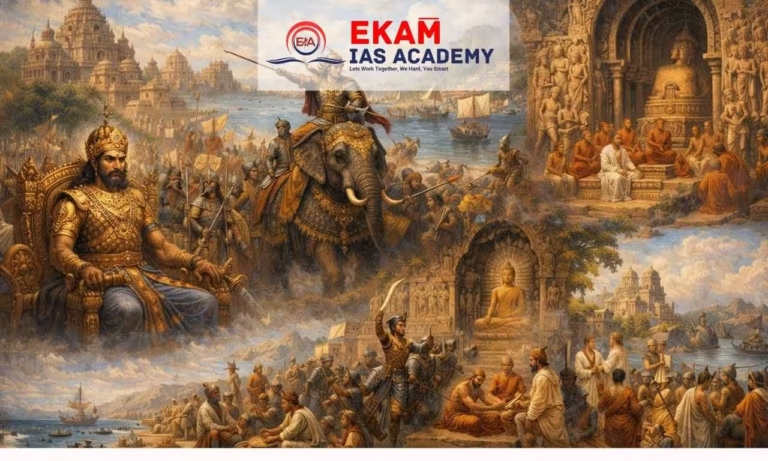
The Satavahana period was an era of unprecedented commercial activity, driven by the Indo-Roman Trade.
- Ports and Cities: Important commercial centers included Bharukachchha (Broach), Sopara, and Kalyan on the west coast.
- Guilds (Shrenis): Artisans were organized into powerful guilds. Inscriptions mention guilds of weavers, potters, and oil-pressers that acted as banks and made public donations.
- Coinage: They issued coins primarily in lead, copper, and potin (an alloy), which was a unique feature of their economy.
2. Social Structure
- Varna System: The kings were staunch supporters of the four-fold varna system.
- Metronymics: A unique feature where kings were named after their mothers (e.g., Gautami-putra, Vashisthi-putra). However, the succession remained strictly patrilineal (father to son).
- Assimilation: They successfully absorbed foreign elements like the Sakas and Yavanas into the Hindu social fold, often as Vratya Kshatriyas.
IV. Religion, Art, and Architecture
The Satavahanas practiced religious pluralism, supporting both Vedic Hinduism and Buddhism.
- Religious Transition: While the kings performed Vedic sacrifices, they provided massive grants for Buddhist Chaityas (prayer halls) and Viharas (monasteries).
- Rock-Cut Architecture: The world-renowned Karle Chaitya (the largest in India) and the caves at Kanheri and Nasik were developed during this period.
- Amaravati School of Art:
- Developed in the lower Krishna valley.
- Characterized by the use of white marble and narrative art (depicting Jataka tales).
- Focused on “feminine beauty” and dynamic, crowded scenes rather than just the individual figure of the Buddha.
UPSC Prelims: PYQs & Practice Questions
Previous Year Questions (PYQs)
Question 1 (1998)
Q: Which of the following dynasties were the first to make land grants to Brahmins and Buddhist monks?
Options:
(a) Mauryas
(b) Satavahanas
(c) Guptas
(d) Shungas
Answer: (b)
Explanation: The Satavahanas were the pioneers in the practice of granting tax-free land (Agraharas) to Brahmins and Buddhist monks, a practice that later intensified under the Guptas.
Question 2 (1996)
Q: The Satavahana coinage was predominantly made of which material?
Options:
(a) Gold
(b) Silver
(c) Lead
(d) Terracotta
Answer: (c)
Explanation: While they issued some copper and potin coins, the Satavahanas are uniquely known for their extensive use of lead in their coinage.
Question 3
Q: With reference to the history of ancient India, which of the following was a common feature between the Satavahanas and the Kushanas?
Options:
(a) Both issued gold coins on a large scale.
(b) Both were of foreign origin.
(c) Both patronized Buddhism.
(d) Both had their capital at Purushapura.
Answer: (c)
Explanation: Both dynasties were great patrons of Buddhism; the Satavahanas built grand Chaityas like Karle, while the Kushanas convened the Fourth Buddhist Council.
Practice Questions (Prelims)
Question 1
Q: Which Satavahana king is credited with the composition of 'Gathasaptasati'?
Options:
(a) Simuka
(b) Satakarni I
(c) Hala
(d) Gautamiputra Satakarni
Answer: (c)
Explanation: King Hala, the 17th ruler of the dynasty, was a renowned scholar who wrote the Gathasaptasati in Prakrit.
Question 2
Q: Consider the following statements regarding Satavahana administration:
Statements:
1. The empire was divided into 'Aharas'.
2. The 'Gaulmika' was a rural administrator who also headed a military contingent.
Options:
(a) 1 only
(b) 2 only
(c) Both 1 and 2
(d) Neither 1 nor 2
Answer: (c)
UPSC Mains: Previous Year & Practice Questions
Previous Year Mains Questions
Cultural Synthesis
Question: “The Satavahanas acted as a bridge between the culture of the North and the South.” Discuss.
Indo-Roman Trade
Question: Evaluate the socio-economic significance of the Indo-Roman trade during the Satavahana period.
Gautamiputra Satakarni
Question: Analyze the role of Gautamiputra Satakarni in the revival of Satavahana power.
Amaravati School of Art
Question: Examine the features of the Amaravati School of Art and its narrative style.
Land Grants and Administration
Question: Discuss the impact of land grants on the administrative structure of the Deccan under the Satavahanas.
Mains Practice Questions (Add-ons)
Social Structure
Question: “Though the Satavahanas followed a matronymic naming system, their succession remained patrilineal.” Comment on the social structure of the era.
Rural Administration
Question: Explain the importance of the ‘Gaulmika’ system in the context of increasing militarization of rural administration.
Religious Policy
Question: Compare and contrast the religious policies of the Satavahanas with those of their contemporaries, the Western Kshatrapas.
The Satavahanas: The Lords of the Deccan - FAQs
Why are the Satavahanas called 'Andhras' in the Puranas?
The Puranas refer to them as Andhrabhrityah (Servants of the Andhras) or Andhras. While their early inscriptions are found in Maharashtra, their later power was centered in the Andhra region, leading to this nomenclature.
What is the 'Nanaghat Inscription'?
It was issued by Nayanika, the queen of Satakarni I. It is a vital source for early Satavahana history, mentioning the performance of Vedic sacrifices and the growing influence of the dynasty.
What was the significance of the ship symbol on Satavahana coins?
Coins issued by Yajna Sri Satakarni often featured a ship with two masts. This highlights the importance of maritime trade and the dynasty’s naval strength in the Indian Ocean and Bay of Bengal.
Did the Satavahanas support the Varna system?
Yes. Gautamiputra Satakarni claimed to be the protector of the Brahmins and the Varnashrama Dharma. He specifically took pride in stopping the “mixing of the four castes” (Vinivartita-chaturvarna-sankara).
What is the most famous Buddhist monument of the Satavahana period?
The Karle Chaitya in Maharashtra is the most famous. It is the largest rock-cut Buddhist prayer hall in India, known for its magnificent pillars and arched roof.