Table of Contents
ToggleThe Constitutional Evolution: Acts of Parliament
The British Parliament sought to regulate the East India Company (EIC) as it acquired vast territories. This led to a series of Charter Acts that gradually stripped the Company of its autonomy.
The Regulating Act of 1773
This was the first step toward parliamentary control over the Company.
- Governor-General of Bengal: The Governor of Bengal was designated as the Governor-General of Bengal (Warren Hastings was the first).
- Executive Council: A council of four members was created to assist the Governor-General.
- Supreme Court: A Supreme Court of Judicature was established at Calcutta (1774) with Sir Elijah Impey as the Chief Justice.
- Subordination: The Presidencies of Bombay and Madras were made subordinate to Bengal in matters of war and diplomacy.
Pitt’s India Act of 1784
This Act established the System of Dual Government in England.
- Board of Control: Created to manage political affairs (representing the British Crown).
- Court of Directors: Remained in charge of commercial affairs.
Significant Terminology: Company’s territories in India were for the first time called the “British possessions in India.”
Charter Act of 1813
- Trade Monopoly: Ended the Company’s monopoly over Indian trade, except for trade in tea and trade with China.
- Education: Sanctioned an annual sum of one lakh rupees for the promotion of literature and science.
- Christian Missionaries: Allowed missionaries to come to India to spread Christianity.
Charter Act of 1833 (The Saint Helena Act)
- Final Centralization: The Governor-General of Bengal became the Governor-General of India (Lord William Bentinck).
- End of Commercial Body: The EIC lost its status as a commercial entity and became a purely administrative body.
- Law Commission: A fourth member (Law Member) was added to the Council; Lord Macaulay was the first, leading to the codification of laws.
The Pillars of Administration
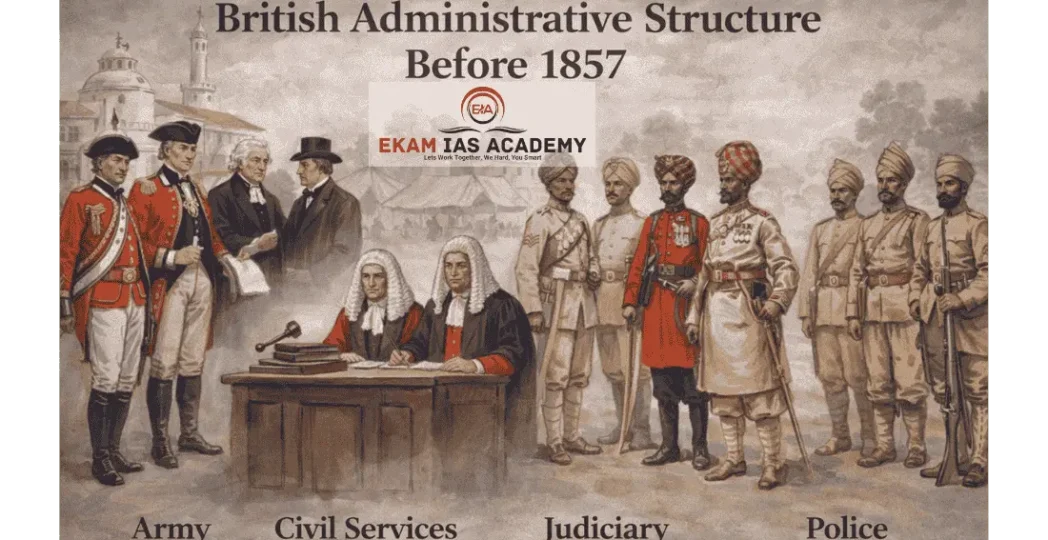
The British rule was sustained by four main “pillars”: the Civil Services, the Army, the Police, and the Judiciary.
The Civil Services
Modernized by Lord Cornwallis, who is known as the “Father of Civil Services in India.”
- Cornwallis Code: He separated the revenue administration from the administration of justice.
- Covenanted vs. Uncovenanted: Higher posts were reserved for Europeans (Covenanted), while Indians were restricted to lower posts.
- Fort William College: Established by Wellesley in 1800 to train young civilians.
- Haileybury College: Established in England (1806) to replace Fort William College for training.
- Open Competition: The Charter Act of 1853 introduced an open competitive system for recruitment.
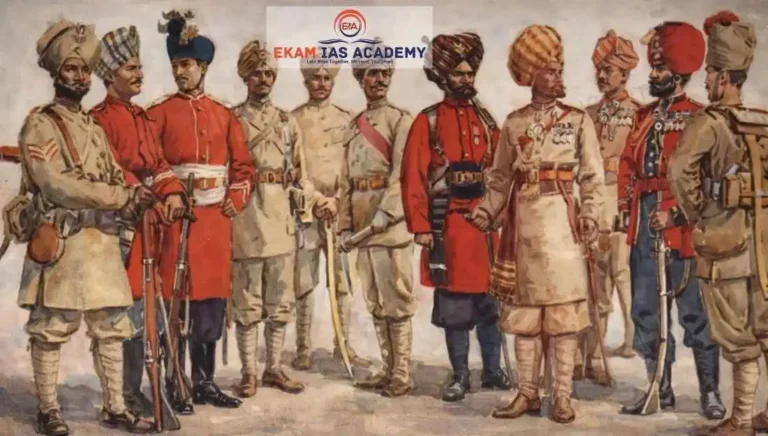
The Army
The army was the instrument of conquest and the protector of the empire.
- Composition: The majority were Indian Sepoys, but the commanding officers were strictly British.
- Fixed Ratio: The British maintained a specific ratio of Europeans to Indians to prevent mutinies (though this was breached before 1857).
The Police
Before Cornwallis, internal security was the responsibility of Zamindars.
- Thanas: Cornwallis established a system of Thanas (circles) headed by a Daroga (an Indian).
- District Superintendent of Police (SP): This office was later created to head the district police.
The Judiciary
The British replaced the traditional systems with a codified, Western legal framework.
- Warren Hastings: Established Diwani Adalats (Civil) and Faujdari Adalats (Criminal).
- Cornwallis: Abolished the District Faujdari courts and established Provincial Courts of Appeal at Calcutta, Dacca, Murshidabad, and Patna.
- William Bentinck: Abolished the Provincial Courts and transferred their work to District Commissioners and District Judges. He also allowed the use of Vernacular languages in lower courts and English in the Supreme Court.
Social and Educational Policies
British administration was also characterized by a “Civilizing Mission” and administrative efficiency.
- Orientalists vs. Anglicists: A debate over whether to promote traditional Indian learning or Western education.
- Macaulay’s Minute (1835): Settled the debate in favor of English education. The goal was to create a class of Indians “Indian in blood and color, but English in taste.”
- Wood’s Despatch (1854): Known as the “Magna Carta of English Education in India,” it proposed a comprehensive plan from primary school to university level.
Administrative Significance for UPSC
- Centralization: The shift from 1773 to 1833 shows a clear path toward a single, unified command for the entire subcontinent.
- Exclusion of Indians: The hallmark of this era was the deliberate exclusion of Indians from the higher echelons of power (Cornwallis’s policy of “Every native of Hindustan is corrupt”).
- Rule of Law: The British introduced the concept of Rule of Law and Equality before the law, though in practice, Europeans were often tried by separate courts and laws.
UPSC Prelims: PYQs & Practice Questions
Previous Year Questions (PYQs)
Question 1 (UPSC 2007)
Q: Consider the following statements:
1. Warren Hastings was the first Governor-General who established a regular police force in India on the British pattern.
2. A Supreme Court was established at Calcutta by the Regulating Act, 1773.
3. The Indian Penal Code came into effect in the year 1860.
Which of the statements given above are correct?
Options:
(a) 1 and 2 only
(b) 2 and 3 only
(c) 1 and 3 only
(d) 1, 2, and 3
Answer: (b)
Explanation: Warren Hastings did not establish a regular police force; this reform is credited to Lord Cornwallis in 1791. The Regulating Act of 1773 set up the Supreme Court at Calcutta, and the Indian Penal Code came into force in 1860.
Question 2 (UPSC 2012)
Q: By which one of the following Acts was the Governor-General of Bengal designated as the Governor-General of India?
Options:
(a) The Regulating Act
(b) The Pitt’s India Act
(c) The Charter Act of 1813
(d) The Charter Act of 1833
Answer: (d)
Explanation: The Charter Act of 1833 centralized administration and redesignated the Governor-General of Bengal as the Governor-General of India. Lord William Bentinck became the first to hold this title.
Practice Questions for Prelims
Question 3
Q: With reference to the ‘Cornwallis Code’ of 1793, consider the following statements:
1. It established the principle of ‘Sovereignty of Law’.
2. It separated revenue administration from judicial administration.
3. It mandated that all high-ranking judicial posts be held by Indians to ensure local context.
Which of the statements given above is/are correct?
Options:
(a) 1 and 2 only
(b) 2 only
(c) 1 and 3 only
(d) 1, 2, and 3
Answer: (a)
Explanation: Statement 3 is incorrect. Cornwallis followed a strict policy of Europeanization and reserved high offices for Europeans.
Question 4
Q: The “Board of Control” was established by which of the following acts to provide the British Government control over the Company’s civil, military, and revenue affairs?
Options:
(a) Regulating Act of 1773
(b) Pitt’s India Act of 1784
(c) Charter Act of 1813
(d) Charter Act of 1853
Answer: (b)
Explanation: Pitt’s India Act of 1784 introduced the Dual System of Control through the Board of Control and the Court of Directors.
UPSC Mains – Previous Year & Practice Questions
Previous Year Questions (PYQs)
Regulating Act of 1773
Question: “The Regulating Act of 1773 was the first step towards parliamentary control over the East India Company.” Discuss. (UPSC 1994/Modified)
Charter Act of 1833
Question: Examine the role of the ‘Charter Act of 1833’ as a landmark in the legislative and administrative history of British India. (UPSC 2005/Modified)
Lord Cornwallis
Question: “Lord Cornwallis is considered the father of modern Indian administration.” Evaluate his contributions to the civil services and judiciary. (UPSC 1997/Modified)
Educational Policy
Question: Analyze the shift in the British educational policy from the ‘Orientalist’ approach to the ‘Anglicist’ approach during the early 19th century. (UPSC 2013/Modified)
Macaulay Minute
Question: Critically examine the impact of the ‘Macaulay Minute’ on the social and intellectual landscape of 19th-century India. (UPSC 2011/Modified)
Mains Practice Questions
Colonial Administration
Question: “The administrative structure before 1857 was characterized by extreme centralization and the exclusion of Indians from power.” Elaborate.
Police System
Question: Evaluate the evolution of the British Police System from the Zamindari-led security arrangements to the professionalized ‘Daroga’ system.
Judicial System
Question: “The British judicial system introduced the ‘Rule of Law’ in India but simultaneously created a complex and expensive legal maze.” Critically analyze.
British Administrative Structure and Policies Before 1857 - FAQs
What was the primary motive behind the Regulating Act of 1773?
The British Parliament wanted to address the corruption of Company officials and the financial crisis of the EIC. It was the first time the British government intervened to regulate the affairs of the Company in India.
Why is Lord Cornwallis called the 'Father of Civil Services in India'?
He professionalized the bureaucracy by raising salaries, forbidding private trade, and establishing a clear hierarchy based on merit (for Europeans), ensuring a more disciplined administrative cadre.
What was the 'Law Commission' of 1833?
Established under the Charter Act of 1833, it was headed by Lord Macaulay. Its goal was to codify Indian laws, which eventually led to the creation of the Indian Penal Code (IPC) and the Civil Procedure Code.
How did the Charter Act of 1813 change the nature of British rule?
By ending the Company’s trade monopoly, it shifted the focus from “Company trade” to “Imperial trade.” It allowed British industrial interests to treat India as a market and opened the doors for Christian missionaries to influence Indian society.
What was 'Wood’s Despatch' of 1854?
Often called the “Magna Carta of English Education in India,” it was a comprehensive plan for education from primary schools to universities. It recommended the use of vernacular languages at the primary level and English at the higher level.
What were 'Diwani' and 'Faujdari' Adalats?
These were courts established by Warren Hastings. Diwani Adalats dealt with civil matters (property, marriage, etc.), while Faujdari Adalats dealt with criminal matters. Initially, civil courts were supervised by European collectors, while criminal courts remained under Indian officials.