Table of Contents
ToggleBritish Economic Policy
Analyzing British economic policy in India is fundamental to understanding the colonial era, as the primary objective of British rule was the economic exploitation of the Indian subcontinent to serve the interests of the Industrial Revolution in Britain.
Phases of British Economic Exploitation
The British economic impact can be categorized into three broad historical phases, each characterized by a different mode of exploitation:
Phase of Mercantilism (1757–1813):
- Objective: Direct plunder and establishing a trade monopoly.
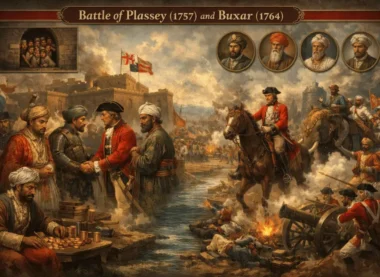
- Mechanism: Following the Battle of Plassey, the East India Company used the surplus revenue of Bengal to purchase Indian goods (investments) for export to Europe.
- Result: This period saw the “Drain of Wealth” begin in earnest as the Company no longer needed to import bullion from England to buy Indian commodities.
Phase of Industrial Capitalism (1813–1858):
- Objective: Converting India into a market for British manufactured goods and a source of raw materials
- Mechanism: The Charter Act of 1813 ended the Company’s monopoly, allowing one-way free trade. Cheap, machine-made British textiles flooded Indian markets.
- Result: This led to Deindustrialization, where traditional Indian handicrafts were destroyed, forcing artisans back into an already burdened agricultural sector.
Phase of Financial Capitalism (Post-1858):
- Objective: Investment of British surplus capital in India.
- Mechanism: Capital was invested in Railways, tea plantations, and banking, with the Indian taxpayer guaranteeing high returns to British investors.
Land Revenue Systems: The Structural Shackles
The British introduced various revenue systems to maximize the collection of land rent, which was their primary source of income.
Permanent Settlement (1793):
- Introduced by Lord Cornwallis in Bengal, Bihar, and Odisha.
- Zamindars were made hereditary owners of the land as long as they paid a fixed revenue to the state
- Impact: Created a loyal class of landlords but led to the extreme oppression of the ryots (peasants).
Ryotwari System:
- Introduced by Thomas Munro and Alexander Read in Madras and Bombay presidencies.
- Revenue was settled directly with the cultivator (Ryot).
- Impact: Though it removed middlemen, the revenue demand was excessively high, leading to widespread peasant indebtedness.
Mahalwari System:
- Applied in the North-West Provinces, Punjab, and Central India.
- The revenue unit was the Mahal (village or estate).
- Impact: The village community was held collectively responsible for payment, often leading to the displacement of traditional village structures.
The Process of Deindustrialization
The decline of Indian traditional industries was a hallmark of British policy.
- Destruction of Handicrafts: High tariffs were imposed on Indian goods entering Britain, while British machine-made goods entered India with negligible duties.
- Ruralization of Economy: As urban artisans lost their livelihoods, they moved to villages, increasing the pressure on land and leading to the fragmentation of landholdings.
Drain of Wealth Theory
Championed by Dadabhai Naoroji, this theory explained how India’s wealth was being systematically siphoned off to Britain without any equivalent return.
- Constituents: Home charges (interest on public debt, salaries/pensions of British officials), military expenditure, and profits of British capitalists.
- Significance: This critique became the primary ideological weapon for early nationalists (the Moderates) to expose the exploitative nature of British rule.
UPSC Prelims: PYQs & Practice Questions
Previous Year Questions (PYQs)
Question 1 (UPSC 2011)
Q: With reference to the period of colonial rule in India, “Home Charges” formed a vital part of the drain of wealth from India. Which of the following funds constituted Home Charges?
1. Funds used to support the India Office in London.
2. Funds used to pay salaries and pensions of British personnel engaged in India.
3. Funds used for waging wars outside India by the British.
Select the correct answer using the codes given below:
Options:
(a) 1 only
(b) 1 and 2 only
(c) 2 and 3 only
(d) 1, 2, and 3
Answer: (d)
Explanation: Home Charges included expenses incurred in England on behalf of India such as maintaining the India Office, paying pensions/salaries of British personnel, and servicing interest/charges linked to wars and other expenditures.
Question 2 (UPSC 2018)
Q: The staple commodities of export by the English East India Company from Bengal in the middle of the 18th century were:
Options:
(a) Raw cotton, oil-seeds, and opium
(b) Sugar, salt, zinc, and lead
(c) Copper, silver, gold, spices, and tea
(d) Cotton, silk, saltpetre, and opium
Answer: (d)
Explanation: In the mid-18th century, the Company’s Bengal exports were dominated by textiles (cotton and silk), saltpetre (for gunpowder), and opium (linked to the China trade).
Previous Year Questions (PYQs)
Question 3
Q: Which of the following acts ended the trade monopoly of the East India Company in India, opening the doors for ‘Industrial Capitalism’?
Options:
(a) Regulating Act of 1773
(b) Charter Act of 1813
(c) Charter Act of 1833
(d) Government of India Act 1858
Answer: (b)
Explanation: The Charter Act of 1813 ended the Company’s trade monopoly in India (except tea and China trade), marking the shift toward free trade and industrial exploitation.
Question 4
Q: The ‘Ryotwari Settlement’ was primarily introduced in which of the following regions?
Options:
(a) Bengal and Bihar
(b) Madras and Bombay Presidencies
(c) United Provinces and Punjab
(d) Awadh and Odisha
Answer: (b)
Explanation: Thomas Munro and Alexander Read introduced the Ryotwari system mainly in the Madras and Bombay Presidencies, settling revenue directly with the cultivators (ryots).
UPSC Mains – Previous Year & Practice Questions
Previous Year Questions (PYQs)
Drain of Wealth
Question: “The colonial economy was a classic case of the ‘drain of wealth’ which impoverished India to enrich Britain.” Examine the ‘Drain of Wealth’ theory. (UPSC 2014/Modified)
Land Revenue Systems
Question: “The British land revenue policy was designed to extract the maximum surplus from the peasantry.” Discuss with reference to Permanent, Ryotwari, and Mahalwari settlements. (UPSC 2011/Modified)
De-industrialization
Question: Analyze the impact of the Industrial Revolution in England on the ‘De-industrialization’ of India in the 19th century. (UPSC 2016)
Railway Expansion
Question: “The railway construction in India was an instance of ‘Private profit at Public risk’.” Critically evaluate the financial arrangements of railway expansion. (UPSC 1999/Modified)
Commercialization of Agriculture
Question: Discuss the causes and consequences of the commercialization of Indian agriculture during the 19th century. (UPSC 2018)
Mains Practice Questions
Permanent Settlement
Question: “The Permanent Settlement of 1793 created a loyal class of zamindars but turned the actual tiller of the soil into a mere tenant-at-will.” Substantiate.
Home Charges
Question: Evaluate the role of the ‘Home Charges’ as a mechanism for the systematic transfer of Indian capital to Britain.
Famines under Colonial Rule
Question: “British economic policies were responsible for the recurring famines in India during the 19th century.” Critically analyze.
British Economic Policy in India - FAQs
What is 'De-industrialization' in the Indian context?
It refers to the decline of traditional Indian handicraft and textile industries because of the influx of cheap, machine-made British goods and the high tariffs imposed on Indian exports to Europe.
How did the 'Drain of Wealth' affect the Indian economy?
It prevented internal capital formation in India. The surplus that could have been invested in Indian industries was instead used to fuel the Industrial Revolution in Britain, keeping India in a state of chronic poverty.
Why did the British introduce the 'Commercialization of Agriculture'?
They needed “cash crops” like cotton, indigo, jute, and tea to feed British industries. This forced farmers to move away from food grains, making them more vulnerable to price fluctuations and famines.
What was the 'Guarantee System' in Indian Railways?
To encourage British private companies to build railways, the British government guaranteed a 5% return on their investment. This was paid out of Indian taxes, even if the railways were making a loss.
What was the difference between the Zamindari and Ryotwari systems?
In the Zamindari system (Permanent Settlement), the landlord was the owner and the state collected a fixed tax from him. In the Ryotwari system, the state dealt directly with the peasant (Ryot), but the tax was often revised and set extremely high.
Who were the 'Drain of Wealth' theory’s main proponents?
Dadabhai Naoroji (the pioneer), R.C. Dutt (Economic History of India), and M.G. Ranade. They used economic data to prove that British rule was financially ruining India.