Table of Contents
ToggleFactors Leading to the Rise of Early Nationalism
Early nationalism was not an overnight phenomenon but a result of several administrative, economic, and social changes under British rule.
- Political and Administrative Unification: The British brought the entire subcontinent under a single administrative setup, unified laws, and a centralized government. This created a sense of “oneness” among Indians.
- Western Education: The introduction of English education opened a window to Western liberal thoughts, ideas of democracy, liberty, and secularism. Leaders like Dadabhai Naoroji and Pherozeshah Mehta were products of this intellectual awakening.
- Role of the Press: Vernacular and English newspapers (e.g., The Hindu, Amrita Bazar Patrika, Bengalee) acted as the vehicle for spreading nationalist ideas and criticizing colonial policies.
- Reactionary Policies of Lord Lytton: The Vernacular Press Act (1878), the Arms Act (1878), and the reduction of the age for Civil Services exams from 21 to 19 acted as immediate provocations.
- The Ilbert Bill Controversy (1883): The white opposition to a bill allowing Indian judges to try Europeans exposed the deep-seated racial arrogance of the British and taught Indians the power of organized protest.
The Birth of the Indian National Congress (INC)
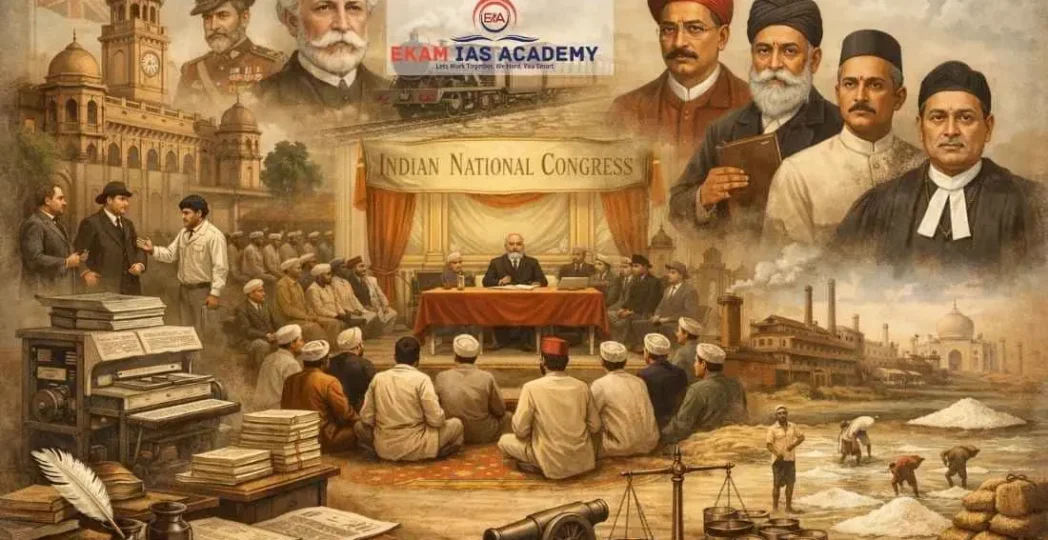
While several regional associations existed (e.g., Poona Sarvajanik Sabha, Indian Association of Calcutta), the need for an all-India body culminated in the first session of the INC in December 1885 at Gokuldas Tejpal Sanskrit College, Bombay.
- Founder: A.O. Hume, a retired British official, played a pivotal role (leading to the Safety Valve Theory).
- First President: W.C. Bonnerjee.
- The Safety Valve Theory vs. Lightning Conductor Theory: * Safety Valve: Proposed by Lala Lajpat Rai, suggesting the INC was created to provide a safe outlet for Indian discontent to prevent another 1857-style revolt.
- Lightning Conductor: Proposed by Gopal Krishna Gokhale, suggesting that Indian leaders used Hume as a “lightning conductor” to protect the fledgling organization from early suppression by the colonial government.
Key Leaders of the Moderate Phase
The early nationalists were primarily from the educated middle class—lawyers, journalists, and doctors.
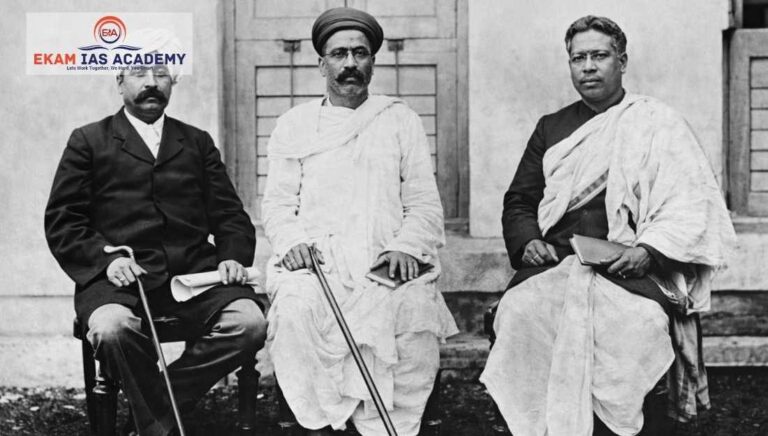
- Dadabhai Naoroji: Known as the “Grand Old Man of India,” he was the first to analyze the economic impact of British rule.
- Gopal Krishna Gokhale: The political guru of Mahatma Gandhi and founder of the Servants of India Society.
- Pherozeshah Mehta: Known for his brilliant oratory and command over the Bombay Corporation.
- Surendranath Banerjea: A pioneer of organized nationalist agitation and founder of the Indian Association.
- Justice M.G. Ranade: The intellectual powerhouse who focused on social and economic reforms.
Objectives and Methods of the Moderates
The Moderates believed in constitutionalism and the “innate sense of justice” of the British people.
The 3P's Method
Their strategy was defined by Prayers, Petitions, and Protests.
- They sent memorandums to the government and the British Parliament.
- They held annual sessions to pass resolutions and educate public opinion.
- They worked within the framework of the law, avoiding any form of violent or mass agitation.
Political Demands
- Expansion of Legislative Councils: Greater representation of Indians in the councils.
- Simultaneous Exams: Holding the Indian Civil Service (ICS) exams in both England and India.
- Separation of Powers: Separating the judiciary from the executive.
Repeal of the Arms Act and the Vernacular Press Act.
Economic Demands (The Core Contribution)
The Moderates’ greatest achievement was the Economic Critique of Colonialism.
- Drain of Wealth Theory: Dadabhai Naoroji (in his book Poverty and Un-British Rule in India) proved that India’s wealth was being siphoned to Britain through Home Charges, interest on debt, and military expenditure.
- They demanded the reduction of land revenue and the abolition of the Salt Tax.
- They advocated for the protection of Indian industries through tariffs.
Achievements and Limitations
Achievements:
- Indian Councils Act, 1892: Though limited, it was the first victory for Moderate agitation, increasing the number of non-official members in councils.
- Economic Awakening: They successfully stripped the “benevolent” mask of British rule, proving it was primarily exploitative.
- National Identity: They sowed the seeds of pan-Indianism, bringing people from different provinces onto a single platform.
Limitations:
- Narrow Social Base: Their movement was confined to the urban elite. They failed to involve the masses (peasants and workers).
- Lack of Faith in the Masses: Moderates believed the masses were not yet ready for political participation.
- The “Begging Bowl” Policy: Later Extremists criticized their methods as ineffective “political mendicancy.”
UPSC Prelims: PYQs & Practice Questions
Previous Year Questions (PYQs)
Question 1 (UPSC 2016)
Q: What was the main reason for the split in the Indian National Congress at Surat in 1907?
Options:
(a) Introduction of communalism into Indian politics by Lord Minto.
(b) Extremists’ lack of faith in the capacity of the Moderates to negotiate with the British Government.
(c) Foundation of Muslim League.
(d) Aurobindo Ghosh’s inability to be elected as the President of the Indian National Congress.
Answer: (b)
Explanation: The Surat Split occurred due to a deep ideological divide. The Extremists were dissatisfied with the Moderates’ policy of constitutional agitation and believed negotiations with the British would not bring meaningful political reforms.
Question 2 (UPSC 2018)
Q: Which of the following led to the introduction of English Education in India?
1. Charter Act of 1813
2. General Committee of Public Instruction, 1823
3. Orientalist and Anglicist Controversy
Select the correct answer using the code given below:
Options:
(a) 1 and 2 only
(b) 2 only
(c) 1 and 3 only
(d) 1, 2, and 3
Answer: (d)
Explanation: The Charter Act of 1813 provided funds for education, the General Committee administered educational policy, and the Orientalist–Anglicist debate was settled in favor of English education through Macaulay’s Minute (1835).
Practice Questions for Prelims
Question 3
Q: With reference to the Indian Councils Act of 1892, consider the following statements:
1. It was a result of the constant demands of the early Congress leaders.
2. It introduced the principle of direct elections for the first time in India.
3. It gave the members the right to discuss the budget and ask questions.
Which of the statements given above is/are correct?
Options:
(a) 1 and 3 only
(b) 2 only
(c) 1 and 2 only
(d) 1, 2, and 3
Answer: (a)
Explanation: The Act was passed due to sustained pressure from early Congress leaders and allowed discussion of the budget and questions. It did not introduce direct elections; members were nominated based on recommendations.
Question 4
Q: The British Committee of the Indian National Congress was established in London in 1889 to advocate for Indian causes. Who was its chairman?
Options:
(a) Dadabhai Naoroji
(b) William Wedderburn
(c) A.O. Hume
(d) W.C. Bonnerjee
Answer: (b)
Explanation: William Wedderburn served as the chairman of the British Committee of the INC, which worked to influence British public opinion and published the journal India.
UPSC Mains – Previous Year & Practice Questions
Previous Year Questions (PYQs)
Moderates & Mass Movements
Question: “The Moderates failed to carry the masses with them, but they provided the ideological platform for the subsequent mass movements.” Discuss. (UPSC 2017/Modified)
Economic Critique
Question: Explain the ‘Economic Critique’ of the British rule by the early nationalists and its role in the growth of national consciousness. (UPSC 2014)
Safety Valve Theory
Question: “The Indian National Congress in its early years was a ‘Safety Valve’ for the British.” Critically examine this view. (UPSC 1998/Modified)
Ilbert Bill Controversy
Question: How far was the Ilbert Bill controversy responsible for the birth of organized nationalism in India? (UPSC 2013/Modified)
Dadabhai Naoroji
Question: Discuss the contributions of Dadabhai Naoroji to the Indian National Movement. (UPSC 1990/Modified)
Mains Practice Questions
Political Unification
Question: “The early nationalists were the first to recognize that India was a nation in the making.” In this context, evaluate their contribution to political unification.
Constitutional Agitation
Question: Critically analyze the methodology of ‘Constitutional Agitation’ used by the Moderates. Was it merely “political mendicancy”?
Judicial–Executive Separation
Question: “The early nationalists’ demand for the separation of the judiciary from the executive remains a relevant theme in the Indian polity today.” Elaborate on the origins of this demand.
Early Nationalism: The Era of the Moderates (1885–1905) - FAQs
What were the 'Three Ps' of the Moderate phase?
They stand for Prayers, Petitions, and Protests. The Moderates believed in working within the colonial legal framework to bring about gradual reform.
What was the 'Welby Commission' (1895)?
Officially known as the Royal Commission on Indian Expenditure, it was set up to investigate the “Drain of Wealth” as argued by the Moderates. Dadabhai Naoroji was the first Indian to be a member of this commission.
Why did the Moderates focus on the 'Drain of Wealth'?
They realized that the “benevolence” of British rule was a myth. By showing that Indian poverty was a direct result of British policy, they provided a scientific, economic basis for nationalism that even ordinary people could eventually understand.
Did the Moderates demand 'Purna Swaraj' (Complete Independence)?
No. Their demands were focused on Administrative Reform, greater representation in the Legislative Councils, and “Self-government within the Empire” on the lines of colonies like Canada or Australia.
What was the significance of the 1892 Council Act for the Moderates?
It was their first major victory. For the first time, non-official members were allowed to discuss the budget and express their views, even if they could not yet vote on it.
What is the 'Lightning Conductor' theory?
Proposed by G.K. Gokhale, it suggests that Indian leaders intentionally chose A.O. Hume (a Briton) to lead the INC initially so that the government wouldn’t crush the movement in its infancy, viewing it as a British-led organization.