Table of Contents
ToggleThe Foundation: Rise and Zenith of the Sikh Empire
To understand the wars, one must understand the state built by Maharaja Ranjit Singh (the “Lion of Punjab”).
- State Building: Ranjit Singh unified disparate Sikh Misls into a powerful empire extending from the Khyber Pass to the Sutlej River.
- The Khalsa Army: He modernized his military using French and Italian generals (e.g., Allard and Ventura), creating the Fauj-i-Khas, which was considered the most disciplined infantry in Asia outside of the British.
Diplomacy: Through the Treaty of Amritsar (1809), he maintained a strategic peace with the British, accepting the Sutlej as the boundary.
The Decline: Post-Ranjit Singh Instability (1839–1845)
The death of Ranjit Singh in 1839 triggered a period of anarchy and palace intrigues.
- Succession Crisis: A series of assassinations saw rulers like Kharak Singh, Nau Nihal Singh, and Sher Singh perish in quick succession.
- Rise of the Army Punchayats: In the absence of a strong monarch, the Khalsa Army became the sovereign power, dictating terms to the Lahore Durbar.
- British Encroachment: The British annexation of Sindh (1843) and their buildup of troops on the Sutlej frontier alarmed the Sikh leadership.
The First Anglo-Sikh War (1845–1846)
The Immediate Provocation
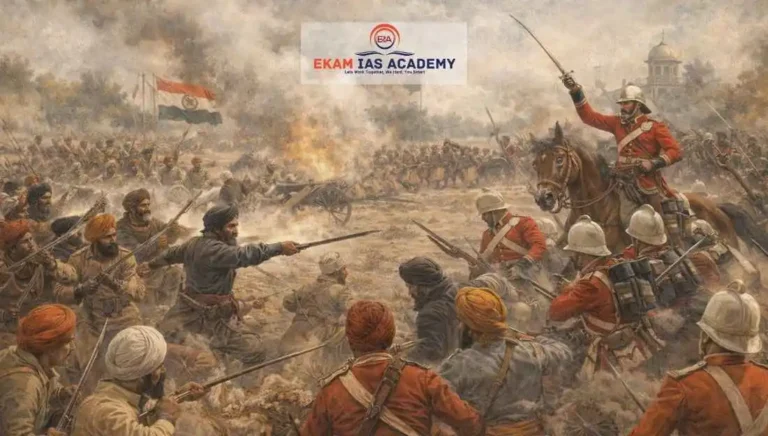
The war began in December 1845 when the Sikh Army crossed the Sutlej, which the British interpreted as a violation of the 1809 treaty. However, the Sikh soldiers were driven by a fear of British encirclement.
Major Battles
- Battle of Mudki (1845): A chaotic evening battle where the British suffered heavy casualties but held their ground.
- Battle of Ferozeshah (1845): One of the most dangerous battles for the British. The Khalsa fought with such tenacity that the British were on the verge of retreat before Lal Singh and Teja Singh (Sikh commanders) committed acts of treachery.
- Battle of Aliwal (1846): A decisive British victory under Sir Harry Smith.
- Battle of Sobraon (1846): The final, bloody encounter. The Sikh army was trapped against the Sutlej and decimated.
The Treaty of Lahore (1846)
The defeated Lahore Durbar was forced into a humiliating peace:
- Territorial Cession: The Jalandhar Doab was annexed by the British.
- War Indemnity: A massive fine of 1.5 crore rupees was imposed.
- Kashmir: Since the Durbar couldn’t pay the full fine, Gulab Singh (Dogra ruler) paid the British and was given Kashmir, becoming the Maharaja of the newly created princely state.
- British Resident: Henry Lawrence was stationed at Lahore to oversee the minor Maharaja Duleep Singh.
The Second Anglo-Sikh War (1848–1849)
Causes of the Second Conflict
- Humiliation: The Sikh soldiers and nobility felt betrayed by the 1846 treaty and the influence of the British Resident.
- The Multan Revolt: The immediate spark was the rebellion of Mulraj (Governor of Multan) after he was asked to pay higher revenues. He murdered two British officers, triggering a general uprising.
- Nationalist Fervor: The rebellion spread as Sikh veterans rallied for a final stand against foreign rule.
Major Battles
- Humiliation: The Sikh soldiers and nobility felt betrayed by the 1846 treaty and the influence of the British Resident.
- The Multan Revolt: The immediate spark was the rebellion of Mulraj (Governor of Multan) after he was asked to pay higher revenues. He murdered two British officers, triggering a general uprising.
- Nationalist Fervor: The rebellion spread as Sikh veterans rallied for a final stand against foreign rule.
The Annexation (March 1849)
Lord Dalhousie, without waiting for instructions from London, declared the annexation of Punjab.
- Maharaja Duleep Singh was pensioned off to England.
- The famous Koh-i-Noor Diamond was surrendered to the British Crown.
- Punjab was placed under a Board of Administration (The Lawrence Brothers).
Why the British Won: Critical Analysis
For the UPSC Mains, focus on these strategic factors:
- Treachery at the Top: The Sikh military leadership (Lal Singh and Teja Singh) were often in secret correspondence with the British, intentionally mismanaging battles.
- Resource Exhaustion: The British could draw on the resources of the rest of India (Bengal’s wealth), while Punjab was fighting an isolated war.
- Artillery Superiority: In the final stages, British heavy artillery (honed in European wars) outmatched the Sikh guns.
- Administrative Modernization: The British were able to quickly establish a “benevolent despotism” in Punjab, winning over the peasantry and neutralizing the old landed aristocracy.
UPSC Prelims: PYQs & Practice Questions
Previous Year Questions (PYQs)
Question 1 (UPSC 1996/Modified)
Q: Who among the following was the Governor-General of India when the Second Anglo-Sikh War was fought?
Options:
(a) Lord Hardinge
(b) Lord Dalhousie
(c) Lord Canning
(d) Lord Ellenborough
Answer: (b)
Explanation: Lord Dalhousie was the Governor-General during the Second Anglo-Sikh War (1848–49). After the British victory, Punjab was annexed in March 1849.
Question 2 (UPSC 1993/Modified)
Q: Which of the following battles is known as the “Battle of the Guns”?
Options:
(a) Battle of Aliwal
(b) Battle of Sobraon
(c) Battle of Gujarat
(d) Battle of Chillianwala
Answer: (c)
Explanation: The Battle of Gujarat (February 21, 1849) was the decisive engagement of the Second Anglo-Sikh War. It is called the “Battle of the Guns” due to the extensive and decisive use of artillery.
Practice Questions for Prelims
Question 3
Q: With reference to the Treaty of Lahore (1846), consider the following statements:
1. It followed the conclusion of the Second Anglo-Sikh War.
2. The Jalandhar Doab was annexed by the British.
3. Sir Henry Lawrence was appointed as the British Resident at Lahore.
Which of the statements given above are correct?
Options:
(a) 1 and 2 only
(b) 2 and 3 only
(c) 1 and 3 only
(d) 1, 2, and 3
Answer: (b)
Explanation: The Treaty of Lahore followed the First Anglo-Sikh War, not the second. Under the treaty, the British annexed the Jalandhar Doab, and Sir Henry Lawrence was appointed as the Resident to supervise the Lahore Durbar.
Question 4
Q: The Treaty of Amritsar (1846), involving Gulab Singh, was a consequence of which war?
Options:
(a) First Anglo-Afghan War
(b) First Anglo-Sikh War
(c) Second Anglo-Sikh War
(d) Gurkha War
Answer: (b)
Explanation: After the First Anglo-Sikh War, the Lahore Durbar failed to pay the full war indemnity. Consequently, Kashmir was ceded to the British, who sold it to Gulab Singh for 75 lakh rupees through the Treaty of Amritsar.
UPSC Mains – Previous Year & Practice Questions
Previous Year Questions (PYQs)
Annexation of Punjab
Question: “The annexation of Punjab was the culmination of a decade-long policy of aggressive expansion by the British.” Discuss. (UPSC 1994/Modified)
First Anglo-Sikh War
Question: Examine the causes of the First Anglo-Sikh War. To what extent was the instability of the Lahore Durbar responsible for it? (UPSC 1991/Modified)
Khalsa Army
Question: “The Sikh army was arguably the most formidable opponent the British faced in India.” Evaluate the military strength of the Khalsa in the mid-19th century. (UPSC 1998/Modified)
Lord Dalhousie & Punjab
Question: Discuss the role of Lord Dalhousie in the final consolidation of the British Empire in India with special reference to Punjab. (UPSC 2004/Related context)
Lawrence Brothers
Question: Critically analyze the administrative system introduced in Punjab by the Lawrence brothers after its annexation. (UPSC 1995/Modified)
Mains Practice Questions
Second Anglo-Sikh War
Question: “The Second Anglo-Sikh War was not just a rebellion by a few chiefs, but a popular uprising of the Sikh nation to regain its lost sovereignty.” Comment.
Impact of First Anglo-Sikh War
Question: Evaluate the impact of the First Anglo-Sikh War on the territorial integrity and financial health of the Sikh State.
Chillianwala vs Gujarat
Question: Compare the British military strategy in the Battle of Chillianwala with that of the Battle of Gujarat. What led to the drastic change in outcomes?
The Anglo-Mysore Wars - FAQs
Why did the British wait until 1845 to attack Punjab?
As long as Maharaja Ranjit Singh was alive, he maintained a strong, modernized army and a policy of cautious friendship with the British. It was only after his death in 1839 that the resulting anarchy and the rise of an “uncontrollable” Khalsa Army gave the British a pretext to intervene.
What was the role of the 'Dogra' chiefs in the Sikh defeat?
Figures like Gulab Singh and Lal Singh are often accused of treachery. During critical battles like Ferozeshah and Sobraon, they intentionally mismanaged the troops or provided information to the British, seeking to preserve their own positions in a post-war settlement.
What happened to the Koh-i-Noor diamond after the war?
As part of the terms of the annexation of Punjab in 1849, the 11-year-old Maharaja Duleep Singh was forced to surrender the diamond to the British Queen. It was subsequently sent to England.
Why was the Battle of Chillianwala a shock to the British?
The British suffered nearly 2,500 casualties and lost several regimental colors. The Sikh army used the terrain effectively, and the British commander, Lord Gough, was heavily criticized for his “frontal assault” tactics, leading to his temporary recall.
What was the 'Board of Administration' for Punjab?
After annexation, Dalhousie set up a three-man board consisting of Henry Lawrence, John Lawrence, and Charles Mansel. They were tasked with disarming the population, settling land revenues, and building infrastructure like the Grand Trunk Road to stabilize the region.
Who was Maharani Jindan?
She was the widow of Ranjit Singh and regent for Duleep Singh. The British viewed her as a major obstacle to their influence, leading to her removal from power and eventual exile, which became a rallying cry for Sikh soldiers during the Second War.