Table of Contents
ToggleIntroduction: The Paradox of a Corporate Conquest
The British conquest of India is a unique phenomenon in world history. Unlike the Mughal or Mongol conquests, it was initiated not by a monarch, but by a joint-stock company—the East India Company (EIC). What began as a quest for pepper and textiles culminated in the “Jewel in the Crown” of the British Empire. This transition was facilitated by the internal decay of the Mughal Empire and the superior military and diplomatic strategies of the British.
The Prelude: India in the Mid-18th Century
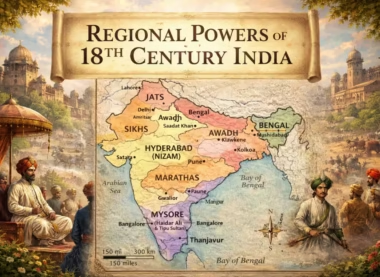
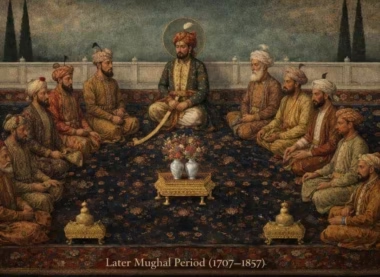
Before the British could dominate, the “Great Mughals” had to decline. The death of Aurangzeb in 1707 triggered a period of instability.
- The Weakening Center: Successors were weak, leading to the rise of powerful nobles and regional governors.
- Rise of Regional Powers: States like Bengal (Murshid Quli Khan), Awadh (Saadat Khan), and Hyderabad (Nizam-ul-Mulk) became virtually independent.
- External Invasions: The invasions of Nadir Shah (1739) and Ahmad Shah Abdali shattered the remaining prestige of the Mughal throne.
- The Maratha Challenge: The Marathas emerged as the strongest contenders for the Mughal mantle but were weakened by the Third Battle of Panipat (1761).
The Anglo-French Rivalry: The Carnatic Wars
The first step toward conquest was the elimination of other European rivals. The struggle between Britain and France played out in the Carnatic region (South India).
- First Carnatic War (1746–48): An extension of the War of Austrian Succession. It demonstrated the superiority of small, disciplined European-trained infantries over larger Indian armies.
- Second Carnatic War (1749–54): Fought over disputed successions in Hyderabad and Carnatic. It saw the rise of Robert Clive.
- Third Carnatic War (1758–63): The decisive Battle of Wandiwash (1760) ended French dreams in India, leaving the EIC as the sole European power.
The Foundation: The Conquest of Bengal
Bengal was the wealthiest province of India. Its conquest provided the EIC with the financial resources to fund further expansions.
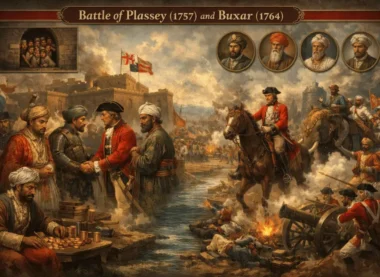
A. The Battle of Plassey (June 23, 1757)
- Causes: Siraj-ud-Daulah’s opposition to the misuse of Dastaks (trade permits) and the fortification of Calcutta. The “Black Hole Tragedy” served as a catalyst.
- The Conflict: Not a true military battle but a “great betrayal.” Clive conspired with Mir Jafar, Jagat Seth, and Omichund.
- Significance: It placed a puppet Nawab on the throne and opened the gates to the wealth of Bengal.
B. The Battle of Buxar (1764)
- The Coalition: Mir Qasim (Nawab of Bengal), Shuja-ud-Daulah (Nawab of Awadh), and Shah Alam II (Mughal Emperor).
- Outcome: The British victory was a military masterpiece compared to Plassey.
- Treaty of Allahabad (1765): The EIC obtained the Diwani Rights (right to collect revenue) of Bengal, Bihar, and Odisha. This started the “Dual Government” system.
Expansion under the "Ring Fence" and Subsidiary Alliance
As the British consolidated Bengal, they moved to neutralize the two biggest threats in the South: Mysore and the Marathas.
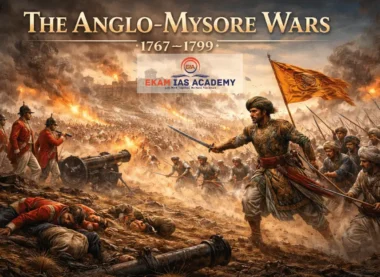
A. Anglo-Mysore Wars (1767–1799)
Mysore, under Haider Ali and Tipu Sultan, was the most formidable challenger due to their modernized army and French links.
- First and Second Wars: Saw the British on the defensive.
- Third War: Lord Cornwallis defeated Tipu, leading to the Treaty of Seringapatam.
- Fourth War (1799): Tipu Sultan died defending his capital. Mysore was placed under the Subsidiary Alliance.
B. Anglo-Maratha Wars (1775–1818)
The Marathas were a loose confederacy (Bhosle, Scindia, Holkar, Gaekwad, and Peshwa). Internal dissensions led to British intervention.
- First War (1775-82): Ended in a stalemate with the Treaty of Salbai.
- Second War (1803-05): Major Maratha chiefs were forced to sign the Subsidiary Alliance.
- Third War (1817-18): Lord Hastings formally abolished the Peshwaship and annexed Maratha territories.
Tools of Conquest: Diplomatic and Administrative Policies
The British did not rely on bullets alone; they used “Legal and Diplomatic Annexation.”
- Subsidiary Alliance (Lord Wellesley): A “Non-Intervention” policy in name, but a tool for subordination. Indian rulers had to maintain a British force at their expense and surrender their foreign policy.
- Doctrine of Lapse (Lord Dalhousie): If an Indian ruler died without a natural heir, the state was annexed to the EIC. This led to the annexation of Satara, Sambalpur, Jhansi, and Nagpur.
- Policy of Paramountcy: Asserting that the Company’s authority was supreme, allowing them to annex any state on grounds of “misgovernance” (e.g., Awadh in 1856).
The Final Frontiers: Sindh and Punjab
By the 1840s, the British looked toward the Northwest to counter the “Russian Threat” (The Great Game).
- Annexation of Sindh (1843): Often criticized as a purely aggressive act. Sir Charles Napier famously noted, “I have Sinde” (a pun on the Latin Peccavi – I have sinned).
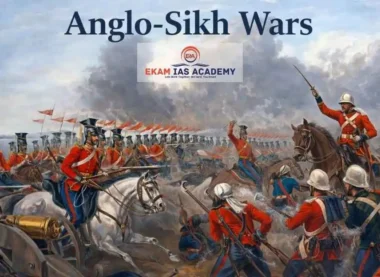
- Anglo-Sikh Wars (1845–1849): After the death of Maharaja Ranjit Singh, the Khalsa army was defeated. Punjab, the last major independent state, was annexed by Dalhousie in 1849.
Why the British Won: A Critical Analysis
For the UPSC Mains, understanding the reasons for British success is vital:
- Superior Arms and Tactics: The British used muskets and cannons that were technically superior to Indian weaponry.
- Military Discipline and Salary: British soldiers were paid regularly, ensuring loyalty, unlike Indian mercenary armies.
- Brilliant Leadership: Figures like Clive, Wellesley, and Dalhousie showed exceptional strategic foresight.
- Economic Stability: The EIC was a wealthy corporation backed by the financial might of the British Industrial Revolution.
- Lack of Nationalist Identity: Indian rulers fought for their own dynasties, often siding with the British to defeat their local rivals.
Conclusion: The Legacy of Conquest
The British conquest transformed India from a manufacturing hub to a source of raw materials. While it brought administrative and judicial unification, it was built on the ruins of India’s traditional economy and political autonomy. This era of conquest eventually gave way to the Era of Resistance, culminating in the Revolt of 1857.
UPSC Prelims: PYQs & Practice Questions
Previous Year Questions (PYQs)
Question 1 (UPSC 2010)
Q: With reference to the British colonial rule in India, consider the following statements:
1. James Augustus Hickey is known as the ‘Father of the Indian Press’.
2. The Battle of Buxar was fought in 1764 between the British East India Company and the combined forces of Mir Qasim, Shuja-ud-Daulah, and Shah Alam II.
Which of the statements given above is/are correct?
Options:
(a) 1 only
(b) 2 only
(c) Both 1 and 2
(d) Neither 1 nor 2
Answer: (c)
Explanation: James Augustus Hickey started the first Indian newspaper, The Bengal Gazette. The Battle of Buxar (1764) was indeed fought between the British and a coalition led by Mir Qasim, Shuja-ud-Daulah, and the Mughal Emperor Shah Alam II.
Question 2 (UPSC 2004)
Q: Which one of the following was the first state to be annexed by the British under the Doctrine of Lapse?
Options:
(a) Jhansi
(b) Sambalpur
(c) Satara
(d) Nagpur
Answer: (c)
Explanation: Lord Dalhousie first applied the Doctrine of Lapse to annex Satara in 1848. Later annexations included Sambalpur (1849), Jhansi (1853), and Nagpur (1854).
Question 3 (UPSC 1993)
Q: The Treaty of Seringapatam is associated with which of the following wars?
Options:
(a) Second Anglo-Maratha War
(b) Third Anglo-Mysore War
(c) Fourth Anglo-Mysore War
(d) Second Anglo-Sikh War
Answer: (b)
Explanation: The Treaty of Seringapatam (1792) was signed after the Third Anglo-Mysore War. Tipu Sultan ceded about half of his territory to the British and their allies as part of the settlement.
Practice Questions for Prelims
Question 1
Q: Which of the following statements regarding the "Subsidiary Alliance" is INCORRECT?
Options:
(a) It was introduced by Lord Wellesley.
(b) The Indian ruler was allowed to maintain independent diplomatic relations with other European powers.
(c) A British Resident was stationed at the ruler’s court.
(d) The ruler had to disband his own army and maintain a British contingent.
Answer: (b)
Explanation: Under the Subsidiary Alliance, the Indian ruler had to surrender their foreign policy and could not employ any other Europeans or negotiate with other powers without British consent.
UPSC Mains – Previous Year & Practice Questions
Previous Year Questions (PYQs)
Plassey & Buxar
Question: “The Battle of Plassey (1757) was a skirmish while the Battle of Buxar (1764) was a real war.” Elaborate.
Anglo-Maratha Struggle
Question: Examine the circumstances which led to the Anglo-Maratha struggle in the late 18th century. What were its consequences?
British Conquest
Question: “The British conquest of India was completed through a combination of diplomatic maneuvers and military strength.” Discuss with reference to the Subsidiary Alliance and Doctrine of Lapse.
Drain of Wealth
Question: How did the ‘Drain of Wealth’ theory influence the Indian National Movement?
Decline of Marathas
Question: Discuss the causes of the failure of the Maratha Empire against the British.
Mains Practice Questions
Anglo-Sikh Wars & Punjab
Question: “The conquest of Punjab was the final arc in the British consolidation of India.” Evaluate the strategic importance of the Anglo-Sikh wars.
Dual Government in Bengal
Question: Critically analyze the role of the ‘Dual Government’ in Bengal (1765–1772) in facilitating the economic ruin of the province.
Tipu Sultan vs Company
Question: Compare and contrast the military strategies of Tipu Sultan and the East India Company. Why did the British ultimately prevail?
The British Conquest of India - FAQs
What was the main difference between the Battle of Plassey and the Battle of Buxar?
Plassey (1757) was won largely through a conspiracy and treachery (Mir Jafar’s betrayal). Buxar (1764) was a pitched military battle where the British proved their technical and tactical superiority over the combined forces of the Mughal Emperor and two powerful Nawabs.
Why is the Treaty of Allahabad (1765) considered a turning point?
It granted the East India Company the Diwani Rights (revenue collection) of Bengal, Bihar, and Odisha. This provided the Company with massive capital, allowing them to fund their future conquests of India using Indian money rather than importing bullion from Britain.
How did the "Ring Fence" policy work?
Introduced by Warren Hastings, it aimed to create “buffer zones” around British territories to protect them from external threats (like the Marathas or Afghans). The British would defend the borders of their allies (like Awadh) to ensure their own security.
Why were the Marathas defeated despite being a formidable power?
Primarily due to internal disunity among the Maratha chiefs (Scindia, Holkar, Gaekwad, etc.), a lack of a unified command structure, and an inferior administrative and financial system compared to the British.
What was the "Great Game"?
It refers to the 19th-century strategic rivalry between the British Empire and the Russian Empire for supremacy in Central Asia. This fear of Russian expansion led the British to annex Sindh and Punjab to secure India’s northwestern frontier.
What were the 'Dastaks' that caused conflict in Bengal?
Dastaks were trade permits issued by the Mughal Emperor exempting the Company’s goods from duties. Conflict arose because Company officials used them for their private trade, causing huge revenue losses to the Nawab of Bengal.