Table of Contents
ToggleIntroduction: A Global Conflict on Indian Soil
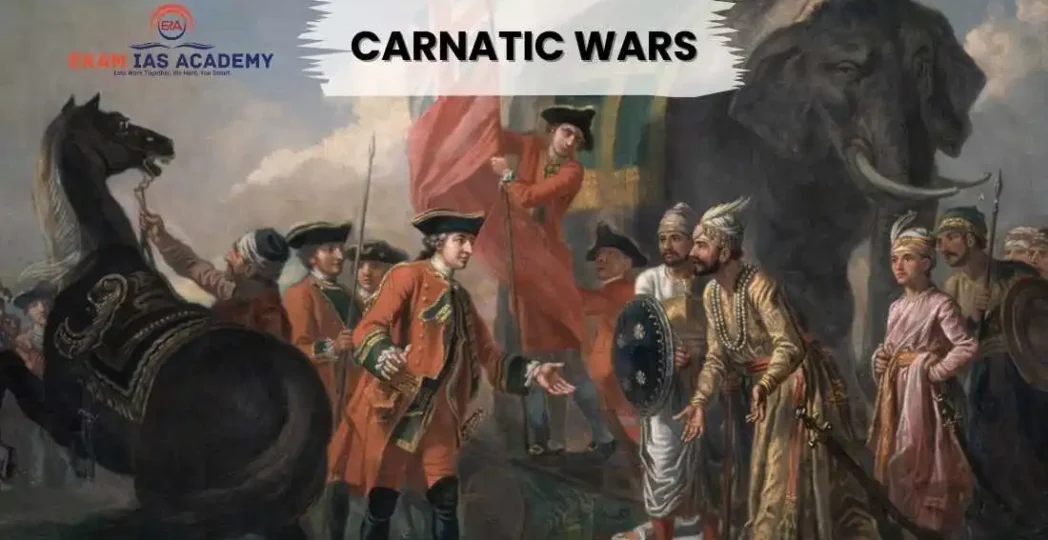
The Carnatic Wars (1746–1763) were a series of three military conflicts in the coastal Carnatic region of South India. While they appeared to be local struggles over succession in Hyderabad and Arcot, they were essentially an extension of the global colonial rivalry between Britain and France. These wars are a watershed moment in UPSC History because they marked the end of the “Trading Company” era and the beginning of the “Territorial Power” era for the British East India Company (EIC).
Background: The Political Vacuum in the South
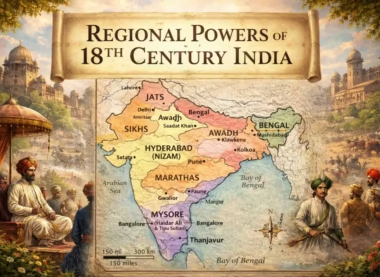
By the 1740s, the Mughal Empire’s authority in South India was nominal.
- The Nizam of Hyderabad: Nizam-ul-Mulk had established a semi-independent state.
- The Nawab of Carnatic: A deputy of the Nizam, but acting independently from Arcot.
- European Ambition: The French (led by the visionary Governor-General Joseph François Dupleix) and the British (based in Madras and Fort St. David) were seeking to influence these local rulers to gain commercial monopolies.
The First Carnatic War (1746–1748)
Context: This was a direct fallout of the War of Austrian Succession in Europe.
- The Conflict: The British navy seized French ships; in retaliation, Dupleix captured Madras in 1746 with the help of a fleet from Mauritius led by La Bourdonnais.
- The Battle of St. Thome (1746): This is one of the most significant battles in military history. A small French force of about 1,000 soldiers (European and disciplined Indian sepoys) defeated a massive army of 10,000 under Anwar-ud-din, the Nawab of Carnatic.
- UPSC Key Point: This battle proved that a small, disciplined, modern army could easily shatter traditional, large Indian infantries.
- Conclusion: The Treaty of Aix-la-Chapelle (1748) ended the war in Europe. Madras was returned to the British in exchange for Louisbourg in North America.
The Second Carnatic War (1749–1754)
Context: Unlike the first war, this was an “unofficial” war fought by the companies through local proxies, despite peace in Europe.
- The Proxy War:
- In Hyderabad: France supported Muzaffar Jang; Britain supported Nasir Jang for the Nizamship.
- In Carnatic: France supported Chanda Sahib; Britain supported Muhammad Ali for the Nawabship.
- Dupleix’s Zenith: Initially, the French succeeded. Both their candidates were placed on the thrones, and Dupleix was appointed Governor of all Mughal territories south of the Krishna River.
- The Rise of Robert Clive: When the French and Chanda Sahib besieged Muhammad Ali at Trichinopoly, a young clerk-turned-soldier named Robert Clive suggested a diversionary attack on Arcot (the capital of Carnatic).
- The Siege of Arcot (1751): Clive’s successful capture and heroic 53-day defense of Arcot turned the tide.
- Conclusion: The French government, frustrated by the lack of profits and constant war, recalled Dupleix to France. The Treaty of Pondicherry (1754) was signed, where both sides agreed not to interfere in the internal affairs of Indian princes.
The Third Carnatic War (1758–1763)
Context: Triggered by the Seven Years’ War in Europe.
- The Decisive Struggle: The French sent Count de Lally to India. He captured Fort St. David but failed to take Madras due to a lack of naval support and funds.
- The Battle of Wandiwash (1760): This was the final nail in the coffin for the French. The British forces under Sir Eyre Coote decisively defeated the French under Lally.
- Significance: This battle ended any possibility of a French Empire in India.
- Conclusion: The Treaty of Paris (1763) restored Pondicherry and Chandernagore to the French but only as “trading posts.” They were forbidden from fortifying them or maintaining significant armies.

Critical Analysis: Why Did the British Win?
For UPSC Mains, it is essential to understand the structural reasons for French failure despite Dupleix’s brilliance:
- Nature of the Companies: The British EIC was a private corporation with high autonomy and massive capital. The French company was state-controlled, bureaucratic, and lacked the commercial spirit.
- Naval Superiority: The British Royal Navy was the undisputed master of the seas, ensuring constant reinforcements and supplies from Europe and Bengal.
- Financial Resource – Bengal: During the Third Carnatic War, the British already had the riches of Bengal (post-Battle of Plassey), providing them with inexhaustible funds.
- Leadership: While Dupleix was a political genius, he lacked military skill. The British had a combination of political-military leaders like Robert Clive, Eyre Coote, and Lawrence.
- Strategic Focus: The French prioritized territorial influence in the Deccan, while the British focused on the wealthy coastal regions and Bengal.
Impact on Indian History
- End of European Rivalry: Britain emerged as the sole European power in India.
- The “Kingmaker” Strategy: The British learned the art of interfering in local successions to extract territorial and commercial concessions—a template they used across India for the next century.
- Military Revolution: The wars sparked the “Europeanization” of Indian armies, as local rulers tried to hire European mercenaries to train their troops.
UPSC Prelims: PYQs & Practice Questions
Previous Year Questions (PYQs)
Question 1 (UPSC 1995/Modified)
Q: With reference to the ‘Carnatic Wars’, which of the following statements is/are correct?
1. The First Carnatic War was an extension of the War of Austrian Succession in Europe.
2. The Battle of Wandiwash ended the French threat in India.
3. The Treaty of Paris (1763) allowed the French to fortify their settlements in India.
Select the correct answer using the code given below:
Options:
(a) 1 and 2 only
(b) 2 and 3 only
(c) 1 and 3 only
(d) 1, 2, and 3
Answer: (a)
Explanation: Statement 3 is incorrect because the Treaty of Paris (1763) restored French settlements (like Pondicherry) but explicitly forbade the French from fortifying them or maintaining troops, reducing them to mere trading posts.
Question 2 (UPSC 2000)
Q: Which one of the following was the immediate cause of the First Carnatic War?
Options:
(a) Rivalry between Dupleix and Clive
(b) Austrian War of Succession
(c) Issues of Carnatic Succession
(d) Capture of French ships by the British
Answer: (d)
Explanation: While the War of Austrian Succession provided the background context, the immediate provocation in India was the seizure of French merchant ships by the British Navy under Commodore Barnett.
Practice Questions for Prelims
Question 3
Q: The Battle of St. Thome (1746) is considered a landmark in Indian history because:
Options:
(a) It led to the final exit of the French from India.
(b) It demonstrated the superiority of small, disciplined European-trained forces over large Indian armies.
(c) It was the first time Robert Clive led a military expedition.
(d) It resulted in the Treaty of Pondicherry.
Answer: (b)
Explanation: A small French force defeated the 10,000-strong army of Mahfuz Khan (Nawab of Carnatic), proving that European discipline and modern weaponry (muskets and cannons) outweighed sheer numerical strength.
Question 4
Q: Consider the following pairs:
1. First Carnatic War — Treaty of Aix-la-Chapelle
2. Second Carnatic War — Treaty of Paris
3. Third Carnatic War — Treaty of Pondicherry
Which of the pairs given above is/are correctly matched?
Options:
(a) 1 only
(b) 2 and 3 only
(c) 1 and 2 only
(d) 1, 2, and 3
Answer: (a)
Explanation: The Second Carnatic War ended with the Treaty of Pondicherry (1754), while the Third Carnatic War ended with the Treaty of Paris (1763). Hence, only the first pair is correctly matched.
UPSC Mains – Previous Year & Practice Questions
Previous Year Questions (Mains)
Global Anglo-French Rivalry
Question: “The Carnatic Wars were essentially a part of the global Anglo-French struggle.” Discuss. (UPSC 1992/Modified)
Dupleix vs Clive
Question: “Dupleix made the mistake of looking for the key of India in Madras and Pondicherry; Clive found it in Bengal.” Critically examine this statement. (UPSC 1998/Repeated theme)
First vs Third Carnatic Wars
Question: Compare the causes and consequences of the First and Third Carnatic Wars. (UPSC 1995)
Naval Power
Question: Discuss the role of naval power in deciding the fate of the Anglo-French struggle in South India. (UPSC 1990/Modified)
Subsidiary System
Question: Critically evaluate the ‘Subsidiary’ system used by the French and later perfected by the British during the Carnatic and Mysore wars. (UPSC 2004/Related context)
Mains Practice Questions
Battle of Wandiwash
Question: “The Battle of Wandiwash was the decisive turning point that ensured British hegemony over the Indian subcontinent.” Substantiate.
Recall of Dupleix
Question: Analyze the impact of the recall of Governor Dupleix on the fortunes of the French East India Company in India.
Deccan Politics
Question: How did the internal dissensions among the Deccan rulers (Hyderabad and Arcot) provide a fertile ground for European intervention during the 18th century?
The Carnatic Wars - FAQs
What exactly was the 'Carnatic' region in the 18th century?
It referred to the territory on the Coromandel Coast (modern-day Tamil Nadu) between the Eastern Ghats and the sea. It was a province under the Subahdar of the Deccan (the Nizam of Hyderabad).
Who were the 'Proxies' in the Second Carnatic War?
- French Side: Muzaffar Jang (Hyderabad) and Chanda Sahib (Carnatic).
- British Side: Nasir Jang (Hyderabad) and Muhammad Ali (Carnatic).
Why did the French government recall Dupleix in 1754?
The French East India Company was losing enormous amounts of money in the wars. The French government was more interested in stability and dividends than territorial expansion, and they viewed Dupleix’s political ambitions as a financial liability.
How did the Battle of Plassey (1757) affect the Third Carnatic War?
The victory at Plassey gave the British control over the immense wealth of Bengal. This revenue allowed them to pay their troops and fund naval operations in the South, whereas the French in the Carnatic were constantly starving for funds and supplies.
What was the 'Three-Pronged Strategy' of the British that led to victory?
- Superior Naval Power (maintaining sea routes to Europe).
- Control over a rich hinterland (Bengal) for funding.
- Better coordination between the Company and the home government.
What was the significance of the Siege of Arcot?
It was Robert Clive’s first major military success. By capturing and defending the capital of the Carnatic with a tiny force, he diverted French resources away from Trichinopoly and shattered the aura of French invincibility.