Table of Contents
ToggleIntroduction: The Anatomy of Decentralization
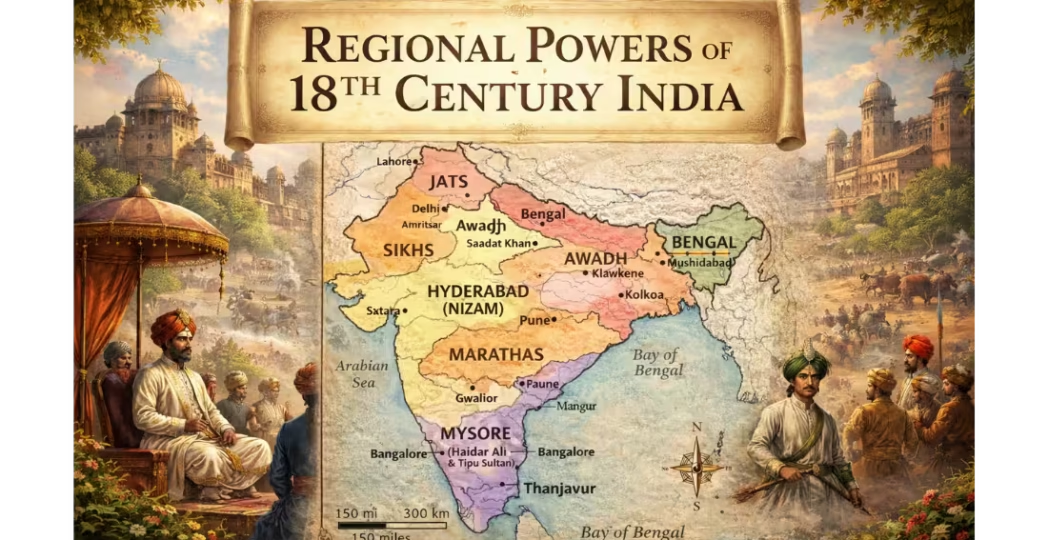
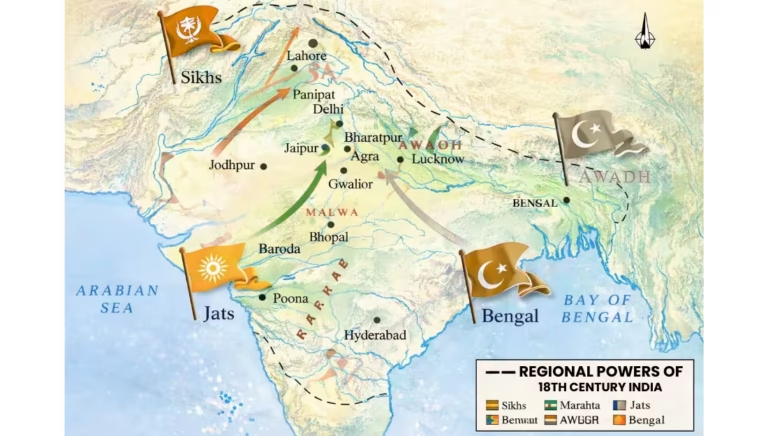
The 18th century was not merely a period of “darkness” but a significant shift from a centralized Mughal autocracy to a system of regional polities. These states can be categorized into three types:
- Successor States: Provinces like Hyderabad, Bengal, and Awadh that broke away from the Mughal Empire.
- Independent Kingdoms: States like Mysore and the Rajput kingdoms that asserted full sovereignty.
- The New States: Entities formed by rebels against the Mughals, such as the Marathas, Sikhs, and Jats.
The Successor States (Mughal Subas)
Hyderabad: The Nizam’s Dominion (1724)
- Founder: Nizam-ul-Mulk Asaf Jah, a powerful Turani noble.
- Establishment: After being frustrated by court politics in Delhi, he defeated the Mughal governor Mubariz Khan at the Battle of Shakur Kheda (1724).
- Governance: He followed a policy of religious tolerance and protected the peasantry from excessive land revenue. He never formally declared independence but ruled as a de facto sovereign.
Bengal: The Economic Powerhouse
- Leadership: Murshid Quli Khan (1717–1727) followed by Shuja-ud-Din and Alivardi Khan.
- Key Features:
- Bengal was the richest province of the Mughal Empire.
- Murshid Quli Khan reorganized the revenue system and transferred large parts of Jagir lands into Khalisa (crown land).
- Alivardi Khan prevented the English and French from fortifying their factories in Calcutta and Chandernagore, maintaining strict control until his death in 1756.
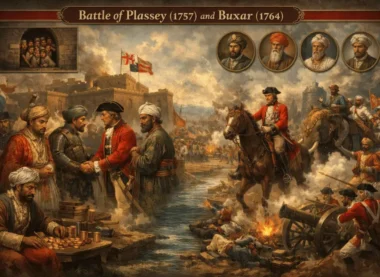
Fall: The internal conspiracy involving Mir Jafar led to the Battle of Plassey (1757), turning Bengal into a British puppet state.
Awadh: The Buffer State
- Founder: Saadat Khan (Burhan-ul-Mulk) in 1722.
- Contribution: He suppressed the rebellious Zamindars and introduced a fresh revenue settlement.
- Safdar Jung: His successor served as the Wazir of the Mughal Empire, blending regional and imperial interests.
The New States (The Resistance)
The Maratha Empire: The Challenger for Delhi
The Marathas were the most formidable challengers to Mughal authority.
- Expansion: Under the Peshwas (Balaji Vishwanath, Baji Rao I), the Marathas transformed from a regional kingdom into a pan-Indian empire.
- The Peshwa System: Power shifted from the Chhatrapati to the Peshwa (Prime Minister).
Fatal Blow: The Third Battle of Panipat (1761) against Ahmad Shah Abdali shattered their dream of ruling India, though they recovered briefly before the Anglo-Maratha Wars.
The Sikh Misls: The Guardians of the North
- Post-Banda Bahadur: After the execution of Banda Bahadur, the Sikhs organized themselves into 12 Misls (military brotherhoods) like the Sukarchakiya and Bhangi misls.
- Consolidation: The weakness of the Mughals and the invasions of Ahmad Shah Abdali allowed the Sikhs to consolidate power in Punjab.
- Ranjit Singh: By the end of the 18th century, Maharaja Ranjit Singh united these misls into a powerful kingdom with a modernized army (Fauj-i-Khas).
The Jats and Rajputs
- Jats: Under Suraj Mal, the Jat kingdom of Bharatpur reached its zenith. He was known as the “Plato of the Jat tribe” for his political sagacity.
- Rajputs: While Aurangzeb’s policies had alienated them, rulers like Jai Singh II of Amber attempted to modernize, founding Jaipur and building astronomical observatories (Jantar Mantars).
The Independent Kingdoms: Mysore
Mysore emerged as a major threat to British expansion in the South.
- Rise of Haidar Ali: He overthrew the Wodeyar dynasty and modernized the Mysore army with French help.
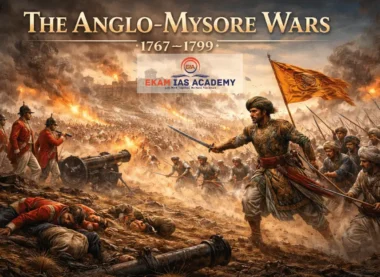
- Tipu Sultan: A visionary ruler who introduced new coinage, a calendar, and modernized agriculture. He is often called the “Tiger of Mysore” for his fierce resistance against the British in four Anglo-Mysore Wars.
Analysis: Why Did These Powers Fail? (UPSC Mains Perspective)
- Lack of Unity: Constant infighting (e.g., Marathas vs. Nizam, Marathas vs. Rajputs) allowed the British to use the “Divide and Rule” policy.
- Financial Instability: Most states suffered from a chronic Jagirdari Crisis and failed to develop a modern debt market or industrial base.
- Military Gaps: While they had brave soldiers, they lacked the superior naval power and disciplined civil-military structure of the British.
UPSC Prelims: PYQs & Practice Questions
Previous Year Questions (PYQs)
Question 1
Q: Which of the following was the main reason for the decline of the Mughal Empire in the 18th century? (UPSC Prelims - Historical Context)
Options:
(a) The religious bigotry of the later Mughals.
(b) The "Jagirdari Crisis" leading to factionalism among nobility.
(c) The invasion of Nadir Shah in 1739.
(d) All of the above.
Answer: (d)
Explanation: While the Jagirdari crisis and internal factionalism were primary structural causes , the external invasions by Nadir Shah and later Ahmad Shah Abdali gave the final "death blow" to the empire's central authority.
Question 2
Q: In 1717, which Mughal Emperor issued the Royal Farman granting the East India Company trade privileges in Bengal?
Options:
(a) Bahadur Shah I
(b) Farrukhsiyar
(c) Muhammad Shah
(d) Shah Alam II
Answer: (b)
Explanation: This Farman, often called the "Magna Carta" of the British in India, allowed them duty-free trade in Bengal in exchange for a fixed annual payment.
Previous Year Questions (PYQs)
Question 1
Q: Match the following founders with their respective states:
(1) Nizam-ul-Mulk — (A) Bengal
(2) Saadat Khan — (B) Hyderabad
(3) Murshid Quli Khan — (C) Awadh
Answer: 1-B, 2-C, 3-A.
Question 2
Q: Who was known as the "Plato of the Jat Tribe" for his political sagacity?
Answer: Suraj Mal.
Explanation: Under his leadership, the Jat kingdom of Bharatpur reached its peak in the mid-18th century.
UPSC Mains: Previous Year & Practice Questions
Previous Year Questions (Mains)
Fragmented Polity & Regional Powers
Question: “The middle of the eighteenth century was a period of a fragmented polity.” Discuss with reference to the rise of regional powers.
Mughal Court Factionalism
Question: Analyze the role of factionalism in the Mughal court and its impact on the stability of the empire.
Socio-Economic Conditions
Question: Evaluate the socio-economic conditions of India on the eve of the British conquest.
Third Battle of Panipat
Question: Discuss the significance of the Third Battle of Panipat (1761) in the context of the Maratha-British struggle for supremacy.
Tipu Sultan’s Mysore
Question: Critically examine the administration of Mysore under Tipu Sultan and its modernization efforts.
Mains Practice Questions
Successor States
Question: To what extent did the “Successor States” of the 18th century maintain the administrative continuity of the Mughal Empire?
Maratha Military System
Question: “The Maratha failure was not a failure of courage but of coordination and modern military strategy.” Comment.
Sikh Misls
Question: Discuss the importance of the Sikh Misls in defending the Indian frontier against external invasions in the 18th century.
The Fragmented Horizon: Regional Powers of 18th Century India - FAQs
What were "Successor States"?
These were provinces that broke away from the Mughal Empire but continued to use Mughal administrative structures, such as Bengal, Awadh, and Hyderabad.
What was the "Ring-Fence" policy?
Introduced by Warren Hastings, this policy aimed to create buffer states (like Awadh) around the British territories to protect them from external threats like the Marathas.
Why did the Marathas lose the Third Battle of Panipat?
Key reasons included internal discord among Maratha leaders, lack of support from regional powers like the Rajputs and Jats, and the superior military tactics and cavalry of Ahmad Shah Abdali.
Who were the "Saiyid Brothers"?
They were the “King-makers” of the early 18th-century Mughal court who controlled the throne and appointed several emperors, including Farrukhsiyar.