Table of Contents
ToggleThe Battle of Plassey: The Great Betrayal (June 23, 1757)
Bengal was the most fertile and wealthiest province of the Mughal Empire. Following the death of Alivardi Khan in 1756, his grandson Siraj-ud-daulah ascended the throne. His reign was immediately challenged by internal rivals—Ghaseti Begum (his aunt) and Shaukat Jung (his cousin). The East India Company (EIC) began exploiting this instability.
Immediate Causes of Conflict
- Misuse of Dastaks: The Company officials used Dastaks (free trade passes) for their private trade, causing immense revenue loss to the Nawab.
- Fortification of Calcutta: Without the Nawab’s permission, the British began fortifying Fort William fearing French attacks during the Seven Years’ War.
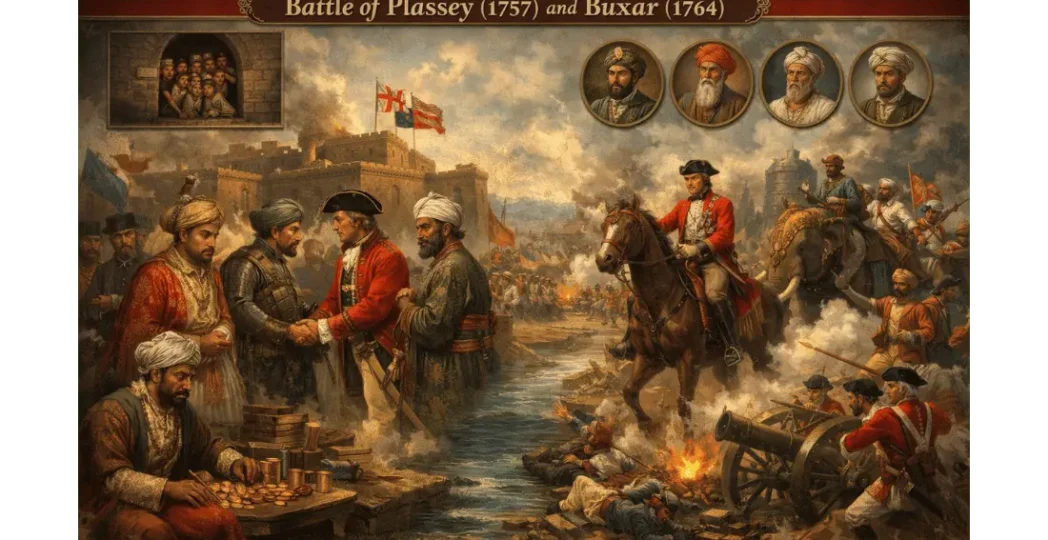
- The Black Hole Tragedy: Siraj-ud-daulah attacked Calcutta and imprisoned British soldiers in a small room. English accounts claim many suffocated, an event used by Robert Clive to justify military retaliation.
The Conspiracy
Robert Clive realized that a direct military victory was difficult. He entered into a secret alliance with the Nawab’s own people:
- Mir Jafar: The Commander-in-Chief (promised the Nawabship).
- Jagat Seth: The biggest banker of Bengal.
- Omichund: An influential merchant.
- Rai Durlabh: A prominent general.
The "Battle" and Its Significance
The “battle” lasted only a few hours. Mir Jafar’s large division of the army remained stationary on the field. Siraj-ud-daulah was captured and executed by Mir Jafar’s son, Miran.
Key Significance:
- Political: The British became “Kingmakers” in Bengal. Mir Jafar became the puppet Nawab.
- Economic: The Company received Zamindari rights of the 24 Parganas and a massive sum of money, which was used to fund the conquest of South India.
- Military: It exposed the vulnerability of Indian traditional armies to European-style organized conspiracies.
The Grand Coalition
The Prelude: From Mir Jafar to Mir Qasim
Mir Jafar soon realized he could not meet the insatiable financial demands of the British. He was replaced by his son-in-law, Mir Qasim, in 1760. Mir Qasim was an able ruler who attempted to assert independence by:
- Shifting the capital from Murshidabad to Munger.
- Modernizing his army with European-style training.
- Abolishing all internal duties to put Indian merchants on equal footing with the British.
This led to a series of skirmishes, forcing Mir Qasim to flee to Awadh.
The Grand Coalition
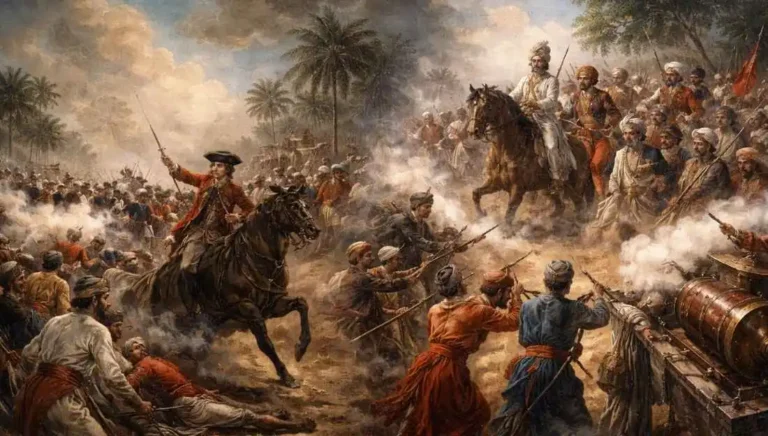
Unlike Plassey, Buxar was a conflict between the EIC and a formidable alliance:
- Mir Qasim (Nawab of Bengal).
- Shuja-ud-daulah (Nawab of Awadh).
- Shah Alam II (The fugitive Mughal Emperor).
The Battle and British Superiority
The British forces, led by Major Hector Munro, met the coalition at Buxar. Despite being outnumbered, the British won a decisive victory due to superior artillery, discipline, and military coordination.
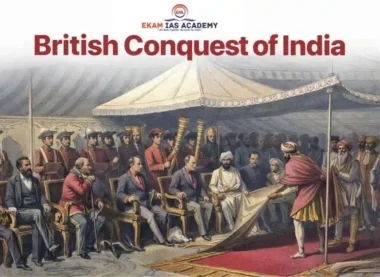
The Treaty of Allahabad (1765)
Robert Clive returned to India to finalize the terms:
- With Shah Alam II: The Emperor granted the Diwani Rights (right to collect revenue) of Bengal, Bihar, and Odisha to the Company. In return, he received an annual tribute of Rs. 26 lakh.
- With Shuja-ud-daulah: He had to pay a war indemnity of Rs. 50 lakh and entered into a defensive alliance, making Awadh a buffer state.
Comparative Analysis: Plassey vs. Buxar
Feature | Battle of Plassey (1757) | Battle of Buxar (1764) |
Nature of Victory | Won through Conspiracy and treachery. | Won through Military Superiority and valor. |
Opponent | Only the Nawab of Bengal (Siraj-ud-daulah). | A coalition including the Mughal Emperor. |
Outcome | Established the British as a Political Influence. | Established the British as Legal Masters of Bengal. |
Financial Impact | Gained the Zamindari of 24 Parganas. | Gained the Diwani Rights (Revenue of 3 provinces). |
The Dual Government in Bengal (1765–1772)
Post-Buxar, Clive introduced the Dual System of Government:
- Nizamat (Administration/Police): Remained with the Nawab.
- Diwani (Revenue/Justice): Controlled by the Company.
This resulted in “Authority without Responsibility” for the British and “Responsibility without Power” for the Nawab. It led to the Great Bengal Famine of 1770 and total administrative collapse, eventually leading to the Regulating Act of 1773.
UPSC Prelims: PYQs & Practice Questions
Previous Year Questions (PYQs)
Question 1 (UPSC 2004)
Q: Which of the following was the first state to be annexed by the British under the ‘Doctrine of Lapse’?
Options:
(a) Jhansi
(b) Sambalpur
(c) Satara
(d) Nagpur
Answer: (c)
Explanation: Satara was the first state annexed under Lord Dalhousie’s Doctrine of Lapse in 1848. Although the doctrine came much later, the political dominance enabling such annexations was established after British victories like Plassey and Buxar.
Question 2 (UPSC 1995/Modified)
Q: With reference to the ‘Treaty of Allahabad’ (1765), consider the following statements:
1. The Diwani rights of Bengal, Bihar, and Odisha were granted to the East India Company.
2. The Nawab of Awadh was forced to pay a war indemnity of Rs. 50 lakh.
3. Shah Alam II was given the districts of Kora and Allahabad.
Which of the statements given above are correct?
Options:
(a) 1 and 2 only
(b) 2 and 3 only
(c) 1 and 3 only
(d) 1, 2, and 3
Answer: (d)
Explanation: After the Battle of Buxar, Robert Clive signed treaties with Shah Alam II and Shuja-ud-Daulah. The Company received Diwani rights, Awadh paid a heavy indemnity, and the Mughal Emperor was granted Kora and Allahabad.
Previous Year Questions (PYQs)
Question 3
Q: Who was the Nawab of Bengal when the Battle of Buxar was fought?
Options:
(a) Siraj-ud-daulah
(b) Mir Jafar
(c) Mir Qasim
(d) Najm-ud-daulah
Answer: (b)
Explanation: Although Mir Qasim fought at Buxar as part of the coalition, the British had already replaced him and reinstated Mir Jafar as the Nawab of Bengal in 1763.
Question 4
Q: The term ‘Dastak’, which was a major cause of conflict between the Nawabs of Bengal and the British, refers to:
Options:
(a) A military rank in the Mughal army
(b) A land revenue system
(c) A trade permit for duty-free trade
(d) A judicial decree
Answer: (c)
Explanation: Dastaks were passes issued for duty-free trade. The conflict intensified because Company officials misused them for private trade, evading local taxes and damaging the Nawab’s revenue.
UPSC Mains – Previous Year & Practice Questions
Previous Year Questions (PYQs)
Plassey vs Buxar
Question: “The Battle of Plassey was a skirmish, while the Battle of Buxar was a real war.” Elaborate. (UPSC 1990/Repeated themes)
Battle of Buxar
Question: Examine the circumstances that led to the Battle of Buxar. What were its consequences for the East India Company? (UPSC 1994)
Treaty of Allahabad
Question: “The Treaty of Allahabad made the British the virtual masters of Bengal.” Discuss the significance of this treaty in the context of British expansion in India. (UPSC 2002/Modified)
Battle of Plassey
Question: How far is it correct to say that the Battle of Plassey was won before it was actually fought? (UPSC 1998)
Dual System in Bengal
Question: Discuss the impact of the ‘Dual System’ of government in Bengal after the Battle of Buxar. (UPSC 2011/Modified)
Previous Year Questions (PYQs)
Mir Qasim of Bengal
Question: “Mir Qasim was the most able Nawab of Bengal after Alivardi Khan, but his very efficiency became his undoing.” Critically analyze.
Awadh as a Buffer State
Question: Evaluate the strategic importance of the ‘Buffer State’ of Awadh in the protection of British interests in Bengal.
Battle of Buxar
Question: Compare and contrast the military tactics used by the British in the Battle of Buxar with those of the Indian coalition. Why did the numerically superior coalition fail?
Plassey (1757) and Buxar (1764) - FAQs
Why is the Battle of Plassey often called a 'fixed' battle?
Because the outcome was decided before the first shot was fired. Robert Clive had already bribed the Nawab’s Commander-in-Chief, Mir Jafar, and wealthy bankers like the Jagat Seths, ensuring the majority of the Nawab’s army would not fight.
What exactly did the 'Diwani Rights' mean for the British?
It gave the Company the legal authority to collect land revenue and administer civil justice in Bengal, Bihar, and Odisha. This meant the British no longer had to bring gold and silver from England to buy Indian goods; they could use Indian tax money to fund their exports.
Why did Mir Qasim shift his capital from Murshidabad to Munger?
He wanted to maintain a safe distance from the British at Calcutta and Murshidabad to prevent their interference in his administration and to modernize his army in relative secrecy.
What was the 'Dual Government' (1765–1772)?
It was a system where the Company had the power (revenue and military) but no responsibility for the welfare of the people, while the Nawab had the responsibility of administration but no power or funds. This led to massive corruption and the famine of 1770.
Who was Hector Munro?
He was the British Major who led the Company forces to a decisive military victory at the Battle of Buxar. Unlike Clive at Plassey, Munro won through tactical discipline on the battlefield.
What happened to the Mughal Emperor after Buxar?
Shah Alam II became a “pensioner” of the British. He was forced to live at Allahabad under British protection, effectively ending the independent sovereignty of the Mughal throne.