
Daily Current Affairs 01-January-2026

Share this Post

LAW ON ‘SUSPENSION OF SENTENCE’

TOPIC: (GS2) POLITY: THE HINDU

Why in News?

The Supreme Court stayed the Delhi High Court’s order suspending a life sentence and granting bail to a former Unnao MLA convicted for rape of a minor. The order has reopened debate on suspension of sentence, life imprisonment, and interpretation of the POCSO Act, 2012.

Key Facts of the Case

  • The accused, a former MLA, was convicted of raping a minor and awarded life imprisonment.
  • He was also convicted for offences connected to the custodial death of the victim’s father.
  • The Delhi High Court suspended the sentence and granted bail during appeal.
  • The Supreme Court stayed this order, restoring the sentence for the time being.

Legal Basis for Suspension of Sentence

  • Section 430, Bharatiya Nyaya Sanhita (BNS), 2023 allows courts to suspend a sentence during appeal.
  • This power is discretionary, not automatic.
  • Suspension affects only punishment, not the finding of guilt.
  • In life imprisonment and grave offences, suspension is an exception, not the rule.

Reasoning by the Delhi High Court

  • The HC held that an MLA is not a “public servant” under Section 21 of the IPC.
  • On this basis, it felt the aggravated offence under Section 5(c) of POCSO was prima facie doubtful.
  • It also relied on the fact that the convict had spent over 7 years in jail, citing concerns of prolonged incarceration.

Judicial Precedents on Suspension

  • Kashmira Singh (1977): Long incarceration may cause injustice if conviction is later altered.
  • Bhagwan Rama Shinde Gosai (1999): Suspension of fixed-term sentences can be liberal.
  • Shivani Tyagi (2024): For life sentences, suspension must be rare and based on objective assessment.
  • Chhotelal Yadav (2025): Suspension justified only when there is palpable or gross error suggesting possible acquittal.
  • Jamna Lal (2025): At suspension stage, courts cannot re-examine factual findings, such as the age of the victim in POCSO cases.

Controversy Over ‘Public Servant’ Interpretation

  • The IPC definition of public servant is narrow and excludes legislators.
  • The POCSO Act does not define “public servant”.
  • Trial courts often adopt a functional approach, similar to the Prevention of Corruption Act, where anyone performing a public duty can qualify.
  • The HC’s strict reliance on IPC led to a restrictive reading, diluting child protection.

Supreme Court’s Approach to POCSO Interpretation

  • The SC has consistently favoured a purposive interpretation of child protection laws.
  • Independent Thought (2017): Removed marital exception for rape of a minor wife.
  • Attorney General vs Satish (2021): Rejected narrow, literal interpretation that weakens POCSO’s intent.
  • The focus is on protecting children, not technical loopholes.

Conclusion

The Supreme Court’s stay reinforces that suspension of life sentences in heinous crimes must remain exceptional. It reiterates that POCSO is a welfare legislation requiring purposive interpretation, not narrow technical readings. Overall, the decision strengthens judicial responsibility, child safety, and public confidence in criminal justice.

100 YEARS OF QUANTUM MECHANICS

TOPIC: (GS3) SCIENCE AND TECHNOLOGY: INDIAN EXPRESS

Why in News?

2025 has been declared the International Year of Quantum Science and Technology by UNESCO, marking 100 years of quantum mechanics. The year commemorates Werner Heisenberg’s 1925 breakthrough at Helgoland that laid the foundation of modern quantum theory.

What is Quantum Mechanics?

  • Quantum mechanics studies the behaviour of particles smaller than atoms, such as electrons and photons.
  • It breaks away from Newtonian determinism and works on probability-based outcomes.
  • Key principles include:
    • Quantisation of energy – energy exists in fixed packets called quanta.
    • Wave–particle duality – particles behave like waves and waves like particles.
    • Uncertainty principle – position and momentum cannot be precisely known together.
    • Superposition – a system can exist in multiple states simultaneously.
  • These ideas explain phenomena that classical physics fails to address.

Major Domains of Quantum Technologies

  1. Quantum Communication
    • Uses quantum properties to enable ultra-secure data transmission.
    • Any interception alters the system, making hacking detectable.
  1. Quantum Computation
    • Employs qubits instead of classical bits.
    • Capable of solving complex problems far faster than conventional computers.
  1. Quantum Simulation
    • One quantum system is used to model another, helping study molecules, materials, and reactions.
  1. Quantum Sensing and Metrology
    • Allows extremely precise measurements of time, gravity, magnetic fields, and motion.

Evolution of Quantum Theory

  • 1900 – Max Planck: Proposed energy is emitted in discrete units, introducing the quantum idea.
  • 1905 – Albert Einstein: Explained the photoelectric effect, proving light behaves as particles.
  • 1913 – Niels Bohr: Developed a quantum model of the hydrogen atom.
  • 1925 – Werner Heisenberg: Formulated matrix mechanics, the first complete quantum framework.
  • 1925–26 – Max Born & Pascual Jordan: Provided mathematical foundations using matrices.
  • 1926 – Erwin Schrödinger: Introduced the wave equation, an alternative formulation.
  • 1927 – Paul Dirac: Unified quantum mechanics with relativity concepts.

Applications of Quantum Technology

  • Electronics & Computing
    • Foundation of semiconductors, transistors, chips, and modern computers.
  • Communication & Navigation
    • Enables lasers, optical fibre networks, atomic clocks, and GPS.
  • Healthcare & Medicine
    • Used in MRI scanners, nuclear imaging, radiation therapy, and diagnostics.
  • Energy & Materials
    • Supports nuclear energy, advanced materials, and high-sensitivity sensors.
  • Emerging Technologies
    • Forms the base for quantum computing, secure communication, and precision sensing.

National Quantum Mission (NQM)

  • Approved in 2023, covering 2023–24 to 2030–31.
  • Aim: Build a strong quantum research and innovation ecosystem in India.
  • Key Objectives:
    • Develop 50–1000 qubit quantum computers within 8 years.
    • Use platforms like superconducting and photonic technologies.
  • Implementation:
    • Establish four Thematic Hubs (T-Hubs) in premier academic and R&D institutions.

Challenges in Quantum Technology

  • Decoherence: Quantum states are extremely fragile and disturbed by the environment.
  • Measurement and Control Issues: Accurate observation without disturbing the system is difficult.
  • Scalability and Error Correction: Large-scale systems need complex correction mechanisms.
  • High Cost and Limited Access: Requires advanced infrastructure and skilled manpower.

Way Forward

  • Strengthen Research Funding for basic and applied quantum science.
  • Build Human Capital through specialised education and interdisciplinary training.
  • Promote Public–Private Partnerships to convert lab research into market-ready products.
  • Global Collaboration to stay competitive in a fast-evolving field.

Conclusion

Quantum mechanics has transformed our understanding of nature and reshaped modern technology. With initiatives like the National Quantum Mission, India is positioning itself in a strategic future domain. Sustained research, skilled manpower, and innovation-driven policy will determine long-term success.

GIG, PLATFORM WORKERS PROTEST

TOPIC: (GS2) POLITY: THE HINDU

Why in News?

Gig and platform worker unions have announced a strike, alleging denial of basic labour rights by digital platforms.
The issue has brought renewed focus on social security, regulation, and worker protection in India’s growing gig economy.

What is the Gig Economy?

  • According to the World Economic Forum, the gig economy involves short-term, task-based work enabled by digital platforms that connect workers and customers.
  • In India, gig workers are largely classified as self-employed, not as regular employees.
  • Services include cab driving, food delivery, beauty services, domestic work, logistics, and digital freelancing.
  • Workers are paid per task or assignment, not through fixed salaries.
  • The sector has seen rising participation of women, especially due to flexible work hours.

Types of Gig Work

  • Web-based gig work
    • Tasks performed online or remotely.
    • Examples: content writing, software development, digital marketing, data analysis.
  • Location-based gig work
    • Work performed physically but arranged through apps.
    • Examples: Ola, Uber, Zomato, Urban Company services.

Advantages of Gig and Platform Work

  • Flexibility
    • Workers can choose working hours and assignments, aiding work–life balance.
  • Income Opportunities
    • Provides livelihoods to youth, migrants, and women without formal degrees.
    • Women can balance domestic responsibilities and paid work.
  • Skill Development
    • Exposure to digital tools, customer interaction, and service delivery improves employability.
  • Economic Contribution
    • Supports logistics, e-commerce, urban mobility, and contributes to GDP growth.

Challenges Faced by Gig Workers

  • Lack of Social Security: Most workers lack health insurance, pension, paid leave, or accident cover.
  • Income Insecurity: Earnings fluctuate due to demand variation, algorithmic pricing, and incentives.
  • Health and Safety Risks: Delivery and transport workers face accidents, long hours, heatwaves, and unsafe roads.
  • Weak Bargaining Power: Fragmented workforce limits collective bargaining with large platforms.
  • Gender Concerns: Women face safety issues, lower participation, and social barriers.
  • Algorithmic Control: Workers are vulnerable to arbitrary account deactivations and opaque rating systems.

Steps Taken by the Government

  1. Code on Social Security, 2020
    • First legal recognition of gig and platform workers.
    • Provides for accident insurance, health and maternity benefits, and old-age protection.
  1. e-Shram Portal (2021)
    • National database for unorganised workers.
    • Over 30 crore registrations, including gig and platform workers.
  1. Union Budget 2025–26
    • Extension of Ayushman Bharat – PMJAY benefits to platform workers.
  1. Social Security Fund (Proposed)
    • Contributions from Centre, States, and digital platforms.
  1. State-Level Initiatives
    • Rajasthan (2023): Welfare cess on employers.
    • Telangana (2025 draft): Mandatory registration of gig workers by aggregators.
    • Karnataka: Platform worker welfare measures.

Way Forward

  • Develop reliable data on gig workers’ socio-economic conditions.
  • Ensure minimum wages, universal social security, and health protection.
  • Enable collective bargaining mechanisms without stifling innovation.
  • Introduce safeguards against algorithmic bias and unfair deactivations.
  • Promote gender-sensitive policies for safety and inclusion.

Conclusion

India’s gig economy offers flexibility and new livelihoods, but remains marked by precarious work conditions. Legal recognition is a positive step, yet effective implementation and regulation are crucial. A balanced approach can ensure innovation with fairness, protecting workers while sustaining growth.

CENTRAL EUROPE’S ’WATER GUARDIANS’ ARE FIGHTING DESERTIFICATION

TOPIC: (GS3) ENVIRONMENT: DOWN TO EARTH

Why in News?

Local farmers and volunteers known as Water Guardians are undertaking grassroots water restoration efforts in Hungary’s semi-arid Homokhátság region. The initiative has drawn global attention to desertification, water mismanagement, and community-led climate adaptation.

The ‘Water Guardians’ Initiative

  • The initiative is led by local farmers and volunteers, acting at the grassroots level.
  • It focuses on retaining rainwater locally instead of allowing it to drain away through canals.
  • Small-scale measures such as blocking drainage channels, restoring wetlands, and reshaping land contours are used.
  • The aim is to recharge groundwater, improve soil moisture, and revive vegetation.
  • It demonstrates a community-driven adaptation model in response to climate stress.

What is Desertification?

  • Desertification is the process of land degradation in arid, semi-arid, and dry sub-humid regions.
  • It occurs due to a combination of climatic variations and human activities.
  • Key features include:
    • Loss of soil fertility
    • Reduction in vegetation cover
    • Decline in water availability
  • Globally, desertification affects around 250 million people and nearly one-third of Earth’s land surface.

Reasons for the Rise in Desertification

1. Climate Change

  • Rising temperatures increase evaporation, drying out soils.
  • Erratic rainfall, prolonged droughts, and shorter wet seasons weaken ecosystems.

2. Declining Groundwater Levels

  • Over-extraction for agriculture and urban use lowers water tables.
  • River channelisation and wetland drainage disrupt natural recharge cycles.

3. Unsustainable Agricultural Practices

  • Overgrazing removes protective grass cover, exposing soil to erosion.
  • Monocropping and excessive chemicals degrade soil structure and microbes.

4. Deforestation

  • Removal of trees weakens root systems that bind soil.
  • Increased surface runoff accelerates land degradation.
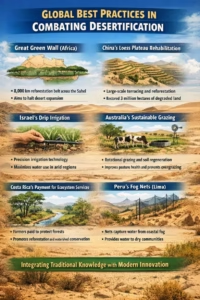
Global Best Practices in Combating Desertification

Impacts of Desertification

Environmental Impacts

  • Decline in biodiversity and ecosystem services.
  • Increased soil erosion, dust storms, and land instability.

Economic Impacts

  • Falling agricultural productivity reduces farmer incomes.
  • Higher costs for irrigation, land reclamation, and drinking water.

Social Impacts

  • Rising food insecurity and nutritional stress.
  • Increased migration from rural areas.

Climate Linkages

  • Loss of vegetation reduces carbon sequestration.
  • Dry soils intensify heatwaves, creating a vicious cycle.

Steps Taken by India to Combat Desertification

1. National Afforestation Programme (NAP) – NAEB

  • Implemented by the National Afforestation and Eco-Development Board (NAEB).
  • Aims at restoration of degraded forest land and adjoining non-forest areas.
  • Emphasises people’s participation through Joint Forest Management Committees (JFMCs).
  • Focuses on soil and moisture conservation, regeneration of native species, and livelihood support to forest-dependent communities.
  • Helps in carbon sequestration, biodiversity conservation, and long-term ecological stability.

2. Aravalli Green Wall Initiative

  • Aims to create a green buffer of about 5 km on both sides of the Aravalli mountain range.
  • Covers 29 districts across Gujarat, Rajasthan, Haryana, and Delhi.
  • Focuses on afforestation, pasture development, and water harvesting structures.
  • Intended to check land degradation, dust storms, and desert expansion from western India.
  • Also supports groundwater recharge and climate resilience in the National Capital Region.

3. National Action Plan to Combat Desertification (2023)

  • Serves as India’s strategic roadmap to address land degradation and drought.
  • Aligns with India’s international commitment under UNCCD to restore 26 million hectares of degraded land by 2030.
  • Promotes sustainable land management practices across agriculture, forestry, and wastelands.
  • Encourages inter-ministerial coordination, use of geospatial technologies, and community involvement.
  • Integrates land restoration with climate change adaptation, food security, and rural livelihoods.

Global Efforts to Combat Desertification

  1. United Nations Convention to Combat Desertification
    • Established in 1994.
    • Only legally binding international framework on desertification and drought.
    • Has 197 Parties, including the European Union.
  1. Land Degradation Neutrality (LDN)
    • Promoted by UNCCD.
    • Seeks to balance land degradation with restoration by 2030.

Conclusion

Desertification threatens ecological balance, livelihoods, and climate resilience across the world. The Water Guardians initiative shows that community-led water management can effectively restore degraded lands. Combining local action, scientific planning, and strong policy support is essential for sustainable land restoration.

INDUSTRIAL HEMP

TOPIC: (GS3) ENVIRONMENT: THE HINDU

Why in News?

The Himachal Pradesh government has announced a policy push to legalise and regulate industrial hemp cultivation. The move aims to promote sustainable agriculture, rural income generation, and industrial applications, while preventing narcotic misuse.

What is Industrial Hemp?

  • Industrial hemp (Cannabis sativa L.) belongs to the Cannabaceae family and is cultivated for industrial and commercial purposes.
  • It contains less than 0.3% THC, which makes it non-psychoactive and legally distinct from marijuana.
  • It is an herbaceous, dioecious plant, primarily valued for its fibres, stalks, and seeds.

Key Characteristics

  • Industrial hemp has a high fibre yield and requires less water compared to crops like cotton.
  • It grows rapidly, improves soil structure, and helps prevent soil erosion.
  • The crop is naturally resistant to many pests, reducing chemical input.
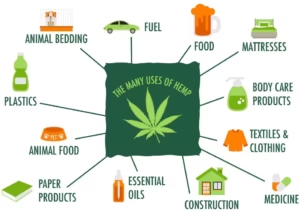
Industrial Hemp                    

Applications of Industrial Hemp

  • Hemp fibre is used in textiles, ropes, paper, upholstery, and biodegradable plastics.
  • The stalk and stem are processed into construction materials, insulation boards, and industrial products.
  • Hemp biomass can be converted into biofuels, supporting renewable energy goals.
  • Hemp seeds are rich in protein and essential fatty acids and are used in food products, cosmetics, oils, and animal feed.

Why Himachal Pradesh is Promoting Hemp

  • The state has suitable climatic and soil conditions for hemp cultivation.
  • Hemp can increase farmer income, especially in rain-fed and hill regions.
  • Legal cultivation helps curb illegal drug-related use through regulation.

Challenges

  • Legal concerns due to association with narcotics require strict monitoring of THC levels.
  • Lack of processing units and farmer awareness remains a constraint.

PARVATI–ARGA BIRD SANCTUARY DECLARED ECO-SENSITIVE ZONE

TOPIC: (GS3) ENVIRONMENT: TIMES OF INDIA

Why in News?

The Parvati–Arga Bird Sanctuary in Uttar Pradesh has been notified as an Eco-Sensitive Zone (ESZ). The decision aims to enhance protection of wetlands and endangered bird species.

About Parvati–Arga Bird Sanctuary

  • The sanctuary is located in Gonda district of Uttar Pradesh.
  • It consists of two permanent freshwater oxbow lakes, Parvati and Arga.
  • It is designated as a Ramsar Site, highlighting its international wetland importance.
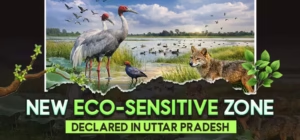
New Eco-Sensitive Zone

Biodiversity Significance

  • The sanctuary hosts critically endangered white-rumped vultures.
  • It also supports Indian vultures and Egyptian vultures, both endangered species.
  • Invasive species like water hyacinth pose ecological challenges.

Flora

  • The vegetation reflects the Indo-Gangetic wetland ecosystem.
  • It supports aquatic plants and provides nesting grounds for birds.

What is an Eco-Sensitive Zone?

  • ESZs are also known as Ecologically Fragile Areas.
  • They are notified by the Ministry of Environment, Forest and Climate Change.
  • ESZs generally extend up to 10 km around protected areas, depending on ecological needs.

Purpose of Declaring ESZ

  • ESZs act as shock absorbers to reduce human pressure on protected areas.
  • They regulate activities like mining, construction, and polluting industries.
  • They ensure a gradual transition from high protection zones to developed areas.

ALTERNATE WETTING AND DRYING (AWD) IN RICE CULTIVATION

TOPIC: (GS3) SCIENCE AND TECHNOLOGY: THE HINDU

Why in News?

Alternate Wetting and Drying (AWD) is being promoted as a climate-smart rice cultivation method that saves water and reduces methane emissions. It also enables farmers to earn carbon income without compromising rice yields.

Problem with Conventional Rice Farming

  • Traditional rice farming keeps fields continuously flooded to control weeds.
  • Flooded conditions create anaerobic soil, encouraging methane-producing microbes.
  • Methane is a greenhouse gas that is 28 times more potent than carbon dioxide.
  • Rice cultivation contributes about 12% of global methane emissions.
  • Methane alone accounts for nearly 30% of current global warming.
  • Emissions from rice farming globally are comparable to those from the aviation sector.

What is Alternate Wetting and Drying (AWD)?

  • AWD is a water management technique where paddy fields are periodically dried and re-flooded.
  • The method disrupts anaerobic conditions, thereby reducing methane formation.
  • It does not require expensive technology, making it suitable for small and marginal farmers.

How AWD is Practised

  • Paddy fields are kept flooded for the first 20 days after transplanting to ensure crop establishment.
  • Between day 21 and day 65, the field undergoes two dry cycles of around six days each.
  • Re-flooding is done before plants experience water stress.
  • Simple perforated water tubes (around 30 cm long) are inserted into the soil to monitor groundwater depth.
  • Irrigation is applied only when the water level falls below a safe threshold.
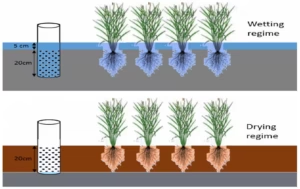
Alternate Wetting an Drying (AWD)

Benefits of AWD

  • AWD can reduce water use by 15–30% compared to continuous flooding.
  • It significantly cuts methane emissions, supporting climate mitigation.
  • Crop yields remain stable or may even improve due to better root aeration.
  • Farmers save on irrigation costs and electricity or diesel usage.
  • AWD supports carbon credit mechanisms, offering additional income opportunities.

Relevance for India

  • India is the world’s largest rice producer and exporter.
  • AWD aligns food security, water conservation, and climate action.
  • It supports India’s Nationally Determined Contributions (NDCs) under the Paris Agreement.
  • The practice strengthens climate-resilient agriculture, especially in water-stressed regions.

Challenges

  • Farmers need training and awareness to adopt AWD correctly.
  • Poor field levelling and unreliable irrigation may affect effectiveness.
  • Institutional support is required to link AWD with carbon markets.

SLOWING EXPANSION OF THE UNIVERSE AND DARK ENERGY

TOPIC: (GS3) SCIENCE AND TECHNOLOGY: THE HINDU

Why in News?

A recent study suggests that the expansion of the universe may be slowing down, challenging existing cosmological models. The findings question the assumption that dark energy is constant.

Expansion of the Universe

  • The universe originated about 13.8 billion years ago in the Big Bang.
  • Since then, space itself has been expanding, leading to the formation of galaxies and cosmic structures.
  • In the 1920s, Edwin Hubble proved that galaxies are moving away from each other.
  • Later observations revealed that this expansion is accelerating, not slowing.

Role of Dark Energy

  • The acceleration is attributed to dark energy, a mysterious repulsive force.
  • Dark energy makes up about 68% of the universe’s total content.
  • It is often modelled as Einstein’s cosmological constant (Λ).
  • Dark energy acts as a kind of anti-gravity, pushing galaxies apart.

Lambda Cold Dark Matter (ΛCDM) Model

  • The ΛCDM model is the standard framework of cosmology.
  • It states that the universe is composed of dark energy, dark matter, and normal matter.
  • According to this model, about 95% of the universe consists of dark matter and dark energy.
  • It successfully explains cosmic microwave background radiation, galaxy formation, and large-scale structure.


Dark Energy vs Dark Matter        

Dark Matter vs Dark Energy

  • Dark matter makes up around 27% of the universe and acts as an attractive gravitational force.
  • It does not emit or reflect light, so it is observed only through gravitational effects.
  • Dark matter holds galaxies together like cosmic glue.
  • Dark energy, in contrast, is a repulsive force that drives cosmic expansion.
  • Dark energy dominates over dark matter at very large scales.

New Findings and Their Implications

  • The new study suggests that dark energy may be weakening over time.
  • If true, the universe’s expansion could slow down in the future.
  • This challenges the assumption that dark energy is constant.
  • It may require modifications or alternatives to the ΛCDM model.

Scientific Significance

  • Opens new questions about the ultimate fate of the universe.
  • Encourages development of new theoretical models.
  • Demonstrates that cosmology is a dynamic and evolving science.

Write a Review

Your email address will not be published. Required fields are marked *