
...
Daily Current affairs 03 April 2026

Daily Current Affairs 03-April-2026

Share this Post

ECI TRANSFERS AND FEDERAL TENSION

TOPIC: (GS2) POLITY: THE HINDU

The Election Commission’s sudden transfers of senior State officers during the 2026 election schedule sparked controversy over its authority.

Immediate Transfers and State Response

  • Rapid transfers announced: The ECI ordered the sudden removal and reassignment of several senior officials, including Chief Secretaries and DGPs, immediately after election schedules were published.
  • State governments taken by surprise: Affected States, notably West Bengal, reported no prior consultation and said the orders arrived without their knowledge.
  • Administrative disruption: The abrupt changes created confusion and slowed routine governance functions at a critical time.
  • ECI’s stated motive: The Commission said the moves were aimed at ensuring impartiality and the smooth conduct of elections.

Constitutional and Legal Provisions on Transfers

  • Article 324: Superintendence, direction and control of elections: Grants the ECI broad powers to ensure free and fair elections; courts have described it as a “reservoir” of powers where no statute exists.
  • Article 310: Tenure of office of persons serving the Union or a State: Civil servants hold office at the pleasure of the President/Governor.
  • Article 309: Recruitment and conditions of service: Parliament/State legislatures may regulate recruitment and service conditions of public servants.
  • Article 312: All-India Services: Empowers Parliament to create All-India Services (basis for All India Services Act, 1951).
  • Seventh Schedule (State List): Public services under State control; transfers of State cadre officers are generally a State function.
  • All India Services Act, 1951 & Service Rules — Statutory framework governing postings, transfers and disciplinary control of IAS/IPS officers.
  • Article 324(6) — Requires State/Union to make staff available to the ECI for conducting elections.

Challenges and Legal Issues

  • Statutory vacuum vs. plenary power: Article 324’s wide scope applies only where a statute does not occupy the field; transfers under service laws may limit ECI’s reach.
  • Administrative disruption: Overnight transfers of top officials can paralyse governance and demoralise bureaucracy.
  • Lack of transparent procedure: No clear, published criteria or process for declaring an officer “biased” or unfit for election duty.
  • Federal tension: ECI actions that bypass State consent strain Centre–State relations and raise constitutional friction.
  • Rule of law concerns: Arbitrary use of power risks violating principles of natural justice and administrative fairness.

Way Forward

  • Clear statutory guidelines: Parliament should consider a law or amendment clarifying ECI’s powers on transfers during elections and the procedure to be followed.
  • Standard operating procedure (SOP): ECI and States must agree on transparent criteria, timelines and review mechanisms for transfers.
  • Independent review panel: Constitute a neutral body to assess allegations of bias against officers before transfers.
  • Strengthen deputation pool: Build a trained, neutral pool of election officials to reduce dependence on sudden State transfers.

Conclusion

Balancing the ECI’s duty to secure free elections with statutory service rules and federal norms requires clear laws. Legal clarity and institutional safeguards will prevent administrative disruption while protecting electoral integrity.

NCERT DECLARED DEEMED UNIVERSITY

TOPIC: (GS2) POLITY: THE HINDU

The Education Ministry has notified the NCERT as an institution deemed to be a university, allowing it to run degree programmes.

What the Notification Does

  • Status granted: NCERT and its six regional institutes recognised as a deemed university.
  • Degree powers: Can design academic programmes and award degrees subject to UGC rules.
  • Doctoral focus: Required to initiate PhD and research programmes and innovative courses.

Conditions and Limits

  • No commercial activity: Prohibited from profit-making ventures.
  • UGC compliance: All courses must meet UGC and statutory council standards.
  • Campus rules: Offcampus or offshore programmes allowed only under UGC guidelines.
  • Accreditation push: NCERT must seek programme and institutional accreditation (NBA/NAAC).

Significance (brief)

  • Strengthens teacher education: Can deepen research in pedagogy and curriculum.
  • Policy alignment: Expected to support National Education Policy 2020 priorities.
  • Quality assurance: Accreditation and UGC oversight aim to maintain academic standards.

Bottom line

The notification empowers NCERT to expand higher education and research in school education, while binding it to regulatory safeguards and non-commercial norms.

ARTEMIS II LAUNCH AND STRATEGIC EDGE OVER CHINA

TOPIC: (GS3) SCIENCE AND TECHNOLOGY: THE HINDU

NASA launched Artemis II in early April 2026 to test crewed deepspace systems and gather data needed for future lunar landings.

Mission Overview

  • Crew: Four astronauts — Reid Wiseman (commander), Victor Glover (pilot), Christina Koch (mission specialist), Jeremy Hansen (Canadian partner).
  • Vehicle: Space Launch System (SLS) rocket and Orion crew capsule.
  • Profile: A freereturn lunar flyby that will take Orion several thousand miles beyond the Moon and return to Earth for a Pacific splashdown after ~10 days.

Primary Objectives

  • System validation: Confirm SLS, Orion, ground teams, lifesupport, communications and navigation work together under crewed conditions.
  • Human factors: Monitor physiological and biological responses to deepspace travel.
  • Reentry test: Evaluate Orion’s heatshield performance during highspeed atmospheric return after lessons from Artemis I.
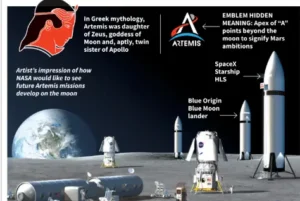
ARTEMIS 2 Launch and Strategic Edge Over China

Program Changes and Timeline

  • Milestone reset: NASA revised Artemis sequencing — Artemis II is a crewed flyby; Artemis III will test lunar lander docking in Earth orbit; Artemis IV aims for the first 21stcentury lunar surface landing (current target 2028).
  • Gateway cancelled: Elements of the cancelled Lunar Gateway are being repurposed for lunar surface infrastructure.

why it matters geopolitically

  • China’s progress: China is advancing crewed and robotic lunar capabilities and aims for a crewed landing by 2030; success or delay in Artemis affects global leadership in lunar resources and norms.
  • Resource race: The Moon’s south pole waterice is a strategic resource; early infrastructure there could shape future scientific and commercial rules.

Risks and Consequences (short)

  • Technical delays or failures could push back lunar landing timelines, raise costs, and weaken partner confidence.
  • Program cost and cadence remain under scrutiny given high expenditures and past schedule slips.

Conclusion

Artemis II is a pivotal test will shape scientific, commercial and strategic competition in lunar space for the coming decade.

SAMPRATI AND JAIN EXPANSION IN ANCIENT INDIA

TOPIC: (GS1) INDIAN ART AND CULTURE: THE HINDU

On Mahavir Jayanti, the Prime Minister inaugurated the Samrat Samprati Museum in Gandhinagar, highlighting Samprati’s role in promoting Jainism after the Mauryan era.

Background

  • Mauryan context: The Mauryan Empire (3rd century BCE) is best known for Ashoka’s promotion of Buddhism, but Jainism also remained influential during and after this period.
  • Family links: Jain traditions record that Chandragupta Maurya embraced Jainism; Samprati is remembered in Shvetambara texts as Ashoka’s grandson who championed Jain faith.

Samprati’s Conversion and Reign

  • Conversion: Jain sources describe Samprati as a devoted follower who adopted Jain practices after guidance from monk Suhastin at Ujjain.
  • Rule: He is traditionally dated to the early 3rd century BCE and is portrayed as a ruler who used his authority to support religious work rather than for political expansion.

How Samprati Spread Jainism (Key Methods)

  • Missionary outreach: Sent monks and teachers to distant regions to preach Jain doctrines and establish local sanghas.
  • Temple and icon patronage: Commissioned construction and renovation of temples and installed images of the Jinas to encourage public worship.
  • Institutional support: Founded charitable centres and religious institutions to sustain monastic communities and lay followers.
  • Cultural integration: Promoted daily devotional practices and rituals that helped embed Jainism in local societies.

Regional Reach and Impact

  • Peninsular and western India: Traditions credit Samprati with strengthening Jain presence in Andhra, Tamil Nadu, Karnataka, Maharashtra and Gujarat.
  • North and central India: Activities in Malwa and Rajputana helped consolidate Jain communities there.
  • Broader claims: Later texts extend his influence to neighbouring regions and parts of Central and West Asia, reflecting the long memory of his patronage.

Legacy and Historical Sources

  • Textual record: Accounts of Samprati appear in medieval works such as Samprati Nripa Charitra, Sampratikatha, Parishistaparva and Prabhavakcharita.
  • Tradition vs. history: Many numerical claims (temple counts, icon installations) are hagiographic; they signal wide reverence rather than precise historical fact.
  • Comparative role: In Jain memory, Samprati occupies a role similar to Ashoka’s in Buddhism — a royal patron who institutionalised and spread a religion.

Conclusion

Samprati’s active patronage, missionary activity and temple-building that helped Jainism gain durable roots across regions. his legacy remains central to Jain historical identity.

FCRA AMENDMENT BILL 2026

TOPIC: (GS2) POLITY: THE HINDU

The Union government introduced the FCRA Amendment Bill, 2026 in the Lok Sabha and later deferred its discussion after widespread protests.

Background

  • The Foreign Contribution (Regulation) Act, 2010 governs how individuals, NGOs and associations receive and use foreign funds to protect national interest.
  • The Act has been amended several times (notably 2016–2020) to tighten oversight of foreign funding.
  • The 2026 Bill aims to plug perceived gaps in handling assets when FCRA registration is cancelled, surrendered, expired or not renewed.

Main Proposals of the Bill

  • Designated authority: A governmentappointed body will take custody, supervise and manage foreign contributions and assets of organisations whose FCRA registration lapses or is cancelled.
  • Temporary custody and return: Unused funds and assets may be returned if registration is later restored.
  • Permanent takeover: If registration is not revived within a specified period or the organisation ceases to exist, assets may be transferred to government bodies or disposed of as prescribed.
  • Special clause for places of worship: Management of a place of worship may be reassigned while preserving its religious character.

Why the Government Supports It

  • Legal clarity: To address ambiguity over asset management when registrations lapse.
  • Prevent misuse: To stop foreign funds being used against national security, public order or sovereignty.
  • Operational control: To provide a clear mechanism for custody and disposal of foreignfunded assets.

Challenges

  • Risk of arbitrary takeover: Delays or denials in renewal could lead to seizure of assets of functioning NGOs and religious bodies.
  • Threat to minority institutions: Critics say the Bill may disproportionately affect minorityrun schools, hospitals and churches that rely on foreign funds.
  • Dueprocess gaps: Lack of an independent review or clear timelines raises naturaljustice concerns.
  • Political timing: The debate has been politicised in Kerala ahead of elections, intensifying public opposition.

Challenges

  • Unclear timelines for restoration and takeover.
  • Capacity issues in managing diverse assets (educational, medical, religious).
  • Potential misuse without strong safeguards and oversight.

Way Forward

  • Set clear timelines for review and restoration before any takeover.
  • Create an independent review panel to examine allegations and recommend action.
  • Limit interim powers to custodial management with strict accountability.
  • Protect religious and charitable assets through stakeholder consultation and judicial review options.
  • Parliamentary oversight and transparent rules for disposal or transfer.

Conclusion

The Bill seeks to close legal gaps in FCRA asset management but raises serious governance and rights issues. Clear procedures, independent safeguards and political consensus are essential to balance national security with civil society autonomy.

ANTARIKSH VENTURE CAPITAL FUND

TOPIC: (GS3) SCIENCE AND TECHNOLOGY: THE HINDU

The Union Minister announced steady progress on the Antariksh Venture Capital Fund, with investments into selected space startups expected from Q1 FY2027.

Fund Overview

  • Type: Closeended Category II AIF registered with SEBI.
  • Sponsor and investor: Sponsored by SIDBI Venture Capital Ltd; key investor is INSPACe under the Department of Space.
  • Target firms: Will back Indian space companies with Technology Readiness Level (TRL) ≥ 4.
  • Objective: Provide growth capital to scale operations, commercialise technologies and accelerate market entry.

Investment Focus and Mechanism

  • Stages covered: Early growth to scaling phases; not seed grants.
  • Use of funds: Product development, manufacturing scaleup, launch services, satellite systems and downstream services.
  • Closeended structure: Fixed tenure fund with defined investment and exit timelines.

Role of INSPACe

  • Singlewindow regulator: Facilitates private sector participation in space activities.
  • Promotion and authorisation: Enables nongovernment entities to build launchers, satellites and offer space services.
  • Three directorates: Promotion Directorate (industry enablement); Technical Directorate (safety and technical review); Program Management & Authorization Directorate (project approvals and oversight).
  • Interface with ISRO: Coordinates access to government infrastructure and capacity sharing.

Significance

  • Fills funding gap: Addresses capital shortfall for hardware and service firms in the space value chain.
  • Commercialisation push: Supports transition from demonstration to marketable products.
  • Strategic autonomy: Strengthens India’s indigenous capabilities and privatepublic collaboration in space.

Conclusion:

The Antariksh Fund is a policy tool to mobilise institutional capital for viable space ventures, complementing regulatory reforms by INSPACe to build a competitive domestic space industry.

E20 FUEL

TOPIC: (GS3) ENVIRONMENT: THE HINDU

The Central government has mandated petrol pumps to sell E20 fuel with a minimum 95 RON octane rating. The move aims to scale ethanol blending and reduce oil import dependence.

What is E20 Fuel

  • Definition: A petrol blend containing 20% ethanol and 80% petrol.
  • Octane advantage: E20 is specified to have at least 95 RON, higher than typical petrol (91–92 RON).
  • Source of ethanol: Made from crops such as sugarcane, maize and other biomass, and can also come from agricultural residues.
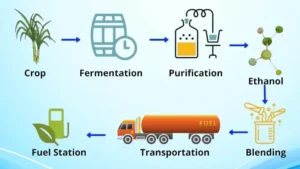
E20 Fuel

Benefits

  • Lower oil imports: Reduces crude oil demand by substituting part of petrol with domestic biofuel.
  • Cleaner combustion: Higher octane and ethanol’s oxygen content can improve combustion and lower some emissions.
  • Rural income: Boosts demand for ethanol feedstocks, supporting farmers and agroindustry.
  • Energy security: Diversifies fuel mix and strengthens domestic fuel resilience.

Challenges

  • Feedstock pressure: Large ethanol demand may affect food crops and land use if not managed.
  • Vehicle compatibility: Older vehicles and some engine components may need checks or adaptations.
  • Supply chain: Requires steady ethanol production, storage, transport and quality control.
  • Environmental tradeoffs: Benefits depend on how ethanol is produced; sustainable feedstocks matter.

Way Forward

  • Scale sustainable ethanol production from diverse, nonfood sources.
  • Ensure fuel quality standards and vehicle compatibility testing.
  • Strengthen logistics and storage for ethanol blending.
  • Monitor environmental and food security impacts while expanding blending.

MULTIDOMAIN DETERRENCE (MDD)

TOPIC: (GS3) SEQURITY: THE HINDU

India is shifting to a MultiDomain Deterrence (MDD) approach to close a growing capability gap with China by integrating military and nonmilitary tools across land, sea, air, cyber, space and information domains.

What is MultiDomain Deterrence

  • Definition: A holistic defence concept that fuses capabilities across Land, Air, Sea, Cyber, Space and Cognitive (information) domains to deter aggression.
  • Core idea: Move from siloed services to a networked “systemofsystems” where sensors, shooters and decisionmakers are digitally linked for rapid, coordinated response.
  • Deterrence by denial and cost imposition: Convince adversaries that operations will fail and incur unacceptable costs across multiple fronts.

Why India Needs MDD

  • China’s modernisation: PLA’s integration of satellites, AI and precision strike widens the capability gap.
  • Twofront reality: Simultaneous threats from China and Pakistan require crossdomain force multiplication.
  • Greyzone threats: Cyberattacks, disinformation and economic coercion demand nonkinetic responses integrated with kinetic options.

Systemic Challenges

  • Weak defenceindustrial base: Limited scale and slow delivery hinder rapid capability buildup.
  • Flawed procurement: Long cycles, red tape and servicecentric buys delay critical enablers (C4ISR, drones, missiles).
  • Fragmented C4ISR and doctrine: Lack of unified command, data standards and interservice doctrine reduces operational synergy.

Way Forward

  • Adopt a middlepath strategy: Retain legacy platforms while rapidly building enabling layers—C4ISR, strike, logistics and closebattle capabilities.
  • Empower private industry: Use iDEX and longterm contracts to scale production and innovation; reduce PSU monopoly.
  • Operationalise theatre commands: Fasttrack integrated commands for unified planning and execution.
  • Invest in attritiontolerant ISR and resilient networks: Field many affordable sensors and hardened communications to survive highintensity conflict.
  • Institutional coordination: Align research, industry, services and political leadership with stable funding and outcomebased plans.

Conclusion

India’s deterrence will be built over time as an integrated system, not by a single weapon. Urgent reforms in industry, procurement, doctrine and command are essential to keep the strategic window open.

Write a Review

Your email address will not be published. Required fields are marked *

Seraphinite AcceleratorOptimized by Seraphinite Accelerator
Turns on site high speed to be attractive for people and search engines.