Table of Contents
ToggleEU’S CARBON BORDER ADJUSTMENT MECHANISM (CBAM) AND INDIA
TOPIC: (GS3) ECONOMY: THE HINDU
The European Union has started implementing its Carbon Border Adjustment Mechanism (CBAM) from January 1, 2026, imposing carbon taxes on imports of steel, aluminium, and other carbon‑intensive goods. This is expected to significantly affect India’s exports to the EU.
What is CBAM?
- CBAM is the world’s first carbon border tax, aimed at preventing “carbon leakage” by aligning imports with EU’s strict climate standards.
- It applies to sectors like steel, aluminium, cement, fertilisers, chemicals, oil refining, paper, and glass.
- India, a major exporter of steel and aluminium to the EU, faces high compliance costs and competitiveness challenges.
- Developing countries argue CBAM violates the principle of Common But Differentiated Responsibilities (CBDR) under international environmental law.
Common But Differentiated Responsibilities (CBDR)
Common But Differentiated Responsibilities (CBDR) is a principle in international environmental law that says all countries share responsibility for protecting the environment, but not equally.
- Formalised at the 1992 Earth Summit in Rio de Janeiro under the United Nations Framework Convention on Climate Change (UNFCCC).
- Recognised the historical disparity: industrialised nations polluted more during their early development, while developing countries are still striving for growth.
Core Idea
- Common Responsibility: All states must act against environmental degradation.
- Differentiated Responsibility: The level of obligation differs depending on:
- Level of development
- Historical contribution to pollution
- Capacity to respond
Importance
- Forms the basis of climate negotiations between developed and developing countries.
- Protects the principle of equity in global climate action.
Seen in agreements like the Kyoto Protocol (1997) and Paris Agreement (2015), where developed nations pledged stronger emission cuts and financial support.
Impact on India
- Export Vulnerability: Steel and aluminium dominate India’s exports to the EU, making them highly exposed to CBAM costs.
- Price Pressure: The Global Trade Research Initiative (GTRI) estimates Indian exporters may need to cut prices by 15–22% to absorb the tax.
- MSME Challenges: Smaller firms face high compliance, verification, and data costs, risking exclusion from EU markets.
- Technology Gap: India’s steel industry relies heavily on blast furnace–basic oxygen furnace (BF–BOF) routes, which have the highest emissions. Cleaner electric arc furnaces (EAFs) are less common due to limited scrap availability.
- Competitive Disadvantage: EU and US producers, with abundant scrap and EAF technology, may benefit under CBAM while Indian firms struggle.
Global Pushback
- Russia and other nations have formally challenged CBAM at the WTO.
- UNCTAD (2021 study): CBAM may cut global CO₂ emissions by only 0.1%, but could worsen trade inequalities and reduce export opportunities for developing countries.
- Developing nations demand CBAM revenues be used to fund cleaner technologies in poorer countries.
India’s Position
- Finance Minister Nirmala Sitharaman termed CBAM unilateral and arbitrary, calling it a disguised trade barrier.
- India has raised concerns in ongoing India–EU trade negotiations, seeking relief for MSMEs.
- Official stance: CBAM undermines energy transition efforts and violates WTO principles.
Way Forward for India
- Technology Transition: Support steelmakers in shifting from BF–BOF to cleaner EAF and DRI routes.
- Data & Compliance: Establish Mutual Recognition Agreements (MRAs) so EU accepts Indian emissions certification.
- Trade Diplomacy: Push for climate finance and carve‑outs for MSMEs in India–EU trade talks.
Conclusion:
CBDR ensures fairness in global climate action by recognizing unequal historical responsibility and varying capacities. It remains a cornerstone principle balancing development needs with environmental obligations in international negotiations.
The European Union has started implementing its Carbon Border Adjustment Mechanism (CBAM) from January 1, 2026, imposing carbon taxes on imports of steel, aluminium, and other carbon‑intensive goods. This is expected to significantly affect India’s exports to the EU.
What is CBAM?
- CBAM is the world’s first carbon border tax, aimed at preventing “carbon leakage” by aligning imports with EU’s strict climate standards.
- It applies to sectors like steel, aluminium, cement, fertilisers, chemicals, oil refining, paper, and glass.
- India, a major exporter of steel and aluminium to the EU, faces high compliance costs and competitiveness challenges.
- Developing countries argue CBAM violates the principle of Common But Differentiated Responsibilities (CBDR) under international environmental law.
INDIAN RAILWAYS IN 2025
TOPIC: (GS3) ECONOMY: THE HINDU
In 2025, Indian Railways achieved historic expansion by connecting the Kashmir Valley and Mizoram to the national rail grid, inaugurated the new Pamban Bridge, and advanced freight corridors. However, safety concerns, freight dependence, and financial stress remain pressing challenges.
Major Milestones in 2025
Kashmir Valley Connectivity:
- Completion of the Udhampur–Srinagar–Baramulla Rail Link (USBRL). Launch of Vande Bharat train between Katra and Srinagar.
- Engineering marvels: Chenab Bridge (world’s highest arch, 359 m), T-50 tunnel (12.77 km), and Anji Bridge (first cable-stayed rail bridge).
Mizoram Rail Link:
- Inauguration of Bairabi–Sairang line (September 2025), connecting Aizawl for the first time.
- Aizawl became the fourth northeastern capital linked by rail after Guwahati, Agartala, and Itanagar.
Pamban Bridge:
- India’s first vertical-lift railway sea bridge (2.08 km) connecting Rameswaram to mainland Tamil Nadu.
Western Dedicated Freight Corridor (WDFC):
- First train ran on 102 km Vaitarna–JNPT section, boosting freight efficiency.
Strategic Himalayan Lines:
- Rishikesh–Karnaprayag line (125 km) with India’s longest tunnel (14.57 km).
- Bhanupalli–Bilaspur–Beri line planned extension to Ladakh, delayed due to funding disputes.
Operational Focus & Targets
- Track expansion, bottleneck removal, and passenger amenities under Amrit Bharat Station Scheme.
- Safety upgrades with Kavach 4.0 deployed on 738 km.
- New services: 13 Amrit Bharat trains, 2 Namo Bharat rapid rail services, trials of Vande
- Bharat sleeper trains.
- Ambitious targets by 2030: 3 billion tonnes freight (up from 1.6 bn in FY25) and 10 billion passengers annually (up from 7 bn in FY25).
Challenges Faced
- Safety Concerns: Stampede at New Delhi station (Feb 2025) killed 18, injured 15. Railways launched crowd management projects and holding areas on busy platforms.
- Freight Dependence: Freight contributes 65% of Railways’ earnings. Heavy reliance on coal (~50% of freight) and seven bulk commodities (87.3% of total loading in FY25).
- Financial Stress: High revenue expenditure and low earnings per route. Standing Committee urged diversification into automobiles, FMCG, and e-commerce.
Way Forward
- Transform into Green Mobility: Aim for net‑zero emissions by 2035 through complete electrification, hydrogen trains, and expanded solar capacity beyond the current 898 MW.
- Diversify Freight & Boost Modal Share: Reduce dependence on coal (~50% of freight) by expanding into automobiles, FMCG, and e‑commerce, with a target to raise rail’s freight share from 27% to 50% by 2035, making Railways the backbone of India’s logistics.
- Transform Passenger Experience with Safety & Technology: Scale up Kavach 4.0 across all high‑density routes to ensure zero major accidents, and expand Vande Bharat sleeper and rapid rail services to connect every state capital, aiming for 10 billion passengers annually by 2030 with world‑class comfort.
GREEN MOBILITY IN RAILWAYS
- Railways account for only ~1% of transport emissions.
- Near‑100% electrification of broad‑gauge network.
- Hydrogen train prototypes under development.
2,626 solar-powered stations and 898 MW solar capacity, with 70% used for traction.
Conclusion
Indian Railways in 2025 showcased engineering triumphs and strategic connectivity, but faces challenges in safety, freight diversification, and financial sustainability. Its green initiatives and ambitious targets highlight its central role in India’s future logistics and mobility strategy.
RECASTING SANITATION WITH URBAN-RURAL PARTNERSHIPS
TOPIC: (GS2) INDIAN POLITY: THE HINDU
Maharashtra has pioneered urban-rural partnerships in faecal sludge management, linking villages to city treatment plants under Swachh Bharat Mission-Grameen (SBM-G) Phase II. This model is seen as a scalable solution to sustain India’s sanitation gains beyond toilet construction.
SBM‑G
- SBM‑G Phase I (2014–2019): Achieved nationwide ODF status by constructing household and community toilets.
- Phase II (2020–2025): Designed to consolidate gains and address the next challenge—waste management in rural areas.
- Implemented by the Ministry of Jal Shakti, Department of Drinking Water and Sanitation.
Objectives of Phase II
- ODF Sustainability: Ensure that villages remain free from open defecation through behaviour change and monitoring.
- ODF Plus Villages: Move beyond toilets to cover solid and liquid waste management (SLWM).
- Waste Management Systems: Promote segregation of biodegradable and non‑biodegradable waste, composting, and recycling.
- Plastic Waste Reduction: Encourage alternatives to single‑use plastics and community‑level recycling.
- Community Participation: Strengthen Gram Panchayats and local institutions to lead sanitation drives.
Current Progress
- As of October 2025, 5.68 lakh villages (97%) declared ODF Plus.
- Faecal sludge management remains a weak link, especially in peri-urban and rural areas.
- Maharashtra has invested in 200 faecal sludge treatment plants and co-treatment facilities in 41 sewage plants.
Case Study: Satara District, Maharashtra
- Satara city’s faecal sludge treatment plant (65 KLD capacity) was underutilised.
- Four villages — Jakatwadi, Songaon, Kodoli, and Degaon — partnered with the city to use its facility.
- Gram panchayats levy a small sanitation tax to fund desludging services every five years.
- Agreement between Satara Panchayat Samiti and Municipal Council allows authorised vehicles to access treatment plants free of cost.
- Ensures affordability, accountability, and safe disposal of waste.
Independent Village Models
- Mayani village (Khatav taluka): Introduced scheduled desludging every 5–7 years via private operators or self-help groups.
- Selected for a cluster-level faecal sludge treatment plant under SBM-G to serve ~80 villages.
- Demonstrates resource pooling for financially viable standalone infrastructure.
Significance of Urban-Rural Partnerships
- Bridges gap between urban treatment facilities and rural sanitation needs.
- Promotes sustainable waste management and prevents informal, unsafe desludging practices.
- Encourages collaboration between local governments, private operators, and communities.
- Strengthens institutionalisation of sanitation services across rural India.
Challenges in Urban–Rural Sanitation Partnerships
- Infrastructure Gaps: Only 200 faecal sludge treatment plants exist in Maharashtra, while India has 5.68 lakh ODF Plus villages.
- Financial Constraints: Nationally, rural sanitation budgets form less than 0.5% of total public health expenditure, restricting expansion.
- Behavioural and Awareness Issues: Surveys show over 60% of rural households never desludge septic tanks until they overflow, risking contamination.
- Coordination Deficit: Lack of clear accountability and monitoring slows implementation.
Way Forward
- Scaling Cluster Models: Replicate Mayani’s cluster‑level faecal sludge treatment plant serving ~80 villages. Pooling resources ensures financial viability and wider coverage.
- Enhanced Funding & Incentives: Increase SBM‑G allocations; introduce performance‑linked grants for panchayats adopting scheduled desludging.
- Technology & Innovation: Promote low‑cost decentralised treatment units, bio‑digesters, and mobile desludging vehicles.
- Capacity Building & Awareness: Train local operators and strengthen monitoring systems. Behavioural campaigns to ensure desludging every 5–7 years, reducing health risks.
Conclusion
Urban-rural partnerships and cluster-based treatment models can ensure that India’s sanitation achievements are sustainable. The true success of Swachh Bharat lies not just in toilet construction but in building robust systems for faecal waste management that protect health, environment, and dignity.
ASSAM TRIBAL ORGANISATIONS FOR SIX OBC COMMUNITIES
TOPIC: (GS2) INDIAN POLITY: THE HINDU
The Coordination Committee of Tribal Organisations of Assam (CCTOA) has opposed the Group of Ministers’ (GoM) proposal to grant Scheduled Tribe (ST) status to six Other Backward Class (OBC) communities, calling it unconstitutional and harmful to the rights of existing tribal groups.
Coordination Committee of Tribal Organisations of Assam (CCTOA):
- Umbrella Body: CCTOA brings together multiple tribal organisations in Assam to represent the collective interests of Scheduled Tribes.
- Protecting Tribal Rights: It strongly opposes granting ST status to new communities, fearing dilution of existing tribal rights and benefits.
- Constitutional Stand: The committee argues that SCs and STs are distinct under the Constitution, and merging categories would harm political representation and reservations for current tribes.
Previous observations on reservation
- Lokur Committee (1965): Defined criteria for identifying STs — primitive traits, distinct culture, isolation, shyness of contact, and backwardness.
- Reservation Cap: The Supreme Court in 1992 ruled that total reservation should not exceed 50%.
- Current Assam Quota: Assam already provides 59% reservation (SC 7%, ST(P) 10%, ST(H) 5%, OBC/MOBC 3%, Adivasis 27%, EWS 10%).
- Political Representation: ST status ensures reserved seats in panchayats, assemblies, and Parliament, making it a sensitive issue for existing tribes.
Key Issue
- The GoM suggested dividing six OBC communities — Koch-Rajbongshi, Chutia, Matak, Moran, Tai Ahom, and Tea Tribes (Adivasis) — into ST (Plain), ST (Hill), and ST (Valley).
- CCTOA argues this move will dilute the rights of the 14 existing ST groups in Assam.
- They claim granting ST status to these communities will reduce political representation and reservation benefits for current tribes.
Concerns Raised by CCTOA
- Unconstitutional: Adding more groups will push reservation beyond 70%, violating the Supreme Court’s 50% cap.
- Political Impact: Existing STs may lose reserved seats in local bodies and Parliament.
- Cultural Criteria Ignored: OBC groups do not meet the tribal characteristics outlined by the Lokur Committee.
- Central Pool Effect: Expansion of ST list will reduce benefits available to current tribes from central government schemes.
SC/ST RECOGNITION
Government identifies a community based on socio‑economic disadvantage or distinct identity.
- Study & Recommendation: Commissions or committees (like the Mandal Commission earlier) study their status.
- Presidential Notification:
- For SCs → Article 341.
- For STs → Article 342.
- The President issues an order specifying which communities are included.
- Parliamentary Approval: Any change (addition/removal) must be approved by Parliament through law.
Implementation: Communities gain constitutional benefits like reservations, welfare schemes, and safeguards.
Conclusion
The debate highlights the tension between demands for inclusion and constitutional limits on reservation. It reflects the challenge of balancing social justice with legal boundaries in India’s affirmative action policies.
TRANSFORMING URBAN INDIA
TOPIC: (GS3) ECONOMY: THE HINDU
At COP30 (Belem, Brazil, November 2025), waste management was placed at the centre of the climate agenda. A global initiative No Organic Waste, NOW was launched to cut methane emissions, highlighting circularity as the path to sustainable urban growth.
No Organic Waste, NOW
- Introduced at COP30 as part of the climate agenda. Led by the Global Methane Hub, in partnership with the UN Environment Programme (UNEP) and the Climate & Clean Air Coalition (CCAC).
- Backed by a $30 million investment to accelerate organic waste diversion projects worldwide.
Core Objective
- Cut Methane Emissions: Organic waste in landfills is a major source of methane, a potent greenhouse gas.
- Promote Circularity: Encourage reuse and recycling of organic matter into compost, biogas, or other productive resources.
- Support Cities: Provide scalable solutions for sustainable urban growth and healthier living environments.
why methane is harmful:
- Strong Greenhouse Gas: Methane traps heat in the atmosphere about 80 times more effectively than CO₂ over 20 years, making it a major driver of global warming.
- Air Pollution & Health Risks: Methane contributes to the formation of ground‑level ozone (smog), which causes respiratory problems and reduces crop yields.
- Climate Feedback Loops: Rising methane emissions from sources like landfills, agriculture, and melting permafrost can accelerate climate change, creating self‑reinforcing warming cycles.
Urban India’s Waste Problem
- Pollution Hotspots: NCR and other metros rank among the world’s most polluted urban regions.
- Citizen Concerns: Despite government and court action, waste mismanagement continues to affect daily life.
- Garbage‑Free Cities Goal: Target set for 2026, seen as essential for sustainability, not just aesthetics.
- Progress: SBM Urban 2.0 has cleared dumpsites in 1,100 cities, but achieving full garbage‑free status requires circular economy adoption across 5,000 towns.
Types of Waste and Challenges
- Organic Waste Over 50% of municipal waste is organic. Composting and bio-methanation plants can convert it into biogas and electricity.
- Plastic and Dry Waste: Plastic is the toughest challenge, harmful to health and ecosystems. Effective segregation at source is critical.
- Construction & Demolition Waste: India generates ~12 million tonnes annually. Unauthorised dumping worsens pollution. Recycling capacity is insufficient.
- Wastewater: Recycling and reuse in agriculture, industry, and horticulture are essential. Missions like AMRUT and SBM emphasise faecal sludge and wastewater management.
Initiatives by India
- Mission LiFE (COP26, Glasgow 2021) Advocated sustainable lifestyles and circular use of resources.
- Urbanisation Challenge: India’s cities are expanding rapidly, creating rising waste and pollution.
- Swachh Bharat Mission (SBM): Achieved open defecation-free status and now aims for garbage-free cities.
- Future Burden: By 2030, Indian cities may generate 165 million tonnes of waste; by 2050, this could rise to 436 million tonnes, worsening emissions and health risks.
COP30 (BELÉM, BRAZIL, NOVEMBER 2025)
- Amazon at the Centre: COP30 was hosted in Belém, Brazil, placing the Amazon rainforest at the heart of global climate discussions and stressing the urgency of halting deforestation.
- Belem Package Adopted: Countries agreed on a comprehensive package covering just transition, adaptation finance, trade, gender, and technology — making COP30 the “COP of Implementation.”
- NDC 3.0 Deadline: Nations submitted updated climate pledges (Nationally Determined Contributions), but current commitments showed only a 12% emission reduction by 2035, far below the 60% required to keep global warming within 1.5°C.
Climate Finance & Global South: Strong emphasis on climate finance and equity, with 76 Global South countries participating, highlighting support for vulnerable nations.
Conclusion:
waste management is vital for India’s urban future. strong policy, technology, and citizen participation, waste can be transformed into a resource, ensuring cleaner cities, healthier populations, and climate resilience.
CLOSE QUARTER BATTLE (CQB) CARBINE
TOPIC: (GS3) SEQURITY: THE HINDU
The Ministry of Defence has signed contracts worth ₹4,666 crore for procuring indigenously developed Close Quarter Battle (CQB) Carbines for the Indian Army and Navy, along with heavyweight torpedoes for the Navy.
Indigenisation of CQB Carbines
- Import Dependence: India earlier imported 80–85% of small arms, mainly from Israel & U.S.
- Atmanirbhar Push: Govt earmarked ₹1.5 lakh crore (2020–25) for indigenous defence procurement; CQB deal worth ₹4,666 crore (2025).
- DRDO–Private Tie‑up: Over 300 defence projects involve industry; import share fell from 46% (2018) to 36% (2024).
- Operational Role: CQB Carbine (3.3 kg, 200 m range, 30‑round mag) vital for urban warfare & counter‑terror ops in J&K and Northeast.

About CQB Carbine
- Calibre: 5.56 x 45 mm.
- Design & Development: By DRDO’s Armament Research & Development Establishment (ARDE), Pune.
- Manufacturing: Bharat Forge Ltd, Pune-based Indian multinational.
- Weight: Around 3.3 kg, making it lightweight and easy to handle.
- Effective Range: 200 meters, suitable for close-quarter combat.
- Magazine: 30-round curved magazine for reliable rapid fire.
- Ammunition: Compatible with both NATO-standard and INSAS rounds.
Key Features & Advantages
- Compact and lightweight, ideal for confined spaces.
- Enhances manoeuvrability compared to standard rifles.
- Designed for urban warfare and counter-terrorism operations.
- Supports India’s defence indigenisation goals under IDDM (Indigenously Designed, Developed, and Manufactured).
Significance
- Strengthens India’s operational readiness in close combat situations.
- Reduces dependence on foreign imports, boosting self-reliance.
- Demonstrates successful collaboration between DRDO and private industry.
- Aligns with the government’s vision of modernising armed forces with indigenous technology.
PRALAY MISSILE
TOPIC: (GS3) DEFENCE: THE HINDU
The Defence Research and Development Organisation (DRDO) recently conducted a salvo launch of two Pralay missiles, showcasing India’s growing indigenous missile capabilities.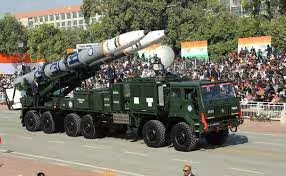
Background
- India has been focusing on indigenously designed and manufactured defence systems under Atmanirbhar Bharat.
- Pralay is part of efforts to strengthen short‑range precision strike capability for the armed forces.
- It complements India’s missile arsenal by filling the gap between long‑range ballistic missiles and tactical battlefield weapons.
Key Features
- Type: Short‑range, surface‑to‑surface quasi‑ballistic missile.
- Range: 150–500 km, suitable for tactical battlefield use.
- Payload: 500–1,000 kg; can carry conventional warheads.
- Propulsion: Solid fuel, ensuring quick launch readiness.
- Accuracy: Equipped with advanced guidance systems; CEP < 10 meters.
- Speed: Terminal velocity of Mach 6.1, enabling rapid target engagement.
- Targets: Designed to strike radar stations, command centres, airstrips, and other strategic assets.
- Manoeuvrability: Can alter trajectory mid‑flight, making interception difficult.
Development & Industry Collaboration
- Developed by: DRDO’s Research Centre Imarat (RCI), with support from other DRDO labs.
- Manufacturing Partners: Bharat Dynamics Limited (BDL), Bharat Electronics Limited (BEL), and several MSMEs.
- Represents successful public‑private collaboration in defence technology.
Significance
- Enhances India’s tactical strike capability in short‑range combat scenarios.
- Strengthens deterrence by providing a quick‑response weapon system.
- Reduces dependence on imports, aligning with India’s defence indigenisation goals.
AI IMPACT SUMMIT 2026
TOPIC: (GS2) INTERNATIONAL RELATIONS: THE HINDU
Prime Minister Narendra Modi will inaugurate the AI Impact Summit 2026 at Bharat Mandapam, New Delhi, from 15–20 February 2026, with participation from over 100 countries.
About the Summit
- A global high‑level platform to promote responsible, inclusive, and outcome‑oriented AI solutions.
- Hosted by India, reflecting its growing role in shaping global digital governance.
- Focused on applying AI to productive sectors of the economy.
Key Highlights
- Participation: Delegates from 100+ countries; 15–20 Heads of Government expected, including France.
- Registrations: Over 15,500 participants from 136 countries.
- Global South Representation: 76 countries participating, highlighting inclusivity.
- Global Leaders: Bill Gates, Demis Hassabis, Dario Amodei, Shantanu Narayen, Marc Benioff, Cristiano Amon, Raj Subramaniam among confirmed attendees.
- Expertise Pool: 100+ AI leaders including CXOs, CSOs, academics, and policy thinkers.
Core Objectives
- Develop AI solutions for key sectors:
- Healthcare: Better diagnostics, telemedicine, and public health systems.
- Agriculture: Smart farming, crop monitoring, and supply chain efficiency.
- Governance: Transparent service delivery and citizen‑centric administration.
- Education: Digital learning tools and personalised education models.
- Manufacturing: Automation, productivity enhancement, and Industry 4.0 adoption.
Significance
- Strengthens India’s position as a global hub for AI innovation and policy dialogue.
- Promotes collaboration between developed nations and the Global South.
- Aligns with India’s digital economy vision and Atmanirbhar Bharat in technology.