Table of Contents
ToggleHORMUZ HALT AND INDIA’S OIL SECURITY STRATEGY
TOPIC: (GS2) INTERNATIONAL RELATIONS: THE HINDU
Disruptions in oil shipments through the Strait of Hormuz due to conflict in West Asia have prompted India to consider increasing imports of Russian crude to maintain supply stability.
India’s Oil Dependence and Hormuz
- India is the thirdlargest consumer of crude oil, importing over 88% of its needs.
- Around 2.5–2.7 million barrels per day of crude imports pass through the Strait of Hormuz, accounting for nearly half of India’s total imports.
- Major suppliers through Hormuz include Iraq, Saudi Arabia, UAE, and Kuwait.
- India also relies heavily on Hormuz for LPG and LNG imports, making it a critical chokepoint for energy security.
Strategic Importance of the Strait
- The Strait of Hormuz is a narrow waterway between Iran and Oman, connecting the Persian Gulf to the Arabian Sea.
- It is the world’s most important oil transit chokepoint, handling nearly 20% of global petroleum and LNG trade.
- Recent claims by Iran’s Revolutionary Guards about closure led traders, insurers, and shipping firms to suspend shipments, raising global concerns.
Russian Crude as an Alternative
- India had reduced Russian oil imports during trade talks with the U.S., but disruptions in Hormuz have revived interest.
- Russian crude is available in large volumes in the Indian Ocean and Arabian Sea, including floating storage.
- Industry estimates suggest 10 million barrels of Russian crude are currently accessible in Asian waters.
- India imported 1.1 million barrels per day of Russian crude in February 2026, down from a peak of over 2 million barrels in 2025, leaving scope for increase.
India’s Energy Cushion
- Indian refiners hold 10 days of crude inventories and about a week’s worth of fuel stocks.
- Strategic petroleum reserves provide an additional week’s supply.
- These buffers offer shortterm protection against sudden disruptions.
Alternative Sourcing Options
- India can diversify imports from U.S., West Africa, Latin America, and Russia.
- Spot purchases and strategic reserves can help bridge temporary shortages.
- Russian crude in nearby waters offers immediate flexibility if Middle Eastern supplies remain blocked.
Key Vulnerabilities
- LPG imports (80–85%) are India’s biggest vulnerability, with no large strategic reserves.
- Around 60% of LNG imports also pass through Hormuz, with limited alternative buffers.
- Prolonged disruption could impact domestic fuel prices and household energy security more severely than crude oil.
Conclusion
Russian crude offers a shortterm cushion, the real challenge lies in securing LPG and LNG supplies. Diversification of sources, are essential to reduce dependence on this volatile chokepoint.
IRAN’S POWER PYRAMID AND SUPREME LEADER’S ROLE
TOPIC: (GS2) INTERNATIONAL RELATIONS: THE HINDU
The assassination of Ayatollah Ali Khamenei, Iran’s Supreme Leader, has triggered a leadership transition. The Assembly of Experts has begun deliberations to select his successor, while an Interim Leadership Council temporarily holds authority.
Historical Roots of Religion and Politics
- In Shiamajority Iran, clerics historically opposed monarchs and played active roles in political movements.
- Examples include the Tobacco Movement (1890s), the Constitutional Revolution (1906–11), protests against the Shah’s White Revolution (1963), and finally the 1979 Islamic Revolution.
- Mosques became safe spaces for mobilisation against repression, strengthening clerical influence.
1979 Revolution and Clerical Supremacy
- Ayatollah Khomeini’s leadership introduced the doctrine of velayatefaqih (rule of the jurist), making clerics the ultimate authority.
- The 1979 Constitution created the post of Supreme Leader, combining religious legitimacy with political power.
- After Khomeini’s death in 1989, amendments redistributed some executive powers but retained clerical supremacy.
Ayatollah Khamenei’s Leadership
- Khamenei became Supreme Leader in 1989 after serving as President during the IranIraq War.
- His leadership style blended religious authority with political control, often described as hardline but occasionally pragmatic.
- Domestically, he faced criticism during protests such as the Mahsa Amini movement (2022) and economic unrest.
- His “resistance economy” aimed to reduce dependence on the West but did not fully resolve economic challenges.
Institutions and Power Structure
- Iran’s system is hierarchical yet interconnected, rooted in revolutionary ideology.
- The Supreme Leader oversees the military, judiciary, media, and religious institutions.
- The Islamic Revolutionary Guard Corps (IRGC) is a key pillar, defending the regime internally and expanding influence abroad by supporting groups like Hezbollah and Hamas.
- Elections for President and Parliament exist, but clerical supremacy dominates decisionmaking.
Continuity and Change
- Both Khomeini and Khamenei shaped Iran’s unique clerical governance system.
- While reforms occurred, the principle of Supreme Leader supremacy remained central.
- Khamenei balanced rival factions, issued a fatwa against nuclear weapons, and approved the 2015 nuclear deal (JCPOA), showing a mix of ideology and pragmatism.
Challenges Ahead
- Leadership transition will test Iran’s constitutional mechanisms.
- Economic hardships, sanctions, and political restrictions have widened the gap between state and society.
- Growing public dissatisfaction demands greater accountability and participation.
Conclusion
The Supreme Leader remains the cornerstone of Iran’s political system, blending religious authority with state power. Khamenei’s death marks a turning point, and the successor’s ability to balance ideology, governance, and public expectations will shape Iran’s future stability.
RESETTING INDIA–CANADA RELATIONS
TOPIC: (GS2) INTERNATIONAL RELATIONS: THE HINDU
During Canadian Prime Minister Mark Carney’s visit to India, both countries signed a longterm uranium supply agreement and revived negotiations on the Comprehensive Economic Partnership Agreement (CEPA).
Background of Relations
- India and Canada share over 75 years of diplomatic relations, designated as a Strategic Partnership in 2018.
- The Indian diaspora in Canada is significant, with 1.8 million people of Indian origin (nearly 4% of Canada’s population), including over 425,000 students.
- Relations soured after the 2023 Nijjar controversy, leading to diplomatic expulsions and suspension of trade talks.
Major Outcomes of the Visit
- Uranium Supply Agreement: A $1.9 billion deal signed for 10,000 tonnes of uranium (2027–2035). Supports India’s civil nuclear programme, energy security, and clean energy transition.
- CEPA Negotiations: Terms of Reference finalised to boost bilateral trade from $8.66 billion (2024–25) to $50 billion by 2030.
- Energy Cooperation: Partnership in uranium, renewable energy, LPG, nuclear technology, and Small Modular Reactors (SMRs).
- Canada joined the International Solar Alliance and Global Biofuel Alliance, strengthening India’s climate diplomacy.
- Security Cooperation: Agreement to strengthen counterterrorism, intelligence sharing, and address Khalistani extremism.
Strategic Significance for India
- Energy Security: Reliable uranium supply ensures stable nuclear power generation.
- Economic Diversification: CEPA reduces dependence on U.S. markets and expands trade partnerships.
- Climate Goals: Cooperation in nuclear and renewable energy supports India’s netzero targets.
- IndoPacific Strategy: Strengthens ties with a G7 partner, enhancing India’s global standing.
Challenges
- Trust Deficit: Lingering tensions over the Nijjar killing and allegations of Indian involvement.
- Khalistan Issue: India’s concerns over separatist groups in Canada remain unresolved.
- Trade Barriers: Regulatory differences have delayed CEPA for years.
- Implementation Risks: Past uranium deals faced supply issues, raising reliability concerns.
Way Forward
- Institutionalised dialogue and regular engagement to rebuild trust.
- Fasttracking CEPA by addressing regulatory hurdles. Expanding energy partnerships, including SMRs and renewables.
- Transparent investigation mechanisms and intelligence cooperation to manage security concerns.
- Constructive diaspora engagement to balance extremism concerns with democratic freedoms.
Conclusion
The 2026 agreements mark a cautious reset in India–Canada relations. While uranium supply and CEPA talks signal pragmatic cooperation, unresolved security issues and mistrust remain obstacles.
NUCLEIC ACID TEST (NAT) FOR BLOOD TRANSFUSION
TOPIC: (GS3) SCIENCE AND TECHNOLOGY: THE HINDU
The Supreme Court of India is examining whether the Nucleic Acid Test (NAT) should be made compulsory in blood banks to ensure safer blood transfusions, following petitions citing risks of transfusionrelated infections.
Background of the Case
- A petition filed by an NGO argued that safe blood transfusion is part of the fundamental right to life under Article 21.
- The plea highlighted that NAT is more sensitive than current screening methods and can prevent infections like HIV, Hepatitis B, and Hepatitis C.
- The Court has sought data on costeffectiveness, feasibility, and Statelevel implementation before deciding.
What is NAT?
- NAT is a molecular diagnostic technique that detects the genetic material (DNA/RNA) of viruses in donated blood.
- It reduces the window period between infection and detectability, making transfusions safer.
- Current practice in India relies mainly on ELISA tests, which are cheaper but less sensitive in early infection stages.
Constitutional Dimension
- The petitioner argued that access to safe blood is part of the right to health and dignity under Article 21.
- The Supreme Court has previously interpreted Article 21 broadly to include healthcare and public safety.
- Making NAT mandatory would align with the State’s duty to protect public health.
Cost and Feasibility Concerns
- The Court raised concerns about whether economically weaker States can afford NAT implementation.
- Infrastructure, trained personnel, and financial resources are required for nationwide adoption.
- The Court has asked for details on where NAT is currently used and its operational status across States.
Public Health Context
- Reported cases of children contracting HIV from contaminated transfusions have intensified debate.
- Thalassemia patients, who need frequent transfusions, are especially vulnerable.
- Incidents in Madhya Pradesh and Jharkhand highlight gaps in current screening systems.
Policy and Regulatory Framework
- Blood safety is regulated under the Drugs and Cosmetics Act, 1940, supervised by the National Blood Transfusion Council (NBTC).
- Mandatory screening currently includes HIV, Hepatitis B & C, malaria, and syphilis, but NAT is not compulsory.
- Introducing NAT nationwide would require upgraded labs, skilled staff, and higher financial allocations.
Conclusion
The Supreme Court’s decision will have significant implications for India’s health governance and the constitutional right to safe medical care.
SEBI TO LEVERAGE AI AND TECH AGAINST MARKET MANIPULATION
TOPIC: (GS3) ECONOMY: THE HINDU
The SEBI Chairman announced that the regulator will strengthen surveillance using Artificial Intelligence (AI) and advanced technology to curb market manipulation and cyber fraud.
Key Announcements
- TechDriven Surveillance: AI tools to detect suspicious trading patterns and manipulation. Stronger enforcement against fraudulent brokers and cyber criminals.
- SEBI Check Tool: Allows investors to verify registered intermediaries before payments. Designed to prevent scams by fake brokers offering unrealistic returns.
- Investor Awareness Push: AIbased outreach pilot reached 3.85 lakh people. Campaigns caution against financial influencers promising “astronomical” returns.
- Market Stability Measures: Steps taken to reduce speculation in equity derivatives, especially shortduration options.
- Enforcement Record: Action against unregistered advisors and manipulators. High success rate in tribunal and Supreme Court cases.
Future Focus Areas
- Revitalising agricultural commodity markets.
- Deepening the corporate bond market.
- More scientific policy making with impact assessments.
Significance
- Strengthens investor protection and market transparency.
- Builds trust in capital markets by tackling fraud.
- Reflects a shift toward datadriven regulation.
- Aligns with India’s digital public infrastructure ecosystem, including UPI.
Conclusion
SEBI’s adoption of AI and technology marks a major step in modernising financial regulation. By combining surveillance, investor awareness, and enforcement, it aims to ensure safer, transparent, and resilient capital markets in India.
ALMA TELESCOPE
TOPIC: (GS3) SCIENCE AND TECHNOLOGY: THE HINDU
Astronomers recently used the ALMA telescope to capture the central region of the Milky Way, revealing a complex network of cosmic gas filaments in unprecedented detail.
About ALMA
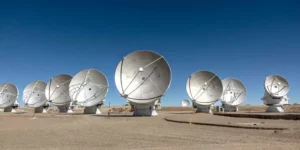
- Full name: Atacama Large Millimeter/submillimeter Array (ALMA).
- Location: Atacama Desert, Chile.
- Operational since 2013.
- Jointly developed by the US National Radio Astronomy Observatory (NRAO), National Astronomical Observatory of Japan (NAOJ), and the European Southern Observatory (ESO).
- Studies celestial objects at millimetre and submillimetre wavelengths.
Key Properties
- Extraordinary sensitivity to detect faint radio signals.
- Comprises 66 highprecision antennas, spread over up to 16 km.
- Antennas can be moved closer or farther apart, functioning like a zoom lens for different perspectives.
Major Discoveries
- 2013: Identified starburst galaxies earlier in cosmic history than previously known.
- Produced detailed images of the protoplanetary disc around HL Tauri, a young star about 450 light years away.
- Observed the Einstein ring phenomenon, where light bends around massive objects due to gravitational lensing.
Significance
- ALMA provides insights into galaxy formation, star birth, and cosmic structures.
- Helps astronomers study the early universe and understand the physics of interstellar matter.
- Its latest findings on the Milky Way’s centre deepen knowledge of gas dynamics and starforming regions.
Conclusion
The ALMA telescope is one of the most advanced radio astronomy facilities in the world. By unveiling hidden structures of the universe, it strengthens our understanding of cosmic evolution and supports cuttingedge astrophysical research.
ELIGIBLE MANUFACTURER IMPORTERS (EMIS) SCHEME
TOPIC: (GS3) ECONOMY: THE HINDU
The Central Board of Indirect Taxes and Customs (CBIC) has recently issued detailed guidelines, eligibility conditions, and application procedures for the Eligible Manufacturer Importers (EMIs) scheme.
About the Scheme
- A trustbased facilitation initiative aimed at easing compliance for manufacturers.
- Allows approved importers to clear goods without immediate customs duty payment.
- Duties can instead be paid monthly under the Deferred Payment of Import Duty Rules, 2016.
- Duration: Effective from 1 April 2026 to 31 March 2028.
Eligibility
- Existing Authorised Economic Operators (AEOs) are eligible.
- AEOT1 entities, including MSMEs meeting conditions, can also participate.
- Participants are expected to gradually upgrade to AEOT2 or AEOT3 status, gaining faster clearances and priority treatment.
Key Features
- Simplifies import procedures, reducing compliance burden.
- Encourages manufacturers to maintain high standards of compliance.
- Provides flexibility in duty payments, improving cashflow management.
- Linked with the AEO Programme, which offers enhanced facilitation and global recognition.
Expected Benefits
- Improves ease of doing business by reducing procedural delays.
- Strengthens compliance culture among manufacturers.
- Supports domestic manufacturing growth by lowering transaction costs.
- Encourages MSMEs to integrate into global supply chains with better facilitation.
Conclusion
By easing duty payments and linking with the AEO framework, it is expected to boost manufacturing competitiveness and support India’s trade and industrial growth.
SULPHUR DIOXIDE (SO₂)
TOPIC: (GS3) ENVIRONMENT: THE HINDU
India currently has no national emission standards for sulphur dioxide from steel plants and mill zones, despite these being recognised as major SO₂ sources.
About Sulphur Dioxide
- A colourless gas with a sharp, irritating smell (like a struck match).
- Easily dissolves in water and can exist as a liquid under pressure.
- Widely used in chemical manufacturing, paper pulping, food processing, and metal industries.
Sources and Occurrence
- Industrial sources: Burning of coal and oil in power plants, copper smelting, and steel production.
- Natural sources: Volcanic eruptions release SO₂ into the atmosphere.
- Industrial preparation: Produced by burning sulphur or sulphur compounds such as pyrites.
- The largest contributor is fossil fuel combustion in power plants and heavy industries.
Impacts
- Human health: Causes respiratory problems, irritation of eyes and throat, and worsens asthma.
- Environment: Contributes to acid rain, damaging crops, forests, and aquatic ecosystems.
- Climate: SO₂ aerosols can affect atmospheric chemistry and influence global warming patterns.
Policy Context
- India regulates air pollutants under the Air (Prevention and Control of Pollution) Act, 1981, but lacks specific SO₂ emission norms for steel plants.
- Establishing national standards is crucial for public health protection and environmental safety.
Conclusion
Sulphur dioxide remains a critical pollutant from industrial and natural sources. With rising emissions from steel and power plants, India urgently needs clear national standards