

Daily Current affairs 04 March 2026

Daily Current Affairs 04-March-2026

Share this Post

U.S.–ISRAEL ATTACKS ON IRAN AND GLOBAL FUEL TRADE

TOPIC: (GS2) INTERNATIONAL RELATIONS: THE HINDU

The recent U.S.–Israel military strikes on Iran and Tehran’s retaliation, including the closure of the Strait of Hormuz, have triggered a surge in global oil prices and threatened energy security worldwide.

Escalation in West Asia Conflict

  • Operation Epic Fury: Joint strikes by the U.S. and Israel targeted over 500 sites in Iran, resulting in more than 780 deaths and extensive infrastructure damage.
  • Iran’s Retaliation: Iran launched missile attacks on U.S. bases across Qatar, UAE, Saudi Arabia, Kuwait, Bahrain, and Jordan, marking a direct regional escalation.
  • Regional War: The confrontation has expanded into a wider West Asian conflict, disrupting oil and gas supplies. Brent crude prices spiked above $110 per barrel, raising global inflation concerns.
  • Energy Security Impact: Gulf states account for nearly 30% of global oil exports; disruptions threaten India’s energy imports (India sources ~60% of crude from the Gulf).
  • Geopolitical Fallout: The conflict risks destabilising shipping routes like the Strait of Hormuz, through which 20% of global oil trade passes.
U.S-Israel Military Strikes on Iran

Strait of Hormuz

  • Geographic Location: A narrow waterway between Iran and Oman, linking the Persian Gulf with the Arabian Sea.
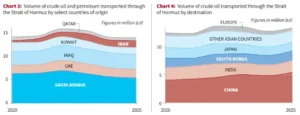
  • Global Oil Chokepoint: Handles about 20% of world oil exports and nearly 31% of seaborne crude flows, making it the most critical energy transit route.
  • Volume of Trade: Around 14 million barrels per day of crude oil and petroleum products pass through this strait.
  • Disruption Risks: Closure or blockades through threats, minelaying, or direct military attacks by Iran have halted shipments, threatening global energy security.
  • Strategic Impact: Any disruption affects India’s energy imports (60% sourced from Gulf) and raises global oil prices, as seen during past tensions when crude spiked above $110 per barrel.

Impact on Global Energy

  • Oil prices surged to $78.31 per barrel, up nearly 12% in a week.
  • Qatar suspended LNG production at the world’s largest export facility.
  • Refineries in Saudi Arabia and Iraq also halted operations.
  • West Asia accounts for 31% of global oil production and 38% of global oil exports (2024).

Impact on China and India

  1. China:
    • Imported 5.4 million barrels/day via the Strait in FY25Q1.
    • 56% of its oil imports came from West Asia in 2024.
    • Holds 1.2 billion barrels in strategic and commercial reserves (up 30% since 2020).
    • Heavily dependent on Iranian crude (97% of Iran’s exports went to China in 2024).
  1. India:
    • Imported 2.1 million barrels/day via the Strait.
    • Holds crude reserves sufficient for 25 days.
    • Vulnerable if disruption continues, as most imports come from Gulf suppliers.

Impact of Strait of Hormuz Closure

  • Global Energy Security Threat: Disruption raises risks of fuel price inflation and volatility in international markets.
  • Immediate Supply Challenges: Major importers like India and China face direct shortages due to heavy reliance on Gulf oil.
  • Need for Diversification: Highlights importance of alternative energy sources, strategic petroleum reserves, and new transport routes to reduce dependence on this chokepoint.

Conclusion

For India, securing alternative supplies, expanding reserves, and diversifying energy partnerships are critical to withstand prolonged disruptions in this vital chokepoint.

PAKISTAN’S ARMS SALES AND STRATEGIC CONCERNS FOR INDIA

TOPIC: (GS3) SEQURITY: THE HINDU

Pakistan recently signed its largest defence export deal worth $4.6 billion with Libya’s National Army, alongside negotiations with Sudan for another multibillion dollar arms deal.

Recent Developments

  • Libya Deal: Agreement with Libyan National Army for 16 JF17 fighter jets and 12 Super Mushak trainers. Deal reportedly financed by the UAE.
  • Sudan Negotiations: Talks with Sudan Armed Forces for $1.5 billion defence equipment, including Karakorum8 aircraft, drones, and air defence systems.
  • Pakistan claims defence exports worth $13 billion, including supplies to Azerbaijan, Myanmar, Nigeria, and offers to Bangladesh.

Drivers of Pakistan’s Defence Push

  • Leveraging joint ventures with China and Türkiye.
  • Support from Gulf monarchies seeking regional proxies.
  • Aggressive marketing using Islamic solidarity, military links, and competitive pricing.
  • Strategic partnerships, including a defence pact with Saudi Arabia and backing from the U.S. administration.

Constraints

  • Limited Production Capacity: Annual output restricted to about 25 JF17 aircraft, with dependence on foreignsourced components.
  • Dependence on External Financing: Many deals rely on thirdparty funding from Gulf states, making them vulnerable to external political and financial shifts.
  • Legal and Geopolitical Barriers: Target markets such as Libya and Sudan are under UN arms embargoes, complicating legitimacy and execution of contracts.
  • Quality and Reputation Risks: Concerns over substandard product performance could damage Pakistan’s credibility in global defence markets.
  • Regional Rivalries: SaudiUAE competition and broader Gulf tensions may undermine or destabilise these defence agreements.

Strategic Implications for India

  • Pakistan’s growing role as a security provider in the Gulf could challenge India’s influence.
  • Defence exports help Islamabad shed its image of terrorism and financial instability.
  • Enhanced militaryindustrial role may embolden Pakistan to revive crossborder terrorism.
  • India risks losing strategic space in a region where it has strong economic and energy ties.

Steps for India

  • Expand Export Volume: Scale up defence exports beyond the current $2.8 billion by leveraging indigenous manufacturing capabilities.
  • Focus on Global South & Neighbourhood: Target friendly nations and regional partners with costeffective, reliable systems suited to their needs.
  • Leverage Oil Trade: Use India’s position as a major crude importer to encourage Gulf states to balance trade by procuring Indian defence products.
  • Utilise Aid & Credit Lines: Integrate defence exports with India’s development aid programmes and concessional credit facilities to support partner nations.
  • Create Dedicated Export Body: Establish a specialised defence export promotion organisation with autonomy to market products, negotiate contracts, and conclude deals efficiently.

Conclusion

Pakistan’s aggressive defence sales strategy is reshaping its role in West Asia and Africa. For India, the challenge lies in scaling up defence exports, deepening partnerships, and leveraging economic influence to maintain strategic balance in the region.

ALIGNING RELIGIOUS TOURISM WITH ECOLOGY

TOPIC: (GS3) ENVIRONMENT: THE HINDU

The Standing Committee of the National Board for Wildlife (SCNBWL) recently proposed to expand religious structures inside sanctuaries, raising concerns about balancing faith practices with ecological protection.

Religion–Ecology Linkages in India

  • Overlap with Sensitive Ecosystems: India’s sacred geography often coincides with forests, caves, shrines, and pilgrimage routes located inside or near protected areas.
  • Traditional Regulation: For centuries, belief systems and community norms restricted extraction and ensured coexistence with nature.
  • Rising Pressures: Mass tourism and commercialisation now strain fragile ecosystems, with pilgrim numbers rising sharply (e.g., Kumbh Mela 2019 drew ~25 crore visitors).
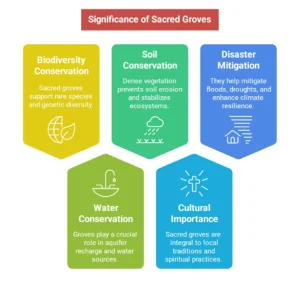
  • Sacred Groves as Biodiversity Refuges: India has over 13,000 documented sacred groves, covering thousands of hectares, especially in Maharashtra, Karnataka, Kerala, and Himachal Pradesh. These groves conserve species diversity and water sources.
  • Protected Area Stress: India has 104 national parks and 564 wildlife sanctuaries, many hosting religious sites. Unregulated expansion risks habitat fragmentation and human–wildlife conflict

Sanctuary Expansion Concerns

  • Proposal in Gujarat: A plan to expand a religious site inside a sanctuary was first approved but later withdrawn.
  • Precedent Risk: Expansion could set a dangerous precedent for diverting protected areas to religious institutions.
  • Legal Restrictions: Under the Forest (Conservation) Act, 1980, any construction on forest land after 1980 is treated as encroachment.
  • Wildlife Protection Norms: The Wildlife (Protection) Act, 1972 and NTCA guidelines allow only limited, justified interventions to manage ecological pressures.

Sacred Groves

  • Sacred groves are communityprotected forest patches linked to local faith traditions.
  • They act as biodiversity refuges, restricting extraction and disturbance.
  • India has over 13,000 documented sacred groves, especially in states like Maharashtra, Karnataka, Kerala, and Himachal Pradesh.
Aligning Religious Tourism with Ecology

Govt Initiatives

  • Forest Rights Act, 2006: Recognises rights of Scheduled Tribes and forest dwellers.
  • National Tiger Conservation Authority (NTCA): Issues norms for managing religious tourism in tiger reserves.
  • ATREE–WWF Guidelines (2023): Proposed a green pilgrimage model with caps on visitors, waste management, and transport restrictions.

Ecological Challenges of Religious Tourism

  • Habitat Fragmentation: Unregulated construction inside forests breaks natural habitats and increases human–wildlife conflict (e.g., rising leopard encounters near pilgrimage routes in Uttarakhand).
  • Ignoring Forest Rights: Failure to recognise rights under the Forest Rights Act, 2006 marginalises local communities who traditionally protect sacred groves and forest shrines.
  • Commercialisation Pressure: Large pilgrimages overwhelm fragile ecosystems — for instance, the Amarnath Yatra and Kumbh Mela have reported issues of waste, pollution, and strain on local resources.

Way Forward

  • Noexpansion principle: Ban new constructions in core forest areas.
  • Casebycase evaluation of longstanding sites with strict ecological safeguards.
  • Mandatory settlement of forest rights before regulating access.
  • Green pilgrimage models: Visitor caps, waste management, bans on night traffic.
  • Multistakeholder governance: Forest departments, temple trusts, local bodies, and conservation NGOs.
  • Awareness campaigns involving religious leaders to promote ecofriendly practices.

Examples & Importance

  • KalakadMundanthurai, Ranthambhore, Corbett: Pilot projects showed reduced roadkill, plastic waste, and water contamination.
  • Sivakasi (Tamil Nadu): Improved safety record in fireworks industry through training — similar awareness can help religious tourism.
  • India hosts millions of pilgrims annually (e.g., 2.5 crore at Kumbh Mela 2019), making ecological safeguards critical.

Conclusion

India must integrate faith and ecology by protecting sacred landscapes while respecting cultural traditions. A principled approach  zero tolerance for new encroachments, recognition of forest rights, and adoption of green pilgrimage models.

INDIA’S NEED FOR A MANDATORY R&D DISCLOSURE STANDARD

TOPIC: (GS3) SCIENCE AND TECHNOLOGY: THE HINDU

Experts have proposed a Mandatory R&D and Technology Disclosure Standard under SEBI’s Listing Obligations and Disclosure Requirements (LODR) to improve transparency and boost corporate innovation in India.

Mandatory R&D Disclosure Standard

  • Structured Innovation Reporting: Requires listed firms to disclose R&D spend, patents, workforce details, project maturity, and revenue from new products under SEBI’s LODR framework.
  • Transparency for Investors: Helps markets distinguish genuine innovation from lowquality projects, reducing information gaps and lowering cost of capital.
  • Boost to Innovation: Encourages higher R&D intensity, efficient resource use, and strengthens India’s move toward a knowledgedriven economy without dictating spending levels.

India’s R&D Ecosystem

  • Low R&D Intensity: India’s corporate R&D spending is only 0.23% of GDP, far below global peers like South Korea (4.8%), China (2.4%), and the OECD average (~2.5%).
  • Weak Disclosure Mechanisms: Absence of structured reporting means investors cannot distinguish genuine innovation from lowquality or copycat projects, leading to mispricing.
  • Undervaluation of Innovation: With poor visibility, innovation is systematically undervalued and underproduced, discouraging firms from investing in risky but highimpact projects.
  • Limited Indigenous ValueAdd: In licensed defence and aerospace production, India’s domestic contribution has historically been 25–35%, concentrated in structural manufacturing rather than mission systems.
  • Global Comparison: Countries with mandatory R&D disclosure frameworks (e.g., China’s Shanghai Stock Exchange) saw 6–12% rise in R&D intensity in OECD economies and 3–14% rise across large crosscountry samples.

Global Evidence

  • OECD Economies: Studies show that structured R&D disclosure can raise innovation intensity by 6–12%, proving transparency directly boosts investment in research.
  • China’s Shanghai Stock Exchange: Mandated disclosures led to higher innovation output, especially among nonstate enterprises, hightech firms, and financially constrained companies.
  • South Korea (KIFRS Framework): Introduction of mandatory intangible asset disclosures pushed firms to increase R&D spending, as visibility of innovation metrics created market discipline.
  • CrossCountry Firm Samples: Evidence suggests disclosure improves allocation of funds towards riskier innovation projects, rather than traditional capital expenditure.
  • OECD Intangibles Report (2021): Countries with compulsory innovation reporting achieved better patent productivity and commercial outcomes per unit of R&D spending.

Proposed Framework

  • Disclosure standard under SEBI’s LODR, 2015.
  • Firms to report across five dimensions:
    1. R&D expenditure (capital and revenue, with segment details).
    2. Patent activity (filings, grants, expirations).
    3. Technology workforce composition.
    4. Technology Readiness Level (TRL) of major projects.
    5. Innovation turnover (share of revenue from products introduced in last five years).
  • Voluntary disclosure for two years, then mandatory.

Rationale

  • Reduces information asymmetry: Investors can identify genuine innovators.
  • Lowers cost of capital: Transparency builds investor confidence.
  • Strengthens market discipline: Firms face pressure to improve innovation metrics.
  • Improves efficiency: Better allocation of funds leads to more patents and stronger outcomes.
  • Nondistortionary policy: Does not force spending, only ensures accurate information.

Significance

  • Encourages highquality innovation and prunes weak projects.
  • Enhances investment efficiency and supports India’s innovation ecosystem.
  • Aligns with India’s goal of becoming a knowledgedriven economy.

Conclusion

Mandatory R&D disclosure is a lowcost, highimpact reform. By shining light on innovation metrics, India can strengthen investor confidence, improve efficiency, and ensure that genuine innovation flourishes.

SAFETY IN EXPLOSIVES UNITS

TOPIC: (GS3) DISASTER MANAGEMENT: THE HINDU

Recent explosions at Firecrackers industry killed workers, exposing serious lapses in safety norms and weak regulatory oversight in India’s explosives industry.

Background

  • India’s highrisk industries often operate with poor safety records, unskilled labour, and weak regulation.
  • The Konaseema blast (2025) killed 10 people, prompting new safety norms.
  • Despite this, the Vetlapalem blast (2026) killed 20 workers, showing noncompliance.
  • In Nagpur, multiple accidents in explosives factories have killed over 20 workers in two years, mostly women.

Major Concerns in Explosives Industry

  • Exceeding Limits: Many factories operate beyond their permitted quotas of explosives and workforce strength.
  • Exploited Workforce: Majority of workers are poorly paid women, often displaced from farmland acquired for factories.
  • Political Influence: Owners’ strong political connections weaken enforcement and shield them from strict action.
  • Regulatory Corruption: The regulator, Petroleum and Explosives Safety Organisation (PESO), has itself faced corruption inquiries for licence irregularities.
  • Accountability Gap: Despite repeated accidents, some factory owners have even received national honours, raising serious questions about responsibility and oversight.

Lessons from Tamil Nadu

  • Sivakasi’s fireworks industry, once infamous for child labour and accidents, improved safety through:
    • Worker training and awareness.
    • Owner commitment to safety norms.
    • However, illegal units still report accidents.

Challenges

  • Weak Enforcement: Safety rules and SOPs are poorly implemented, leading to frequent violations.
  • Corruption & Influence: Regulatory action is diluted by political connections and bribery.
  • Untrained Workforce: Workers often lack proper training and awareness of safety risks.
  • Profit Over Safety: Business owners prioritise financial gains over worker protection.
  • No Accountability: Repeated accidents occur without strict penalties or responsibility being fixed.

Way Forward

  • Strict Enforcement: Apply safety norms rigorously with zero tolerance for violations.
  • Independent Oversight: Strengthen PESO with transparent monitoring to curb corruption.
  • Worker Training: Make safety training compulsory for workers and supervisors.
  • Technology Use: Adopt modern tools for tracking explosive handling and storage.
  • Owner Accountability: Impose penalties, cancel licences, and enforce criminal liability for negligence.
  • Learning from Sivakasi: Replicate its model of awareness, training, and compliance to improve safety.
  • Community Involvement: Engage locals to ensure they are informed and protected.

Conclusion

Unless regulatory mechanisms are strengthened, owners held accountable, and workers trained, accidents will continue. A safetyfirst approach is essential to protect lives and restore trust in highrisk industries.

INDIA’S FIGHTER JET ACQUISITIONS

TOPIC: (GS3) SEQURITY: THE HINDU

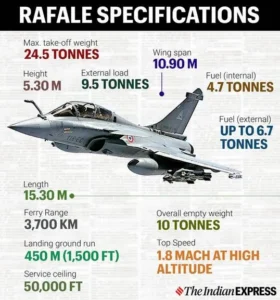
India’s Defence Acquisition Council has cleared the procurement of 114 Rafale fighter jets from Dassault Aviation, valued at ₹3.25 lakh crore.

Background

  • India operates 29 fighter squadrons against an authorised strength of 42.
  • Retirement of MiG21s (2025) exposed gaps in fleet strength.
  • Neighbours: Pakistan has ~25 squadrons, China ~65.
  • Operation Sindoor (2025) highlighted vulnerabilities in beyondvisualrange engagements.
India's Fighter JET Acquisitions                                          

Rafale Deal

  • 114 aircraft: 18 flyaway, 96 to be built in India.
  • Indigenous content: 30% initially, targeted to reach 60%.
  • Tata Advanced Systems to manufacture fuselage sections in Hyderabad (24 annually from FY2028).
  • France emphasises Make in India, but source code access for radar and electronic warfare systems denied.

Technology Transfer Challenges

  • Without source codes, India cannot independently integrate indigenous weapons or sensors.
  • Past Mirage2000 upgrades showed dependence on French vendors, costing over €1 billion.
  • Turkey’s TFX programme illustrates risks of partial transfer — airframe rights but engine dependence.
  • Russia has offered deeper access with Su57, but sanctions and engine transition raise doubts.

Diversification Strategy

  • India diversifies across France, Russia, Israel, and the U.S. to avoid supplier monopoly.
  • Export of Su30MKI to Armenia with indigenous Uttam AESA radar and Astra missiles signals India’s shift from licensee to modifierexporter.
  • Budget 202627: ₹7.85 lakh crore defence allocation, with 75% capital outlay for domestic procurement.

Challenges

  • Indigenous valueadd remains 25–35%, mostly in structural manufacturing.
  • Weak Tier2 and Tier3 supplier ecosystem.
  • Shortage of skilled aerospace engineers and advanced design capabilities.
  • Risk of India becoming an assembler without design authority.

Way Forward

  • Double R&D intensity to match global standards.
  • Build deeptier aerospace supply chains with capital and certification support.
  • Secure source code access through negotiations or indigenous development.
  • Scale human capital in aerospace engineering, AIdriven design, and simulation.
  • Strengthen indigenous platforms like Tejas Mk2 and AMCA to accumulate intellectual property.

Conclusion

India’s fighter jet acquisitions are not just about fleet expansion but about industrial sovereignty. Strategic autonomy will depend less on the number of aircraft and more on ownership of mission software, design architecture, and indigenous innovation capacity.


AI IMPACT CASEBOOKS IN INDIA AI SUMMIT 2026

TOPIC: (GS3) SCIENCE AND TECHNOLOGY: THE HINDU

At the India AI Impact Summit 2026, a set of AI Impact Casebooks were released showcasing how indigenous AI tools are being deployed across regions of the Global South to address challenges faced by farmers, students, patients, and the physically challenged.

What are AI Impact Casebooks?

  • They are documentation of real-world AI deployments in India and other Global South countries.
  • Highlight inclusive, region-specific applications of AI in agriculture, healthcare, education, accessibility, and gender empowerment.
  • Aim to demonstrate how indigenous AI innovations can solve local problems at scale.

Accessibility Casebook

  • PathPal: Edge-AI tool for visually impaired, reads handwritten notes, printed text, and currency with instant audio feedback.
  • SMARTON: Converts complex documents, tables, and diagrams into structured audio for inclusive education (15,000+ users).
  • Shruti AI: Real-time voice-to-Indian Sign Language translation for the deaf.
  • Vaani AI: Augmentative communication for autism and speech impairments.
  • Pheezee: Wearable device tracking muscle recovery for stroke and amputee patients.

Agriculture Casebook

  • MapMyCrop: Satellite + AI monitoring of sugarcane farms, boosting yields by 57%.
  • Chemistry-Aware Crop Yield Prediction: Detects soil toxicities, reduces nitrogen use by 28%.
  • MahaVISTAAR (Maharashtra) & FarmAdvice (Africa): Voice-first advisories in local dialects, bridging literacy gaps.

Gender Empowerment Casebook

  • NyayaSakhi-SWATI (Maharashtra): AI legal assistant for domestic violence survivors.
  • AtenIA (Peru): AI mentoring to encourage girls in STEM; STEM career intent rose from 9% to 76%.
  • YASHODA AI: Trains women to identify AI-driven harms like deepfakes.
  • MetsaQ (Odisha): Voice-based agricultural advisories via SHGs; 34% women farmers accessed credit (baseline 11%).

Health Casebook

  • Nayanamritham 2.0 (Kerala): AI-enabled diabetic retinopathy screening.
  • CATB: AI cough analysis for TB detection.
  • AI-assisted cervical cancer screening in Rwanda & Kenya.
  • AyurVAID D-RISK: Non-invasive diabetes detection.
  • Virtual Cardiac Twin: 3D heart visualisation for surgeons.

Education Casebook

  • BharatGen Yojaka: AI assessment of spoken language with teacher oversight.
  • Chimple: Generative AI studio for vernacular learning games.
  • QwiXGenie: AI tutoring for coding in Tier-2/3 cities.
  • PadhAI: Speech recognition for oral reading fluency.

Significance

  • Demonstrates India’s indigenous AI capacity in solving local challenges.
  • Promotes inclusive growth by targeting vulnerable groups — farmers, women, students, and the disabled.
  • Strengthens India’s role in shaping AI for social good in the Global South.

Conclusion

The AI Impact Casebooks highlight India’s shift from being a technology consumer to a technology innovator, using AI to empower communities, improve livelihoods, and enhance social equity.

CENTRE SIGNS ₹5,083 CRORE MARITIME SECURITY DEAL

TOPIC: (GS3) SEQURITY: THE HINDU

The Defence Ministry has signed contracts worth ₹5,083 crore to strengthen maritime security, including procurement of six ALH MkIII helicopters for the Coast Guard and Shtil missiles for the Navy.

Key Acquisitions

  • Advanced Light Helicopters (ALH MkIII)
    • Contract with Hindustan Aeronautics Ltd. (HAL) worth ₹2,901 crore.
    • Six twinengine helicopters with modern features for maritime roles.
    • Capable of missions from shore bases and ships at sea.
    • Will enhance Coast Guard’s ability to protect offshore installations, artificial islands, fishermen, and marine environment.
    • Project involves supply from 200+ MSMEs, generating ~65 lakh manhours of employment.
  • Shtil SurfacetoAir Missiles
    • Contract with Russia’s JSC Rosoboronexport, valued at ₹2,182 crore.
    • To be installed on frontline warships.
    • Provides layered air defence against diverse aerial threats.
    • Offers rapidreaction, allweather engagement capability, improving survivability in contested maritime zones.

Indigenous Push

  • ALH MkIII procurement falls under Indigenously Designed, Developed, and Manufactured (IDDM) category.
  • Reinforces Aatmanirbhar Bharat and MakeinIndia initiatives.
  • Encourages domestic defence production and MSME participation.

Strategic Significance

  • Strengthens India’s maritime security architecture.
  • Enhances air defence capability of Navy warships.
  • Boosts employment and industrial growth through indigenous manufacturing.
  • Reflects India’s continued defence partnership with Russia while promoting selfreliance.

Conclusion

The dual acquisition of ALH MkIII helicopters and Shtil missiles represents a balanced approach — advancing indigenous defence manufacturing while leveraging strategic partnerships abroad under the Aatmanirbhar Bharat vision.

Write a Review

Your email address will not be published. Required fields are marked *