
Table of Contents
ToggleINDIA’S SOFT POWER
TOPIC: (GS2) INTERNATIONAL RELATIONS: THE HINDU
India recently repatriated the Piprahwa Buddhist relics, which were nearly auctioned abroad, and showcased them at the international exposition “The Light and The Lotus” in New Delhi. The episode highlights India’s cultural diplomacy and Buddhist soft power.
Soft power
- Soft power means influencing others through attraction and persuasion rather than force or money. It uses culture, values, and diplomacy to build goodwill and shape preferences.
- Cultural Example: India’s yoga, Bollywood films, and cuisine spread worldwide, creating a positive image of the country.
- Diplomatic Example: India’s Buddhist diplomacy (sharing relics, gifting Bodhi tree saplings) strengthens ties with Asian nations.
- Contrast with Hard Power: Unlike military strength or economic sanctions, soft power works through credibility, culture, and values.

Piprahwa relics
- Cultural Diplomacy: By reclaiming and showcasing Buddhist relics, India projects itself as the custodian of ancient heritage and spirituality.
- Global Connect: Buddhism has followers across Asia and beyond; sharing relics and Bodhi tree saplings strengthens India’s ties with these countries.
- Peace Narrative: Linking Buddha’s philosophy of dialogue and non‑violence to India’s foreign policy enhances India’s image as a nation promoting peace and harmony.
Rescue from Auction and Repatriation (2025)
- Auction Threat: Sotheby’s Hong Kong listed relics worth over $100 million as collectibles.
- India’s Response: Ministry of Culture issued legal notice; ASI and diplomatic channels intervened.
- Resolution: Godrej Group purchased relics and returned them to India, loaned to National Museum for five years.
- Avoided ethical concerns of direct state purchase of sacred objects.
Shared Buddhist Heritage and Soft Power
- Relics displayed globally in Thailand, Mongolia, Vietnam, Russia, inspiring millions.
- India gifted Bodhi tree saplings to countries like China, Japan, Korea, Mongolia.
- Symbolic diplomacy: Bodhi tree planted in Hiroshima as a peace symbol.
Preservation of Buddhist Heritage
- International: Restoration of pagodas in Myanmar; aid to Nepal after earthquake.
- Domestic: Development of Buddhist Circuit, promotion of Pali language, improved infrastructure for pilgrimage sites.
Challenges and Way Forward
- Colonial Legal Ambiguities: Need stronger global cooperation on cultural property.
- Auction Houses: Prevent commercialisation of sacred antiquities.
- International Law Gaps: UNESCO conventions limited for pre‑1970 removals.
- Future Strategy: Build global database of stolen antiquities; expand cultural diplomacy through Buddhism, yoga, and heritage narratives.
Piprahwa Relics
Relics are special objects from the past, often linked to history or religion. A relic is something that has survived from an earlier time, like an old artifact or tradition.
- Religious Relics: In many faiths, relics are holy objects – for example, bones, ashes, or personal belongings of saints, monks, or spiritual leaders.
- Excavated in 1898 at Piprahwa (Uttar Pradesh) near Nepal by William Claxton Peppé.
- Relics include 349 gemstones, bone fragments, ash, reliquaries, and caskets believed to be linked to Lord Buddha.
Under colonial law (Treasure Trove Act, 1878), most relics went to the British Crown; some remained with the Peppé family for over 127 years.
Conclusion
The Piprahwa relics’ return is a civilisational reclamation, blending law, diplomacy, and moral authority. It strengthens India’s image as the custodian of Buddha’s legacy and a nation promoting peace, dialogue, and shared heritage in global geopolitics.
SOCIAL SECURITY FOR GIG WORKERS
TOPIC: (GS2) GOVERNANCE: THE HINDU
A nationwide strike by gig workers on December 31, 2025 highlighted their demand for fair wages and secure working conditions under the new labour codes.
Who are Gig Workers?
- Platform‑based Workers as they earn through digital apps such as food delivery, ride‑hailing, and courier services.
- Distinct from Regular Employees: India’s labour codes recognise them separately, not as traditional employees.
- Social Security Contribution: Platforms must pay into a Social Security Fund, but issues of wages and working conditions are not covered.
- India’s gig economy has grown rapidly, with around 12 million gig workers in FY 2024–25, up from 7.7 million in 2020–21, now making up over 2% of the total workforce.
Key Provisions in Draft Rules
- Gig workers must register on a government portal.
- Aggregators must upload and update worker details every quarter.
- Eligibility: At least 90 days with one aggregator, or 120 cumulative days across multiple aggregators in a financial year.
- One calendar day can count multiple times if a worker earns via different platforms.
Concerns
- Exclusion from Wage Protection: Code on Wages does not recognise gig workers as employees, leaving issues like rate cuts and incentives unaddressed.
- Rigid Eligibility: 90/120‑day thresholds may penalise workers during illness, maternity, or demand slumps.
- Opaque Systems: Lack of clarity on benefits, dispute resolution, and minimum support from the Social Security Fund.
- Data Transparency: Workers currently lack access to verified records of jobs, hours, and deductions.
- Platform Control: Rules do not limit how platforms organise work, leaving workers vulnerable to algorithmic changes.
Way Forward
- Inclusive Design: Eligibility rules must account for illness, maternity, and seasonal demand fluctuations.
- Clear Benefits: Specify minimum benefits, claims process, and dispute resolution mechanisms.
- Transparency: Aggregators should provide periodic statements of work and earnings, with scope for workers to contest errors.
- Worker Protection: Social security must be accessible, reliable, and not dependent on platform goodwill.
Conclusion
The draft Rules are a step towards recognising gig workers, but without wage protection and stronger safeguards, insecurity will persist. For genuine reform, India must ensure social security that is practical, transparent, and inclusive, addressing the structural issues that triggered the strikes.
RECOGNISING WOMEN’S LABOUR
TOPIC: (GS2) GOVERNANCE: THE HINDU
A recent UN report (2023) highlighted that women globally spend more time than men on unpaid care and domestic work.
Invisible Contribution of Women’s Work
- In India, unpaid and emotional labour gained attention after the Madras High Court (2023) acknowledged household work as contributing to family assets.
- Women’s efforts within households often remain unrecognised and undervalued.
- Tasks involving domestic care, emotional support, and mental labour are vital for families and society but are rarely counted in economic indicators.
- scholars highlight that GDP‑focused growth models and policy frameworks overlook care work, treating it as less important than conventional “productive” labour.
Why Women’s Labour Remains Invisible
- Structural Bias: Male breadwinner model dominates economic thinking.
- Policy Priorities: Focus on GDP and physical infrastructure sidelines social infrastructure like childcare and elder care.
- Gender Division of Labour: Biological roles used to mask historical and social inequalities.
- Governance Gap: National budgets and labour laws fail to include unpaid care and emotional work.
Why Recognising Women’s Care Work Matters
- Economic Value of Unpaid Work: Women in India spend 299 minutes per day on unpaid domestic and caregiving work, compared to 97 minutes by men (Economic Survey 2019‑20).
- Studies estimate unpaid care work contributes nearly 20% of India’s GDP equivalent, though it is not officially counted.
- Social Justice and Gender Equality: Recognition ensures women’s contribution is valued equally, reducing gender inequality and giving them dignity in both family and society.
- Policy Support and Welfare Design: Current programs like PM Matru Vandana Yojana and ICDS indirectly support women’s caregiving, but broader recognition could expand benefits.
- Empowerment and Visibility: Valuing care work strengthens women’s bargaining power and visibility in households.
Global Examples of Recognition
- Bolivia: Constitution recognises household work as economic activity; housewives entitled to social security.
- Trinidad & Tobago: Counting Unremunerated Work Act (1996) mandates measurement and valuation of unpaid care work.
- Argentina: Law grants pension credits for women’s unpaid care work in raising children.
- Gap: No country has yet formally recognised emotional and mental labour in legislation.
Indian Context
- No Legal Framework: India lacks laws to recognise or compensate unpaid care work.
- Judicial Intervention: Madras High Court (2023) ruled that household work contributes to family assets, entitling wives to equal property share.
- Need for Reform: Recognition must extend beyond courts to policy, ensuring men share caregiving responsibilities.
Way Forward
- Policy Inclusion: Incorporate unpaid and emotional labour into national statistics and budgets.
- Social Infrastructure: Invest in childcare, elder care, and mental health services.
- Gender Reconfiguration: Encourage men to co‑shoulder care responsibilities.
- Legal Recognition: Frame laws to value unpaid care work and provide social security benefits.
- Emotional Labour: Explicitly acknowledge its role in sustaining households and economies.
Conclusion
Women’s unpaid and emotional labour is the hidden backbone of families and economies. Without structural reforms and legal recognition, this work will remain invisible, perpetuating gender inequality and limiting women’s full participation in the formal economy.
SECURITY CAMPS IN INDIA’S FIGHT AGAINST MAOIST
TOPIC: (GS3) SEQURITY: THE HINDU
Maoist violence has sharply declined in India, with incidents dropping nearly 90% between 2010 and 2025. Security camps established in remote Bastar areas of Chhattisgarh are being credited as a turning point in curbing Left Wing Extremism (LWE).
Maoism in Bastar
- Shift to Dandakaranya (1980s): Maoists moved into the Dandakaranya region after facing heavy pressure in Andhra Pradesh, using the area as a safe base.
- Favourable Terrain: Bastar’s thick forests, hilly terrain, and geographical isolation provided natural cover and made it difficult for state forces to operate.
- Tribal Marginalisation: Neglect of tribal communities and their struggles over jal, jungle, zameen (water, forest, land) created fertile ground for Maoist influence.
- Governance Deficit: Weak presence of administration and poor delivery of welfare allowed Maoists to establish parallel structures of control.
- Gradual State Response: With time, civil administration and security forces expanded their reach, setting up camps and infrastructure that began reclaiming Maoist‑dominated areas.
Decline of Maoism
- LWE‑affected districts reduced from 126 in 2010 to just 11 in 2025.
- Only Bijapur, Narayanpur, and Sukma remain highly affected.
- Large numbers of cadres have surrendered or been neutralised.
- Maoist capability in recruitment, funding, and arms acquisition has weakened.
Role of Security Camps
- Enhanced Security Presence: Camps increased police‑to‑population ratio, deterring Maoist activity.
- Quicker Response: Reduced reaction time in emergencies, boosting confidence of forces.
- Psychological Impact: Locals saw Maoists losing ground, shifting trust towards the government.
- Better Intelligence: Human intelligence improved as locals cooperated more with security forces.
- Infrastructure Development: Camps facilitated roads, mobile towers, and improved local lifestyles.
Way forward:
- Rights‑Based Governance: Implement constitutional guarantees like the Panchayats (Extension to Scheduled Areas) Act and Forest Rights Act.
- Transparent Handling: Address tribal concerns democratically, as surrendered Maoist leaders now seek political participation.
- Long‑Term Planning: A dedicated task force with a vision till 2047 under Viksit Bharat can ensure sustainable peace.
- Consolidation: Security gains must be matched with social justice, livelihood opportunities, and inclusive development.
Conclusion
Security camps have transformed the fight against Maoism by combining force presence with governance outreach. While violence has reduced drastically, lasting peace will depend on addressing structural tribal issues and ensuring constitutional rights.
INDIA’S SEAFOOD EXPORTS
TOPIC: (GS3) ECONOMY: THE HINDU
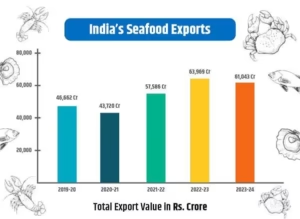
India’s seafood exports grew by 16% in value and 12% in volume in FY 2025‑26 (April–October), despite higher U.S. tariffs. Exporters compensated by expanding into new markets such as China, Vietnam, Belgium, Malaysia, and Germany.
Importance of the Sector
- India has a 7,500 km coastline and rich inland water resources.
- It is the 3rd largest fish producer globally and 2nd largest aquaculture producer.
- The sector supports employment, rural livelihoods, food security, and foreign exchange earnings.
Production Base
- Marine Fisheries: Concentrated along eastern and western coasts.
- Inland Fisheries: Depend on rivers, reservoirs, ponds, and wetlands.
- Aquaculture: Shrimp farming (especially Vannamei) dominates export volumes and earnings.
Export Composition
- Shrimp: Largest share, especially frozen varieties.
- Other Products: Frozen fish, squid, cuttlefish, crabs, and value‑added seafood.
- Growth supported by cold‑chain infrastructure and compliance with global food safety standards.
Major Markets
- Traditional Destinations: U.S., China, Japan, EU, and Southeast Asia.
- Diversification Strategy: Reduced dependence on U.S. by expanding into China, Vietnam, Belgium, Malaysia, and Germany.
- Recent Trends:
- Exports to China rose to $845.67 million.
- Vietnam recorded 100% growth in value and 90% growth in volume.
- Belgium saw nearly 90% growth in imports.
Institutional Support
- Marine Products Export Development Authority (MPEDA): Ensures quality, traceability, and market access.
- Government Schemes: Pradhan Mantri Matsya Sampada Yojana (PMMSY) strengthens infrastructure, processing, and sustainability.
- Policy Push: Regular consultations with exporters to resolve non‑tariff barriers and identify new markets.
Conclusion
India’s seafood sector is evolving into a globally competitive and diversified export industry. Strong growth, new market penetration, and institutional backing highlight its ability to withstand trade uncertainties and contribute significantly to India’s economy.
ECONOMIC LOSSES FROM NATURAL DISASTERS IN INDIA
TOPIC: (GS3) ECONOMY: THE HINDU
Recent data shows that India loses about 0.4% of its GDP annually due to natural disasters. With rising frequency and intensity of floods, storms, and landslides.
Rising Disaster Risks in Asia
- Escalating Threats: Emerging Asian economies such as India, China, and ASEAN‑11 are increasingly vulnerable to natural disasters.
- Frequency: In the past decade, the region has averaged 100 disasters annually, impacting nearly 80 million people each year.
- Economic Losses: India alone loses about 0.4% of its GDP annually due to disaster‑related damages.
- Country‑Specific Risks:
- India: Floods and storms are the primary hazards, causing widespread displacement and infrastructure damage.
- Philippines & Vietnam: Hit regularly by tropical cyclones, among the most destructive in Asia.
- China & Indonesia: Face high seismic risks, including earthquakes and volcanic eruptions.
- Global Ranking: India ranks second only to the Philippines in the World Risk Index, reflecting high exposure and vulnerability.
India’s Vulnerability
- From 1990–2024, India’s disaster losses averaged 0.4% of GDP annually.
- Losses are mainly hydrological: floods, landslides, and water‑related hazards.
- India ranks second only to the Philippines in the World Risk Index, reflecting high exposure and vulnerability.
Disaster Risk Finance
- Data‑Driven Planning: Governments must build strong databases to assess risks and losses.
- Financial Preparedness: Disaster risk finance is now central to policy, ensuring funds are available for relief and recovery.
- Insurance & Risk Sharing: Mechanisms like catastrophe bonds, insurance pools, and regional cooperation can reduce fiscal stress.
- Infrastructure Investment: Building resilient infrastructure to withstand floods, storms, and seismic activity.
- Community Capacity: Strengthening coping mechanisms at local levels to reduce vulnerability.
Way Forward
- Integrate disaster risk reduction into national development planning.
- Expand early warning systems and climate‑resilient infrastructure.
- Promote regional cooperation among Asian economies for shared risk financing.
- Ensure inclusive policies that protect vulnerable populations most exposed to disasters.
NDMA ACT,
- NDMA Act, 2005: It created the National Disaster Management Authority (NDMA) to plan, coordinate, and implement disaster management policies across India.
- Funding: Disaster management is supported through the National Disaster Response Fund (NDRF) and State Disaster Response Funds (SDRF), financed mainly by the central government.
Allocation to States: The Centre releases funds to states based on recommendations of the Finance Commission, considering factors like vulnerability, past disaster losses, and population exposure.
Conclusion
India’s recurring losses from natural disasters highlight the urgent need for robust disaster risk finance and resilience strategies. With climate change intensifying hazards, proactive planning and financial preparedness are essential to safeguard both lives and economic stability.
VENEZUELA CRISIS AND INDIA’S ENERGY SECURITY
TOPIC: (GS2) INTERNATIONAL RELATIONS: THE HINDU
Following recent U.S. actions in Venezuela, concerns were raised about global oil supply. However, data shows that the crisis is unlikely to affect India’s energy security due to minimal oil trade between the two countries.
Background
- Venezuela’s Role: A member of OPEC, Venezuela contributes only about 1% to global oil supply and 3.5% to OPEC’s exports.
- Heavy Crude Oil: Venezuelan oil is thick and requires special refineries, limiting its global demand.
- Sanctions Impact: U.S. sanctions since 2019 have reduced Venezuela’s oil exports and global partnerships.
India–Venezuela Oil Trade
- Sharp Decline: In 2013, India imported $13 billion worth of oil from Venezuela.
- In 2025 (up to November), imports dropped to just $255.3 million, or 3% of India’s total oil imports.
- Reason for Cutback: India reduced imports due to U.S. sanctions and risk of secondary sanctions.
- Current Status: Venezuela’s oil now mostly goes to China; India has diversified its sources.
Strategic Perspective
- Diversified Imports: India sources oil from multiple countries, reducing dependency on any single supplier.
- Low Exposure: Venezuela’s share in India’s oil basket is negligible, making disruptions less risky.
- Global Supply Stability: Despite geopolitical tensions, global oil markets remain balanced due to other major producers.
Indian initiatives to reduce oil import dependence:
- Biofuels & Ethanol Blending: India is promoting ethanol blending in petrol (target 20% by 2025) and use of biodiesel/biogas to cut crude oil use.
- Electric Mobility & Green Energy: Schemes like FAME II encourage electric vehicles, while the National Green Hydrogen Mission aims to replace fossil fuels in transport and industry.
- Boosting Domestic Production & Gas Economy: Policies like HELP and OALP support exploration of oil and gas, while India plans to raise natural gas share in its energy mix from 6% to 15% by 2030.
OPEC:
- OPEC stands for the Organization of the Petroleum Exporting Countries – a group of major oil‑producing nations that coordinate policies to influence global oil prices.
- Members: It has 13 member countries, mainly from the Middle East, Africa, and South America, with headquarters in Vienna, Austria.
- Role in Oil Market: OPEC countries together control about 40% of global crude oil production and around 60% of international oil trade, giving them strong influence over supply and prices.
Decisions: The group meets regularly to decide on production quotas – increasing or cutting oil output to stabilize or raise prices in the global market
Conclusion
The Venezuela crisis is unlikely to disrupt India’s energy needs. With diversified oil sources and minimal trade with Venezuela, India’s energy security remains stable. However, continued monitoring of global oil dynamics is essential for long-term planning.
MICROLENSING
TOPIC: (GS3) SCIENCE AND TECHNOLOGY: THE HINDU
Scientists recently used microlensing to measure the mass of a rogue planet (a planet not orbiting any star), highlighting its importance in astronomy.
What is Microlensing?
- A phenomenon where the gravity of a foreground object bends and magnifies the light of a background star.
- Based on Einstein’s General Theory of Relativity – gravity acts like a lens.
- Even if the foreground object emits no light, its mass and distance can be studied using microlensing.

Features of Microlensing Events
- Transient and unpredictable – can last from a single day to several months.
- Causes sudden changes in brightness of background stars.
- Useful for detecting distant or invisible objects like brown dwarfs, neutron stars, and isolated black holes.
Importance in Exoplanet Hunting
- Other methods (transit, radial velocity, direct imaging) mainly detect planets close to stars or very large ones.
- Microlensing helps find:
- Jupiter‑like planets at moderate distances.
- Earth‑like planets further out.
- Free‑floating planets not bound to stars.
- Advantage: Detects planets in shorter time frames compared to traditional methods.
Significance
- Expands our ability to study hidden celestial bodies.
- Strengthens India’s and global astronomy research in planetary science and cosmology.
- Demonstrates how physics theories like relativity are applied in modern space exploration.