

Table of Contents
ToggleCLIMATE CHANGE AND NEED FOR INTERNATIONAL LEGAL REFORMS
TOPIC: (GS3) ENVIRONMENT: THE HINDU
Climate change is reshaping international law, raising debates over sovereignty of resources, survival of small island states, migration rights, and maritime boundaries.
Climate Change and International Law
Permanent Sovereignty over Natural Resources (PSNR)
- PSNR gives states the right to use their natural resources, including fossil fuels.
- Global push to keep temperature rise below 1.5°C demands phasing out fossil fuels.
- Proposals like a Fossil Fuel NonProliferation Treaty aim to leave reserves untapped.
- Developing nations may accept limited obligations, but demand finance and technology transfer from developed countries.
Statehood and Territory
- Montevideo Convention (1933) defines statehood: territory, population, government, and capacity for relations.
- Sealevel rise (SLR) threatens small island states, raising doubts about their continued statehood.
- ICJ advisory opinion: loss of one element does not automatically end statehood.
- Pacific Islands Forum (2023) declared climate change cannot erase their legal existence.
- Scholars argue no minimum size of territory is required, but statehood remains precarious.
ClimateInduced Migration
- 1951 Refugee Convention does not cover climate refugees.
- People displaced by SLR lose protections of their home state.
- Scholars like Frank Biermann propose a new protocol under UNFCCC for recognition, protection, and resettlement of climate refugees.
Maritime Zones
- Rising seas unsettle baselines (legal coasts), affecting territorial seas, EEZs, and continental shelves.
- Pacific Island states want baselines declared permanent to protect maritime rights.
- Current UNCLOS rules allow ambulatory baselines (shifting with SLR).
- Reconciling these approaches requires reinterpretation of UNCLOS.
Conclusion:
International law must evolve to protect small island states, vulnerable populations, and global commons. Reform is urgent to ensure fairness between developed and developing nations in the climate era.
AI SAFETY VS NATIONAL SECURITY AND THE ANTHROPIC CASE
TOPIC: (GS2) INTERNATIONAL RELATIONS: THE HINDU
The U.S. Department of Defence declared AI firm Anthropic a “supply chain risk” after it refused to allow its AI tools for domestic surveillance and autonomous weapons.
Background
- Anthropic’s Stand: The company, creator of Claude, rejected U.S. demands to enable surveillance and weaponisation.
- Government Reaction: The Defence Department accused Anthropic of pursuing a “radical agenda” and excluded it from defence supply chains.
- OpenAI’s Response: Soon after, OpenAI agreed to provide flexibility to the Defence Department, weakening collective industry resistance.
Key Issues
- AI Safety Ignored: The U.S. stance undermines commitments made at global forums like the Bletchley Park AI Safety Summit.
- Weaponisation Risks: Reports suggest AI tools were used in military operations against Iran, raising fears of autonomous warfare without safeguards.
- Surveillance Concerns: If powerful states demand unrestricted AI use, weaker nations may follow, legitimising spyware and authoritarian practices.
- Corporate Dilemma: Firms face pressure between profit motives and ethical responsibility; Anthropic resisted, but industry solidarity was lacking.
Global Implications
- Multipolar World Challenge: Great powers ignoring safety norms make it harder to build shared international standards.
- Impact on Middle Powers: Countries prone to surveillance may misuse AI further if global leaders set poor examples.
- Weak Institutions: With global institutions struggling, private firms are being looked to for leadership on safety — but profit pressures limit their role.
AI Threats to Internal Security
- Mass Surveillance & Privacy Breach: AIpowered facial recognition, predictive policing, and data mining can be misused by governments or hostile actors to monitor citizens, suppress dissent, and erode democratic freedoms.
- Cybersecurity Risks: AI can automate sophisticated cyberattacks, including hacking critical infrastructure (power grids, banking systems, defence networks), making internal systems vulnerable to disruption.
- Disinformation & Social Manipulation: AIgenerated deepfakes and fake news can spread rapidly, fueling communal tensions, political instability, and weakening trust in institutions.
Way Forward
- Global AI Governance: Establish binding international rules under UN or G20 frameworks to regulate AI use in defence and surveillance.
- Industry Solidarity: AI firms must coordinate and resist unsafe demands collectively to protect ethical standards.
- Transparency & Accountability
Conclusion
Without stronger international legal frameworks and collective industry backbone, AI risks being normalised for mass surveillance and autonomous weapons, threatening both democratic values and global security.
INDIA’S QUIET DEMOGRAPHIC REVOLUTION
TOPIC: (GS3) ECONOMY: THE HINDU
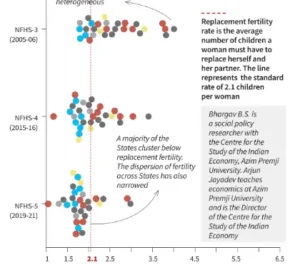
Recent NFHS data shows India’s Total Fertility Rate (TFR) has fallen to around replacement level (2.1) is now moving towards a lowfertility society.
Fertility Transition
- Rapid Decline: TFR dropped from nearly 4 children per woman in the 1990s to around 2.0 today.
- Regional Convergence: Earlier, southern States had lower fertility, but now most States show similar low levels.
- Sharp Declines: Northeastern States (except Tripura), Uttar Pradesh, J&K, Haryana, Punjab, and Rajasthan recorded the highest fertility reductions.
- Already Low States: Karnataka, West Bengal, Gujarat, Maharashtra, and Odisha saw further decline despite starting at lower levels.
Reasons for Decline
- Women’s Education & Delayed Marriage: Higher education increases labour market opportunities, reducing early childbearing.
- Social Norms & Urbanisation: Migration, media exposure, and decades of family planning campaigns spread small family ideals.
- Public Health Successes: Better child survival through vaccination, maternal care, and nutrition reduced the need for precautionary fertility.
- Rising Costs of Children: Education, healthcare, and housing expenses make children more of an investment project than contributors to household income.
Consequences
- Demographic Dividend: Larger workingage population with fewer dependents offers growth potential, but requires labourabsorbing industries and public investment.
- Regional Divergence: Southern and western States face aging populations, while northern and central States remain younger, driving migration flows.
- Policy Shift Needed: Focus must move from population control to building systems for a lowfertility society — childcare, pensions, healthcare for chronic diseases, and urban infrastructure.
Demographic Dividend?
Demographic Dividend refers to the economic growth potential that arises when the proportion of a country’s workingage population (15–64 years) becomes larger than the dependent population (children below 15 years and elderly above 65 years).
- Key Idea: With fewer dependents, more people can work, save, and invest, boosting productivity and growth.
- Conditions: Dividend is realised only if there are jobs, skills, and supportive policies to absorb the workforce.
India’s Demographic Dividend
- Timeline: India entered its demographic dividend phase around 2005–06, expected to last till 2055–56.
- Scale: India has one of the largest youth populations in the world — nearly 65% below 35 years.
- Regional Variation:
- Southern & Western States: Already moving towards aging populations.
- Northern & Central States: Still have high fertility and younger populations, creating uneven opportunities.
- Opportunities: Potential for faster growth through industrialisation, innovation, and services if jobs are created.
- Risks: Without adequate employment and skill development, the dividend may turn into a demographic burden (unemployment, social unrest).
Conclusion
India’s demographic story has shifted from fears of population explosion to challenges of low fertility and aging. The future policy must prioritise employment generation, social security, healthcare and prepare for an aging society.
INDIA RANKS SECOND GLOBALLY IN CHILDHOOD OBESITY
TOPIC: (GS2) HEALTH: THE HINDU
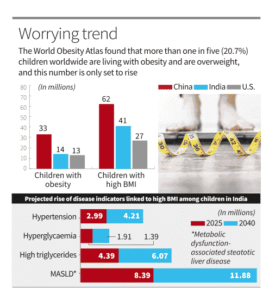
The World Obesity Atlas 2026, released on World Obesity Day (March 4), reported that India has the secondhighest number of children with obesity, after China.
Key Findings
- Global Concentration: Over 200 million children (5–19 years) with obesity are concentrated in just 10 countries.
- India’s Numbers: Nearly 41 million Indian children have high BMI, of which 14 million are obese.
- 5–9 years: 15 million overweight/obese.
- 10–19 years: 26 million overweight/obese.
Country | High BMI Population (Million) | Obese Population (Million) |
China | 62 | 33 |
India | 41 | 14 |
United States | 27 | 13 |
- Risk Factors in India:
- 74% adolescents (11–17 years) lack adequate physical activity.
- Only 35.5% of school children receive school meals.
- 32.6% infants face suboptimal breastfeeding.
- Sugary drink consumption common among children (6–10 years).
Definition of Obesity (WHO Standards)
- Obesity is defined as abnormal or excessive fat accumulation that presents a risk to health.
- Measurement:
- BMI (Body Mass Index) ≥ 25 = Overweight.
- BMI ≥ 30 = Obesity (for adults).
- For children, obesity is defined using agespecific BMI percentiles (≥95th percentile).
Challenges to Society
- Health Burden: Childhood obesity increases risk of diabetes, hypertension, cardiovascular diseases, and early mortality.
- Economic Costs: Rising healthcare expenditure and productivity loss due to chronic illness.
- Social Impact: Obesity leads to stigma, reduced selfesteem, and mental health issues among children.
Way Forward
- Policy Interventions: Taxation on sugarsweetened beverages. Restrictions on junk food marketing to children.
- Schoolbased Measures: Ensure nutritious midday meals. Promote physical activity and sports in schools.
- Public Health Campaigns: Awareness on healthy diets, breastfeeding, and lifestyle changes. Communitylevel programmes to reduce consumption of sugary drinks and processed foods.
Conclusion
India’s demographic advantage is at risk if childhood obesity With millions of children already affected, urgent multisectoral action is needed to prevent obesity from becoming a longterm public health crisis.
WEBSITE BLOCKING PRACTICES IN INDIA
TOPIC: (GS2) GOVERNANCE: THE HINDU
A new study titled “Poisoned Wells: Examining the Scale of DNS Censorship in India” revealed inconsistencies in website blocking by Indian Internet Service Providers (ISPs).
Key Findings
- Scale of Blocking: 43,083 unique domains blocked via DNS filtering; earlier study had only 6,787.
- Inconsistency Across ISPs:
- Terrorismrelated sites: only 40% blocked universally.
- Piracy sites: 4.54% blocked.
- Pornography sites: 0.53% blocked.
- Gambling sites: 13.48% blocked.
- Technical Method: Reliance on DNS filtering, which is easily bypassed.
- Legal Framework: No mandate on specific filtering methods; ISPs free to choose, leading to uneven user experience.
Challenges
- Lack of Uniformity: Different ISPs block different sites, creating confusion and loopholes.
- Weak Technical Standards: DNS filtering is easily circumvented, making censorship ineffective.
- Transparency Issues: Users are not informed why or how sites are blocked, raising accountability concerns.
Regulatory Reforms Needed
- Clear Guidelines: Government must specify uniform technical standards for blocking.
- Transparency Mechanisms: ISPs should publish lists of blocked sites and reasons.
- Independent Oversight: Establish regulatory bodies to review blocking orders and prevent misuse.
Way Forward
- Balance Security & Freedom: Blocking harmful content (terrorism, child exploitation) while protecting legitimate access.
- Strengthen Cyber Laws: Update IT Act provisions to ensure consistent and accountable censorship practices.
- Promote Digital Rights: Encourage open internet principles, with judicial review of blocking orders.
Constitutional Link – Article 19
- Freedom of Speech & Expression: Website blocking directly impacts Article 19(1)(a).
- Reasonable Restrictions: Under Article 19(2), restrictions are allowed for sovereignty, security, public order, decency, and morality.
- Issue: Arbitrary or inconsistent blocking without clear legal basis may violate constitutional protections.
Conclusion
India’s website blocking practices highlight the tension between national security and digital freedom. A balanced approach is needed to safeguard both internal security and citizens’ freedom of expression.
MARRIAGE AS PARTNERSHIP – DELHI HC ON HOMEMAKER’S ROLE
TOPIC: (GS2) POLITY: THE HINDU
The Delhi High Court recognised unpaid domestic labour as a valid economic contribution within marriage, reframing marriage as a partnership.
Homemaking as Economic Contribution
- Recognition of Unpaid Labour: Household management, childcare, and relocation support are treated as economic inputs that sustain the earning spouse’s productivity.
- Partnership Model: Marriage is defined as an economic partnership where contributions may differ but remain equally valuable.
- Legal Entitlement: Moves domestic work from moral appreciation to enforceable legal recognition.
- Enabling Function: Homemaker’s labour facilitates continuity of the earning spouse’s career, including overseas employment.
Educational Qualification vs Maintenance Claim
- Capacity vs Actual Income: Courts must distinguish between theoretical earning ability and proven income.
- Burden of Proof: Denial of maintenance requires evidence of stable taxable income.
- Judicial Clarification: Degrees or employability potential cannot be grounds to refuse maintenance.
Re-entry Barriers After Career Breaks
- Career Disruption: Recognises difficulties in rejoining the workforce after caregiving breaks.
- Gendered Labour Market: Acknowledges structural challenges faced by women in employment continuity.
- Realistic Assessment: Maintenance must be based on present income, not hypothetical opportunities.
- Preventive Safeguard: Protects spouses from being penalised for prioritising household responsibilities.
Scope of Maintenance under Section 125 CrPC & PWDVA
- Social Justice Mandate: Ensures financial support for wives unable to maintain themselves.
- Interim Relief: Provides monetary assistance during proceedings.
- Fairness Mechanism: Treats maintenance as equitable adjustment within marital partnership.
- Rejects Dependency Narrative: Homemaking is not voluntary withdrawal but an economic role.
Judicial Trend
- Kerala HC (Kannan Nair v. Kamala Amma): Recognised homemaking as financial contribution in property disputes.
- Delhi HC (Saurjan Saha v. Rumpa Saha): Rejected demand for proof of negative income.
- Doctrinal Evolution: Strengthens gendersensitive interpretation of maintenance laws.
Gender Justice Dimension
- Structural Inequality: Women disproportionately perform unpaid domestic labour.
- Economic Invisibility: Household work excluded from GDP despite enabling workforce participation.
- Substantive Equality: Recognition advances Article 14based equality beyond formal neutrality.
- Corrective Role of Judiciary: Counters patriarchal assumptions equating worth with paid EMPLOYMENT.
- Welfare Responsibility: Maintenance law ensures dignity and security for nonearning spouses.
Conclusion
The Delhi HC ruling separates earning potential from actual income, reinforces marriage as a partnership, and strengthens substantive equality under constitutional guarantees of dignity and fairness.
IAEA EMERGENCY MEETING ON IRAN CONFLICT
TOPIC: (GS2) INTERNATIONAL RELATIONS: THE HINDU
The International Atomic Energy Agency (IAEA) convened an emergency session in Vienna on March 2 following U.S.–Israeli strikes on Iran amid escalating tensions in West Asia.
About IAEA
- Established: 1957, inspired by U.S. President Eisenhower’s Atoms for Peace speech.
- Nature: Autonomous UN body promoting peaceful use of nuclear technology.
- Headquarters: Vienna, Austria.
- Membership: Over 170 countries.
IAEA’s Observations
- No evidence of damage to Iran’s nuclear facilities.
- No abnormal radiation levels detected in the region.
- Facilities checked include:
- Bushehr Nuclear Power Plant
- Tehran Research Reactor
- Nuclear fuel cycle facilities
- Communication blackout reported with Iranian authorities.
- Statement issued by Director General Rafael Grossi.
Iran’s Position
- Iran’s envoy to IAEA alleged that the Natanz uranium enrichment site was targeted.
- No public proof provided yet.
- Iran has previously curtailed cooperation with IAEA after foreign strikes.
- Possible outcomes:
- Restricting IAEA inspections.
- Raising uranium enrichment levels.
- Framing actions as “selfdefense.”
Significance
- Highlights fragility of nuclear monitoring during armed conflicts.
- Raises concerns about Iran’s future cooperation with IAEA.
- Potential escalation in nuclear activities could destabilize regional and global security.
Conclusion
The Vienna emergency meet underscores the IAEA’s role as a neutral nuclear watchdog in times of geopolitical crisis. Iran’s allegations and communication blackout raise serious concerns.
PUBLIC SECTOR BANK REFORMS – EASE 9.0
TOPIC: (GS3) ECONOMY: THE HINDU
The Department of Financial Services (DFS) launched EASE 9.0 reforms in February 2026 to modernize Public Sector Banks (PSBs).
Key Reforms under EASE 9.0
- Global Capability Centres (GCCs):
- PSBs will adopt GCC strategies in FY 2026–27.
- SBI has already set up the first GCC in Karnataka.
- GCCs perform strategic functions like IT, R&D, and business support.
- Technology Infrastructure:
- Adoption of activeactive data centres for resilience.
- Development of AI stacks, including Large Language Models (LLMs), GPU strategies, and private cloud deployment.
- Enterprisewide consent management systems.
- Data tokenisation and anonymisation for secure business continuity.
- Collaborative Solutions:
- Joint efforts among PSBs to integrate blockchain technology, advanced risk assessment, and fraud detection models.
BFSI Global Capability Centres (GCCs)
- Definition: 100% owned subsidiaries of global financial institutions, centralising highvalue functions like risk management, compliance, fintech, and cybersecurity.
- Evolution: From costsaving hubs to advanced centres for AI, ML, cybersecurity, RegTech, and analytics.
- India’s Position:
- Hosts 185–190 BFSI GCCs employing ~540,000 professionals.
- Projected to grow from USD 40–41 billion (2023) to USD 125 billion by 2032.
- Major hubs: Bengaluru, Hyderabad, Mumbai, Pune, Chennai, Gurugram/NCR.
- Examples: JPMorgan Chase, HSBC, Wells Fargo, Citigroup, Deutsche Bank, Barclays, Goldman Sachs, Morgan Stanley.
R.I.S.E. Framework – Four Pillars of EASE 9.0
- Risk & Resilience: Stronger risk management and operational continuity.
- Innovation: Integration of AI, GenAI, ML, cloud, and microservices.
- Socioeconomic Impact: Inclusive banking for underserved groups, including gig and platform workers.
- Excellence: Improved efficiency, governance, customercentric processes, and costeffective models.
Conclusion
These reforms are crucial for aligning India’s banking sector with the national vision of Viksit Bharat @2047, ensuring PSBs remain competitive in a rapidly evolving global financial ecosystem.
KOSI RIVER
TOPIC: (GS1) GEOGRAPHY: THE HINDU
Why in News?
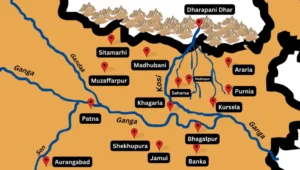
Recent studies highlight that the Kosi River has shifted more than 100 km westward in the last two centuries due to heavy sediment deposition and frequent flooding.
About Kosi River
- The Kosi River is a transboundary Himalayan river system flowing through China (Tibet region), Nepal, and India.
- It is one of the major tributaries of the Ganga River system.
- Because of its frequent floods and shifting channels, it is widely known as the “Sorrow of Bihar.”
Origin and Formation
- The Kosi is formed by the confluence of three major Himalayan rivers:
- Sun Koshi
- Arun
- Tamur
- These rivers originate in the Himalayan region of Tibet and Nepal and merge to form the Sapta Kosi river system before entering India.
Course of the River
- The river flows through Nepal’s mountainous terrain and then enters the plains of India.
- Around 48 km north of the India–Nepal border, several tributaries join the river.
- It cuts through the Siwalik (Shivalik) Hills via the narrow Chatra Gorge before entering the Indo-Gangetic plains.
- After flowing through northern Bihar, the river finally joins the Ganga near Kursela in Katihar district.
- The total length of the river is about 720–730 km.
Drainage Basin
- The Kosi basin covers about 74,500 sq km.
- Out of this, only around 11,000 sq km lies in India, while the majority of the basin is located in Nepal and Tibet.
Changing Course of the River
- Over the past 200–250 years, the Kosi has shifted its channel more than 100 km from east to west.
- This frequent change occurs mainly because the river carries extremely high sediment loads from the Himalayas.
- During the monsoon season, heavy rainfall and sediment deposition cause the river to change channels and create floods.
Agriculture in the Basin
- The sandy alluvial soils deposited by the river are suitable for maize (corn) cultivation.
- The basin also supports paddy, wheat, and pulses, benefiting from the nutrient-rich sediments brought by floods.