Table of Contents
ToggleBSF AND THE INDIA–BANGLADESH RIVERINE BORDER
TOPIC: (GS3) SEQURITY: THE HINDU
The Border Security Force to examine whether reptiles could be used in vulnerable riverine stretches to prevent infiltration on the Bangladesh frontier, following directions from the Home Minister.
India–Bangladesh border
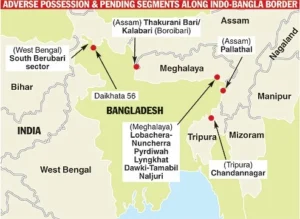
- Border challenge: The India–Bangladesh border is 4,096.7 km long, with significant riverine, floodprone and densely populated stretches that are hard to fence.
- Fencing status: Parliament committee data shows about 371 km of approved fencing remains unfinished, leaving gaps in physical barriers.
What the BSF asked units to do
- Feasibility study: Map riverine “gaps” and assess operational practicality of using reptiles as a deterrent.
- Identify dark zones: List border outposts lacking mobile connectivity for targeted technological fixes.
- Report on local incidents: Provide details of cases registered against villagers in border areas to inform risk assessment.
Challenges
- Human safety risk: Deploying dangerous wildlife near populated riverbanks could endanger villagers on both sides, especially during floods.
- Operational logistics: Procuring, transporting, housing and controlling reptiles at scale raises major practical and ethical questions.
- Legal and environmental concerns: Wildlife protection laws, animal welfare norms and ecological impacts must be examined.
- Alternatives available: The government is already pursuing fencing, floodlights and technological nonphysical barriers; reptiles would be an unconventional supplement, not a replacement.
Conclusion
Any decision must balance border security with human safety, legal and environmental concerns, making technological and communitycentric solutions more practical.
EXPORTERS PUSH TO REVIVE RICEFOROIL BARTER WITH IRAN
TOPIC: (GS3) ECONOMY: THE HINDU
Punjab exporters have urged the Centre to revive an oilforrice barter with Iran to ease stranded basmati shipments as several US sanctions waivers on oil and Chabahar approach expiry in April 2026.
OilforRice Barter with Iran
- The Centre acknowledged it is buying oil and LNG from Iran after a sevenyear gap, prompting exporters to press for renewed trade ties.
- Several US sanctions waivers (for Russian oil, Iranian oil and India’s Chabahar stake) are set to expire in April 2026, raising urgency.
- This proposal seeks use of the Rupee payment mechanism and barter to bypass payment and transit disruptions.
Basmati Exports, Sanctions
- Basmati exports: Over 80% of India’s basmati goes to West Asia; many consignments are stuck in transit, causing losses.
- Sanctions timeline: US waivers for Russian oil and Iranian oil and the Chabahar port concession expire in April 2026, constraining trade options.
- Rupee mechanism: A rupeebased payment corridor (corpus at UCO Bank) exists from 2012 and could be used for commodity settlements.
What exporters want
- Barter deal: Exchange Indian rice (basmati) for Iranian crude oil to bypass hardcurrency and shipping bottlenecks.
- Use rupee corridor: Settle transactions through the Rupee payment mechanism to avoid dollarbased sanctions exposure.
- Relief measures: Seek interest relief and diplomatic support to clear stranded consignments and revive traditional trade links.
Challenges
- Energy security: A barter could ease crude shortages and reduce import bills if logistics and pricing align.
- Sanctions risk: Any deal must navigate US sanctions and waivers; diplomatic engagement with Washington is ongoing.
- Commercial feasibility: Refiners cite high prices, limited availability and refinery adjustments as constraints on largescale Iranian crude uptake.
- Trade logistics: Clearing stranded rice consignments requires shipping, insurance and portsecurity solutions amid regional instability.
Government stance
- Engaged diplomatically: The External Affairs Ministry says it is engaged with the US and stakeholders on Chabahar and sanctions implications.
- Commercial decisions: Petroleum Ministry frames oil purchases as commercially driven, not solely waiverdependent.
Conclusion:
A riceforoil barter with Iran could offer shortterm relief to exporters and energy buyers, but it faces legal, diplomatic and logistical hurdles tied to US sanctions and commercial viability.
THE SHANTI ACT (2025) AND INDIA’S NUCLEAR PRIVATE PARTICIPATION
TOPIC: (GS3) ECONOMY: THE HINDU
Finance Minister announced a target of 100 GW nuclear capacity by 2047 and Parliament passed the SHANTI Act in December 2025.
What the SHANTI Act changes
- Consolidation of laws: The Act repeals the Atomic Energy Act (1962) and the Civil Liability for Nuclear Damage Act (2010) and creates a single modern statute for nuclear energy.
- Private and foreign entry: Limited private ownership and operation of civilian nuclear plants is permitted under strict licensing and oversight.
- Regulatory upgrade: The Atomic Energy Regulatory Board (AERB) is given statutory backing to function as an autonomous safety regulator.
- Liability and insurance: The Act revises the liability framework to make projects more attractive to investors while addressing compensation and insurance norms.
Why nuclear is central to India’s goals
- Energy and development: To reach Viksit Bharat and higher percapita electricity use, India needs large, reliable baseload power beyond intermittent renewables.
- Netzero target: Nuclear is a lowcarbon baseload option that complements renewables and helps meet longterm decarbonisation goals.
- Land and storage constraints: Renewables require large land and storage investments; nuclear offers high energy density and continuous output.
Implementation challenges
- Huge capital need: Adding tens of GW will require hundreds of billions of dollars; private and foreign finance is essential.
- Technology choices: Imported large reactors (e.g., French, US designs) must be indigenised to cut costs; Small Modular Reactors (SMRs) are being pursued for flexibility.
- Regulatory clarity: Rules on fuel ownership, waste management, tariffs, liability, and dispute resolution must be transparent and investorfriendly.
- Public acceptance and safety: Site clearances, exclusion zones and community consent will be politically sensitive.
Policy priorities
- Fasttrack rulemaking that balances safety and investor certainty.
- Innovative financing (publicprivate partnerships, longterm sovereign guarantees).
- R&D push for SMRs, thorium pathways and HALEU fuel cycles.
- Transparent regulator with clear licensing and liability regimes.
Conclusion: The SHANTI Act creates the legal scaffolding for a major expansion of nuclear power in India, but its success depends on prompt, clear rules, large-scale financing, technology strategy and robust safety governance.
THE WTO, PLURILATERALISM AND GLOBAL FRACTURES
TOPIC: (GS2) INTERNATIONAL RELATIONS: THE HINDU
The WTO’s 14th Ministerial Conference in Yaoundé exposed deep divisions over digital trade and disputesettlement reform, underscoring a wider crisis in global multilateralism.
WTO’s 14th Ministerial Conference
- MC14 (Yaoundé, March 2026) ended without consensus on extending the ecommerce moratorium and other major items, signalling a setback for rulesbased trade.
- The impasse has renewed debate on the future of global institutions and the role of bodies like the World Bank in a fragmented world.
- Ecommerce moratorium lapsed (no consensus to extend), allowing members to consider tariffs on digital transactions; a separate ECA was signed by 66 members.
- Plurilateral Investment Facilitation (IFD) faced resistance; India opposed its formal incorporation into WTO rules, highlighting concerns about inclusivity.
- No clear roadmap was agreed for disputesettlement reform or other systemic fixes.
What is the World Bank
- Founding instrument: Articles of Agreement (Bretton Woods), 1944 — agreed at the July 1944 Bretton Woods conference.
- Primary mission: End extreme poverty and boost shared prosperity.
- Core institutions: The World Bank Group comprises several institutions (noted historically as IBRD and others) that together finance development and provide knowledge services.
Main functions
- Project financing: Provides loans, credits and grants for infrastructure, education, health, agriculture and climate projects.
- Technical assistance and policy advice: Offers expertise, capacity building and policy guidance to governments to design and implement reforms.
- Research and data: Produces global and countrylevel research, indicators and development data used by policymakers and scholars.
- Catalysing finance: Mobilises private and public finance by cofinancing projects and issuing guarantees to reduce investor risk.
Immediate impacts
- Ecommerce moratorium lapsed (31 Mar 2026): The 1998 moratorium on customs duties for crossborder electronic transmissions ended, allowing members to consider digital tariffs.
- Direct consumer/business effect: Potential new tariffs could raise prices for downloads, streaming, cloud and software services and increase costs for digital exporters.
- Parallel rulemaking — ECA by 66 members: Sixtysix WTO members signed an Ecommerce Agreement that continues to ban digital customs duties among signatories, creating two coexisting rule sets.
- Fragmentation and compliance burden: Dual regimes (WTO default vs ECA) increase legal complexity and compliance costs for firms operating across jurisdictions.
Why multilateral bodies are failing
- Geopolitical rivalry: Major powers pursue unilateral or blocbased strategies that weaken consensus. (Example: US coercive trade measures and differing stances at MC14.)
- Divergent interests: Developed and developing countries clash on rules for digital trade, investment and special treatment.
- Institutional rigidity: Decisionmaking by consensus makes timely reform hard; plurilateral paths create parallel rule sets.
- Legitimacy and capacity gaps: Multilaterals struggle to adapt governance, financing and enforcement to 21stcentury challenges.
Key examples
- Ecommerce moratorium lapse: opens door to digital tariffs and dual rule frameworks (WTO vs ECA).
- IFD stalemate: shows limits of plurilateral integration without clear legal guardrails.
Way forward
- Modernise governance: Reform voting and decision rules to allow inclusive plurilateralism.
- Build coalitions: Likeminded countries should craft interoperable rules while keeping WTO central.
- Strengthen institutions: Increase funding, transparency and technical capacity for bodies like the World Bank.
Important WTOrelated deals and agreements
- Trade Facilitation Agreement (TFA, 2017 implementation): Simplifies customs procedures; India has been modernising ports, customs IT and singlewindow systems to meet TFA commitments.
- Agreement on Agriculture (AoA): Frames rules on subsidies and market access; influences India’s farm support policies and export controls.
- TRIPS (TradeRelated Aspects of Intellectual Property Rights): Shapes India’s IP laws and publichealth flexibilities (e.g., compulsory licensing debates).
- GATS (General Agreement on Trade in Services): Guides liberalisation of services sectors such as IT, finance and professional services.
Conclusion:
Restoring multilateral credibility requires political will, institutional reform and pragmatic plurilateralism that preserves openness and fairness.
HOW ENERGY EFFICIENCY DRIVES ELEVATIONAL BIRD MIGRATION
TOPIC: (GS3) ENVIRONMENT: THE HINDU
A new global study published in Science Advances shows mountain birds move seasonally mainly to optimise energy use, not simply to follow cooler temperatures.
Background
- Elevational migration: Many bird species move up and down mountains seasonally rather than making long-distance migrations.
- Old idea: It was widely believed birds moved mainly to track cooler temperatures.
- New focus: Researchers tested whether food availability, competition and energy costs explain these movements better.
Study and methods
- Data used: Seasonal records for 10,998 populations across 2,684 species from 34 mountain regions worldwide (citizen science sources).
- Model: The team adapted the Seasonally Explicit Distributions Simulator SEDS to simulate how birds would distribute themselves if they optimised energy use.
- Assumption: Resource availability was proxied by vegetation greenness, which indicates food energy in the ecosystem.
Key findings
- Energy drives movement: Birds move mainly to access food, avoid competition and reduce thermoregulation costs.
- Upslope in winter: Many species move upslope in winter, going against the simple temperature gradient.
- Model match: Simulated seasonal distributions matched real patterns on 28 of 34 mountain slopes, supporting the energyefficiency explanation.
- Climate change effect: Under worstcase climate scenarios to 2100, the model predicts an average upslope shift of about 129 metres for mountain birds.
Energy efficiency hypothesis explained
- Energy budget concept: Birds balance energy spent on staying warm, finding food, avoiding predators and breeding.
- Resource distribution matters: Seasonal changes in insect and fruit abundance at different elevations explain many movements better than temperature alone.
- Competition effect: As more species use the same zone, some shift elevation to reduce competition and access food.
Implications for conservation and management
- Habitat focus: Protecting and restoring food resources across elevations is crucial, not only preserving cooler zones.
- Landuse planning: Agricultural change and deforestation that alter resource patterns can disrupt migration and local populations.
- Monitoring: Use remote sensing and field surveys to map seasonal food availability for targeted action.
Policy recommendations
- Integrate resource maps into protected area planning and corridor design.
- Support citizen science for continuous monitoring of seasonal bird distributions.
- Prioritise research on species groups (frugivores, insectivores) to identify vulnerable guilds.
Conclusion:
Seasonal mountain bird movements are best explained by access to food and competition rather than temperature tracking. Conservation must therefore protect resource availability across elevations to sustain mountain bird communities.
THE EXECUTIVE OFFICE WITHOUT A LIMIT
TOPIC: (GS2) POLITY: THE HINDU
A long cumulative tenure of an elected executive like PM and CM has highlighted that the Constitution sets no formal limit on how long a person may serve as head of government.
Constitutional design and original rationale
- No term cap in text: The Indian Constitution does not set a maximum tenure for the Prime Minister.
- Framers’ logic (Ambedkar): Parliamentary confidence and daily legislative scrutiny (questions, noconfidence motions) were seen as continuous checks on executive power.
- Elections as periodic check: Regular elections were intended to be the main democratic constraint on long tenures.
Why constitutional designers avoided term limits
- Parliamentary principle: The Constitution follows the Westminster model where the head of government serves so long as they command the legislature’s confidence, not for a fixed number of terms. Article 75 reflects this design.
- Preference for continuous accountability: Framers argued that frequent, daytoday scrutiny (questions, debates, noconfidence motions) is a stronger and more flexible check than rigid term caps.
- Practical flexibility: No limit allows stable governments to continue during crises and enables quick changes of leadership through parliamentary processes without constitutional amendments.
Constituent Assembly discussions
- Ambedkar’s rationale (4 Nov 1948): He contrasted “daily assessment of responsibility” with periodic elections and argued the former gives more effective control over the executive. This speech is a central record of the framers’ intent.
- Debate emphasis: Members focused on parliamentary confidence, collective responsibility and the need for an executive that can be held to account by the legislature rather than constrained by fixed term limits.
- Constitutional text: The framers embedded these ideas in Articles governing appointment, tenure and collective responsibility rather than prescribing numerical term limits.
How institutional change weakened the check
- Tenth Schedule (antidefection): Added in 1985, it disqualifies legislators who defy party whips, reducing the ability of MPs to vote against their party on confidence motions.
- Effect on accountability: With party members bound by the whip, the legislature’s capacity to remove a government through internal votes is greatly reduced.
- Lack of intraparty democracy: Parties often lack formal mechanisms for leadership change, concentrating power in the leader’s hands.
Comparative perspective
- Other democracies: Many large democracies (e.g., USA, South Korea, Brazil) impose presidential term limits; parliamentary systems rely on legislative checks instead.
- Risks of prolonged incumbency: Extended rule can amplify incumbency advantages — control over appointments, regulatory bodies, information environment and policy levers — which may erode competitive politics.
- Democratic erosion pathway: Scholars note decline often occurs through gradual institutional weakening rather than abrupt coups.
Possible reforms
- Restore legislative teeth: Exempt confidence votes from antidefection penalties so MPs can remove a government without losing their seats.
- Encourage intraparty democracy: Mandate internal party procedures for leadership selection and removal.
- Constitutional option: Consider a timebound limit on consecutive terms for Prime Ministers and Chief Ministers, with a coolingoff period before reentry.
- State dimension: Address long tenures at state level through similar institutional fixes.
Constitutional provisions
- Article 75(1) Appointment: The President appoints the Prime Minister, usually the leader who commands majority support in the Lok Sabha.
- Article 75(2) Tenure: Ministers, including the Prime Minister, hold office during the pleasure of the President.
- Article 75(3) Qualification/Time limit: A nonMP appointed PM must become a Member of Parliament within six months or cease to hold office.
- Article 74 Aid and advice: The Prime Minister and Council of Ministers aid and advise the President in exercising executive functions.
- Third Schedule Oath and secrecy: The form of oath of office and oath of secrecy for ministers is prescribed in the Third Schedule.
- Collective responsibility (Constitutional practice) — Removal mechanism: The Council of Ministers is collectively responsible to the Lok Sabha; loss of majority leads to resignation or dissolution.
- Tenth Schedule Antidefection: Legislators face disqualification for defying party whips, affecting votes on confidence and parliamentary accountability.
Conclusion
Restoring legislative independence and strengthening party democracy are practical steps to rebalance executive power while respecting voter choice.
UNITED NATIONS DEVELOPMENT PARTNERSHIP FUND
TOPIC: (GS2) INTERNATIONAL RELATIONS: THE HINDU
India’s Permanent Mission and the Fund’s board recently reviewed the Fund’s role in SouthSouth cooperation and its support for sustainable development in vulnerable countries.
What is the Fund
- Established: Launched in 2017 with an initial contribution of $150 million, led by India.
- Purpose: To finance countrydriven, transformational development projects in the Global South.
- Focus groups: Prioritises least developed countries (LDCs) and Small Island Developing States (SIDS).
Key functions
- Project financing: Provides grants and funds for projects implemented by UN agencies in partnership with national governments.
- Thematic reach: Supports initiatives across all 17 Sustainable Development Goals — climate resilience, renewable energy, health, education, water and sanitation, livelihoods, gender equality, and more.
- SouthSouth cooperation: Acts as a platform for peer support and knowledge exchange among developing countries.
Special features
- Demanddriven: Projects are countryled and tailored to local priorities.
- Commonwealth Window: A dedicated stream to accelerate SDG progress in Commonwealth developing countries, managed by the UN Office for SouthSouth Cooperation (UNOSSC).
- UN implementation: UN agencies execute projects in close coordination with recipient governments.
Strategic importance
- Catalyses development finance where needs are greatest and traditional funding is limited.
- Builds capacity in vulnerable states for climate adaptation, health security and infrastructure.
- Strengthens multilateral cooperation by linking donor support with UN technical expertise.
Conclusion:
The Fund is a practical example of SouthSouth partnership, channeling targeted UN support to help vulnerable countries meet the SDGs through locally owned projects.
PROJECT CHETAK
TOPIC: (GS3) SEQURITY: THE HINDU
The 47th Raising Day of Project Chetak was recently celebrated in Bikaner, Rajasthan by the Border Roads Organisation.
What is Project Chetak
- Established: Raised in 1980 to develop infrastructure in the western sector.
- Geographical reach: Covers Rajasthan, Punjab and northern Gujarat and supports border connectivity.
- Scale: Manages over 4,000 km of roads and 214 km of ditchcumbund works.
- Motto: Chetak ka Prayas, Desh ka Vikas.
Core functions and contributions
- Border connectivity: Maintains feeder roads leading to the International Border, aiding troop movement and logistics.
- Upgradation: Continuous efforts to upgrade key routes to National Highway doublelane standards.
- Regional development: Improves access for remote communities, boosting trade and local economies.
- Support to defence: Ensures allweather access for armed forces and emergency services.
Border Roads Organisation key facts
- Role: A specialised road construction force that builds and maintains infrastructure in border and remote areas.
- Formation: Created on 7 May 1960 to secure frontiers and develop strategic routes.
- Administrative control: Fully placed under the Ministry of Defence in 2015.
- Capabilities: Constructs roads, bridges, tunnels, airfields and marine works in difficult terrain.
- Motto: Shramena Sarvam Sadhyam (Everything is achievable through hard work).
Strategic significance
- National security: Enhances operational readiness and rapid deployment along border sectors.
- Economic impact: Facilitates movement of goods and services, linking hinterlands to markets.
- Disaster response: Provides critical access for relief and rescue during emergencies.
Conclusion:
Project Chetak is a longstanding, largescale BRO initiative that strengthens border security and regional development through sustained infrastructure building and upgrades.