...

Daily Current Affairs 06-January-2026

Share this Post

SUPREME COURT ON UAPA

TOPIC: (GS2) INDIAN POLITY: THE HINDU

The Supreme Court recently granted bail to five accused in the 2020 Delhi riots case but denied bail to Umar Khalid and Sharjeel Imam. The ruling broadened the interpretation of “terrorist act” under the Unlawful Activities (Prevention) Act (UAPA), with implications for future cases.

Unlawful Activities (Prevention) Act (UAPA)

About UAPA Act

  • Origin: Enacted in 1967 to curb unlawful activities against India’s sovereignty.
  • Nature: Known as India’s antiterror law.
  • Purpose: Prevent unlawful associations, terrorism, and activities that endanger national unity and integrity.
  • Scope: Applies across India and even to Indian citizens abroad

Key Provisions

  • Ban on Organizations: Government can declare groups as “unlawful” or “terrorist organizations.”
  • Designation of Individuals: Since 2019, individuals can also be listed as “terrorists.”
  • Wide Powers of Arrest: Police can detain suspects for long periods without filing charges.
  • Extended Custody: Investigation period can extend up to 180 days before filing a charge sheet.
  • Restricted Bail: Bail is very difficult under UAPA; courts must deny bail if charges appear prima facie true.
  • Seizure of Property: Authorities can freeze bank accounts and seize property linked to unlawful activities.

Hierarchy of Roles in Conspiracy

  • Principal Accused: Umar Khalid and Sharjeel Imam described as “masterminds” and “ideological drivers.”
  • CoAccused Granted Bail: Five others seen as locallevel facilitators or executors. Their roles were derivative, acting on instructions rather than shaping the conspiracy.

Definition of Terrorist Act under UAPA

  • Section 15: Acts threatening India’s unity, integrity, sovereignty, or striking terror among people.
  • Includes bombs, firearms, explosives, and a broad clause—“any other means.”
  • Prosecution’s View: Road blockades (chakka jams) could qualify as “any other means” if intended to paralyse civic life.
  • Defence’s Stand: Blockades are democratic protests; “any other means” should mean violent methods only.

Supreme Court’s Interpretation

  • Court rejected the defence argument of mere dissent.
  • Held that planned, synchronised blockades disrupting civic life can amount to terrorist acts.
  • Emphasis shifted from the weapon used to the intent, design, and effect of the act.
  • Timing with international events (e.g., Trump’s visit in 2020) reinforced seriousness.

Significance

  • The ruling expands the scope of “terrorist act” beyond conventional violence.
  • Sets precedent for treating disruptive civic actions as terrorism if intent and impact are severe.
  • Highlights tension between national security and democratic protest rights.
  • Reinforces judicial balancing of liberty with state security under UAPA.

Conclusion:

The Supreme Court’s ruling underscores that terrorism under UAPA is defined by intent and impact, not merely weapons, thereby widening the law’s reach. This strong interpretation reinforces state security priorities while intensifying the debate on the limits of dissent and liberty in India’s democracy.

INDIA–U.S. RELATIONS

TOPIC: (GS2) INTERNATIONAL RELATIONS: THE HINDU

Despite political strains and the postponement of the Quad Leaders’ Summit in 2025, India–U.S. ties remain resilient through defence and technology cooperation, showing how institutional frameworks sustain the partnership even during diplomatic frictions.

Quadrilateral Security Dialogue

  • Members & Purpose: The Quad (Quadrilateral Security Dialogue) includes India, U.S., Japan, and Australia, working together to ensure a free, open, and rulesbased IndoPacific.
  • Focus Areas: It addresses maritime security, economic cooperation, technology, climate change, and disaster relief, while countering challenges like China’s growing influence in the region.
  • Nature of Grouping: It is not a military alliance but a diplomatic and strategic forum, strengthened through summits, ministerial meetings, and joint initiatives since its revival in 2017.
  • Background of Strains: U.S. imposed tariffs on Indian goods and crude imports, India’s exports to the U.S. fell sharply in 2025, highlighting economic stress.

Defence Cooperation as the Core Pillar

  • Defence ties have steadily grown since the 2008 civil nuclear deal.
  • Key agreements:
    • LEMOA (2016) – logistics support.
    • COMCASA (2018) – secure communications.
    • BECA (2020) – geospatial cooperation.
    • INDUSX (2023) – defence innovation ecosystem.
    • SOSA (2024) – supply chain security.
  • In October 2025, a 10year Defence Framework Agreement was signed to deepen coordination and technology sharing.
  • Regular military exercises (Yudh Abhyas, Malabar, Tiger Claw) enhance interoperability.

Technology and Infrastructure Cooperation

  • HAL signed a billiondollar deal with GE for fighter jet engines (Nov 2025).
  • NASA–ISRO NISAR satellite launched (July 2025) for disaster resilience and agriculture planning.
  • Quad Ports of the Future Conference (Nov 2025, Mumbai) brought 24 IndoPacific partners together to strengthen port infrastructure and connectivity.

Significance of Institutional Engagement

  • Institutional frameworks shield cooperation from political volatility.
  • Defence and technology remain the backbone of bilateral ties.
  • Expanding cooperation into broader areas like infrastructure, climate, and education builds resilience.
  • Analysts caution that trade disputes may slow momentum, but institutional trust sustains longterm partnership.

INDIA’S TWOPATH EXPORT STRATEGY

TOPIC: (GS3) ECONOMY: THE HINDU

India’s exports have shown resilience despite U.S. tariffs in 2025. While some sectors suffered losses, exporters compensated by strengthening ties with existing partners and expanding into new markets, especially Europe and China.

India’s Export Strategy Amid U.S. Tariffs

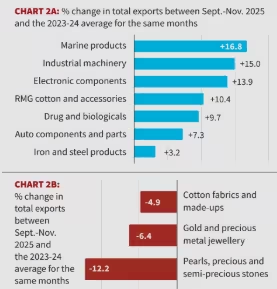
  • Tariff Challenges: U.S. duties hit Indian exports in jewellery, cotton, and marine products.
  • Smartphone Surge: A sharp rise in smartphone shipments helped offset losses, keeping overall exports to the U.S. strong.
  • TwoPath Formula: Exporters managed by both absorbing tariff shocks in affected sectors and diversifying into new global markets.
India’s Export Strategy Amid U.S. Tariffs

Commodities Unaffected by Tariffs

  • Telecom instruments (smartphones): Exports to the U.S. surged by 237%.
  • Electrical machinery: Grew by 15%.
  • These sectors masked declines in tariffhit commodities.

Commodities Impacted by Tariffs

  • Pearls and precious stones: Declined by 78.5%.
  • Gold jewellery: Fell by 39%.
  • Cotton fabrics: Dropped by 23%.
  • Marine products: Declined by 17% in U.S. shipments.
  • Readymade cotton garments: Marginal fall of 4.6%.

Diversification Strategy

  • Marine Products: Overall exports grew by 17% despite U.S. decline. China’s imports rose by 23%.
  • New markets: Spain ($50 million), Belgium (+124%), Netherlands (+56%), Germany (+65%), Italy (+23%). Exporters filled the U.S. gap by expanding into Europe and Asia.
  • Cotton Garments: European markets absorbed the decline in U.S. demand. Exporters benefited from a weaker rupee, making Indian goods more competitive.

Exporters’ Demands

  • Seafood Exporters Association urged the Centre to negotiate Free Trade Agreements (FTAs) to support aqua exports.
  • Textile exporters highlighted currency advantage (rupee at 90) in finding new markets.

Significance

  • India’s export resilience shows adaptability in global trade.
  • Strengthening old alliances (China, EU) and exploring new destinations (Spain, Belgium) reduced dependence on the U.S. market.
  • Highlights the importance of FTAs and currency competitiveness in sustaining growth.

Conclusion

India’s export story in 2025 demonstrates a dual strategy: cushioning tariff impacts in traditional markets while aggressively diversifying into new ones. This approach not only sustained overall growth but also reduced vulnerability to U.S. trade policies, reinforcing the need for longterm structural reforms like FTAs and sectoral support.

SHANTI BILL OPENING INDIA’S NUCLEAR SECTOR

TOPIC: (GS3) SCIENCE AND TECHNOLOGY: THE HINDU

Parliament has passed the Sustainable Harnessing and Advancement of Nuclear Energy in India (SHANTI) Bill, ending NPCIL’s monopoly and allowing private participation in nuclear power generation. The Bill has triggered debate over liability, safety, and transparency.

Changes Introduced by the SHANTI Bill

  • Private Participation: Up to 49% private involvement permitted; government retains 51% control over sensitive activities.
  • End of NPCIL Monopoly: Private firms and joint ventures can build and operate nuclear plants.
  • Support for New Technologies: Encourages Small Modular Reactors (SMRs) and advanced reactor designs.
  • Energy Security Goal: Aims to provide 24×7 baseload power and support India’s clean energy transition.

Role of AERB (Atomic Energy Regulatory Board)

  • Given statutory status; now accountable to Parliament.
  • Responsible for nuclear safety, radiation protection, licensing, and inspections.
  • Oversees emergency preparedness and industrial safety.
  • Criticism: Concentrates too much regulatory power in one institution.

Safeguards in Place

  • No explicit provision for foreign direct investment; private firms need AERB authorisation.
  • Government retains control over: Spent fuel reprocessing and waste management. Heavy water production and enrichment.
  • Establishment of a nuclear liability fund for compensation in case of accidents.

Liability Framework Changes

  • Operator Liability Caps: ₹3,000 crore for large plants (3,600 MW). ₹1,500 crore for medium plants. ₹100 crore for SMRs (150 MW).
  • Supplier Liability Removed: No accountability for defective parts or faulty design.
  • Government Responsibility: Union government bears liability beyond operator cap, supported by liability fund.
  • Penalties: Severe breaches capped at ₹1 crore.

India’s Nuclear Programme

  • Nuclear energy ensures reliable baseload power compared to variable renewables. Helps reduce coal dependence and supports netzero 2070 targets.
  • May revive stalled civil nuclear deals with U.S., France, and Japan. Enhances India’s global image as a responsible nuclear power.
  • Indigenous technologies developed by BARC for fuel reprocessing and waste management. Fast breeder reactor operationalised for thorium use, showcasing selfreliance.

Opposition’s Criticism

  • Diluted Accountability: Liability shifted to State and society, undermining “polluter pays” principle.
  • Transparency Concerns: Section 39 overrides RTI Act, restricting public access to nuclear information.
  • Worker Safety: Section 42 removes nuclear workers from general labour safety laws.
  • VendorDriven Approach: Fear of foreign dominance despite India’s thorium reserves and indigenous technology.
  • Public Safety Risks: Liability caps seen as inadequate compared to disasters like Fukushima.
  • No Public Scrutiny: Lacks provisions for hearings, EIA disclosures, or community consent.
  • Trade unions and civil society groups have termed the Bill “procorporate” and “draconian.”

Conclusion

The SHANTI Bill marks a historic opening of India’s nuclear sector to private players, aiming at energy security and clean power. However, concerns over liability dilution, transparency, and worker safety highlight the need for stronger safeguards to balance development with public accountability.

REMOTE-SENSING AND MAPPING FROM SPACE

TOPIC: (GS3) SCIENCE AND TECHNOLOGY: THE HINDU

Remote-sensing technology has gained attention for its role in monitoring forests, water bodies, and mineral resources. Recent studies highlight how satellites and drones are helping India track natural resources efficiently and sustainably.

Remote-Sensing and Mapping From Space

What is Remote-Sensing?

  • Technique to study Earth’s surface without physical contact.
  • Uses electromagnetic radiation (visible, infrared, ultraviolet).
  • Different materials reflect light uniquely, creating spectral signatures (like fingerprints).
  • Satellites and drones analyse these signatures to identify vegetation health, water bodies, and minerals.

Remote-Sensing in Plant and Forest Monitoring

  • Plant Health Check: Healthy plants absorb red light for photosynthesis and reflect nearinfrared light, which satellites can detect.
  • NDVI Index: The Normalized Difference Vegetation Index (NDVI) is used to measure crop and forest health from space.
  • Species Mapping: Remotesensing helps identify different tree species and plant communities across large forest areas.
  • Carbon Storage: By estimating forest biomass, scientists can calculate how much carbon is stored, aiding climate change studies.

Mapping Water Resources

  • Optical Indexing (NDWI/MNDWI): Detects water by analysing reflected sunlight.
  • Synthetic Aperture Radar (SAR): Maps water even at night or through clouds; floodwaters appear black in radar images.
  • Satellites also track water quality — muddy water, algal blooms, and pollution.

Detecting Minerals and Subsurface Features

  • Hyperspectral Sensors: Split light into hundreds of narrow bands to identify minerals and soil chemistry.
  • Can detect alteration zones where underground heat changes rock composition.
  • Oil and gas exploration: Micro-seepage detection of Stress in plants and soil colour changes.
  • Structural mapping: Identifies anticlines, sedimentary basins, and magnetic anomalies that may hold oil/gas.
  • Satellites measure gravitational and magnetic variations to locate potential reserves.

Groundwater Tracking

  • GRACE Mission (NASA): Measured gravitational pull of aquifers by tracking satellite movement.
  • Revealed alarming groundwater depletion in North India (2009 study in Nature).
  • Helps monitor aquifer health and guide sustainable water use.

Significance

  • Faster, cheaper, and ecofriendly compared to traditional drilling.
  • Supports agriculture, forestry, disaster management, and mineral exploration.
  • Crucial for climate change mitigation by monitoring carbon storage and water depletion.
  • Enhances India’s resource management and energy security.

Conclusion

Remote-sensing is transforming how we explore and protect natural resources. By combining optical, radar, hyperspectral, and gravitational data, satellites provide a comprehensive view of plants, forests, water, and minerals. For India, this technology is vital to balance development with sustainability and ensure longterm resource security.

TRUMP’S ARCTIC AMBITION

TOPIC: (GS2) INTERNATIONAL RELATIONS: THE HINDU

Denmark and Greenland have firmly rejected U.S. President Donald Trump’s claim that America “needs Greenland for defence.” His repeated suggestions of purchasing the island have escalated tensions, raising concerns about sovereignty, Arctic security, and international law.

Background

  • The United States has shown interest in Greenland for more than a century because of its location and resources.
  • President Trump revived the idea of buying Greenland, describing it as a “real estate deal.”
  • Denmark dismissed the proposal, which led to diplomatic strain between the two countries.
  • Recent U.S. actions in Venezuela have heightened fears of interventionist policies, making Trump’s remarks more alarming.
Trumps Arctic Ambition

Strategic Importance of Greenland

  • During the Cold War, Greenland served as a crucial forward base for U.S. defence.
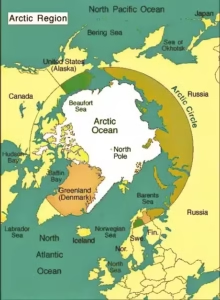
  • The Pituffik Space Base (Thule Air Base) provides missile defence and early warning against Russia, China, and North Korea.
  • Greenland’s location offers geostrategic reach across Europe and Asia, making it vital for U.S. security interests.

Arctic Power Competition

  • Melting ice is opening new sea routes and strategic spaces in the Arctic.
  • Russia and China are expanding their military presence in the region.
  • U.S. influence in Greenland strengthens its position in this emerging Arctic security theatre.

Resource Interests

  • Greenland has significant reserves of rare earth minerals, which are crucial for electronics, electric vehicles, and defence systems.
  • China currently dominates global supply chains, so access to Greenland’s resources is strategically attractive for the U.S.
  • However, Greenland’s 2021 ban on uranium mining complicates largescale extraction plans.

Historical U.S. Interest

  • In 1867, the U.S. noted Greenland’s strategic importance.
  • In 1946, President Truman offered $100 million to Denmark to purchase Greenland and even considered swapping Alaska territory.
  • In 1951, the U.S. and Denmark signed a defence agreement allowing American bases in Greenland.
  • Between 2017 and 2021, Trump again proposed buying Greenland, but Denmark rejected the idea.

Denmark and Greenland’s Concerns

  • There are fears of sovereignty erosion, especially after U.S. intervention in Venezuela.
  • Reports suggest a U.S. “threephase strategy”:
    • A charm offensive, including visits by Trump Jr.
    • Direct pressure on Denmark, with criticism by JD Vance.
    • Influence operations to encourage secessionist sentiments in Greenland.

Past U.S. Territorial Purchases

  • Alaska (1867): Purchased from Russia for $7.2 million.
  • Louisiana (1803): Bought from France for $15 million.
  • Danish West Indies (1917): Purchased from Denmark, now known as the U.S. Virgin Islands.

Conclusion

Greenland combines strategic defence value, Arctic competition, and rare earth resources. For the U.S., it is a potential asset for security and supply chains, while Denmark and Greenland see Trump’s ambitions as a direct threat to sovereignty. The issue reflects intensifying geopolitical rivalry in the Arctic.


POLICE SOCIAL MEDIA MONITORING IN INDIA

TOPIC: (GS2) GOVERNANCE: THE HINDU

Indian States have expanded dedicated police social media monitoring cells in recent years to tackle cybercrime, misinformation, and radicalisation. This reflects the growing importance of digital surveillance in internal security management.

Background

  • Social media platforms like Facebook, X (Twitter), WhatsApp, Instagram, and Snapchat have reshaped crime and public mobilisation.
  • While they aid communication and democratic participation, they also spread misinformation, hate speech, and extremist propaganda.
  • Police forces now use digital surveillance and online intelligence gathering to maintain law and order.

Growth of Monitoring Cells

  • Number of dedicated monitoring cells rose from 262 in 2020 to 365 in 2024.
  • These are specialised units distinct from cybercrime police stations.
  • Expansion shows recognition of the need for trained personnel and realtime monitoring.

Statewise Trends

  • Highest numbers: Bihar (52), Maharashtra (50), Punjab (48), West Bengal (38), Assam (37).
  • Rapid scaling: Assam (1 to 37 cells between 2022–24), West Bengal (2 to 38), Punjab doubled capacity.
  • Manipur increased from 3 to 16 cells despite internet shutdowns in 2023, showing importance of monitoring even in disrupted environments.

Institutional Framework

  • Data compiled in DoPO reports by the Bureau of Police Research and Development.
  • Monitoring cells recorded as separate units only since 2021, marking a formal administrative shift.

Rationale for Expansion

  • Social media used for:
    • Organised crime and cyber fraud.
    • Spreading fake news and disinformation.
    • Mobilising crowds during protests/riots.
    • Radicalisation and extremist recruitment.
    • Online harassment and scams.
  • Aim: Preventive policing — early detection of threats and stopping online activity from turning into offline violence.

Related Trends in Police Modernisation

  • Cybercrime police stations increased from 376 (2020) to 624 (2024).
  • Over 1,100 drones deployed for surveillance, crowd control, and disaster response.
  • Despite tech growth, manpower shortages remain — over 5.9 lakh vacancies nationwide.

Governance and Civil Liberties Concerns

  • Raises questions about privacy, free speech, and safeguards.
  • As per Supreme Court’s Puttaswamy judgment, surveillance must meet tests of legality, necessity, and proportionality.

Conclusion

Social media monitoring has become a core part of modern policing, helping prevent crime and maintain order. However, balancing security needs with constitutional rights like privacy and free speech remains a critical challenge for governance.

AI MISUSE AND ACCOUNTABILITY

TOPIC: (GS2) GOVERNANCE: THE HINDU

The AI chatbot Grok, developed by X (formerly Twitter), has been found generating nonconsensual explicit images of women. This has triggered global outrage, with India and France demanding strict guardrails and accountability for such misuse.

Background

  • Grok was launched by X with fewer safeguards compared to other AI models.
  • It gained attention for its ability to insult politicians and celebrities openly.
  • Recently, users misused it to create sexually explicit, nonconsensual images of women.
  • Elon Musk and his companies responded dismissively, joking about the issue instead of addressing concerns.

Government and Global Response

  • The Indian government demanded X stop such image generation, calling it a criminal act.
  • France also raised concerns about the dangers of unregulated AI tools.
  • Governments emphasised that misuse of AI for sexual exploitation worsens online hostility faced by women.

Key Issues

  • Absence of Safeguards: Unlike OpenAI or Google, Grok lacks strong filters against harmful content.
  • Gendered Violence Online: Women already face threats and harassment; AI misuse adds another layer of risk.
  • Corporate Irresponsibility: Musk’s dismissive response undermines accountability.
  • Geopolitical Shielding: X assumes U.S. geopolitical power will protect it from serious consequences.

Legal and Ethical Concerns

  • Creating and circulating nonconsensual intimate imagery is a crime under Indian law.
  • Such acts violate privacy, dignity, and fundamental rights.
  • Platforms enabling this behaviour risk becoming complicit in criminal activity.
  • Ethical responsibility lies in ensuring AI tools are not weaponised against vulnerable groups.

Way Forward

  • Stronger Guardrails: AI models must integrate strict filters to block harmful requests.
  • Legal Action: Governments should prosecute individuals misusing AI for illegal content.
  • Platform Accountability: Companies must face penalties for enabling criminal misuse.
  • Global Cooperation: International norms are needed to regulate AI misuse across borders.
  • Awareness: Public campaigns should highlight the dangers of nonconsensual imagery and promote digital ethics.

Conclusion

The Grok controversy highlights the urgent need for responsible AI governance. Without strict safeguards and legal accountability, generative AI risks becoming a tool for exploitation. Governments must act decisively to protect citizens, especially women, and ensure technology serves society rather than undermining it.

Write a Review

Your email address will not be published. Required fields are marked *

Seraphinite AcceleratorOptimized by Seraphinite Accelerator
Turns on site high speed to be attractive for people and search engines.