
Table of Contents
ToggleRIGHT TO DISCONNECT IN AN ECONOMY
TOPIC: (GS2) INDIAN POLITY: THE HINDU
Shashi Tharoor, Member of Parliament, has introduced a Private Member’s Bill seeking to legally guarantee the Right to Disconnect for Indian employees. The proposal comes amid growing concerns over burnout, excessive working hours, and mental health issues in India’s workforce.
Right to Disconnect:
- It means employees are not obliged to respond to work calls, emails, or messages after official working hours.
- Work-Life Balance: Protects personal time like evenings, weekends, and holidays from work intrusion.
- No Penalty: Workers cannot be punished or discriminated against for ignoring after-hours communication.
- Applies to All: Covers regular employees, contractual staff, freelancers, and gig workers.
- Health & Well-being: Helps reduce stress, burnout, and lifestyle diseases caused by overwork.
- Global Practice: Countries like France, Portugal, and Italy already have such laws to safeguard workers.

Current Situation in India
- ILO Data: 51% of Indian workers put in more than 49 hours weekly, ranking India second globally for long working hours.
- Burnout Crisis: Nearly 78% of employees report job burnout, causing physical and emotional strain.
- Health Impact: Overwork contributes to hypertension, diabetes, anxiety, and depression.
- Legal Gap: The Occupational Safety, Health and Working Conditions Code (2020) covers traditional workers but excludes many employees such as gig, freelance, and contractual workers.
- Case Example: The death of Anna Sebastian Perayil (E&Y employee, 2024) highlighted dangers of overwork.
Global Perspective
- France: First country to introduce Right to Disconnect in 2017.
- Other Nations: Portugal, Italy, Ireland, and Australia have adopted similar laws.
- Lesson: Respecting downtime is seen as essential for sustainable economic growth.
Key Provisions of Proposed Bill
- Employees cannot be punished or discriminated against for ignoring work-related communication after office hours.
- Establishment of grievance redressal mechanisms for violations.
- Extension of protection to gig and contractual workers.
- Integration of mental health support into workplace safety norms.
Importance for India
- Public Health: Reduces stress-related illnesses and improves overall well-being.
- Productivity: Well-rested employees are more innovative and efficient.
- Social Stability: Prevents erosion of family and personal time.
- Economic Sustainability: Ensures long-term workforce resilience.
Way Forward
- National Law: Pass a central legislation to guarantee the Right to Disconnect for all categories of workers, including gig and contractual employees.
- Uniform Standards: Ensure consistency across States so that protections are not fragmented or uneven.
- Cultural Shift: Promote awareness campaigns to change workplace norms that glorify long hours and late-night emails.
- Focus on Output: Encourage organisations to measure productivity by quality of work, not by hours logged.
- Mental Health Support: Make counselling, stress management, and psychological services mandatory in workplaces.
Conclusion:
India cannot afford to glorify exhaustion; legislating the Right to Disconnect is vital to protect workers’ health and productivity. Without this reform, the nation risks burning out its demographic dividend instead of harnessing it for sustainable growth.
US ACTIONS IN VENEZUELA AND INTERNATIONAL LAW
TOPIC: (GS2) INTERNATIONAL RELATIONS: THE HINDU
The United States recently carried out military operations in Venezuela, detaining President Nicolás Maduro. These actions have sparked global debate as they are seen as violations of international law and sovereignty.
Background:
- The United States carried out attacks on Venezuelan drug boats and took President Nicolás Maduro into custody.
- These actions are being called illegal under international law, no matter what Venezuela’s internal politics are.
- The incident highlights concerns about misuse of military power and the weakening of global legal rules.
Use of Force under International Law
- UN Charter Article 2(4): Prohibits use of force in international relations.
- Exceptions: Only allowed in self-defence or with UN Security Council approval.
- U.S. Justification: Claimed law enforcement and regional security reasons, but these do not meet legal standards.
- Monroe Doctrine Revival: Seen as a return to imperialist policies undermining sovereignty in Latin America.
Immunity of Heads of State
- ICJ Precedent (Arrest Warrant Case): Heads of state enjoy personal immunity from foreign courts.
- Maduro’s Status: Regardless of disputed elections, he exercised effective control over Venezuela, making him legally recognised.
- Violation: Forcibly taking custody of a sitting head of state without consent is an internationally wrongful act.
- Dangerous Precedent: Allowing states to deny immunity based on subjective recognition would destabilise international law.
Larger Implications
- Weakening of International Law: Powerful nations increasingly disregard legal norms.
- Domestic Rule of Law Link: Decline in democracy and rule of law at home weakens respect for international law abroad.
- Authoritarian Trends: Both authoritarian and hegemonic states undermine global legal frameworks.
- Need for Collective Action: Democracies must unite to defend international law against violations.
Way Forward
- Strengthen domestic rule of law to reinforce respect for international law.
- Ensure adherence to UN Charter principles, especially prohibition of force.
- Build global consensus against unilateral military actions.
- Promote accountability mechanisms for violations by powerful states.
Conclusion
The U.S. operation in Venezuela is not just unlawful but dangerously precedent-setting. If unchecked, such actions will dismantle the fragile architecture of international law and embolden authoritarianism worldwide. The defence of sovereignty and legal norms is no longer optional — it is the frontline battle for preserving global order.
IRAN AND THE NEED FOR REFORMS AND GLOBAL ENGAGEMENT
TOPIC: (GS2) INTERNATIONAL RELATIONS: THE HINDU
Iran is witnessing its largest nationwide protests since the 2022–23 Mahsa Amini unrest, triggered by economic collapse and political repression. The crisis has intensified after foreign involvement claims and U.S. threats of military action.
Background
- Protests began on December 28, 2025, with shopkeepers in Tehran striking against the sharp fall of the Iranian rial.
- Demonstrations have spread nationwide, leaving at least 12 people dead in a week.
- The unrest comes just six months after Iran’s 12-day war with Israel, worsening economic and political instability.
- Foreign involvement is suspected: Israel’s Mossad claimed its operatives were present, while U.S. President Donald Trump warned Iran of military retaliation if protesters were harmed.
Economic Challenges
- Currency Collapse: The rial has lost nearly 60% of its value since the June war.
- Inflation: Food inflation reached 64% in October, second highest globally after South Sudan.
- Oil Exports: Declined by 7% in 2025 compared to 2024.
- Power Shortages: Daily electricity cuts have become routine.
- Government Admission: President Masoud Pezeshkian acknowledged his administration was “stuck” and unable to deliver quick solutions.
Political and Social Dimensions
- Repression Cycle: Economic decline and external threats have led to harsher crackdowns on dissent.
- Partial Reforms: Pezeshkian eased morality police restrictions but remains constrained on economic and security issues.
- Public Anger: Years of shrinking opportunities and curbs on freedoms have created deep frustration.
- Regime’s Response: Authorities often blame foreign powers, ignoring internal governance failures.
International Context
- U.S. Policy: Economic sanctions and threats worsen hardships for ordinary Iranians while fuelling regime paranoia.
- Global Engagement: Analysts argue Washington should support reformist leadership instead of escalating tensions.
- Need for Diplomacy: Iran must re-engage with the world to stabilise its economy and reduce isolation.
Way Forward
- Initiate economic reforms and tackle corruption to restore public trust.
- Expand political freedoms and reduce repression to ease domestic anger.
- Rebuild international relations to attract investment and stabilise trade.
- Encourage dialogue with reformist leadership rather than external threats.
Conclusion
Iran’s leadership faces a stark choice: continue down the path of repression and economic collapse, or embrace reforms and reconnect with the world. Religion and nationalism alone cannot contain the fury of a population battered by inflation, unemployment, and shrinking freedoms. Without bold reforms and genuine global engagement, the regime risks being consumed by its own crisis.
RETHINKING INDIA’S SKILLING OUTCOMES
TOPIC: (GS3) ECONOMY: THE HINDU
Despite large-scale government investment in vocational training through schemes the employability outcomes remain weak. Recent reports highlight low industry participation, limited credibility of Sector Skill Councils, and modest wage gains for trained youth.
Skilling in India
- Scale of Ecosystem: schemes like Pradhan Mantri Kaushal Vikas Yojana (PMKVY), which trained and certified 1.40 crore candidates between 2015–2025.
- Low Coverage: Despite this, only 4.1% of India’s workforce has received formal vocational training (PLFS, World Bank), showing little improvement from 2% a decade ago.
- Global Contrast: In OECD countries, 44% of upper-secondary learners are enrolled in vocational programmes, rising to 70% in Austria, Finland, Czech Republic, and Netherlands.
- Employability Outcomes: Wage gains from vocational training remain modest and uneven, particularly in the informal sector where most workers are absorbed.
Why Skilling Fails to Inspire Aspiration
- Low Recognition: Certified skills often lack value in the labour market.
- Education Disconnect: Skilling is not integrated into higher education pathways.
- Limited Participation: Post-degree skilling is not common among graduates.
- Global Contrast: Countries like Austria and Finland have strong vocational enrolment, unlike India.
Industry’s Role and Challenges
- Beneficiary of Skilling: Industry faces high attrition (30–40%) and productivity losses.
- Weak Participation: Employers rarely use public skilling certifications for hiring.
- Preference for Private Training: Companies rely on internal programmes or private platforms.
- NAPS Impact: Apprenticeship schemes have improved participation but unevenly, mostly among large firms.
- Lack of Incentives: Industry is not compelled to co-design curriculum or certification standards.
Sector Skill Councils (SSCs) – Structural Weakness
- Mandate: SSCs were meant to define standards, certify job readiness, and anchor employability.
- Fragmentation: Training, assessment, certification, and placement are handled by different entities, diffusing accountability.
- Credibility Gap: Employers do not trust SSC credentials compared to degrees or private certifications (e.g., AWS, Microsoft).
- Outcome Failure: SSCs focus on standards but not on ensuring employability.
Way Forward
- Integrate Skills into Degrees: Embed vocational training within formal education.
- Industry Co-Ownership: Treat industry as a partner in curriculum design and certification.
- Strengthen Apprenticeships: Expand NAPS and workplace-based skilling.
- Accountability for SSCs: Make them responsible for placement and employability outcomes.
- Modernise ITIs: Programmes like PM-SETU should build stronger execution models with industry involvement.
Government initiatives:
- Pradhan Mantri Kaushal Vikas Yojana (PMKVY): Flagship scheme that provides free skill training and certification to youth in various trades.
- Skill India Mission: Launched in 2015 to train millions of youth in industry-relevant skills and improve employability.
- National Apprenticeship Promotion Scheme (NAPS): Encourages companies to offer apprenticeship opportunities with financial support from the government.
- Pradhan Mantri Kaushal Kendras (PMKKs): Model training centres set up across districts to provide high-quality skill training.
- Digital India & Future Skills PRIME: Focus on digital literacy, IT skills, and emerging technologies like AI, cloud, and cybersecurity.
Conclusion
India’s skilling challenge is not about lack of funding but about weak accountability and poor industry integration. For India to harness its demographic dividend, skilling must transform into a pillar of national productivity and dignity of labour, driving sustained economic growth.
BIOMATERIALS AND INDIA’S PATH TO SUSTAINABILITY
TOPIC: (GS3) ENVIRONMENT: THE HINDU
India’s biomaterials sector is expanding, with major investments like Balrampur Chini Mills’ PLA plant, reflecting efforts to cut fossil-based imports and promote sustainability.
What are Biomaterials?
- Materials made from biological sources or engineered using biological processes.
- Uses: Found in packaging, textiles, construction, and healthcare.
- Types:
- Drop-in biomaterials: Chemically identical to petroleum-based materials (e.g., bio-PET).
- Drop-out biomaterials: Chemically different, needing new processing systems (e.g., PLA).
- Novel biomaterials: Offer unique properties like self-healing, bioactive implants, and advanced composites.

Why India Needs Biomaterials
- Reduce reliance on fossil-based imports for plastics and chemicals.
- Provide new income streams for farmers by using crop residues and feedstocks.
- Align with climate goals and bans on single-use plastics.
- Strengthen India’s competitiveness in global markets shifting toward low-carbon products.
Current Status in India
- Market Size: Bioplastics valued at $500 million in 2024, expected to grow rapidly.
- Investments: Balrampur Chini Mills’ PLA plant in Uttar Pradesh is a major step.
- Innovation: Startups like Phool.co (flower waste biomaterials) and Praj Industries (bioplastics plant).
- Challenges: Dependence on foreign technology for converting feedstocks into final products.
Way Forward
- Expand biomanufacturing infrastructure (fermentation, polymerisation).
- Improve feedstock productivity in crops like sugarcane and maize.
- Invest in R&D and standards for both drop-in and novel biomaterials.
- Build waste management and composting systems to ensure environmental benefits.
- Provide government incentives, pilot plants, and procurement support to encourage industry adoption.
- Ensure clear regulations and labelling norms to build consumer trust.
Conclusion
Biomaterials are not just an environmental solution but a strategic industrial opportunity for India. By scaling innovation, ensuring policy coordination, and reducing reliance on imports, India can transform its agricultural strength into a sustainable biomaterials industry, securing both economic growth and ecological resilience.
DOCTORS AS AGENTS OF SOCIAL CHANGE
TOPIC: (GS2) SOCIAL JUSTICE AND HEALTH: THE HINDU
India’s healthcare system has come under focus due to high out-of-pocket health spending, expanding private sector dominance, and a sharp rise in non-communicable diseases. This has triggered discussions on the need for doctors to engage beyond clinical practice to address policy gaps and social determinants of health.
State of Healthcare in India
- Quality & Access Issues: India’s healthcare system faces serious ethical concerns like fake medicines and unnecessary surgeries, while public health spending remains low (around 2.1% of GDP), leading to high out-of-pocket costs that push millions into poverty.
- Disease Burden & Workforce Shortage: Non-communicable diseases account for about 63% of deaths, yet India has only 8.3 doctors and 17.4 nurses per 10,000 people far below WHO’s recommended threshold.
- Frontline & Infrastructure Challenges: ASHA workers receive meagre pay and lack job security, and many PHCs/CHCs operate without adequate staff or equipment, leaving rural areas disproportionately underserved.
Impact of Privatisation
- Private healthcare accounts for nearly 55–60% of total health spending in India, making healthcare expensive for common citizens.
- Doctors in private hospitals often face pressure to meet financial targets, affecting ethical medical decision-making.
- Government schemes like AB PMJAY, while expanding insurance coverage, increasingly channel public funds to private hospitals instead of strengthening public infrastructure.
- High fees in private medical colleges, often exceeding ₹40–50 lakh for MBBS, push doctors to focus on income recovery rather than community health.
Medical Education Issues
- Medical training has become exam-oriented, with excessive focus on MCQs rather than bedside clinical skills.
- An MBBS degree is often considered inadequate, forcing doctors into multiple postgraduate courses and fellowships.
- Limited exposure to public health and social medicine reduces understanding of poverty, nutrition, housing, and sanitation as causes of disease.
Doctors’ Role Beyond Clinics
- Doctors directly observe how poverty leads to malnutrition, pollution causes respiratory diseases, and unsafe roads result in trauma cases.
- Their social credibility gives them influence in courts, media debates, and policy discussions.
- Silence from doctors allows harmful policies and profit-driven practices to continue unchecked.
Challenges Faced by Healthcare Providers
- ASHA workers, who form the backbone of primary healthcare, are paid incentives rather than fixed salaries and have repeatedly protested for minimum wages and social security.
- Public hospitals are overcrowded, with India having only 0.7 doctors per 1,000 people, below the WHO recommended ratio of 1:1000.
- Doctors face long working hours, staff shortages, and frequent violence at workplaces, leading to stress and professional burnout.
Policy Failure and Accountability
- India accounts for over 25% of global TB cases, despite decades of control programmes.
- Rising cases of kidney failure, cancer, anaemia, and road traffic injuries highlight failures in regulation, prevention, and implementation.
- The healthcare system focuses more on treatment than prevention, ignoring root causes such as tobacco promotion, pollution, and unsafe infrastructure.
Way Forward
- Doctors must collectively question harmful health policies and profit-driven healthcare models.
- Strong advocacy can push governments to increase public health spending, currently only around 2.1% of GDP.
- Physicians should amplify the voices of vulnerable communities and integrate medical ethics with social justice.
Recommendations from Policies and Committees
- Increase Public Health Spending (National Health Policy, 2017): The government should raise public health expenditure to 2.5% of GDP to strengthen preventive care, primary health centres (PHCs), and reduce people’s dependence on costly private hospitals.
- Parliamentary Standing Committees: There is a need for strict regulation of private hospitals to prevent unnecessary surgeries, overcharging, and unethical practices, along with better monitoring of government health insurance schemes to reduce misuse of public funds.
- Strengthen Health Workforce ASHA workers should be given fixed salaries, social security, and pensions, and vacant posts in PHCs and CHCs must be filled by doctors, nurses, and trained mid-level providers to improve rural healthcare delivery.
Conclusion
Doctors are not only providers of treatment but also trusted social leaders. In a deeply unequal society like India, they carry both the authority and responsibility to challenge systems and policies that create disease, suffering, and injustice.
SURYASTRA ROCKET SYSTEM
TOPIC: (GS3) SCIENCE AND TECHNOLOGY: THE HINDU
The Indian Army has recently signed a ₹293 crore agreement with Pune-based NIBE Limited, in partnership with Israel’s Elbit Systems, for the supply of the Suryastra Rocket Launcher System. This marks a significant step in India’s push for indigenous defence technology.
Suryastra Rocket System
- It is the country’s first home-grown universal multi-calibre rocket launcher.
- Designed by NIBE Limited (Pune) with technological support from Israel’s Elbit Systems.
- Built on Elbit’s PULS (Precise & Universal Launching System) platform.

Key Features
- Long-Range Strikes: Can hit surface-to-surface targets at ranges of 150 km and 300 km.
- Multi-Target Capability: Able to attack several targets at different ranges at the same time.
- High Accuracy: Demonstrated precision with a circular error probable (CEP) of less than 5 metres during trials.
- Loitering Munitions: The same launcher can fire loitering munitions up to 100 km range, adding versatility.
- Advanced Fire Control: Equipped with GPS, inertial navigation, and digital ballistic computation for precise targeting.
- Quick Reload & Mobility: Semi-automated reload and shoot-and-scoot ability reduce vulnerability to enemy counter-attacks.
Strategic Importance
- Enhances India’s self-reliance in defence manufacturing.
- Provides the Army with a modern, flexible, and accurate rocket artillery system.
- Strengthens India’s deterrence capability against adversaries by combining long-range precision with rapid deployment.
- Collaboration with Israel reflects India’s focus on technology transfer and defence partnerships.
OPEC+
TOPIC: (GS2) INTERNATIONAL RELATIONS: THE HINDU
OPEC+ has recently decided to keep oil production steady despite internal disagreements and global geopolitical tensions. This move is significant as it impacts global energy prices and market stability.
About OPEC+
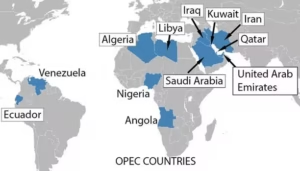
- OPEC+ is a coalition of major oil-exporting nations. Formed in 2016 as an extension of OPEC to include non-OPEC producers.
- Membership: Comprises 22 countries – 12 OPEC members plus 10 non-OPEC nations (Azerbaijan, Bahrain, Brunei, Kazakhstan, Russia, Mexico, Malaysia, South Sudan, Sudan, and Oman).
- Objective: To coordinate crude oil production levels and ensure stability in the global oil market. Members meet regularly to decide output quotas and manage supply-demand balance.
- Establishment: Founded in 1960 by Iran, Iraq, Kuwait, Saudi Arabia, and Venezuela.
- Recent Change: Angola officially exited OPEC on 1 January 2024.
- Headquarters: Located in Vienna, Austria.
Importance of OPEC+
- Global Oil Prices: Decisions directly influence international crude oil prices and energy security.
- Market Stability: Helps prevent extreme fluctuations in oil supply and demand.
- Geopolitical Impact: Cooperation between OPEC and non-OPEC countries (like Russia) reflects the strategic importance of energy diplomacy.
- India’s Relevance: As a major oil importer, India closely monitors OPEC+ decisions for their impact on inflation, trade balance, and energy policy.