

The U.S. Treasury Department issued an order permitting India to import Russian oil for 30 days to ease supply shocks caused by Iran’s blockade of the Strait of Hormuz and rising global crude prices.
Need for Russian Oil
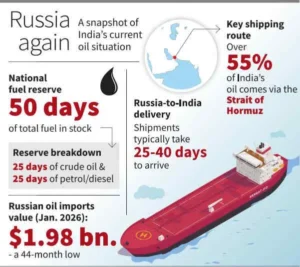
- Over 55% of India’s oil imports pass through the Strait of Hormuz.
- Disruptions raise India’s monthly oil bill (~$11.5 billion).
- If Brent crude crosses $90 per barrel, India’s CAD could rise to 1.4% of GDP and the rupee may weaken to ₹95 per U.S. dollar.
- Russian imports are seen as a buffer against price volatility.
Key Developments
- Temporary Relief: U.S. Treasury Secretary Scott Bessent said the measure is shortterm and applies only to oil already stranded at sea.
- Market Impact: Brent crude prices surged to $88 per barrel, up 20% in a week.
- India’s Reserves: Government confirmed India has 25 days of crude oil, petrol, and diesel reserves.
- Russian Oil Discount: Officials noted Russian oil may no longer be available at a discount, as China is also competing for supplies.
Import Trends:
- India imported $1.98 billion worth of Russian crude in Jan 2026, the lowest in 44 months.
- Russia’s share in India’s oil imports fell to 19.3% in Jan 2026, compared to 27.5% in Nov 2025 and 33% in May 2025.
- Current imports: 1.04 million barrels/day from Russia.
Economic Concerns
- Moody’s Analysis: India is highly dependent on West Asian crude.
- Costly imports could weaken the rupee, raise inflation, worsen CAD, and complicate fiscal management.
- Policy Pressure: India faces U.S. pressure to reduce Russian imports while balancing domestic energy needs.
Ratio of Oil Imports by Country
- Russia: 19.3%
- West Asia (Saudi Arabia, Iraq, UAE, etc.): ~55%
- United States & Others: Growing share, replacing part of Russian imports
Conclusion
The U.S. waiver provides India shortterm relief amid global energy disruptions. Diversifying energy sources and strengthening reserves remain critical for energy security and economic stability.
The Indian Institute of Science (IISc) has launched a Moonshot Project to develop advanced brain coprocessors.
Moonshot Project
- Objective: To design implantable and noninvasive brain coprocessors that can decode brain signals, process them using AI, and reencode them back into the brain through stimulation or feedback.
- Technology:
- AIpowered closedloop devices connecting different brain regions.
- Neuromorphic hardware mimicking brain processes.
- Origin: Evolved from a pilot project under IISc’s Brain, Computation and Data Science initiative.
- Funding: Supported by the Pratiksha Trust.

Key Features
- Brain Coprocessors: Emerging technology to enhance natural brain abilities in reallife situations.
- Multidisciplinary Approach: Involves neuroscience, AI, engineering, and medical sciences.
- Application: Focused on restoring sensorimotor functions, especially after stroke.
Significance
- Medical Impact:
- Rehabilitation of stroke survivors.
- Restoration of critical functions like goaldirected reach and grasp.
- Innovation: Firstofitskind brain coprocessor in India.
- Future Potential: Could pave the way for advanced cognitive rehabilitation and treatment of neurological disorders.
Conclusion
The Moonshot Project marks a major leap in India’s neuroscience and AI research, aiming to merge technology with medicine for human benefit and lay the foundation for future breakthroughs in neuroAI integration.
The United States recently expressed concern over the growing use and capabilities of Iran’s Shahed drones in global conflict zones.
Shahed Drones
- Origin: Developed by Iran; “Shahed” means witness in Farsi.
- Type: Low-cost, one-way attack drones (OWA UAVs), also called “kamikaze” or “suicide drones”.
- Function: Fly toward a target and explode on impact, acting like guided missiles.
- Variants:
- Shahed-131: Range of 700–900 km.
- Shahed-136: Longer range of 2,000–2,500 km.
- Russia refers to them as Geran-1 and Geran-2.
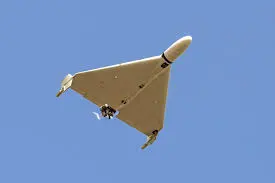
Key Features
- Size & Weight: Around 2.5–3 metres long; launch weight ~200 kg.
- Launch System: Uses a disposable rocket booster, followed by a piston engine.
- Navigation: Combines civilian GPS/GLONASS with inertial navigation systems (INS).
- Warheads: Can carry high-explosive, thermobaric, or shrapnel-filled munitions.
- Deployment: Can be launched from static mounts or mobile vehicles.
Strategic Significance
- Cost Advantage: Estimated cost between $20,000–$50,000, far cheaper than cruise or ballistic missiles.
- Tactical Use: Deployed in swarms to overwhelm air defences from multiple directions.
- Nickname: Often called the “poor man’s cruise missile” due to affordability and effectiveness.
Conclusion
Shahed drones represent a new era of low-cost aerial warfare. Their increasing use in global conflicts raises concerns about security, defence preparedness, and drone regulation in international defence discussions.
The United States and Israel recently carried out joint strikes on Iran, leading to Iranian retaliation against economic targets in Gulf Cooperation Council (GCC) states.
MultiFront Conflict in West Asia
- The conflict has expanded into a multifront crisis involving state and nonstate actors.
- Strategic maritime chokepoints like the Strait of Hormuz, Red Sea, and Persian Gulf are now flashpoints, threatening global energy supplies and shipping routes.
Key State Actors
- United States & Israel: Aim to dismantle Iran’s nuclear programme and weaken its proxy networks.
- Iran: Seeks regime survival, spreads conflict regionally to raise costs for US and allies, and deter further strikes.
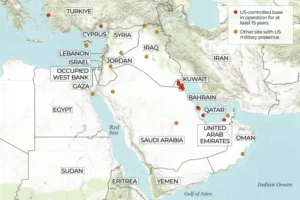
- GCC Nations (Saudi Arabia, UAE, Qatar, Bahrain, Kuwait, Oman): Host major US bases but face Iranian attacks on airports, oil facilities, and civilian infrastructure.
NonState Actors – “Axis of Resistance”
- Hezbollah (Lebanon): Engaged in clashes with Israel, aligned with Iran.
- Houthis (Yemen): Target commercial ships in the Red Sea and Gulf of Aden, disrupting global trade.
- Popular Mobilization Forces (Iraq): Launch strikes on US bases and Israeli interests.
- Kurdish Militias: Some supported by US and Israel as allies against Iran; Kurds remain a stateless ethnic group spread across West Asia.
Strategic Importance
- Maritime Chokepoints: Strait of Hormuz, Gulf of Oman, and Red Sea are vital for global oil trade.
- Proxy Warfare: Iran uses allied militias to expand conflict beyond its borders.
- India’s Concern: Heavy dependence on Gulf energy supplies makes stability in West Asia crucial for India’s economy and security.
Conclusion
For India, safeguarding energy imports and maritime security in these chokepoints is critical, making the region a priority in foreign policy and strategic planning.
Recent reports show GPS spoofing incidents affecting aircraft navigation near Iran and the UAE, creating a “digital fog of war.”
What is GPS Spoofing?
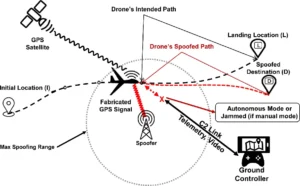
- Definition: GPS spoofing is the act of sending fake satellite signals to mislead GPS receivers.
- Purpose: It tricks devices into showing false location, speed, altitude, or time data.
- Difference from Jamming:
- Jamming blocks signals.
- Spoofing replaces real signals with fake ones.
How It Works
- Signal Manipulation: Spoofed signals are stronger than genuine ones, so receivers accept them as real.
- Aircraft Impact: Pilots may see incorrect positions on navigation systems, leading to misguided flight paths.
- Tools Used: Specialised hardware or software broadcasts counterfeit GPS signals.
Where It’s Reported
- Conflict Zones:
- Black Sea region
- West Asia and Middle East
- Areas with military operations or electronic warfare
Security Implications
- Aviation Risk: Misleading aircraft navigation can cause route errors or safety hazards.
- Military Use: Used to confuse enemy systems, disrupt operations, or mask troop movements.
- Civilian Threat: Can affect ships, drones, and vehicles, especially in sensitive zones.
Conclusion
GPS spoofing is a growing digital threat that manipulates navigation systems with false data. As its use spreads in conflict-prone regions, it poses serious risks to civilian and military operations.
Why in News?
A pair of rare Dusky Eagle Owls was recently sighted in the Phato tourism zone of Terai West Forest Division in Uttarakhand, near Corbett Tiger Reserve.
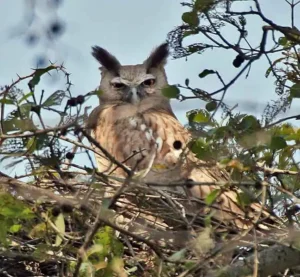
Physical Characteristics
- The Dusky Eagle Owl is a large and powerful owl species with a strong body and broad wings.
- Size: Approximately 48–53 cm in length, with females generally larger than males.
- Colouration:
- The body appears greyish-brown.
- Underparts are greyish-white with dark brown streaks.
- Wings are dark brown with pale streaks.
- Ear Tufts: Prominent ear-like feather tufts, which give it the characteristic eagle-owl appearance.
- Eyes: Large eyes adapted for excellent night vision.
Habitat and Behaviour
- This owl typically inhabits dense forests, riverine woodlands, and areas with large old trees.
- It prefers regions near water bodies, where prey availability is higher.
- During the daytime, it usually rests quietly in shaded branches or thick foliage to avoid disturbance.
- It becomes active around dusk and at night, although it may occasionally hunt during cloudy daylight conditions.
Feeding and Hunting Adaptations
- The species is a skilled predator with powerful talons and strong flight capability.
- It feeds mainly on:
- Small mammals such as rodents
- Birds
- Occasionally reptiles and insects
- Its sharp hearing and silent flight help it locate prey efficiently in low-light conditions.
Breeding and Nesting Behaviour
- Unlike many birds, the Dusky Eagle Owl does not build its own nest.
- Instead, it uses abandoned stick nests originally built by large birds of prey, including:
- Kites
- Vultures
- Eagles
- The nests are typically located on tall trees, providing safety from predators.
Conservation Status
- IUCN Red List: Least Concern (LC)
- Although the global population is stable, local threats include:
- Habitat loss due to deforestation
- Disturbance near nesting sites
- Decline of old-growth trees
Conservation of mature forests and riverine ecosystems is important for sustaining its population.