
Daily Current affairs 08 April 2026

Daily Current Affairs 08-April-2026

Share this Post

WOMEN’S RESERVATION & POLITICAL DYNAMICS

TOPIC: (GS2) POLITY: THE HINDU

Recent reports suggest the government may implement  the Women’s Reservation Act, 2023 (Nari Shakti Vandan Adhiniyam) using the 2011 Census which promises onethird reservation for women in Lok Sabha and State Assemblies.

Background

  • Parliament passed the 106th Constitutional Amendment in September 2023.
  • It reserves 33% of seats for women, including SC/ST constituencies.
  • Implementation was deferred until after Census and delimitation.
  • Opposition parties and women’s groups demanded immediate enforcement, but the government insisted on waiting for updated data.

Shift in Approach

  • Reports indicate delimitation may now be based on the 2011 Census instead of waiting for the new Census.
  • Lok Sabha seats may expand from 543 to 816 (nearly 50% increase).
  • This move decouples women’s reservation from the upcoming Census that is expected to include caste enumeration.

Political Implications

  • Enables the ruling party to claim credit for delivering women’s reservation.
  • Likely to mobilise women voters in upcoming Assembly elections and strengthen electoral prospects for 2029.
  • Positions the government as champion of gender justice.

Federal Concerns

  • Delimitation based purely on population favours northern States (higher fertility rates).
  • Southern States, despite economic contributions and stabilised populations, risk losing relative influence.
  • Expansion of seats may partly balance this, but northern States will still gain more absolute numbers.
  • Example: Uttar Pradesh and Bihar together could approach 180 seats, while five southern States combined may reach around 195.

Data Issues

  • Using 2011 Census data is outdated given migration, urbanisation, and COVIDrelated demographic changes.
  • The upcoming Census may reveal caste data, intensifying demands for subquotas within women’s reservation (especially OBCs, including Muslim OBCs).
  • Moving ahead now postpones these pressures but does not resolve them.

Operational Challenges

  • Rotation of reserved constituencies remains undefined.
  • Frequent rotation may disrupt accountability and development.
  • Smaller States/UTs may have different rotation rules compared to larger States.

Need for Deliberation

  • Women’s reservation is a historic reform, but sequencing matters.
  • Implementing without fresh data risks distorting representation.
  • Thorough deliberation is essential before restructuring India’s representative system.

KERALA’S WELFARE PITCH & DEVELOPMENT INDICATORS

TOPIC: (GS2) POLITY: THE HINDU

Kerala goes to Assembly elections on April 9, 2026, with results on May 3, 2026. The State’s welfarefocused manifestos coincide with Kerala ranking highest in most social, health, and education indicators.

Political Context

  • Contest between LDF (incumbent), UDF (opposition), and NDA (expanding presence).
  • All parties highlight welfare schemes, especially pensions, in their manifestos.
  • Welfare promises are backed by Kerala’s strong performance in development indicators.

Economic Performance

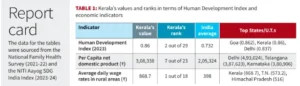
  • Kerala ranks 7th among 23 States in per capita Net State Domestic Product.
  • Average daily wage rate: ₹868, the highest in India.
  • Economic growth benefits rural areas, showing inclusive development.
  • Ranked 2nd in Human Development Index (HDI), reflecting health, education, and living standards.
Keralas Welfare Pitch & Development Indicators

Health Indicators

  • Infant Mortality Rate (IMR): 4.4 (lowest in India; national average 35.2).
  • Maternal Mortality Ratio: lowest in the country.
  • Low share of teenage pregnancies (15–19 years).
  • 93% of women have access to hygienic menstrual protection.
  • Child vaccination coverage: 78% (ranked 12th among 29 States).
  • Stunting among children (0–5 years): second lowest after Sikkim.

Education Indicators

  • High Adjusted Net Enrolment Rate (ANER) in elementary education.
  • Gross Enrolment Ratio (GER) in higher secondary above national average (57.6%).
  • Among top three States for GER.
  • Gender Parity Index (GPI): 1.44, highest among 29 States, showing balanced malefemale enrolment.

Infrastructure Indicators

  • Urban households in kachha houses: negligible (0%), better than national average of 0.9%.
  • Ranked 2nd in rural Internet teledensity, showing strong digital access.

Ecological Challenges

  • Kerala is among the top 10 States producing high levels of plastic waste per thousand population.
  • It also figures in the top nine States for per capita fossil fuel consumption.
  • Despite social and economic progress, environmental sustainability remains a weak link in Kerala’s development model.

Development Highlights

  • Kerala successfully blends economic growth with welfare policies, evident in high wages, HDI, and health outcomes.
  • Strong achievements in education and infrastructure reinforce its reputation as a welfareoriented State.
  • Election manifestos promising pensions and welfare align with Kerala’s established track record in human development.

Conclusion:

Kerala’s development model shows how sustained investment in welfare, health, and education can deliver inclusive growth. Yet, balancing this progress with environmental sustainability will be crucial for its future trajectory.


LIMITS OF NEUTRALITY IN ADDRESSING CASTE

TOPIC: (GS2) POLITY: THE HINDU

The Supreme Court has put an interim stay on the UGC Promotion of Equity in Higher Education Institutions Regulation, 2026, which was framed to tackle caste-based discrimination in universities.

Background

  • Regulations emerged from the Abeda Salim Tadvi v Union of India case, linked to caste discrimination and student suicides.
  • The rules define caste-based discrimination as unfair treatment against SCs, STs, and OBCs.
  • Debate arose over whether the definition should be caste-neutral, including “general category” students.

Why Neutrality Fails

  • Article 14 ensures equality, but Article 15 allows special provisions for disadvantaged groups.
  • Formal equality assumes all groups face discrimination equally, but caste is structural and hierarchical.
  • A caste-neutral definition risks diluting protections by equating systemic oppression with isolated bias.
  • SC/ST students face exclusion, humiliation, and institutional bias, sometimes leading to suicides.
  • Recognising caste-based discrimination specifically is not reverse bias; it ensures substantive equality.

Constitutional Perspective

  • Substantive equality: Focuses on removing historical disadvantages, not just treating everyone the same.
  • Articles 14 and 15 permit differential treatment to remedy structural inequality.
  • Neutrality would flatten unequal realities into abstract sameness, ignoring caste hierarchies.

Enforcement Challenges

  • The real issue lies in weak implementation and poor accountability in institutions.
  • Regulations must ensure:
    • Independent complaint mechanisms.
    • Time-bound inquiries.
    • Transparency in outcomes.
    • Penalties for non-compliance.
  • Monitoring, audits, and oversight are essential for effectiveness.

Key Insights

  • Regulations aim to protect historically excluded groups, not to deny others protection.
  • Neutrality risks weakening the law’s ability to address caste as a system of power.
  • Strong enforcement is more important than abstract debates on definitions.
  • Institutions must be held accountable for how they respond to discrimination.

Conclusion

True equality in higher education requires context-sensitive measures that recognise caste hierarchies. Strengthening enforcement, not diluting definitions, is the key to ensuring dignity and fairness for all students.

INDIA’S UPDATED CLIMATE PLEDGES

TOPIC: (GS3) ENVIRONMENT: THE HINDU

India has announced revised Nationally Determined Contributions (NDCs) under the Paris Agreement, updating its climate targets while balancing developmental needs.

What are NDC?

  • NDCs are voluntary commitments under the Paris Agreement for climate action.
  • India has opted for continuity with incremental progress, confident that its pledges align with climate justice and its role as a developing nation.
  • Structural constraints of being a lower middle-income country shape India’s choices.

New goals

  • Emission Intensity Reduction: Target raised from 45% below 2005 levels by 2030 to 47% by 2035.
  • Non-Fossil Fuel Capacity: 60% of installed power generation capacity to come from non-fossil sources.
  • Carbon Sinks: Forest and tree cover to absorb 3.5–4 billion tonnes of CO₂ equivalent above 2005 levels.

Developmental Context

  • India’s energy base is coal-dependent, making emission cuts costly.
  • Renewable energy expansion requires massive investment in battery storage and transmission capacity.
  • Hydropower expansion is limited due to environmental and regulatory challenges.
  • Transition costs include higher maintenance for thermal plants and economic burden of leap-frogging technologies (e.g., EVs, BSVI standards).

Global Debate

  • Critics argue India’s pledges are insufficient for the 1.5°C global warming goal.
  • Some call targets “too easy,” while others demand focus on actual renewable generation rather than installed capacity.
  • India counters that its per capita emissions are only one-third of the global average and that climate justice requires recognition of historical responsibility of big emitters.

Cost of Going Green

  • Scaling up renewable energy and storage could cost trillions of rupees.
  • Government resources diverted to climate action may affect other developmental sectors.
  • Lack of adequate climate finance support from developed nations adds to India’s burden.

Strategic Insights

  • India’s NDCs reflect pragmatism, balancing climate responsibility with developmental needs.
  • Commitments are framed within national circumstances, as permitted by the Paris Agreement.
  • India insists on equity and differentiated responsibility in global climate action.

Conclusion

India’s updated pledges show cautious progress, prioritising sustainable growth without compromising development goals. The challenge ahead lies in mobilising resources and technology to meet commitments while ensuring fairness in global climate responsibility.

CBSE AI CURRICULUM AND STUDENT PREPAREDNESS

TOPIC: (GS2) GOVERNANCE: THE HINDU

On 1 April 2026, the government introduced a CBSE curriculum on Computational Thinking (CT) and Artificial Intelligence (AI) for Classes 3–8, beginning in the 2026–27 academic session.

Aim of the Curriculum

  • Build skills in logical reasoning, problem-solving, and pattern recognition.
  • Introduce students to AI applications in daily life.
  • Designed as a step toward future-ready education.

Foundational Challenge: LSRW Skills

  • Listening, Speaking, Reading, Writing (LSRW) are essential for meaningful learning.
  • CT curriculum is language-driven, requiring reading and comprehension.
  • Activities like puzzles, problem-solving, and assessments depend on basic literacy skills.
  • Students with weak reading ability may see CT tasks as reading challenges rather than thinking exercises.

Evidence of Learning Deficit

  • ASER 2024: Over half of Class 5 students in government schools cannot read a Class 2-level text.
  • Literacy gap persists across government, private, rural, and urban schools.
  • PARAKH 2024: Found urban private school students performed worse than rural peers at Grade 3 level.
  • CBSE students are also affected by the national literacy crisis.

Literacy Goals vs Reality

  • NIPUN Bharat Mission (2021) aimed for foundational literacy by Grade 3 by 2026–27.
  • ASER 2024 shows improvement but targets remain unmet.
  • CT curriculum rollout coincides with the literacy deadline, creating a policy mismatch.

Dependence on Foundational Skills

  • CT curriculum focuses on higher-order skills like critical and analytical thinking.
  • These require strong comprehension abilities.
  • From Class 6 onwards, assessments include projects, journals, and written assignments.
  • Students with weak literacy risk early breakdown in learning pipeline.

Global Experience

  • Countries like Finland, Singapore, South Korea introduced AI education only after achieving strong literacy.
  • India’s rollout overlaps with unfinished literacy goals, raising concerns about sequencing.

Key Insights

  • CT curriculum is ambitious and well-designed but assumes literacy readiness.
  • Without strong LSRW skills, assessments may measure literacy gaps instead of computational thinking.
  • Policy sequencing must ensure literacy first, AI next for true transformation.

Conclusion

The CBSE AI curriculum is a progressive step, but its success depends on bridging foundational literacy gaps. Without strong reading and comprehension skills, the promise of computational thinking and AI education cannot be fully realised.

FAST BREEDER REACTOR AND CRITICALITY

TOPIC: (GS3) SCIENCE AND TECHNOLOGY: THE HINDU

India’s 500 MWe Prototype Fast Breeder Reactor (PFBR) at Kalpakkam, Tamil Nadu, has achieved criticality, marking a major step in India’s nuclear energy programme.

Fast Breeder Reactor (FBR)

  • FBRs generate more fissile material than they consume.
  • They use fast neutrons instead of slow (thermal) neutrons.
  • Fuel: Mixed Oxide (MOX) – plutonium with uranium-238.
  • “Breeding” process: Converts non-fissile uranium-238 into fissile plutonium-239.
  • Crucial for India due to limited uranium reserves but abundant thorium resources.
  • Forms the second stage of India’s three-stage nuclear programme.

Significance of FBRs

  • Enhance fuel efficiency by maximising energy from uranium.
  • Reduce nuclear waste by utilising otherwise unused materials.
  • Enable conversion of thorium into uranium-233 for the third stage.
  • Strengthen long-term energy security and reduce dependence on imported uranium.

Criticality in Nuclear Reactors

  • Criticality = reactor achieves a self-sustaining chain reaction.
  • States of criticality:
    • Subcritical: Reaction dies out.
    • Critical: Stable, self-sustaining reaction.
    • Supercritical: Reaction grows rapidly.
  • Achieving controlled criticality is a key commissioning milestone before power generation.

India’s PFBR at Kalpakkam

  • Located at Indira Gandhi Centre for Atomic Research (IGCAR).
  • Operated by BHAVINI, under Department of Atomic Energy.
  • Sodium-cooled, pool-type reactor using MOX fuel.
  • Designed to produce more fissile material than consumed.
  • Safety feature: Negative void coefficient – reduces reaction rate if overheating occurs.
  • Positions India among select nations with advanced FBR technology (Russia being the other).

India’s Three-Stage Nuclear Programme

  • Stage 1: Pressurised Heavy Water Reactors (PHWRs) – produce plutonium.
  • Stage 2: Fast Breeder Reactors (PFBR) – use plutonium to generate more fissile material.
  • Stage 3: Thorium-based reactors – convert thorium into uranium-233 for sustainable energy.

Conclusion

The PFBR’s criticality achievement at Kalpakkam is a historic milestone in India’s nuclear journey. It strengthens India’s path toward a closed nuclear fuel cycle, enhances energy independence, and lays the foundation for a thorium-based future.

MISSION MITRA

TOPIC: (GS3) SCIENCE AND TECHNOLOGY: THE HINDU

ISRO has launched Mission MITRA in Ladakh to test the mental and physical endurance of Gaganyaan astronauts under extreme conditions.

Mission MITRA

  • Full Form: Mapping of Interoperable Traits and Response Assessment.
  • Conducted jointly by ISRO and IAF-Institute of Aerospace Medicine.
  • Location: Leh, Ladakh – chosen for its high altitude, freezing temperatures, low oxygen, and isolation, simulating space-like conditions.
  • Involves India’s four designated Gaganyaan astronauts, supported by scientists, engineers, doctors, and psychologists.

Objectives

  • Study physiological, psychological, and operational dynamics of astronauts and ground teams.
  • Assess team interoperability between crew and mission control.
  • Examine decision-making effectiveness under environmental and operational stress.

Significance

  • Provides vital insights for human spaceflight missions, especially long-duration stays in orbit or deep space.
  • Helps design better training modules, support systems, and safety protocols.
  • Strengthens India’s preparedness for Gaganyaan and future interplanetary missions.

Conclusion

Mission MITRA is a pioneering behavioural study that bridges space science with human endurance research. By testing astronauts in Ladakh’s extreme environment, India is laying the groundwork for safe and successful human space exploration.

GOVERNMENT E MARKETPLACE (GEM)

TOPIC: (GS3) ECONOMY: THE HINDU

The Government e Marketplace (GeM) has crossed a record ₹18.4 lakh crore Gross Merchandise Value (GMV) since its launch, including ₹5 lakh crore GMV in 2025–26.

About GeM

  • Launched in 2016 by the Ministry of Commerce & Industry.
  • Serves as India’s national public procurement portal.
  • Used by Central & State Ministries, Departments, PSUs, and affiliated bodies for procurement of goods and services.
  • Enhances transparency, efficiency, and inclusivity in government procurement.

Features

  • Fully digital, cashless, and system-driven platform.
  • Provides end-to-end solutions for buyers and sellers.
  • Equipped with AI-powered tools and a multilingual Learning Management System (LMS).
  • Offers voice-enabled navigation and region-specific training modules to support sellers, including those in remote areas.

Objectives

  • Ensure speed, transparency, and efficiency in procurement.
  • Provide multiple modes of procurement:
    • Direct purchase
    • e-Bidding
    • Reverse e-Auction
    • Direct reverse auction
  • Mandate procurement by ministries/departments through GeM.
  • Enable efficient price discovery, economies of scale, and dissemination of best practices.

Conclusion

GeM has transformed India’s public procurement system into a transparent and technology-driven platform. Its record GMV achievement reflects growing trust and adoption, making it a cornerstone of digital governance and economic efficiency.

Write a Review

Your email address will not be published. Required fields are marked *