
Table of Contents
ToggleANTIMICROBIAL RESISTANCE (AMR) IN INDIA
TOPIC: (GS2) INDIAN POLITY: THE HINDU
Prime Minister Narendra Modi, in his December 2025 Mann Ki Baat address, highlighted antimicrobial resistance (AMR) as a major public health concern, stressing the dangers of indiscriminate antibiotic use and the urgent need for awareness and action.
What is AMR?
- What is AMR? Antimicrobial Resistance (AMR) happens when bacteria, viruses, or fungi stop responding to medicines, making infections harder to cure. Globally, AMR is estimated to cause 1.27 million deaths annually (Lancet, 2022).
- India’s Situation: Misuse and overuse of antibiotics is the main driver of AMR. Studies show that over 58% of antibiotics in India are sold without prescription, leading to irrational use.
- Health Impact: According to the ICMR (2024), resistance is rising in common infections like pneumonia and urinary tract infections. AMR is projected to cause up to 1 million deaths per year in India by 2050 if unchecked.
- Economic Burden: AMR could reduce India’s GDP by up to 7% by 2050, due to healthcare costs and productivity losses (World Bank estimate).
Current Situation in India
- ICMR Data: Antibiotics are becoming less effective against common infections like pneumonia and urinary tract infections.
- Public Behaviour: Self-medication and over-the-counter antibiotic use are widespread.
- National Action Plan (2017): Steps like banning colistin as a growth promoter have been taken, but awareness remains limited.
- Surveillance Gaps: India’s AMR surveillance network (NARS-Net) has 60 labs, but recent WHO GLASS reporting used data from only 41 sites across 31 States/UTs.
- Urban Bias: Most surveillance centres are in cities and tertiary hospitals, leaving rural and semi-urban areas underrepresented.
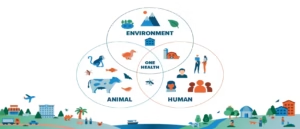
Need for a One Health Approach
- Recognises the interconnectedness of human, animal, and environmental health.
- AMR is not just a hospital issue; it spreads through agriculture, veterinary practices, and poor waste management.
- Coordinated action across sectors is essential to control resistance.
Key Challenges
- Incomplete Data: Lack of comprehensive national-level AMR statistics.
- Exclusion of Private Sector: Private hospitals and smaller centres are not fully integrated into surveillance.
- Limited Awareness: General public often unaware of risks of antibiotic misuse.
- Weak Infrastructure: Surveillance and monitoring systems need expansion and better funding.
Way Forward
- Expand AMR surveillance to cover rural areas, primary and secondary centres, and private hospitals.
- Strengthen public awareness campaigns against self-medication and misuse of antibiotics.
- Adopt the One Health framework to integrate human, animal, and environmental health strategies.
- Invest in new medicines, diagnostics, and vaccines as per WHO’s Global Plan (2015).
- Ensure political will and funding to sustain long-term AMR control measures.
Conclusion
Antimicrobial Resistance (AMR) is emerging as a silent pandemic that threatens to undo decades of medical progress in India. Without urgent action on surveillance, rational drug use, and a One Health approach, it could become a major public health disaster.
NATGRID SURVEILLANCE
TOPIC: (GS3) SCIENCE AND TECHNOLOGY: THE HINDU
Recent reports reveal the expansion of NATGRID, including its integration with the National Population Register (NPR) and increased access for police units, raising concerns about privacy, oversight, and digital authoritarianism.
About NATGRID
- Purpose: Created after the 26/11 Mumbai attacks to improve coordination among intelligence agencies.
- Function: Allows 11 central agencies to access data from 21 different sources like travel, telecom, finance, and identity records.
- Technology: Acts as a central platform to combine scattered data for faster investigation and threat detection.
- Current Status: Now fully operational and handles around 45,000 data requests every month.
- Expanded Access: Use of NATGRID has widened to include state police, even at the Superintendent level.
Integration with NPR and Gandiva
- NATGRID is now linked to the National Population Register (NPR), which holds data on 1.19 billion residents.
- This shift moves from tracking events to mapping individuals, raising fears of mass surveillance.
- Deployment of Gandiva, an advanced analytics engine, enables entity resolution — matching fragmented data to individuals.
- Combined with facial recognition, this allows deep profiling using KYC and driving licence databases.
Key Concerns
- Lack of Oversight: NATGRID operates without a statutory framework or independent monitoring, even by Parliament.
- Risk of Bias: Algorithms may reinforce existing social prejudices (caste, religion, geography) under the guise of objectivity.
- Scale of Surveillance: High volume of queries risks turning safeguards into routine formalities.
- Mission Drift: Originally meant for counter-terrorism, NATGRID is now used for routine policing.
Way Forward
- Establish legal safeguards and a clear statutory framework for surveillance systems.
- Ensure judicial and parliamentary oversight to prevent misuse.
- Promote transparency in intelligence operations and accountability for failures.
- Limit surveillance to specific, justified cases, not mass profiling.
- Strengthen data protection laws and uphold the privacy rights affirmed in the Puttaswamy judgment (2017).
Conclusion
NATGRID’s expansion reflects a shift from targeted intelligence to widespread surveillance. Without legal checks and democratic oversight, it risks becoming a tool of digital authoritarianism. India must balance national security with civil liberties to preserve constitutional values and public trust.
TAMIL NADU ASSURED PENSION SCHEME (TAPS)
TOPIC: (GS3) ECONOMY: THE HINDU
The Tamil Nadu government has announced the Assured Pension Scheme (TAPS) as a middle path between the Old Pension Scheme (OPS) and the Contributory Pension Scheme (CPS), ahead of the upcoming Assembly elections.
Tamil Nadu Assured Pension Scheme:
- OPS vs CPS: OPS guaranteed lifelong pension linked to Pay Commission revisions. CPS, introduced in 2003, required employee contributions but offered uncertain benefits.
- Demand for OPS Restoration: Around six lakh employees under CPS have been pressing for OPS revival, while nearly two lakh staff remain under OPS.
- Government Response: TAPS blends features of OPS and the Unified Pension Scheme (UPS) used by central government employees.
Features of TAPS
- Pension at 50% of Last SalaryWhen an employee retires, their pension will be half of the last salary they received. Example: If someone’s final salary was ₹60,000 per month, their pension will be ₹30,000 per month.
- Minimum Assured Pension for All: Even if an employee has worked for a shorter period, they will still get a minimum guaranteed pension.
- Employee Contribution Continues: Like the Contributory Pension Scheme (CPS) and Unified Pension Scheme (UPS), employees will still contribute a part of their salary during service.
- Death-cum-Retirement Gratuity Included: Employees will receive a lump sum payment at the time of retirement or if they pass away while in service.
Fiscal Context
- Tamil Nadu’s debt-to-GSDP ratio is about 26.1%, higher than the pre-COVID level of 21.5%.
- The State must manage both OPS retirements (till 2033) and contributions for TAPS employees simultaneously.
- Revenue Concerns: State’s Own Tax Revenue (SOTR) growth was only 3.94% (Apr–Sep 2025) compared to the projected 22.6%. GST restructuring adds uncertainty to future finances.
- Limited fiscal space restricts populist spending, unlike examples seen in other states.
Way Forward
- Ensure long-term sustainability of pension schemes without burdening state finances.
- Monitor revenue growth and adjust contributions accordingly.
- Balance employee welfare with fiscal discipline.
- Transparent communication with employees to manage expectations.
Insurance and Pension
Purpose
- Insurance: Provides financial protection against unexpected risks like death, illness, or accidents. Example: Life insurance pays money to a family if the insured person passes away.
- Pension: Ensures regular income after retirement to support old-age living expenses. Example: A government employee receives monthly pension after retiring at 60.
Payment Structure
- Insurance: Usually, a one-time lump sum or coverage amount is paid when the insured event occurs. Example: Health insurance covers hospital bills during illness.
- Pension: Provides periodic payments (monthly/annual) for a long duration, often lifelong. Example: Employees under the National Pension Scheme (NPS) get monthly payouts after retirement.
Conclusion
TAPS represents a middle path between OPS and CPS, offering assured benefits while maintaining fiscal responsibility. It reflects the government’s attempt to balance electoral promises with economic realities, ensuring that Tamil Nadu avoids financial stress while addressing employee concerns.
YOUTH LEADERSHIP AND VIKSIT BHARAT
TOPIC: (GS3) ECONOMY: THE HINDU
The Viksit Bharat Young Leaders Dialogue (VBYLD) 2026 is scheduled from January 9–12, 2026, with participation from over 50 lakh youth, highlighting the role of young Indians in shaping the nation’s vision for 2047.
Driving India’s Vision for 2047
- India’s Youth Strength: India has the largest youth population globally — about 66% under the age of 35 and nearly 50% below 25 years (UN data, 2024). This makes youth leadership crucial for achieving the vision of a developed India by 2047.
- Government Emphasis: Prime Minister Narendra Modi has highlighted yuva shakti as the driving force for governance, innovation, and social change, linking youth participation directly to national progress.
- Launch of VBYLD: The Viksit Bharat Young Leaders Dialogue (VBYLD) was introduced in January 2025, engaging over 30 lakh youth through challenges and essays, and culminating in a national-level dialogue with 3,000 youth leaders.
Importance of Youth Leadership
- Youth are not just participants but drivers of change in education, technology, governance, and community development.
- Their ideas emerge from campuses, start-ups, sports fields, and villages, reflecting diversity of thought and experience.
- India’s demographic dividend is its biggest national asset, capable of strengthening democracy and ensuring inclusive growth.
VBYLD 2025 Achievements
- Over 30 lakh youth engaged through the Viksit Bharat Challenge.
- More than 2 lakh essays submitted and thousands of ideas presented at State-level events.
- Culminated at Bharat Mandapam, New Delhi, where 3,000 youth leaders interacted directly with the Prime Minister.
- The initiative ensured that every participant had a voice and platform, regardless of geography or background.
VBYLD 2026 Highlights
- Scheduled for January 9–12, 2026, coinciding with National Youth Day (12 January) in honour of Swami Vivekananda.
- Over 50 lakh youth participated in the Viksit Bharat Quiz, the first stage of selection. Inclusion of the Indian youth diaspora, giving the dialogue global resonance.
- New initiatives: Design for Bharat and Tech for Viksit Bharat, expanding scope to innovation and technology.
- Provides a platform for critical thinking, solution-building, and leadership training.
Way Forward:
- Continuous Youth Engagement: India has 371 million youth (15–29 years), nearly 27% of the population. Platforms like VBYLD must evolve into year-round forums (digital + local councils) to keep youth ideas active beyond events.
- Inclusive Participation: About 65% of India’s youth live in rural areas and nearly 180 million are young women.
- Global Partnerships: India has the largest diaspora youth population — 18 million abroad. Linking them through initiatives like Tech for Viksit Bharat and collaborating with global youth platforms will amplify India’s voice internationally.
Conclusion
India’s journey to becoming a Viksit Bharat by 2047 depends on the imagination and leadership of its youth. Platforms like VBYLD transform young citizens from passive participants into active leaders, ensuring that their vision shapes the nation’s future.
CHANGING CONSUMPTION BASKET
TOPIC: (GS3) ECONOMY: THE HINDU
The latest Household Consumption Expenditure Survey (HCES) 2023–24 by MoSPI reveals major shifts in how Indian households spend money, marking a transition from basic needs to aspirational and service-oriented consumption.
Household Consumption Expenditure Survey (HCES)
- The Household Consumption Expenditure Survey (HCES) is conducted every five years by the Ministry of Statistics and Programme Implementation (MoSPI) to track how Indian households spend across various categories.
- It provides granular data on Monthly Per Capita Expenditure (MPCE) for both rural and urban populations, helping policymakers understand consumption trends and revise poverty estimates.
- The 2023–24 round is the first full update since 2011–12, offering fresh insights into India’s economic transition and middle-class expansion.
According to the latest data:
- Food & beverages share in MPCE declined from ₹ ₹48 to ₹39 in urban areas, confirming Engel’s Law.
- Miscellaneous services (health, education, transport) rose sharply, especially in rural areas — from ₹21.87 to ₹35.82 per ₹100 spent.
- Fuel & light spending dropped due to improved access to electricity and LPG, with rural MPCE falling from ₹10.8 to ₹6.0.
- Urban housing rent increased from ₹4.46 to ₹6.58 per ₹100, reflecting urbanisation and rental stress.

Decline in Food Spending
- Rural food spending dropped from ₹59 to ₹47 per ₹100; urban from ₹48 to ₹39.
- Confirms Engel’s Law: as income rises, food share declines even if total spending increases.
- Shift from cereals to protein-rich items like eggs, fish, and processed foods.
Low Spending on Intoxicants
- Spending on pan, tobacco, and similar items remains low: under ₹3.8 per ₹100.
- Slight rise in rural areas calls for targeted health awareness campaigns.
Fuel & Light Expenditure Falls
- Rural fuel spending fell from ₹10.8 to ₹6; urban from ₹8 to ₹5.
- Reflects success of schemes like Saubhagya and PM Ujjwala Yojana.
- Indicates shift to modern, cleaner energy sources.
Clothing & Footwear Trends
- Spending declined slightly in both sectors, showing move from need-based to discretionary buying.
- Rural spending remains steady due to seasonal needs and rising aspirations.
Rise in Urban Housing Costs
- Urban rent share rose from ₹4.46 to ₹6.58 per ₹100.
- Linked to urbanisation, migration, and rental stress.
- Rural rent remains low due to self-owned or informal housing.
Growth in Miscellaneous Spending
- Includes health, education, transport, and services.
- Rural share rose from ₹21.87 to ₹35.82 per ₹100.
- Reflects inclusive growth, digital access, and better service availability.
Conclusion
India’s consumption habits are evolving. The HCES data shows a clear shift from survival-based spending to aspirational and service-driven choices, reflecting rising incomes, better infrastructure, and changing lifestyles.
INDIA’S PROGRESS ON CLIMATE COMMITMENTS
TOPIC: (GS3) ENVIRONMENT: THE HINDU
India has achieved significant progress in reducing emissions intensity and expanding renewable energy capacity, recent Aravalli judgment has also highlighted the importance of protecting sensitive ecosystems while pursuing development.
Paris Climate Summit (2015)
- Achieve 40% non-fossil fuel power capacity.
- Install 175 GW renewable energy by 2022.
- Create a carbon sink of 2.5–3 billion tonnes CO₂ through forests.
- Reduce emissions intensity of GDP by 33–35% by 2030 (baseline 2005).
- India is the third-largest emitter globally, though its per capita emissions remain lower than developed countries.
Renewable Energy Expansion
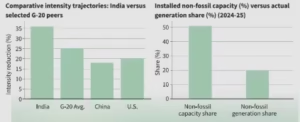
- Non-fossil capacity rose from 29.5% (2015) to 51.4% (2025).
- Solar grew from 2.8 GW (2014) to ~110 GW (2025); wind reached ~51 GW.
- Yet, renewables supplied only 22% of electricity in 2024–25, as coal (~240 GW) continues to provide baseload.
- Storage gap: Demand projected at 336 GWh by 2030, but only 500 MWh operational in 2025.
- Missed target: 175 GW renewables by 2022; new ambition is 500 GW by 2030.
Forest Carbon Sink
- India has sequestered 30.43 billion tonnes CO₂ stock by 2023, adding 2.29 billion tonnes since 2005.
- Only 0.2 billion tonnes remain to meet the 2030 pledge.
- Issues:
- Implementation gaps in Compensatory Afforestation Fund (₹95,000 crore); Delhi used only 23% of funds (2019–24).
- Climate stress reduces actual carbon absorption in regions like the Western Ghats.
Way Forward
- Coal Transition Roadmap: India still relies on 253 GW of coal-based capacity (2025), which supplies over 70% of electricity generation.
- Battery Storage and Grid Expansion: Renewable energy contributes 51% of installed capacity but only 22% of actual electricity generation (2024–25) due to intermittency.
- The Central Electricity Authority projects a need for 336 GWh of storage by 2030, while current operational capacity is just 500 MWh (2025).
- Forest Governance Reform: India has sequestered 30.43 billion tonnes CO₂ stock (2023), nearly achieving its 2.5–3 billion tonnes pledge.
Major Indian Climate Initiatives
- National Action Plan on Climate Change (NAPCC, 2008): Umbrella framework with 8 national missions (Solar Mission, Energy Efficiency, Sustainable Agriculture, etc.).
- National Solar Mission (2010): Helped scale solar capacity from 2.8 GW in 2014 to ~110 GW by 2025.
- Perform, Achieve and Trade (PAT) Scheme: Reduced energy use in sectors like cement, steel, and power, cutting emissions intensity.
- UJALA Scheme (2015): Distributed over 370 million LED bulbs, saving electricity and reducing emissions.
Conclusion
India has achieved some climate targets, but the main task now is to actually reduce total emissions and ensure that renewable energy produces steady, reliable power. The next five years are crucial for improving energy storage, cutting dependence on coal, and balancing climate action with environmental restoration.
APPAREL EXPORT PROMOTION COUNCIL (AEPC)
TOPIC: (GS3) ECONOMY: THE HINDU
A. Sakthivel has been appointed as the Chairman of AEPC for the fifth time, highlighting his continued leadership in promoting India’s apparel exports.

Background
- Established in 1978 under the Foreign Trade (Development and Regulation) Act, 1992.
- Functions under the Ministry of Textiles, Government of India.
- Serves as the official body of apparel exporters, representing their interests globally.
- Headquarters: Gurgaon, Haryana.
Objectives and Role
- Promote and support the export of Indian garments and textiles.
- Act as a bridge between government, exporters, and international buyers.
- Enhance the competitiveness of Indian apparel in global markets.
Structure
- Governing body led by an elected chairman.
- Supported by regional and sectoral committees.
- Includes stakeholders such as government representatives, exporters, and industry associations.
Functions
- Export Promotion: Facilitates global trade of Indian apparel.
- Market Research: Studies global demand and fashion trends.
- Trade Fairs: Organizes events like the India International Garment Fair (twice a year, 300+ exhibitors).
- Policy Advocacy: Liaises with government to resolve export-related issues.
- Skill Development: Provides training and workshops for workforce upskilling.
- Quality Standards: Ensures compliance with international certifications.
- Data Collection: Publishes industry reports and export statistics.
Conclusion
AEPC plays a vital role in strengthening India’s apparel exports, supporting both policy and market development. With Sakthivel’s reappointment, the council is expected to continue driving India’s textile sector towards greater global competitiveness.

SHINE SCHEME
TOPIC: (GS1) SOCIAL ISSUES: THE HINDU
The SHINE Scheme (Standards Help Inform & Nurture Empowered Women) was launched in New Delhi during the 79th Bureau of Indian Standards (BIS) Foundation Day, placing women at the center of India’s quality and safety journey.
About SHINE Scheme
- Introduced by the Bureau of Indian Standards (BIS).
- Focuses on empowering women with knowledge of standards, safety, and quality.
- Works through structured training programs, partnerships with NGOs and Self-Help Groups (SHGs), and community-level initiatives.
- Aims to strengthen family well-being and livelihoods by spreading awareness about product standards and safe practices.
- Encourages women to become agents of change in promoting quality culture at the grassroots level.
Key Features
- Training & Awareness: Locally delivered sessions on standards and safety.
- Community Outreach: Collaboration with SHGs and NGOs for wider reach.
- Livelihood Support: Knowledge of quality standards helps women improve small businesses and household enterprises.
- Household Safety: Promotes safe products and practices within families.
Bureau of Indian Standards (BIS)
- National Standards Body of India, established under the BIS Act, 2016.
- Successor of the Indian Standards Institution (ISI, 1947).
- Functions under the Ministry of Consumer Affairs, Food & Public Distribution.
- Represents India in ISO and IEC.
- Headquarters: New Delhi, with regional and branch offices nationwide.
Conclusion
The SHINE Scheme is a step towards inclusive quality governance, ensuring that women play a central role in spreading awareness about standards and safety, thereby contributing to stronger communities and sustainable livelihoods.