

Daily Current affairs 09 April 2026

Daily Current Affairs 09-April-2026

Share this Post

CEASEFIRE BETWEEN U.S. AND IRAN

TOPIC: (GS2) INTERNATIONAL RELATIONS: THE HINDU

The U.S. and Iran have agreed to a two-week ceasefire after weeks of conflict, but tensions remain due to Israel’s continued military actions.

U.S. and Iran Ceasefire

  • Ceasefire Agreement: On April 8, U.S. President Trump accepted a two-week truce and direct talks with Iran.
  • Iran’s Assurance: Tehran promised safe passage of vessels through the Strait of Hormuz.
  • Peace Proposals: Iran presented a 10-point peace formula, while the U.S. offered a 15-point plan.
  • Regional Scope: Iran and Pakistan confirmed the truce applies across all fronts, including Lebanon.

Background of the Conflict

  • The war began on February 28 when U.S. bombing killed Iran’s Supreme Leader Ayatollah Ali Khamenei.
  • Israel strongly supported the U.S. military action.
  • Iran retaliated by attacking U.S. bases in the Gulf and controlling the Strait of Hormuz.
  • The war disrupted global trade, raising oil, gas, and food prices.

Impact of the War

  • U.S. objectives (destroying Iran’s missiles, navy, nuclear programme, regime change) were not achieved.
  • Iran emerged strategically stronger despite heavy losses.
  • Global economy suffered due to rising energy and food costs.
  • Pakistan played a constructive diplomatic role in facilitating talks.

Issues in Ceasefire

  • Wide gap between U.S. 15-point proposal and Iran’s 10-point formula.
  • Iran demands removal of sanctions and guarantees against future aggression.
  • Israel, while welcoming the truce, refuses to stop attacks in Lebanon.
  • U.S. rhetoric and threats have worsened diplomatic relations.

Way Forward

  • Restrain Israel’s Militarism: Peace requires halting unilateral Israeli strikes in Lebanon and elsewhere.
  • Balanced Diplomacy: U.S. must avoid inflammatory language and focus on constructive negotiations.
  • Address Core Demands: Sanctions relief and security guarantees are essential for durable peace.
  • Regional Stability: Broader cooperation with Pakistan, Oman, and other mediators can strengthen dialogue.

Conclusion

A durable solution lies in respecting Iran’s security concerns, reducing sanctions, and fostering regional cooperation to prevent future escalation.

SPORTS GOODS MANUFACTURING IN INDIA

TOPIC: (GS3) ECONOMY: THE HINDU

NITI Aayog and the Foundation for Economic Development (FED) released a report on India’s sports equipment manufacturing sector, highlighting its export potential and structural challenges.

Importance of Sports Manufacturing

  • Sports is more than entertainment; it drives economic activity.
  • India contributes only 0.5% to the global sports equipment trade (~$50 billion).
  • Despite legacy skill centres, structural issues limit competitiveness.

Manufacturing Landscape

  • Geographic concentration: Jalandhar (Punjab) and Meerut (Uttar Pradesh) produce over 80% of domestic output.
  • Dominated by MSMEs: Focus on stitched balls, cricket gear, protective accessories, entry-level fitness items.
  • Strengths: Skilled artisans, traditional expertise.
  • Weaknesses: Limited scaling, poor adoption of modern technology, lack of global brands.
  • Diversity challenge: Different raw materials and techniques for footballs, hockey sticks, golf shafts → policy design becomes complex.

Cost Disadvantage

  • Indian firms face 15% higher production costs compared to China and Pakistan.
  • Example: Football in India costs ₹100 vs ₹85–87 abroad.
  • Causes: Higher input prices, inefficient logistics, small-scale operations.

challenges

  • Raw Materials & Machinery: Advanced polymers, composites, fabrics often imported. High import duties raise costs.
  • Logistics & Infrastructure: Manufacturing concentrated in North India, high transport costs to ports. Rising land prices, fragmented industrial zones, compliance delays reduce efficiency.
  • Certification & Standards: International sports bodies demand strict quality standards. Certification costs ₹5–50 lakh per SKU → discourages innovation.
  • Demand-Side Weakness: Few Indian sports brands with global appeal. Low marketing budgets, weak athlete-brand partnerships.

way forward

  • Policy Support: Rationalise import duties on specialised inputs. Provide fiscal incentives (export-linked, certification support).
  • Technology & Scale: Leverage strengths in textiles, plastics, footwear, engineering. Upgrade clusters for high-performance equipment.
  • Domestic Raw Materials: Invest in composites and performance fabrics locally. Reduce dependence on imports.
  • Brand Building: Promote Indian sports brands globally. Launch national campaigns with athletes, federations, and industry.

Conclusion

With reforms in raw materials, certification, logistics, and branding, India can shift from low-value contract manufacturing to advanced, large-scale production.

JAN VISHWAS 2.0 AND TRUST-BASED COMPLIANCE

TOPIC: (GS3) ECONOMY: THE HINDU

Parliament has passed the Jan Vishwas (Amendment of Provisions) Bill, 2026, which expands decriminalisation of minor business offences and promotes trust-based regulation.

Background of Reform

  • Jan Vishwas Act, 2023: Decriminalised 183 provisions across 42 Central Acts.
  • Jan Vishwas 2.0 (2026): Enlarges scope → 784 provisions amended across 79 Acts, with 717 offences decriminalised.
  • Aim: Shift from criminal punishment for minor lapses to civil penalties and administrative measures.

Key Features of Jan Vishwas 2.0

  • Decriminalisation: Removes criminal liability for minor procedural lapses (delays in filing, clerical errors).
  • Rationalisation of Laws: Eliminates outdated and redundant offences. Strengthens coherence of regulatory framework.
  • Trust-Based Regulation: Focus on voluntary compliance rather than fear-driven adherence. First-time or minor violations may attract warnings or lower penalties.

Significance

  • Ease of Doing Business: Reduces compliance burden, especially for MSMEs.
  • Judicial Relief: With ~50 million cases pending, shifting minor offences out of criminal courts reduces congestion.
  • Investor Confidence: Creates predictable and transparent regulatory environment.
  • Economic Efficiency: Aligns regulation with evolving business realities.

Role of Industry & Stakeholders

  • Confederation of Indian Industry (CII) played a major role in advocating reforms.
  • Suggested shift from court fines to executive penalties with clear rules.
  • Recommended retrospective application to cover pending cases.
  • Continuous consultation ensured balance between facilitation and enforcement.

Way Forward

  • Effective Implementation: Build institutional capacity for administrative adjudication.
  • Uniform Enforcement: Ensure consistency across ministries and departments.
  • Clear Guidance: Provide transparent rules to businesses for compliance.
  • Retrospective Relief: Review pending minor cases for closure under new framework.

Conclusion

Jan Vishwas 2.0 shifts India’s regulatory approach from criminalisation to trust-based compliance. It promotes entrepreneurship, and builds investor confidence, with success relying on transparent implementation and stakeholder engagement.

HEAT STRESS AND INDIA’S TEXTILE INDUSTRY

TOPIC: (GS3) ECONOMY: THE HINDU

India’s textile hubs like Tiruppur and Bengaluru are facing severe productivity losses due to extreme heat, raising concerns about worker welfare and supply chain sustainability.

Heat Stress Impact on Workers

  • A worker in Tamil Nadu loses 50% work capacity at 40°C, with no cooling breaks or sick leave.
  • Heat stress directly reduces wages and productivity, hitting informal workers hardest.
  • At 33–34°C, studies show labour capacity is halved.

Productivity Crisis

  • Between 2001–2020, India lost 259 billion labour hours annually due to heat stress (~$600 billion).
  • In 2024, losses reached 247 billion hours.
  • Factories in Maharashtra and Karnataka report production drops of up to 50%.
  • Machines also overheat, causing shutdowns and delays.
  • Research shows annual output falls 2% per degree Celsius, and 4% on hot days.

Textile Industry Context

  • Employs 45 million workers.
  • India controls 39% of global cotton cultivation.
  • Extreme heat threatens both human labour and machinery, leading to operational collapse.

Supply Chain Trap

  • Global brands impose strict deadlines and penalties for delays.
  • Workers cannot exceed biological limits, forcing managers into impossible choices.
  • International buyers diversify sourcing (Vietnam, Mexico), but Indian factories lack bargaining power.
  • Informal workers absorb the cost through lost wages.
  • By 2030, India may lose 5.8% of daily working hours → equal to 34 million full-time jobs.

Way Forward

  • Policy Recognition: Treat heat stress as a supply chain risk; integrate climate projections into trade policy.
  • Heat-Action Plans: Enforce temperature thresholds, cooling breaks, and health checks in industrial clusters.
  • Financial Reform: Banks and governments must support cooling systems, water management, and resilient technologies.
  • Labour Protection: Strengthen codes to guarantee water, shaded rest areas, and worker safety.
  • Innovation: Invest in R&D for cooling wearables, heat-tolerant cotton, and energy-efficient processes.
  • Global Responsibility: International buyers must share adaptation costs via fair pricing and longer lead times.

Conclusion

Without urgent reforms, productivity losses will cripple industry and workers will continue to bear the hidden thermal cost of global trade.

FAST BREEDER REACTORS (FBRS) IN INDIA

TOPIC: (GS3) SCIENCE AND TECHNOLOGY: THE HINDU

On April 6, 2026, India’s Prototype Fast Breeder Reactor (PFBR) at Kalpakkam achieved first criticality, marking a major milestone in India’s nuclear programme.

What is Criticality?

  • A reactor achieves criticality when the nuclear chain reaction sustains itself.
  • It means the reactor is stable but not yet producing commercial electricity.
  • After criticality, the reactor runs at low power for months to test safety and performance before full-scale operation.
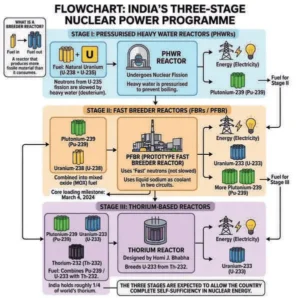
Fast Breeder Reactors in India

How FBRs Work

Fast Breeder Reactor (PFBR)

  • Location: Kalpakkam, Tamil Nadu.
  • Purpose: Uses spent fuel and depleted uranium to produce more plutonium, forming part of India’s three-stage nuclear programme.
  • Delays: Achieved criticality 16 years late; fuel cycle facility expected only by 2029.
  • Cost Overrun: Final cost ₹8,181 crore, more than double the sanctioned amount.
  • Issues: Poor planning, weak procurement, and lack of transparency.

Difference Between FBR and PHWR

  • PHWRs: Use natural uranium, require moderators to slow neutrons, low fuel efficiency.
  • FBRs: Use plutonium, rely on fast neutrons, breed more fuel, higher efficiency.

India’s Three-Stage Nuclear Programme

  • Stage 1: PHWRs use natural uranium → produce electricity, plutonium, and depleted uranium.
  • Stage 2: FBRs use plutonium + depleted uranium → generate more plutonium and electricity.
  • Stage 3: Advanced reactors use plutonium + thorium → achieve long-term energy self-sufficiency.
  • Reason: India has abundant thorium but limited uranium reserves. FBRs act as a bridge to thorium-based reactors.

Challenges

  • PFBR uses liquid sodium coolant: efficient but highly reactive with air/water → requires strict safety.
  • High costs, complex engineering, and risk of leaks (Japan’s Monju reactor shut after sodium fire).
  • France’s Superphénix closed due to technical and political issues.
  • Globally, FBRs are technically feasible but not yet economically viable.

India’s Pursuit of FBRs

  • PFBR approved over two decades ago; designed by Indira Gandhi Centre for Atomic Research.
  • Built by Bharatiya Nabhikiya Vidyut Nigam Ltd.
  • Faced cost overruns (₹3,500 crore → ₹8,181 crore) and repeated delays.
  • India continues due to long-term fuel security goals and state-driven nuclear policy.

What Next for PFBR?

  • Operated at low power to test behaviour under different conditions.
  • Data collection → refine safety protocols.
  • Approval from Atomic Energy Regulatory Board required for commercial operation.
  • Parallel development of reprocessing facilities and future FBRs (FBR-1, FBR-2).
  • Success will determine if India can achieve a closed fuel cycle and thorium-based energy future.

India’s Nuclear Power

  • Nuclear power contributes around 3% of electricity (8.78 GW capacity).
  • India aims for net-zero emissions by 2070.
  • Nuclear plants require only 6% of land compared to equivalent solar generation → helps protect biodiversity.
  • Breeder reactors are fuel-efficient, extend fuel cycle, and reduce dependence on uranium imports.

Conclusion

The PFBR’s criticality is a first step, not the end goal. India’s three-stage nuclear vision depends on FBRs to bridge uranium scarcity and thorium abundance. While technically complex and costly, FBRs remain central to India’s long-term energy security.

RBI’S MPC DECISION ON REPO RATE

TOPIC: (GS3) ECONOMY: THE HINDU

The Monetary Policy Committee (MPC) of the RBI kept the repo rate unchanged at 5.25%, factoring in the temporary ceasefire in West Asia and its impact on inflation and growth.

What is Repo Rate?

  • Repo rate is the rate at which RBI lends money to commercial banks against government securities.
  • It is a key tool of monetary policy to control inflation and liquidity.
  • Lower repo rate → cheaper loans, boosts growth.
  • Higher repo rate → costlier loans, helps control inflation.

MPC’s Decision

  • Repo rate held steady at 5.25%.
  • Stance: Neutral.
  • Ceasefire in West Asia partly influenced the decision.

Concerns Highlighted

  • Geopolitical Risks: West Asia conflict adds uncertainty to energy supply and infrastructure. Strait of Hormuz disruptions may affect input availability.
  • Inflation Outlook: CPI inflation projection raised to 4.5% (from 4.4%). Crude oil factored at $85/barrel (2026) and $75/barrel (2027).
  • Growth Outlook: Real GDP growth forecast for 2026-27 cut to 6.9% (down 70 bps). Supply shocks and elevated commodity prices likely to slow growth.

What is MPC?

The Monetary Policy Committee (MPC) is a body of the Reserve Bank of India (RBI) that decides India’s monetary policy. It was set up under the RBI Act, 1934 (amended in 2016).

  • Composition: 6 members (3 from RBI including the Governor, and 3 nominated by the Government of India).
  • Function: To set the repo rate and other policy rates to control inflation and ensure economic stability.
  • Decisions are taken by majority vote and announced bi-monthly.

Role of MPC in Economy

  • Maintains price stability while supporting growth.
  • Uses repo rate changes to influence borrowing costs, liquidity, and demand.
  • Helps manage inflation expectations and currency stability.
  • Provides transparency and accountability in monetary policy decisions.

Conclusion

The RBI’s MPC has chosen caution by keeping the repo rate unchanged amid global uncertainties. While the ceasefire offers temporary relief, risks from energy prices and geopolitical instability continue to weigh on India’s inflation and growth outlook.

MEASURING DISTANCES IN DEEP SPACE USING PULSARS

TOPIC: (GS3) SCIENCE AND TECHNOLOGY: THE HINDU

Indian scientists, including researchers from IIT-Kanpur, have developed a new method to measure cosmic distances by combining dispersion measure (DM) and scatter broadening of pulsar signals.

Pulsars

  • Dead Star Remnants: Pulsars are the leftover cores of massive stars that exploded in supernovae.
  • Rapid Rotation: They spin extremely fast — some rotate hundreds of times per second.
  • Radio Beams: They emit beams of radio waves (and sometimes X-rays or gamma rays).
  • Lighthouse Effect: As they spin, these beams sweep across space. If Earth lies in the path, we see regular pulses — like a lighthouse beam sweeping across ships.
  • Cosmic Clocks: Their rotation is so steady that pulses arrive at fixed intervals, making them more accurate than atomic clocks in some cases.
  • Scientific Use:
    • Help astronomers measure distances in space.
    • Used to detect gravitational waves.
    • Provide insights into extreme physics (like matter under intense gravity).
  • Famous Example: The Vela Pulsar in the Gum Nebula is one of the brightest pulsars visible from Earth.

Traditional Dispersion Measure (DM)

  • Radio waves slow down differently depending on frequency when passing through ionised gas (plasma).
  • Delay helps estimate number of electrons between Earth and pulsar.
  • More electrons → farther pulsar.
  • Limitation: Depends on electron distribution models, which can be unreliable in complex regions (e.g., Gum Nebula).

New Method to Measure Pulsar Distances

  • Plasma scattering: Space has ionised gas (plasma). Its irregularities scatter pulsar radio waves, making signals reach Earth by multiple paths → brightness changes (scintillation).
  • Scatter broadening: Scattering stretches/smears signals, reducing clarity.
  • Dispersion + Scattering: Scientists combined Dispersion Measure (DM) (electron count along path) with scattering effects to locate turbulent plasma regions more precisely.
  • k-Factor: A new parameter introduced to simplify scattering calculations. It adjusts for turbulence, electron density, and plasma location.

Significance of Study

  • Applied systematically on 10 pulsars near Gum Nebula.
  • Refined model of electron distribution in the nebula.
  • Found Vela pulsar lies behind the nebula’s front shell.
  • Method has no hard distance limit → can be applied even beyond the Milky Way (e.g., fast radio bursts).

Conclusion

By combining dispersion and scattering, Indian scientists have provided a more reliable way to map pulsars and understand interstellar plasma, strengthening India’s role in global astrophysics research.

CHIEF ELECTION COMMISSIONER (CEC)

TOPIC: (GS2) POLITY: THE HINDU

Recent notices by Opposition MPs seeking the removal of CEC Gyanesh Kumar were rejected by the Lok Sabha Speaker and Rajya Sabha Chairman due to lack of evidence.

Office of the CEC

  • Head of the Election Commission of India (ECI), a constitutional body under Article 324.
  • Responsible for conducting free and fair elections to Parliament, State Assemblies, and offices of President & Vice-President.

Appointment

  • Appointed by the President of India.
  • As per Chief Election Commissioner and Other Election Commissioners Act, 2023, selection is made by a committee:
    • Prime Minister
    • Leader of Opposition in Lok Sabha
    • One Union Cabinet Minister
  • Ensures transparency and balance in appointments.

Tenure

  • Holds office for 6 years or until age 65 years, whichever is earlier.
  • Service conditions cannot be altered to their disadvantage → guarantees independence.

Powers and Functions

  • Superintendence, direction, and control of elections.
  • Preparation and revision of electoral rolls.
  • Monitoring election expenditure and enforcing Model Code of Conduct.
  • Plenary powers to act where laws are silent, ensuring integrity of elections.

Removal Process

  • Removal similar to a Supreme Court judge under Article 324(5).
  • Grounds: proved misbehaviour or incapacity.
  • Requires motion passed in both Houses of Parliament with special majority (majority of total membership + two-thirds present and voting).
  • High threshold protects independence of the office.

Conclusion

The CEC plays a crucial role in safeguarding democracy. The recent rejection of removal notices highlights the high constitutional standards required to protect the credibility of the Election Commission.

Write a Review

Your email address will not be published. Required fields are marked *