
Table of Contents
ToggleGSDP AND CENTRAL–STATE TRANSFERS
TOPIC: (GS3) ECONOMY: THE HINDU
Debates around the 16th Finance Commission’s recommendations have revived discussions on whether Gross State Domestic Product (GSDP) should be used as a fairer basis for central–State tax transfers, especially after high-contributing States raised concerns about inequitable devolution.
About Gross tax revenues
- The Centre shares its gross tax revenues with States based on Finance Commission (FC) recommendations.
- Transfers include tax devolution, grants-in-aid, and centrally sponsored schemes (CSS).
- Current concerns:
- Loss of fiscal autonomy after GST implementation.
- Revenue losses due to GST rate cuts.
- Rising share of CSS, limiting States’ spending flexibility.
- Cesses and surcharges collected by Centre but not devolved.
- High-performing States feel penalised as their devolution shares decline.
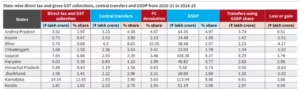
Tax Collection vs Tax Contribution
- States like Maharashtra, Karnataka, Tamil Nadu argue they contribute more to central taxes but receive less in transfers.
- Direct tax data often misrepresents contributions because taxes are recorded at the registered office location, not where production occurs.
- Example: Tamil Nadu’s automobile industry sells nationwide, but tax payments may be recorded in another State.
- Hence, PAN-based jurisdiction data is unreliable for measuring State contributions.
GSDP as a Proxy
- GSDP reflects the economic base of each State and can serve as a proxy for tax contribution.
- Evidence:
- Correlation between GSDP and direct tax collections: 0.75.
- Correlation between GSDP and GST collections: 0.91.
- Suggests GSDP share is a strong indicator of tax accrual at State level.
Current Transfer Trends (2020–25)
- Centre devolved 41% of gross tax revenues (15th FC recommendation).
- Total transfers: ₹75.12 lakh crore.
- Uttar Pradesh received 15.81%, Bihar 8.65%, West Bengal 6.96%.
- Maharashtra contributed 40.3% of taxes but received only 6.64%.
- Karnataka (12.65% contribution, 3.9% transfers) and Tamil Nadu (7.61% contribution, 4.66% transfers) also under-represented.
Gainers and Losers under GSDP Formula
- If transfers were based on GSDP share:
- Winners: Maharashtra, Gujarat, Karnataka, Tamil Nadu.
- Losers: Uttar Pradesh, Bihar, Madhya Pradesh.
- Gains/losses would be moderate, as GSDP shares align more closely with tax contributions than current formulas.
Way Forward
- Giving higher weight to GSDP in FC formulas can balance efficiency (tax contribution) and equity (redistribution).
- Would improve fairness, credibility, and trust in India’s inter-governmental fiscal system.
GDP (Gross Domestic Product)
- Definition: The total value of goods and services produced within a country in a given year.
- Scope: Covers the entire nation’s economy.
- Use: Measures national economic growth and overall performance.
- Example: India’s GDP shows how much the whole country produces in a year.
GSDP (Gross State Domestic Product)
- Definition: The total value of goods and services produced within a State or Union Territory in a given year.
- Scope: Focuses on the economy of a single State.
- Use: Helps compare economic performance across States and plan regional policies.
- Example: Tamil Nadu’s GSDP shows how much that State contributes to India’s economy.
Conclusion:
GDP shows the overall economic output of the whole country, while GSDP reflects the economic performance of individual States. Together, they help measure national growth and regional contributions in a simple way.
SUPREME COURT’S GREEN GOVERNANCE AND EMERGING CONCERNS
TOPIC: (GS2) INDIAN POLITY: THE HINDU
The Supreme Court’s recent rulings on eco-sensitive zones, Aravalli mining, and vehicle restrictions have reignited debates on whether the Court is overstepping into the role of a regulator, creating uncertainty in environmental governance.
Background
- Traditionally, the Court reviews the legality of administrative decisions.
- In recent years, it has moved towards issuing forward-looking directions, often filling gaps left by weak regulatory enforcement.
- This trend has led to the Court acting like a managerial authority, raising questions about stability and institutional balance.
Court’s Approach
- Substitution for Regulators: Instead of disciplining regulators, the Court often takes over their role.
- Shifting Justifications: Moves from legality-based reasoning to consequence-based decisions.
- Expertise Concerns: Relies on expert committees but sometimes contests or reverses their findings (e.g., Aravalli definition).
- Impact on Public Challenge: Early judicial involvement discourages statutory review and limits contestation.
- Continuing Mandamus: Frequent interim orders and modifications create instability.
Need for Stability
- Court should focus on disciplining regulators rather than replacing them.
- Establish clear thresholds for when managerial directions are issued.
- Ensure time-bound regulatory action with transparency and public data.
- Avoid sweeping rules that invite exceptions; provide clarity on evidence required for modifications.
Key Judicial Interventions
- Eco-Sensitive Zones (2022–23): Initially mandated a 1 km buffer around protected areas; later modified after States argued feasibility issues.
- Diesel Vehicle Ban (2015–16): Imposed a ban on large diesel cars in NCR, later replaced with a compensatory charge.
- Old Vehicle Restrictions (2025): Broad ban on older vehicles, later narrowed to those below Bharat Stage-IV standards.
- Firecracker Regulation: Imposed near-total bans, later relaxed for festivals and “green crackers.”
- Vanashakti Case (2025): Declared ex post facto clearances invalid, but later reversed citing economic disruption.
Judicial Overreach
Judicial overreach happens when courts go beyond their constitutional role of interpreting laws and start interfering in the functioning of the legislature or executive.
- Crossing Boundaries: Instead of just reviewing legality, courts begin to make laws or govern directly, which is not their mandate.
- Examples:
- Issuing directions that act like new laws.
- Taking over administrative functions (e.g., regulating policies, bans, or schemes).
- Continuous monitoring of executive actions through “continuing mandamus.”
- Impact:
- May weaken the authority of elected governments and regulators.
- Creates uncertainty for citizens, businesses, and policymakers.
- Can blur the separation of powers between the three organs of government.
- Difference from Judicial Activism:
- Judicial Activism = proactive steps to protect rights and ensure justice.
- Judicial Overreach = crossing limits and encroaching into the domain of legislature/executive.
ISRO AND THE NEXT BIG CHALLENGE
TOPIC: (GS3) SCIENCE AND TECHNOLOGY: THE HINDU
As India prepares for Gaganyaan, Chandrayaan-4, and the Next-Generation Launch Vehicle (NGLV), questions arise about institutional capacity, legal clarity, and competitiveness in a liberalised space sector.
Background
- ISRO has built a strong record with reliable rockets like PSLV and GSLV.
- Landmark missions:
- Chandrayaan-3: Successful lunar landing (2023).
- Aditya-L1: India’s first solar observatory (2024).
- NISAR: Joint NASA-ISRO Earth observation mission (2025).
- These achievements have placed India among leading spacefaring nations.
Key Challenges Ahead
Capacity to Execute Complex Missions
- ISRO is preparing for human spaceflight (Gaganyaan), advanced science missions, and NGLV development.
- Launch frequency is low: only five launches in 2025, below projections.
- Bottlenecks: limited integration capacity, dependence of private firms on ISRO facilities, and cascading delays when missions face anomalies.
- Need: stronger industrial supply chains, more test facilities, and clear prioritisation of mission timelines.
Governance and Legal Framework
- India lacks a comprehensive national space law.
- Current institutions:
- ISRO – research and advanced capability.
- IN-SPACe – authorisation and promotion.
- NSIL – commercialisation.
- Without statutory authority, roles remain unclear, leaving ISRO burdened with regulatory tasks.
- A national space law would: Define liability, insurance, and dispute resolution. Protect ISRO from ad hoc demands.
Competitiveness and Ecosystem Development
- Global trend: reusable launch vehicles, frequent launches, rapid satellite manufacturing.
- India’s NGLV aims for 30-tonne payloads to low-earth orbit with reusability.
- Challenges: limited advanced manufacturing, capital shortages, and slow industrial depth.
- Investment in India’s space sector fell in 2024; IN-SPACe launched a technology adoption fund to support startups and reduce import dependence.
Way Forward
- Expand industrial base and private participation to ease ISRO’s workload.
- Pass a national space law to clarify responsibilities and protect ISRO’s role.
- Strengthen manufacturing and financing capacity for reusable and high-payload vehicles.
- Ensure ISRO transitions from individual landmark missions to a sustained, routine space programme.
Conclusion
ISRO’s past achievements have built global credibility, but the next phase depends on institutional strength, legal clarity, and industrial competitiveness. India’s space future will be defined not just by extraordinary missions but by the ability to deliver them consistently and sustainably.
PRAGATI PLATFORM
TOPIC: (GS3) ECONOMY: THE HINDU
The PRAGATI (Pro-Active Governance and Timely Implementation) platform has enabled the completion of 43 major power projects worth ₹3.02 lakh crore, while 10 projects worth ₹1.10 lakh crore are still under construction.
About Pragati platform
- High-Level Monitoring: PRAGATI (Pro-Active Governance and Timely Implementation) is a platform chaired by the Prime Minister to review and fast-track delayed power projects, transmission lines, and distribution reforms.
- Faster Project Clearance and Problem Solving: It helps resolve issues like land acquisition, forest clearances, funding delays, and inter-departmental bottlenecks in power projects, ensuring timely completion of generation and grid infrastructure.
- Improving Service Delivery and Financial Health: Through regular reviews, PRAGATI supports reforms in DISCOMs, reduction of AT&C losses, smart metering, and better subsidy targeting, improving the overall efficiency of the power sector.
Key Achievements
- Total projects reviewed: 53 (Power Ministry).
- Completed projects: 43, valued at ₹3.02 lakh crore.
- Ongoing projects: 10, valued at ₹1.10 lakh crore.
- Overall value: ₹4.13 lakh crore.
Major Entities Involved
- Power Grid Corporation of India Ltd (PGCIL): 22 projects reviewed.
- National Thermal Power Corporation (NTPC): 16 projects.
- National Hydroelectric Power Corporation (NHPC): 4 projects.
- Tehri Hydro Development Corporation (THDC): 4 projects.
- Current status: Two projects each of these entities are still under construction, rest commissioned.
Significance
- Helps overcome frozen or delayed projects, ensuring better utilisation of resources.
- Strengthens India’s power infrastructure and supports energy security.
- Demonstrates effective use of digital governance tools for accountability and monitoring.
- Encourages coordination between Centre, States, and PSUs for faster execution.
Why DISCOMS Are in Losses
- Mounting Financial Losses:
- Despite multiple bailouts (latest in 2021–22), DISCOMs accumulated losses of ₹6.77 lakh crore by 2022–23.
- Losses have been rising at an average of 7% annually since 2015–16.
- Operational Inefficiencies & Subsidies:
- DISCOMs often sell electricity below cost to certain consumer segments (agriculture, households) due to political subsidies.
- In 2022–23 alone, state-owned DISCOMs reported ₹68,832 crore losses, four times higher than the previous year.
- Debt Burden & Bailout Dependence:
- Schemes like UDAY (2015) transferred liabilities to State governments, but structural reforms were limited.
- By 2023, total indebtedness of DISCOMs stood at ₹5.74 lakh crore, straining State finances.
Conclusion
PRAGATI has proven to be a successful governance innovation, unlocking stalled investments and accelerating project completion. By ensuring transparency and timely monitoring, it has contributed significantly to India’s power sector growth and infrastructure development.
TEX-RAMPS SCHEME
TOPIC: (GS3) ECONOMY: THE HINDU
The Ministry of Textiles has signed MoUs with 15 States under the Tex-RAMPS scheme to improve textile-related research, data quality, and planning. The move aims to strengthen evidence-based policymaking and promote cluster-level development in the textile sector.
Significance of India’s Textile Sector
- Promotes Heritage & Modernisation: India’s textile industry preserves traditional crafts like handlooms and khadi while adopting modern technologies. The sector contributes ~2.3% to India’s GDP and ~12% to total exports (2024).
- Formalisation of Workforce: The industry employs over 45 million workers, making it the second-largest employer after agriculture. Formalisation helps provide social security and better wages to informal workers.
- Global Manufacturing Hub: India is the second-largest textile and apparel producer globally, with exports valued at USD 44 billion in 2023–24, aiming to reach USD 100 billion by 2030.
- Policy Alignment: Supports Make in India, Vocal for Local, and employment generation. The sector is expected to create ~7 million new jobs by 2030 under schemes like PM MITRA Parks.
About Tex-RAMPS Scheme
- Tex-RAMPS stands for Textiles-focused Research, Assessment, Monitoring, Planning, and Start-up Support.
- It aims to strengthen the statistical and research ecosystem of the textile sector.
- The scheme focuses on improving the coverage, accuracy, timeliness, and reliability of textile-related data.
- It encourages States to adopt evidence-based planning rather than generic policy approaches.
Features of the Scheme
- MoUs have been signed with 15 States, promoting cooperative federalism.
- The scheme adopts a bottom-up approach, focusing on district and cluster-level planning.
- It covers key subsectors such as:
- Handlooms
- Handicrafts
- Apparel
- Technical textiles
- Emphasis is on local strengths, regional skills, and traditional crafts.
Financial Support
- Each participating State or Union Territory will receive an annual grant of ₹12 lakh.
- Additionally, ₹1 lakh per district per year will be given for preparing and implementing district action plans.
- Funds are meant for research, surveys, data collection, and local planning activities.
Expected Benefits
- Better data will help in targeted welfare schemes for artisans and weavers.
- It will support cluster-based development, improving productivity and incomes.
- Encourages startups and innovation in the textile value chain.
- Enhances coordination between Centre, States, and local bodies.
Challenges Faced by the Textile Sector
- Fragmented Industry Structure: Majority of units are small and unorganised, limiting economies of scale. Only 15–20% of production comes from large integrated mills.
- High Dependence on Cotton: Cotton accounts for ~60% of raw material use, making the sector vulnerable to crop fluctuations and global price volatility.
- Global Competition & Market Access: India faces stiff competition from Bangladesh, Vietnam, and China, which enjoy lower production costs and better trade agreements. India’s share in global textiles trade is only ~4%, despite its large workforce.
BIO-BITUMEN
TOPIC: (GS3) ENVIRONMENT: THE HINDU
India has entered an era of eco-friendly road construction after the successful transfer of technology for producing Bio-Bitumen from farm residues via pyrolysis, announced by the Union Minister of State for Science and Technology.
About Bio-Bitumen
- Definition: A sustainable alternative to petroleum-based bitumen, made from renewable organic materials like agricultural waste, plant oils, lignin, or biomass.
- Purpose: Reduces carbon emissions and import dependency while supporting green infrastructure.
- Innovation: Developed indigenously by CSIR-Central Road Research Institute (CRRI), New Delhi and CSIR-Indian Institute of Petroleum (IIP), Dehradun.
Production Process
- Biomass Collection: Post-harvest residues (e.g., rice straw) are gathered and processed.
- Pyrolysis: Biomass undergoes thermal decomposition to produce bio-oil.
- Refining & Modification: Bio-oil is refined and modified to improve viscosity, stability, and adhesive properties.
- Blending: Bio-bitumen can be mixed with conventional bitumen; 20–30% replacement is proven safe without performance loss.
Significance
- Environmental Benefits: Lower greenhouse gas emissions, reduced stubble burning, and sustainable waste management.
- Economic Impact: Cuts reliance on imported petroleum bitumen, saving foreign exchange.
- Infrastructure Growth: Supports India’s vision of “Clean, Green Highways” and aligns with climate commitments.
- Innovation in Roads: Encourages adoption of indigenous technology for eco-friendly construction.
Conclusion
Bio-Bitumen represents a green innovation in road building, turning farm waste into a valuable resource. It strengthens India’s push for sustainable infrastructure while reducing pollution and import dependence.
DUST EXPERIMENT (DEX)
TOPIC: (GS3) SCIENCE AND TECHNOLOGY: THE HINDU
ISRO recently confirmed through its first-ever Dust Experiment (DEX) that an interplanetary dust particle enters Earth’s atmosphere every 1,000 seconds, marking a major milestone in India’s space research.
About Dust Experiment (DEX)
- First Indian-made instrument to detect high-speed Interplanetary Dust Particles (IDPs).
- Developed by the Physical Research Laboratory (PRL), Ahmedabad.
- Launched aboard the PSLV Orbital Experimental Module (POEM) during the PSLV-C58 XPoSat Mission on January 1, 2024.
- Designed to study cosmic dust in both planetary atmospheres and space environments.

Features
- Compact instrument weighing 3 kg, operating on just 4.5 W power.
- Uses hypervelocity principle to capture impacts of fast-moving dust particles.
- Operated at an altitude of 350 km.
- Acts as a prototype detector for future planetary missions.
Significance
- Provides new insights into cosmic dust and its role in shaping planetary atmospheres.
- Crucial for planning human deep-space missions like Gaganyaan, ensuring astronaut safety.
- Helps understand the “meteor layer” formed by dust particles in Earth’s atmosphere.
- Supports India’s ambition to lead in space science and planetary exploration.
What are Interplanetary Dust Particles (IDPs)?
- Microscopic fragments from comets and asteroids.
- Form the meteor layer in Earth’s atmosphere, visible as shooting stars.
- Studying them reveals clues about the early solar system and presolar environments.
Conclusion
DEX marks India’s entry into space dust research, strengthening ISRO’s scientific capabilities and laying the foundation for safer and more advanced deep-space missions.