Daily Current affairs 10 February 2026

Daily Current Affairs 10-February-2026

Share this Post

AI IMPACT SUMMIT 2026 AND INDIA’S ROLE IN GLOBAL AI GOVERNANCE

TOPIC: (GS2) INTERNATIONAL RELATIONS: THE HINDU

India will host the AI Impact Summit 2026 (Feb 16–20), the first time this global AI governance forum is being held in the Global South.

Global AI Summits

  • Bletchley Park Summit (2023) – Focused on catastrophic AI risks.
  • Seoul Summit (2024) – Expanded agenda to innovation and inclusivity.
  • Paris Summit (2025) – Shifted towards implementation and economic opportunities.
  • India Summit (2026) – Emphasises “People, Planet, Progress,” highlighting developmental and social dimensions of AI.

India’s Distinct Approach

  • Moves beyond risk containment to real-world problem-solving.
  • Represents the Global South, ensuring AI governance reflects diverse needs.
  • Seeks to capture economic and developmental benefits while promoting responsible AI.

Scale and Participation

  • Largest AI summit so far, with 100+ countries, 15–20 heads of government, 50+ ministers, and 40+ CEOs.
  • PM Narendra Modi to inaugurate, host a dinner, and lead a CEO roundtable.
  • Multi-stakeholder participation: governments, industry, academia, civil society, and international institutions.

Key Themes and Deliberations

  • AI and Jobs – Impact on employment and workforce transformation.
  • Trust and Safety – Frameworks for ethical and secure AI systems.
  • Sectoral Applications – AI in healthcare, agriculture, finance, and education.
  • Innovation Showcase – 500+ AI startups and 500 sessions alongside main programme.

India’s AI Push

  • India AI Mission (₹10,370 crore) – Launch of indigenous AI language models (foundational and small).
  • Policy Incentives – Tax holiday till 2047 for foreign data centres.
  • Startup Ecosystem – Global showcase of Indian innovation.

China’s Participation

  • India invited China despite geopolitical sensitivities.
  • Precedent: China attended earlier summits in UK, Seoul, and Paris.
  • Reflects easing ties – resumption of direct flights, rare earth supply approvals for Indian firms.

Constraints for India

  • Hardware Dependence – Reliance on imported GPUs and advanced computing equipment.
  • Energy Needs – AI data centres require massive power; nuclear energy being explored as a long-term solution.
  • Budget Signals – Subsidy for compute under IndiaAI Mission halved in Union Budget 2026–27, though electronics manufacturing and iPhone exports grew.

Way Forward

  • Strengthen Domestic AI Infrastructure – Invest in indigenous hardware and energy solutions to reduce reliance on imports.
  • Inclusive Global Leadership – Use summit to represent Global South priorities and align AI with SDGs.
  • Balanced Policy Frameworks – Promote innovation while ensuring ethical safeguards and equitable access.

Conclusion

By balancing innovation with inclusivity and sustainability, India can strengthen its role as both a technology leader and a representative of developing nations in the evolving AI economy.

INDIA AND THE KIMBERLEY PROCESS

TOPIC: (GS2) INTERNATIONAL RELATIONS: THE HINDU

India has taken over the Chair of the Kimberley Process (KP) for 2026, a global mechanism to regulate the trade of conflict diamonds.

Kimberley Process

  • Origin: Initiated in May 2000 by southern African nations to curb the trade in conflict diamonds.
  • Certification Scheme (KPCS): Established in 2003 with 37 signatories; today includes 60 participants representing 86 countries.
  • Coverage: Accounts for 99.8% of global rough diamond production.
  • Mechanism:
    • Each shipment of rough diamonds must carry a KP certificate.
    • Trade allowed only between certified KP members.
    • Countries must share accurate production and trade statistics.

India’s Strategic Role

  • Importer: India imports about 40% of global rough diamonds (by quantity and value).
  • Hub: Surat and Mumbai are the world’s largest centers for cutting and polishing.
  • Exports: Re-exports polished diamonds to China, Hong Kong, Israel, UAE, and the US.
  • Leverage: India’s central position in the diamond value chain allows it to influence reforms in KP governance.

Core Issues in KP

  • Narrow Definition: Conflict diamonds are defined only as those funding rebel groups, ignoring: State-linked violence and human rights abuses.
  • Environmental damage and illicit artisanal mining. Smuggling and trafficking networks.
  • Decision-Making Flaws: Political vetoes can block identification of conflict diamonds.
  • Case Study: Central African Republic – embargo in 2013 worsened smuggling and violence; rejoined KP in 2024.

Reform Agenda for India

  • Broaden Scope: Form a technical working group on violence and human rights risks beyond insurgencies.
  • Digital Certification: Introduce tamper-proof blockchain-based KP certificates and harmonised customs data exchange.
  • Capacity Building: Establish regional KP hubs in Africa to provide training, IT support, and certification assistance.
  • Transparency: Push for independent audits and public release of detailed KP statistics.
  • Civil Society Engagement: Ensure robust participation of NGOs and open communication channels.

Conclusion

By leveraging its global position in the diamond trade, India can make KP more inclusive, transparent, and sustainable, aligning it with the needs of producer countries and the Global South.

FORM 7 CONTROVERSY

TOPIC: (GS2) POLITY: THE HINDU

Reports suggest fraudulent bulk applications have led to the removal of 6.5 crore names across nine States and three Union Territories.

What is Form 7?

  • Used to object to inclusion of a voter’s name in the electoral roll.
  • Grounds: death, duplication, shifting residence, age ineligibility, citizenship issues, or misrepresentation.
  • Legal Basis: Section 13(2) of the Registration of Electors Rules, 1960 under the Representation of the People Act, 1950.
  • Who can file? Any voter in the constituency (expanded in 2022; earlier restricted to same booth).  Booth Level Agents (BLAs).
  • Verification Process:
    • BLOs conduct physical checks.
    • Death cases require neighbour confirmation and death certificate.
    • Absent voters → three physical visits.
    • Notice issued to concerned voter; appeals possible to District Magistrate within 15 days.

Extent of Deletions in SIR

  • Forms Distributed: 50.94 crore enumeration forms in Phase II of SIR (covering 99.94% of voters).
  • Deletions Reported: 6.5 crore names removed from draft rolls.
  • States/UTs Affected: Chhattisgarh, Goa, Gujarat, Kerala, Madhya Pradesh, Rajasthan, Tamil Nadu, Uttar Pradesh, West Bengal, Puducherry, Andaman & Nicobar Islands, Lakshadweep.
  • Numbers:
    • Uttar Pradesh – 2.89 crore deletions.
    • Tamil Nadu – 97 lakh deletions.
    • Gujarat – 74 lakh deletions.
  • Category: Removed voters placed under ASD (Absent, Shifted, Dead/Duplicate).

Allegations and Concerns

  • Congress Claim: Coordinated misuse of Form 7 to disenfranchise voters, allegedly benefiting BJP.
  • Reports: Individuals in Rajasthan and Gujarat found Form 7 applications submitted in their names without consent.
  • Risk: Potential disenfranchisement of marginalised and backward communities.
  • Legal Provision: Filing false declarations under Form 7 is punishable under Section 32, Representation of the People Act, 1950 (up to one year imprisonment or fine).

Way Forward

  • Strengthen Verification: Ensure strict checks by BLOs and EROs before deletions; digital tracking of objections to prevent misuse.
  • Transparency Measures: Publish detailed data on deletions and objections; allow public scrutiny to build trust.
  • Safeguard Voter Rights: Introduce stronger penalties for fraudulent filings and enhance grievance redressal mechanisms for affected voters.

Conclusion

Ensuring transparent verification and safeguarding voter rights is essential to protect democratic participation and prevent disenfranchisement of vulnerable communities.

OPPOSITION’S MOTION AGAINST LOK SABHA SPEAKER

TOPIC: (GS2) POLITY: THE HINDU

Opposition parties under the INDIA alliance are considering a no-confidence motion against Speaker Om Birla, alleging partisan conduct.

Background of the Controversy

  • Suspension of eight Opposition MPs. No action against BJP MP Nishikant Dubey’s remarks on former Prime Ministers.
  • House is being run “one-sided.” Over 100 MPs reportedly signed notice for Speaker’s removal.

Appointment of Speaker

  • Election: Conducted after Lok Sabha convenes post-general elections. President sets date; Pro-tem Speaker presides until election.
  • Eligibility: Any Lok Sabha member can contest.
  • Voting: Simple majority of members present and voting.
  • Tenure: Speaker remains until next Lok Sabha is constituted, unless removed earlier.
  • Role: Upholds neutrality, ensures smooth functioning of House, interprets rules, and maintains discipline.

Constitutional Provision for Removal of Speaker

  • Article 94(c): Any Lok Sabha member may give written notice to move resolution for Speaker’s removal. Requires 14 days’ notice to Secretary-General.
  • Process:
    • Resolution taken up in Lok Sabha.
    • Needs majority of all members present and voting.
    • If passed, Speaker vacates office.

Challenges Ahead

  • Opposition lacks numerical strength to pass motion.
  • Even if notice is given, ruling party majority ensures Speaker’s position remains secure.
  • However, the move highlights erosion of trust between government and Opposition in parliamentary functioning.

Way Forward

  • Strengthen Parliamentary Dialogue: Encourage structured debate and ensure Opposition voices are heard to reduce disruptions.
  • Neutrality of Speaker’s Office: Reinforce impartiality through transparent rulings and fair allocation of speaking opportunities.
  • Institutional Safeguards: Consider reforms to protect Speaker’s independence, such as bipartisan consultation in appointment and removal processes.

Conclusion

Strengthening dialogue and reinforcing the impartiality of the Speaker’s office remain crucial to uphold the credibility of parliamentary democracy.

RURAL AND URBAN CONSUMERS

TOPIC: (GS3) ECONOMY: THE HINDU

The RBI Consumer Confidence Survey (Jan 2026) highlights rural consumers remain optimistic and aspirational, while urban consumers show caution despite stable incomes.

Findings from the Survey

Rural Consumers

  • Positive Outlook: Optimistic about the economic situation and employment opportunities.
  • Income Sentiment: 25.9% reported decline vs 22.6% increase → net -3.3%.
  • Spending Pattern: Higher spending on non-essential items, showing lifestyle aspirations despite income concerns.
  • Future Expectations: Confidence in economy and jobs has strengthened compared to last survey round.

Urban Consumers

  • Negative Outlook: Pessimistic about economy, jobs, and price levels.
  • Deepening Pessimism: Sentiment worsened since last survey round.
  • Income Sentiment: 23% reported decline vs 26.3% increase → net +3.3%.
  • Spending Pattern: More cautious, prioritising essential spending; discretionary spending remains limited.
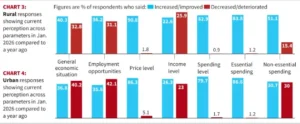
Rural & Urban Consumers

Consumer Confidence Index

  • Urban Index: Negative due to inflationary concerns and weak employment sentiment.
  • Rural Index: Positive, driven by optimism in economy and jobs despite income pessimism.

Spending Insights

  • Both rural and urban households reported higher spending compared to last year.
  • Essential Spending: Indicates inflationary pressures.
  • Non-Essential Spending: Reflects aspiration for better lifestyle, especially in rural areas.

Implications

  • Dual-track consumption pattern – Rural optimism and aspirational spending on non-essentials can drive demand in FMCG and lifestyle sectors, while urban caution may slow growth in discretionary markets.
  • Policy focus shift – Rural confidence highlights the need for targeted support to sustain aspirations, while urban pessimism signals the importance of inflation management and job creation.
  • Economic balancing act – Divergent consumer behaviour reflects uneven recovery, requiring balanced fiscal and monetary strategies to ensure inclusive growth.

Challenges

  • Inflationary pressures – Rising essential spending indicates cost-of-living concerns, especially in urban areas, which could dampen overall demand.
  • Income uncertainty – Despite optimism in rural areas, declining income perceptions pose risks to sustained consumption growth.
  • Structural inequality – The gap between rural aspirations and urban caution underscores uneven distribution of opportunities, making it harder to design uniform policy interventions.

Conclusion

The survey reveals a dual-track economy: rural India is driving aspirational demand beyond essentials, while urban India remains cautious due to inflation and uncertainty. Policymakers must balance support for rural aspirations with measures to restore urban consumer confidence.

GRAVITY AND EARTH’S JOURNEY THROUGH SPACE

TOPIC: (GS3) SCIENCE AND TECHNOLOGY: THE HINDU

A recent article revisited the role of gravity in Earth’s motion through space, highlighting how it keeps life grounded while enabling Earth’s rapid travel around the Sun.

Discovery and Significance of Gravity

  • Isaac Newton (17th century) explained gravity as the force of attraction between masses.
  • On Earth, gravity binds humans, oceans, and atmosphere to the planet.
  • Gravity also acts as centripetal force, enabling celestial bodies to revolve rather than collide.

Earth’s Motion in Space

  • Earth revolves around the Sun once every year, covering 1 billion km annually.
  • Speed: Earth travels at 1,07,000 km/hr, far faster than any human-made vehicle.
  • This motion is possible because space is a vacuum—no friction to slow Earth down.
  • Earlier theories proposed an invisible medium called aether, disproved by the Michelson-Morley experiment (1887).

Examples of Gravitational Pull

  • Earth’s gravity keeps the Moon in orbit, similar to how a rope pulling a bicycle can make it circle around.
  • The Sun’s gravity ensures Earth’s revolution, maintaining planetary stability.

Broader Implications

  • Gravity ensures Earth’s extraordinary journey through space, making life possible.
  • Despite ordinary daily routines, humanity collectively completes a cosmic voyage each year.
  • Astrophysics continues to explore unanswered questions about stars, galaxies, and cosmic evolution.

Conclusion

Gravity is the invisible force that anchors life and drives Earth’s rollercoaster-like journey through space. India’s scientific community, through figures like Jayant Narlikar, has contributed to global astrophysics while promoting rational thinking.

COPERNICUS SENTINEL-2 MISSION

TOPIC: (GS3) SCIENCE AND TECHNOLOGY: THE HINDU

The European Space Agency (ESA) recently released a high-resolution image of the 2026 Winter Olympic venues in northern Italy captured by the Copernicus Sentinel-2 mission.

About Copernicus Sentinel-2 Mission

  • Developer: European Space Agency (ESA).
  • Part of: Copernicus Programme – EU’s Earth observation initiative.
  • Objective: Monitor variability in land surface conditions.
  • Satellites: Two polar-orbiting satellites (S-2B and S-2C) in sun-synchronous orbit.
  • Capabilities:
    • Wide swath width of 290 km.
    • High revisit time for frequent monitoring.
    • Provides multispectral imagery across 13 bands (visible to shortwave infrared).
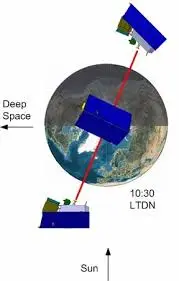
Copernicus Sentinel-2 Mission

Applications

  • Agriculture: Precision farming and food security.
  • Environment: Ecosystem monitoring, water quality assessment.
  • Disaster Management: Tracking volcanoes, floods, wildfires, landslides.
  • Climate Studies: Observing methane emissions and land-use changes.

Copernicus Programme – Key Facts

  • EU’s Space Programme Component: Managed by the European Commission with ESA partnership.
  • Data Sources:
    • Earth observation satellites.
    • In-situ sensors (ground stations, airborne, sea-borne).
  • Access: Free and open data for global users.
  • Sentinels: Family of satellites designed for operational needs of Copernicus.

Conclusion

The Copernicus Sentinel-2 mission is central to global Earth monitoring, combining high-resolution imagery with open-access data.

INDIAN NATIONAL CENTRE FOR OCEAN INFORMATION SERVICES (INCOIS)

TOPIC: (GS3) SCIENCE AND TECHNOLOGY: THE HINDU

INCOIS, under the Ministry of Earth Sciences, is launching three new ocean information servicesJellyAIIP, SAMUDRA 2.0 Mobile App, and SIVAS along with a new logo.

INCOIS

  • Established: 1999 as an autonomous body under the Ministry of Earth Sciences (MoES).
  • Location: Hyderabad, Telangana.
  • Mandate: Provide ocean information and advisory services to society, industry, government, and scientific community through sustained ocean observations and research.
  • Global Role: Permanent member of UNESCO’s Intergovernmental Oceanographic Commission (IOC).
  • Key Facility: Hosts the Indian Tsunami Early Warning Centre (ITEWC), which issues alerts within 10 minutes, serving India and 28 Indian Ocean countries.
INCOIS

Major Initiatives of INCOIS

  • SARAT (Search and Rescue Aided Tool) – Assists Coast Guard, Navy, and Coastal Police in locating missing persons or objects at sea.
  • SynOPS Platform – Integrates real-time ocean data to improve coordination during extreme events.

New Services Launched

  1. JellyAIIP (Jellyfish Aggregation Information Interactive Portal)
    • Web-based platform for reporting and visualising jellyfish swarming/stranding events.
    • Features geospatial mapping, hotspot analysis, and multilingual first-aid guidance.
  1. SAMUDRA 2.0 Mobile App
    • Upgraded multilingual advisory app.
    • Provides ocean information, forecasts, and early warnings for fishermen and maritime users.
  1. SIVAS (Swell-Surge Inundation Vulnerability Advisory System)
    • Coastal inundation early warning service.
    • Currently operational for Kerala coast.
    • Issues multilingual forecast bulletins on swell-surge flooding events.

Conclusion

INCOIS plays a critical role in ocean monitoring and disaster preparedness, supporting both national and regional needs. With the launch of JellyAIIP, SAMUDRA 2.0, and SIVAS, India strengthens its ocean advisory ecosystem, ensuring better safety for coastal communities and maritime stakeholders.

GIANT PHANTOM JELLYFISH (STYGIOMEDUSA GIGANTEA)

TOPIC: (GS3) ENVIRONMENT: THE HINDU

Scientists recently recorded the rare Giant Phantom Jellyfish during a deep-sea expedition near Argentina.

Giant Phantom Jellyfish

Taxonomy & Identity

  • Scientific Name: Stygiomedusa gigantea
  • Belongs to the family Ulmaridae
  • A deep-sea scyphozoan jellyfish known for its ghost-like translucent body

Physical Features

  • Among the largest known jellyfish
  • Bell diameter: Can exceed 1 metre
  • Oral arms: Four long, ribbon-like arms growing over 10 metres
  • No tentacles, unlike typical jellyfish
  • Body made of soft, gelatinous tissue, enabling survival under extreme pressure

Habitat & Distribution

  • Found in deep ocean waters worldwide, except possibly the Arctic Ocean
  • Lives mainly in the “Midnight Zone” (’bathypelagic zone’)
    • Depth: roughly 1,000–4,000 metres
    • Region of permanent darkness and high pressure

Feeding Behaviour

  • Uses ribbon-like oral arms to trap plankton, small fish, and drifting organisms
  • Arms move like curtains, guiding prey toward the mouth

Rarity & Scientific Importance

  • First specimen collected in 1899
  • Fewer than ~130 confirmed observations worldwide
  • Rare sightings due to:
    • Extreme habitat depth
    • Limited deep-sea exploration
  • Provides insights into deep-sea food webs, adaptations to pressure, and ocean ecosystem health
Write a Review

Your email address will not be published. Required fields are marked *