Daily Current Affairs 10-January-2026

Share this Post

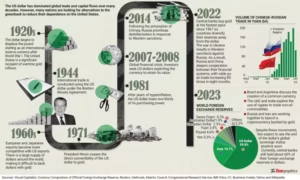
DE-DOLLARISATION FEAR

TOPIC: (GS3) ECONOMY: THE HINDU

The U.S. has introduced tough sanctions on Russian oil and shown renewed interest in Venezuelan oil reserves. These moves highlight America’s concern over the weakening dominance of the petrodollar in global trade and finance.

Shift in Global Oil Trade and Currency Use

  • Dollar Dominance in Oil Trade: For decades, crude oil has been priced and settled in U.S. dollars, reinforcing the dollar’s central role in global finance.
  • Impact of Russia Sanctions: After sanctions on Russia (2014 Crimea, 2022 Ukraine war), major buyers like China and India began exploring non-dollar payment systems to continue energy imports.
  • Rise of Alternative Currencies: The Chinese yuan has emerged as a key settlement currency in energy trade, marking a gradual move towards de-dollarisation in global commerce.
DE-Dollarisation Fear

U.S. Strategy

  • Russia Sanctions Bill: Allows tariffs up to 500% on nations importing Russian oil.
  • Venezuela Factor: After Nicolás Maduro’s capture, U.S. focus shifted to Venezuela’s oil reserves.
  • Both steps aim to safeguard the dollar’s dominance rather than purely punish rivals.

Global Shifts

  • China’s Role: Uses yuan in energy trade, boosting renminbi’s global standing. Leads in electric vehicle (EV) sales, reshaping oil demand.
  • India’s Position: Began paying for some Russian crude in yuan. Russian oil now forms a significant share of India’s imports.
  • BRICS Initiative: Exploring a parallel currency system to challenge dollar supremacy.

Implications

  • Dollar-centric financial order faces erosion.
  • Energy transition (EVs, renewables) reduces oil dependence, weakening petrodollar influence.
  • U.S. actions reflect unease about China’s growing economic and financial clout.

Conclusion

The issue is not just about oil or geopolitics but about the future of global trade and finance. De-dollarisation trends, led by China and supported by BRICS, pose a structural challenge to U.S. economic dominance.

US EXIT FROM GLOBAL CLIMATE FRAMEWORK

TOPIC: (GS3) ENVIRONMENT: THE HINDU

The United States has formally withdrawn from the UNFCCC and related climate institutions after Donald Trump’s return to the presidency. This reversal of post-2021 re-engagement creates an emissions gap for 2030 targets and shifts leadership space to China.

Significance of US Withdrawal

  • Institutional Role: The US played a major role in shaping climate institutions like IPCC, International Solar Alliance, and IRENA.
  • Scientific Contribution: Provided advanced climate modelling, emissions tracking, and global data-sharing networks.
  • Policy Signal: Its participation gave credibility to global climate ambition, even if its domestic record was uneven.

Impact on Global Emissions Reduction

  • Mitigation Gap: Exit adds to shortfall in meeting 2030 emission pathways.
  • Burden Shift: Developing nations face more pressure to compensate for reduced US ambition.
  • Credibility Loss: Weakens enforcement and trust within the Paris Agreement framework.

Consequences for India

  • External Pressure: India may face stronger global expectations to cut emissions faster.
  • Technology Access: Reduced collaboration in clean energy research and innovation platforms.
  • Investment Climate: Uncertainty may slow foreign capital inflows for renewable projects.

Global Leadership Dynamics

  • Strategic Vacuum: China gains space to dominate renewable manufacturing and supply chains.
  • Economic Leverage: Strengthens China’s role in financing and infrastructure ecosystems.
  • Geopolitical Shift: Moves climate governance leadership away from Western institutions.

Climate Finance & Multilateral Commitments

  • Funding Gap: Decline in concessional finance for mitigation and adaptation projects.
  • Institutional Weakening: Collective responsibility frameworks lose credibility.
  • Operational Uncertainty: Ongoing funding mechanisms for developing nations face disruption.

Why Impact is Larger than US Emissions Alone

  • Systemic Role: US acted as coordinator, funder, and standard-setter in climate governance.
  • Network Effects: Withdrawal disrupts global research, verification, and compliance systems.
  • Long-Term Costs: Creates structural weaknesses that persist beyond current political cycles.

Conclusion

For India, this means greater decarbonisation pressure, reduced access to technology and finance, and exposure to shifting global power dynamics — highlighting the fragility of voluntary climate agreements.

THE PHALTAN CASE AND VICTIM’S DIGNITY

TOPIC: (GS2) INDIAN POLITY: THE HINDU

The death by suicide of a young woman doctor in Phaltan, Maharashtra, after alleging rape and harassment by a police officer has sparked nationwide concern over victim dignity, secondary victimisation, and gaps in the effective implementation of pro-women criminal laws.

Background

  • The doctor left a note on her palm alleging sexual assault and harassment.
  • Her pleas for help were ignored by authorities, showing administrative failure.
  • Later, public comments by officials revealed private details of her life, amounting to character assassination.

Legal Safeguards for Victim’s Dignity

  • Criminal Law (Amendment) Act, 2013 (Nirbhaya Act): Introduced provisions to stop character assassination in rape trials.
  • Section 53A, Indian Evidence Act (now Section 50, BSA 2023): Victim’s personal life, habits, or friendships cannot be used to presume consent.
  • Section 146, Indian Evidence Act (now Section 48, BSA 2023): Ban on cross-examination about “immoral character” or past sexual history.
  • Section 228A IPC (now Section 72, BNS 2023): Prohibits disclosure of victim’s identity, even posthumously, without authority.

Supreme Court Directives

  • State of Punjab vs Gurmit Singh (1996): Prior sexual history irrelevant; every woman has the right to refuse.
  • Insult to Injury Principle: Victim-blaming adds trauma and undermines justice.
  • Ban on Identity Disclosure: Protects victims from public shaming and media scrutiny.

Challenges Exposed by Phaltan Case

  • Institutional insensitivity: Women’s Commission comments revealed private details.
  • Gap between law and practice: Patriarchal attitudes persist despite reforms.
  • Lack of victim-friendly investigation culture.

Way Forward

  • Training & Sensitisation: Police, prosecutors, and judges must be trained to handle sexual violence cases empathetically.
  • End Victim Blaming: Society must reject attitudes that question a victim’s character.
  • Infrastructure Boost: Expand forensic labs, digital evidence facilities, women’s desks, and legal aid.
  • Accountability of Public Officials: Women in authority must uphold constitutional morality and avoid victim shaming.

Conclusion

The Phaltan case is a reminder that laws alone cannot ensure justice. True change requires sensitivity, accountability, and societal transformation. Protecting a victim’s dignity is as important as punishing the offender.

DOOMSDAY GLACIER DESTABILISATION

TOPIC: (GS3) ENVIRONMENT: THE HINDU

A new study published in the Journal of Geophysical Research: Earth Surface shows rising fractures in the Thwaites Glacier (West Antarctica). This raises fears of large-scale collapse of Antarctic ice sheets and global sea-level rise.

About Thwaites Glacier

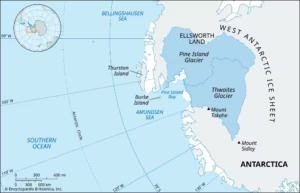
  • Located in West Antarctica, draining into the Amundsen Sea.
  • Known as one of the fastest-changing glacier systems globally.
  • Nicknamed “Doomsday Glacier” because its collapse could raise sea levels by ~65 cm.
  • Acts as a gateway glacier — destabilisation here can trigger wider ice sheet breakdown.
Doomsday Glacier

Key Structural Features

  • Thwaites Eastern Ice Shelf (TEIS): Floating extension of the glacier.
  • Pinning Point: Undersea ridge that slows ice flow but causes compression and cracks.
  • Shear Zone: Area upstream of pinning point where ice undergoes intense deformation.

Fracture Patterns Observed

  • Two stages of fracturing: Long cracks parallel to ice flow. Smaller cracks perpendicular to flow.
  • Fracture length doubled in 20 years: ~165 km in 2002 → ~335 km in 2022.

Consequences

  • Breakdown of shear zone speeds up ice movement.
  • Increased ice discharge into the ocean.
  • Raises risk of destabilising the entire West Antarctic Ice Sheet, threatening global coastlines.

Conclusion

The destabilisation of Thwaites Glacier highlights the vulnerability of Antarctic ice sheets. Its collapse could have catastrophic global impacts, making it a critical focus area for climate science and international environmental policy.
TRUMP’S RUSSIA SANCTIONS BILL AND INDIA–US TRADE

TOPIC: (GS2) INTERNATIONAL RELATIONS: THE HINDU

The US has introduced a Russia Sanctions Bill proposing 500% tariffs on imports from countries trading in Russian-origin oil and uranium. India, a major buyer of Russian crude, could face severe trade and investment consequences if the Bill is enforced.

Features of the Bill

  • Imposes 500% tariffs on goods and services from nations importing Russian petroleum or uranium.
  • Direct Russian imports into the US also face similar duties.
  • Expands restrictions on Russian leadership and military commanders.
  • Provides Trump stronger tariff powers by bypassing earlier legal challenges under IEEPA.
  • Supported by Section 232 investigations, allowing 50% tariffs on steel, aluminium, and copper.

Implications for India

  • Trade Exposure: India exports goods worth $85 billion annually to the US; punitive tariffs could choke this flow.
  • Sectoral Impact: Labour-intensive sectors like textiles, footwear, and marine products most vulnerable.
  • Extended Scope: Electronics, pharmaceuticals, coffee, and tea may also be targeted.
  • Energy Link: India’s continued purchase of discounted Russian oil could trigger sanctions.

Comparative Impact: India vs China

  • China: Better export diversification, dominance in sunrise sectors, and control over critical minerals.
  • Recorded $1 trillion trade surplus in 2025 despite tariffs.
  • India: Exports less technology-intensive goods, easier to replace in US markets.
  • More vulnerable due to weaker diversification and reliance on traditional sectors.

Effect on India’s Trade Negotiations

  • Weakens India’s bargaining power in ongoing talks with EU, ASEAN, GCC, Australia, Canada, and others.
  • External pressure may force India to soften its red lines on agriculture and dairy.
  • Could reduce India’s ability to resist demands for deeper market access.

Investment and Currency Concerns

  • Rising tariff risks deter foreign investment flows (FDI, FPI, debt).
  • Bank of America report (2025) notes stalled capital inflows.
  • RBI sold $65 billion in spot market; rupee weakened by 7% in one year.
  • Real effective exchange rate depreciated by 9%, adding macroeconomic stress.

Conclusion

For India, balancing energy security with trade diplomacy will be crucial to mitigate risks while diversifying markets and strengthening domestic manufacturing.

SAMAGRA SHIKSHA 3.0

TOPIC: (GS2) INDIAN POLITY: THE HINDU

The Union Government has begun nationwide consultations with States and stakeholders to design Samagra Shiksha 3.0 for the 2026-27 academic cycle in school education aligned with NEP 2020 and the vision of Viksit Bharat 2047.

Background

  • Samagra Shiksha launched in 2018 by merging Sarva Shiksha Abhiyan, Rashtriya Madhyamik Shiksha Abhiyan, and Teacher Education schemes.
  • It provides a holistic framework covering pre-primary to senior secondary education.
  • Samagra Shiksha 3.0 builds on five years of NEP 2020 implementation.

Core Objectives

  • Universal enrolment till Class XII. Reduce dropout rates. Ensure equity for disadvantaged groups.
  • Improve foundational and grade-level learning outcomes. Strengthen teacher training and school leadership.

Key Focus Areas

  • Access & Infrastructure: Bridge regional and social gaps in schooling facilities.
  • Quality of Learning: Competency-based curriculum and uniform benchmarks.
  • Teacher Development: Continuous training and leadership capacity building.
  • Digital Education: Use of technology, AI, and digital platforms.
  • Equity & Inclusion: Support for girls, SC/ST students, children with disabilities, and aspirational districts.

Governance Approach

  • Emphasis on bottom-up planning with States preparing annual plans based on local realities.
  • Promotes convergence among ministries, States, and civil society for effective implementation.

Key Themes of Consultation

  • Addressing learning gaps post-pandemic.
  • Linking nutrition with learning outcomes.
  • Integrating vocational education and skill pathways.
  • Using AI for personalised learning.
  • Making schools drivers of social and economic transformation.

Conclusion

Samagra Shiksha 3.0 aims to create a globally competitive yet locally rooted education system, responsive to diverse student needs. By combining best practices, technology, and cooperative federalism, it seeks to strengthen India’s school education ecosystem for the coming decade.

GADGIL REPORT ON WESTERN GHATS

TOPIC: (GS3) ENVIRONMENT: THE HINDU

Renowned ecologist Madhav Gadgil passed away at 83 in Pune. His 2011 report on the Western Ghats Ecology continues to influence environmental policy and debate, especially after recurring ecological disasters.

Importance of the Western Ghats

  • Stretch across Gujarat to Kerala and Tamil Nadu.
  • Source of major rivers like Cauvery, Krishna, Godavari, Periyar, Netravathi.
  • Recognised as a UNESCO biodiversity hotspot with many unique species.

Formation of WGEEP

  • Set up in March 2010 after concerns raised during the Save Western Ghats movement.
  • Chaired by Madhav Gadgil, the panel was tasked with: Studying the ecology of the region.
    • Identifying Ecologically Sensitive Areas (ESAs).
    • Suggesting conservation and sustainable development strategies.

Key Recommendations of Gadgil Panel

  • Entire Western Ghats (1.29 lakh sq km) declared ecologically sensitive.
  • Introduced three-tier zoning: ESZ 1 (most fragile), ESZ 2, ESZ 3.
  • Proposed bans on: Genetically modified crops, new SEZs, new hill stations. New mining and quarrying in ESZ 1; phase-out of existing mines in ESZ 1 & 2.
  • Suggested creation of Western Ghats Ecology Authority (WGEA) with experts and ministry representatives.

Political Resistance

  • Report submitted in 2011, made public only in May 2012 after RTI and court action.
  • Kerala and Maharashtra opposed the report: Kerala feared impact on agriculture and livelihoods. Maharashtra objected to WGEA as a parallel institution.
  • Gadgil promoted inclusive development via Gram Sabha participation.

Kasturirangan Committee (2012)

  • Formed to review Gadgil’s report.
  • Recommended 56,825 sq km as ESA (less than half of Gadgil’s proposal).
  • Focused on village-level identification and targeted restrictions.

Current Status

  • Centre issued six draft ESA notifications, latest in August 2024.
  • Final boundaries still under review by a committee led by Sanjay Kumar.
  • Policy deadlock continues due to state-level disagreements.

Conclusion

The Gadgil Report remains a cornerstone of environmental governance, highlighting the need for balanced development and ecological protection. Its legacy continues to shape debates on conservation, especially in the face of climate change and recurring natural disasters.

VENEZUELA OIL RESERVES AND US CONTROL

TOPIC: (GS2) INTERNATIONAL RELATIONS: THE HINDU

After the capture of Venezuelan President Nicolás Maduro, the US announced plans to take control of Venezuela’s oil sector. This move could reshape global oil markets and affect India’s energy and investment interests.

Venezuela’s Oil Potential

  • Holds the largest proven oil reserves globally — over 300 billion barrels, nearly 20% of world reserves.
  • Despite this, Venezuela produces only 1 million barrels/day, contributing less than 1% to global supply.
  • Member of OPEC, but its share in OPEC exports is just 3.5%.

Reasons for Low Production

  • US sanctions have restricted oil exports.
  • Economic crisis and poor governance have weakened the sector.
  • Neglected infrastructure and lack of investment have stalled output.

🇺🇸 US Strategy and Trump’s Plan

  • President Trump announced that American oil companies will invest in Venezuela to revive its oil industry.
  • Goals include:
    • Restoring production capacity.
    • Opening the sector to foreign investment.
    • Increasing global oil supply over time.
  • Experts say recovery will take several years due to deep structural damage.

India–Venezuela Oil Trade History

  • In 2019, Venezuela was India’s 5th-largest oil supplier.
  • Imports stopped after US sanctions.
  • Brief resumption in 2023 during a six-month waiver, later halted again in 2025.
  • India imported $255.3 million worth of Venezuelan oil till Nov 2025 (just 0.3% of total imports).

Conclusion

US control over Venezuela’s oil sector could reshape global energy dynamics. For India, it presents both risks and opportunities — from securing energy supplies to recovering stalled investments. The situation remains fluid and strategically important.

Write a Review

Your email address will not be published. Required fields are marked *