
SUPREME COURT ON NARCO TESTS
TOPIC: (GS2) INDIAN POLITY: THE HINDU
The Supreme Court struck down a Patna High Court order that allowed an involuntary narco test. The ruling reaffirmed that forced narco analysis violates fundamental rights, especially personal liberty and protection against self-incrimination.
What is a Narco Test?
- A narco analysis test involves injecting sedative drugs like Sodium Pentothal to lower mental resistance.
- It aims to make a person speak more freely by reducing conscious control.
- It is often grouped with polygraph tests and brain mapping as investigative techniques.
- Though not physically violent, it interferes with mental autonomy and free will.
Why Narco Tests Are Constitutionally Problematic
Right Against Self-Incrimination (Article 20(3))
- Article 20(3) protects an accused from being forced to testify against themselves.
- A forced narco test compels speech in an altered mental state, violating this protection.
- The Court clarified that statements obtained without free consent are inadmissible.
Right to Life, Liberty and Privacy (Article 21)
- Article 21 includes bodily integrity, mental privacy, and personal autonomy.
- Forced narco testing fails the test of being fair, just, and reasonable.
- The judgment linked this protection to the Golden Triangle of Articles 14, 19 and 21, as laid down in Maneka Gandhi v. Union of India (1978).
Key Judicial Precedents
Selvi v. State of Karnataka (2010)
- The Supreme Court banned involuntary narco tests, polygraph tests, and brain mapping.
- It laid down safeguards:
- Voluntary and informed consent is mandatory.
- Consent must be recorded before a magistrate.
- Test results have no independent evidentiary value and require corroboration.
Subsequent Rulings
- Manoj Kumar Saini v. State of MP (2023) and Vinobhai v. State of Kerala (2025)
- These cases reiterated that narco test results cannot prove guilt on their own.
Consent and Ethical Dimensions
- Narco tests can be conducted only if the accused voluntarily agrees.
- Even under Section 253 of the Bharatiya Nyaya Sanhita (BNSS), there is no absolute right to demand such tests.
- The Court highlighted ethical principles of autonomy and human dignity, stressing that forced testing violates natural justice.
Impact on Criminal Justice System
- Strengthens rights-based policing and procedural fairness.
- Reinforces that investigative convenience cannot override fundamental rights.
- Ensures consistency and stability in constitutional jurisprudence.
Article 21 – Right to Life
- Article 21 guarantees that no person shall be deprived of life or personal liberty except according to procedure established by law.
- The term “life” means more than mere survival; it includes living with dignity and respect.
- It applies to both citizens and non-citizens.
- Any law affecting life or liberty must be fair, just, and reasonable (Maneka Gandhi case).
- Article 21 protects personal freedom from arbitrary state action.
Rights included under Article 21 (through court interpretations):
- Right to dignity and humane treatment.
- Right to privacy (Puttaswamy judgment).
- Right to health and medical care.
- Right to livelihood.
- Right to a clean and healthy environment.
Conclusion
The Supreme Court’s ruling firmly protects individual liberty by banning involuntary narco tests.
It upholds the principle that justice must be guided by constitutional morality, not coercive investigation methods.
FTAS AND INDIA’S EXPORT CHALLENGE
TOPIC: (GS3) ECONOMY: THE HINDU
India is speeding up Free Trade Agreement (FTA) negotiations with major economies like the U.S., EU, and Canada amid rising tariff pressures on Indian exports. Recent experiences with existing FTAs have renewed debate on whether trade pacts alone can ensure export growth without domestic reforms.
India’s Current FTA Landscape
- India has entered into 20 regional and free trade agreements, excluding recent deals with the UK and EFTA.
- Negotiations are ongoing with key partners such as the United States, European Union, Canada, and Southern African Customs Union.
- Discussions on limited engagement with RCEP have resurfaced, though India remains cautious due to agricultural and rules-of-origin concerns.
Mixed Outcomes from Earlier FTAs
- FTAs with ASEAN, Japan, and South Korea have resulted in rising trade deficits rather than balanced trade.
- India’s trade deficit with ASEAN expanded sharply, driven by faster growth in imports of high-value manufactured goods.
- Although exports increased, capital-intensive imports grew at a quicker pace, worsening the trade balance.
Structural Reasons for Limited Gains
- Many FTAs lacked strong provisions on quality standards, certification, and mutual recognition agreements.
- Non-tariff barriers continued to restrict India’s export potential despite tariff reductions.
- Trade agreements were not tailored to India’s sectoral strengths, reducing their effectiveness.
- Insufficient consultation with industry bodies led to weak alignment between trade policy and ground realities.
- Poor domestic awareness and utilisation of FTAs prevented Indian exporters from using available benefits.
Learning from Improved Agreements
- Recent review of older FTAs has led to course correction in India’s trade strategy.
- The India–UAE CEPA demonstrates better design, with balanced trade outcomes and strong export performance.
- Non-oil bilateral trade reaching $100 billion highlights the importance of carefully negotiated and sector-specific FTAs.
Focus Areas in Ongoing Negotiations
- With the U.S., India must protect interests of services, seafood, engineering goods, and textiles.
- With the EU, attention is needed on carbon-intensive sectors such as steel and cement, especially due to the Carbon Border Adjustment Mechanism (CBAM).
- Trade talks must integrate climate rules, labour norms, and supply-chain standards.
Beyond FTAs: Supporting Exports
- FTAs are only an entry point, not a guarantee of export success.
- India must strengthen export infrastructure, quality standards, technology adoption, and market intelligence.
- Deep integration into global value chains is essential for sustainable trade gains.
Conclusion
Free trade agreements can open markets, but export competitiveness depends on domestic readiness. Without strong policy support and sectoral reforms, FTAs alone cannot deliver long-term trade benefits.
INDIAN OCEAN AS THE CRADLE OF BLUE ECONOMY
TOPIC: (GS3) ECONOMY: THE HINDU
The Indian Ocean is emerging as a key region for the global blue economy amid rising climate risks and renewed focus on sustainable ocean governance.
Global developments like BBNJ Agreement, UN Ocean Conferences, and COP30 have highlighted India’s leadership role in shaping ocean sustainability.
India’s Historical Role in Ocean Governance
- India has consistently supported equitable and fair ocean governance, notably during UNCLOS negotiations, by advocating the principle of “Common Heritage of Mankind.”
- Early visionaries like Jawaharlal Nehru recognised the strategic, economic, and security importance of oceans for India’s future.
- This legacy gives India both credibility and responsibility in present-day ocean leadership.
Why the Indian Ocean Is Critical Today
- The Indian Ocean supports nearly one-third of the global population, making it central to food security and livelihoods.
- It is one of the most climate-vulnerable ocean basins, facing warming, acidification, sea-level rise, and extreme weather events.
- Illegal, unreported and unregulated (IUU) fishing and marine biodiversity loss threaten regional stability and coastal economies.
India’s Blue Economy Vision: Three Core Pillars
Stewardship of the Ocean Commons
- India should promote the Indian Ocean as a shared and cooperative space, not a zone of geopolitical rivalry.
- Emphasis on ecosystem restoration, biodiversity conservation, and sustainable fisheries can prevent over-exploitation.
- Cooperative ocean management strengthens regional trust and long-term sustainability.
Climate Resilience and Ocean Preparedness
- Climate change demands a shift toward adaptation-focused ocean governance.
- India can lead by developing early warning systems, ocean observation networks, and disaster-response mechanisms.
- Technology transfer to Small Island Developing States (SIDS) and African coastal nations will enhance regional resilience.
Inclusive and Sustainable Blue Growth
- The blue economy must drive inclusive growth through green shipping, offshore renewable energy, sustainable aquaculture, and marine biotechnology.
- Development should align with climate goals, ensuring benefits reach all littoral countries, not just advanced economies.
Financing the Blue Economy
- Global momentum is growing for blue finance, including public-private investments and development bank support.
- India can spearhead an Indian Ocean Blue Fund to convert global pledges into actionable regional projects.
- Financial tools like blue bonds can support long-term sustainability initiatives.
Security Through Sustainability
- True maritime security begins with healthy ecosystems, not just naval dominance.
- Environmental threats like coral reef degradation and overfishing directly undermine economic and social stability.
- India’s SAGAR doctrine (Security and Growth for All in the Region) integrates security, development, and environmental stewardship.
India’s Global Responsibility Ahead
- India’s readiness to ratify the BBNJ Agreement positions it as a leader in high seas governance.
- Future initiatives may include green shipping corridors, marine technology transfer, and climate-aligned ocean policies.
- India can set a global example by combining prosperity with sustainability and equity.
Conclusion
The Indian Ocean can become a global model of sustainable and inclusive blue economy under India’s leadership. By prioritising cooperation, climate resilience, and shared prosperity, India can transform ocean governance for the future.
UNEA ADOPTS INDIA’S GLOBAL WILDFIRE MANAGEMENT
TOPIC: (GS3) ENVIRONMENT: THE HINDU
At the UN Environment Assembly (UNEA-7) in Nairobi, member states adopted India’s resolution on strengthening global wildfire management.
Background: Rising Wildfire Threat
- Wildfires are increasing globally due to rising temperatures, irregular rainfall, and changing land-use patterns.
- Forest fires now cause large-scale ecological damage, economic losses, and social disruption, especially in vulnerable regions.
- Many countries still rely on reactive firefighting, which is costly and often ineffective for extreme fires.
India’s Resolution
- Shift from Reaction to Prevention: Emphasises proactive wildfire prevention rather than only emergency response. Focuses on reducing risk before fires occur through planning and preparedness.
- Early Warning Systems: Calls for strong global and regional early-warning mechanisms. Encourages use of satellite data, climate models, and real-time monitoring to detect fire-prone conditions.
- Improved Risk Assessment: Promotes scientific assessment of fire risk zones considering climate, vegetation, and human activity. Supports data sharing among countries for better forecasting and planning.
- Addressing Climate Linkages: Recognises wildfires as a climate-driven disaster, not just a forest issue. Links fire management with climate adaptation strategies.
Why the Resolution Matters
- Ecological Impact: Prevents loss of forests, biodiversity, and soil fertility.
- Economic Impact: Reduces damage to agriculture, infrastructure, and livelihoods.
- Social Impact: Protects communities from displacement, health risks, and loss of income.
- Global Relevance: Fires in one region can affect air quality and climate globally.
India’s Leadership Role
- India positions itself as a voice for climate-vulnerable countries.
- Reflects India’s push for global cooperation on environmental risks.
- Builds on India’s experience in forest fire monitoring, disaster management, and climate action.
UNEA and Global Governance
- UNEA is the highest global decision-making body on environment.
- Adoption of India’s proposal shows international consensus on wildfire prevention.
- Encourages countries to align national policies with global best practices.
Way Forward
- Develop regional wildfire cooperation frameworks.
- Invest in technology, training, and community participation.
- Integrate wildfire management with climate mitigation and adaptation plans.
United Nations Environment Assembly (UNEA)
- UNEA is the world’s highest decision-making body on environmental matters, functioning under the UN Environment Programme (UNEP).
- It was established in 2012 after the Rio+20 Conference and is headquartered in Nairobi, Kenya.
- All 193 UN member states are members, giving UNEA universal legitimacy, unlike many other UN forums.
- UNEA meets biennially to set global environmental priorities, policies, and norms.
- Its resolutions, though non-binding, strongly influence international environmental law, national policies, and global negotiations.
Important UNEP Reports
- Emissions Gap Report
- Assesses the gap between current global emissions and the levels required to meet Paris Agreement targets (1.5°C / 2°C).
- Released annually; widely quoted in climate negotiations.
- Global Environment Outlook (GEO) Report
- UNEP’s flagship report on the state of the global environment.
- Covers climate change, biodiversity, pollution, land and oceans.
- Adaptation Gap Report
- Evaluates the difference between adaptation needs and available finance in developing countries.
- Highlights vulnerability of least developed countries (LDCs) and small island states.
Conclusion
The adoption of India’s proposal marks a global shift towards preventive wildfire governance.
Effective early warning and cooperation can reduce fire disasters and strengthen climate resilience worldwide.
CENSUS 2027 AND NPR DEBATE
TOPIC: (GS2) GOVERNANCE: THE HINDU
The Union Cabinet has approved the Census of India 2027 with an estimated cost of ₹11,718 crore, marking India’s first digital census and first caste-based enumeration since Independence. Notably, the approval does not include a separate budget for updating the National Population Register (NPR), reviving debate on Census–NPR–NRC linkage.
Difference between Census and National Population Register (NPR)
Nature and Purpose
- Census is a statistical exercise conducted to collect demographic, social, and economic data of the population.
- NPR is a population register intended to create a database of usual residents of India.
Legal Basis
- Census is conducted under the Census Act, 1948.
- NPR is prepared under the Citizenship Act, 1955 and Citizenship Rules, 2003.
Frequency
- Census is conducted once every 10 years.
- NPR has no fixed periodicity and can be updated as decided by the government.
Type of Information Collected
- Census collects anonymous data such as age, education, occupation, housing, migration, and now caste details.
- NPR collects personal details like name, date of birth, place of birth, parents’ details, and residential address.
Coverage
- Census covers all persons present in the country at the time of enumeration.
- NPR includes usual residents who have lived in an area for six months or more.
Link with Citizenship
- Census has no role in determining citizenship.
- NPR is considered the first step towards NRC, which aims to identify citizens.
Current Status (2027)
- Census 2027 has been approved with full funding.
- NPR update has not been approved, and the government has stated that no decision has been taken on it so far.
Conclusion:
While the Census is a development and planning tool, the NPR has citizenship-related implications, which explains the heightened political and public sensitivity around its inclusion.
VOLUNTARY PF CONTRIBUTIONS
TOPIC: (GS3) ECONOMY: THE HINDU
The Union Labour and Employment Ministry clarified that Provident Fund (PF) contributions on wages above ₹15,000 are voluntary, not mandatory, under the newly enforced labour codes.
Labour Codes Reform
- India has consolidated 29 central labour laws into 4 labour codes to simplify compliance and improve labour governance.
- The Code on Social Security, 2020 replaces the EPF & Miscellaneous Provisions Act, 1952 along with eight other laws.
- The other three codes are:
- Code on Wages
- Industrial Relations Code
- Occupational Safety, Health and Working Conditions Code
PF Wage Ceiling
- The statutory wage ceiling for mandatory EPF contributions remains ₹15,000 per month, unchanged since 2014.
- Employer and employee contributions beyond ₹15,000 are purely optional, requiring mutual consent.
- There is no legal obligation to contribute PF on the full salary if it exceeds the wage limit.
Impact on Take-Home Salary
- The Ministry clearly stated that there will be no automatic cut in take-home pay due to labour codes.
- Mandatory PF deductions will continue to be calculated only up to the wage ceiling, unless voluntarily extended.
- This addresses fears that labour codes would force higher PF deductions.
Government’s Stand on Raising the Ceiling
- Questions were raised in Parliament about increasing the ceiling to ₹30,000.
- The government clarified that any revision requires extensive consultation with:
- Trade unions
- Industry bodies
- Higher ceilings can reduce net salary for workers and increase hiring costs for employers.
Significance for Workers and Employers
- Protects worker choice and flexibility in retirement savings.
- Prevents sudden financial burden on employees and businesses.
- Ensures smoother transition to the new labour code regime.
Conclusion
The government’s clarification reinforces that labour reforms will not adversely affect workers’ take-home pay. By keeping PF contributions above ₹15,000 voluntary, the new labour codes balance social security goals with economic practicality.
INDIA’S CHANGING SAVINGS PATTERN AND ITS IMPACT ON MARKET STABILITY
TOPIC: (GS3) ECONOMY: THE HINDU
India’s capital markets are witnessing a structural shift where domestic household savings are increasingly replacing foreign portfolio investment (FPI).
Shift in Market Ownership
- FPI share in Indian equities has fallen to a multi-month low due to global uncertainty and better opportunities abroad.
- At the same time, domestic mutual funds and retail investors have emerged as the main market supporters.
- Systematic Investment Plan (SIP) inflows are at record highs, showing strong household participation.
Domestic Investors as Market Stabilizers
- Retail investors now hold around 19% of equity markets, the highest in two decades.
- Strong domestic flows have helped absorb global shocks, reducing sharp volatility.
- The resilience of indices like NIFTY 50 reflects this growing domestic anchor.
Policy Implications:
- Reduced dependence on foreign capital gives the RBI greater monetary policy flexibility.
- Lower pressure to defend the rupee allows better balancing of growth, inflation, and credit expansion.
- Stable household inflows support accommodative policies aligned with development goals like Viksit Bharat 2047.
Vulnerability of New Investors
- Many new retail participants lack financial literacy and risk awareness.
- In case of market corrections, losses may fall disproportionately on first-time and small investors.
- Weak investor confidence during downturns could turn current stability into future fragility.
Booming Primary Markets
- Domestic capital has fuelled a strong IPO market, with record funds raised in the current year.
- Private sector investment commitments have surged, signalling confidence in economic growth.
- However, fast-paced listings raise concerns about quality and valuation discipline.
Valuation and Performance Concerns
- Several recent IPOs show high price-to-earnings ratios, not always backed by strong fundamentals.
- Evidence suggests that many active fund managers fail to outperform markets after costs.
- Increased participation does not automatically guarantee better returns for small investors.
Equity, Inequality and Access Gaps
- Market gains tend to favour higher-income and well-informed groups, widening wealth inequality.
- Recent declines in household equity wealth highlight risks to financially vulnerable investors.
- Limited access to low-cost products worsens the performance and advice gap.
Way Forward:
- Promote low-cost passive funds, improve financial literacy, and reduce expense ratios.
- Strengthen corporate governance and transparency, especially as promoter holdings decline.
- Use gender- and region-specific data to improve inclusive participation.
Conclusion
India’s growing reliance on domestic savings has improved market resilience and policy autonomy.
However, without stronger safeguards and financial awareness, this stability could mask deeper investor risks.
AGENTIC AI
TOPIC: (GS3) SCIENCE AND TECHNOLOGY: THE HINDU
Microsoft CEO Satya Nadella recently highlighted India’s rapid progress in adopting AI and agentic AI solutions. This reflects India’s growing role in advanced digital technologies and intelligent automation.
 What is Agentic AI?
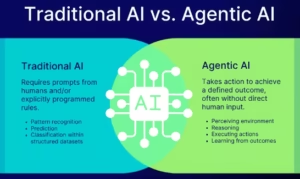
- Agentic AI refers to a new class of artificial intelligence systems capable of independent decision-making and action.
- It uses AI agents that can think, plan, and act to achieve specific goals with minimal human input.
- Unlike conventional AI that mainly responds to instructions, agentic AI shows agency, meaning it can operate proactively.
Features of Agentic AI
- Autonomy: Can set objectives and take actions without continuous supervision.
- Goal-oriented behaviour: Works towards defined outcomes rather than isolated tasks.
- Adaptive learning: Improves performance based on feedback and experience.
Core Components of Agentic AI
- Perception: Collects information from sensors, databases, digital platforms, and user inputs.
- Reasoning: Uses Large Language Models (LLMs) to understand context and interpret data.
- Planning: Breaks down goals into steps and decides the best course of action.
- Action: Executes tasks, interacts with tools, or coordinates with other systems.
- Reflection: Reviews outcomes and adjusts future decisions for better results.
Agentic AI vs Generative AI
- Generative AI focuses on creating content like text, images, or code based on patterns.
- Agentic AI goes beyond generation, using such outputs to complete complex tasks autonomously.
- For example, while ChatGPT can generate code, an agentic system can write, test, deploy, and refine it by itself.
Applications of Agentic AI
- Business automation: Managing workflows and decision-making systems.
- Healthcare: Assisting in diagnostics, patient monitoring, and treatment planning.
- Finance: Automated trading, risk assessment, and compliance checks.
- Governance: Smart public service delivery and policy analysis.
Significance for India
- Supports Digital India and innovation-driven growth.
- Enhances productivity across sectors like IT, manufacturing, and services.
- Positions India as a global hub for next-generation AI solutions.
Conclusion
Agentic AI marks a shift from reactive machines to intelligent, autonomous systems.
Its growing adoption in India highlights the country’s readiness for the future of AI-driven decision-making.