
Table of Contents
ToggleINDIA–U.S. TRADE AGREEMENT DEBATE
TOPIC: (GS3) ECONOMY: THE HINDU
India and the U.S. are negotiating an Interim Bilateral Trade Agreement (2026), but concerns have arisen over unilateral U.S. announcements, tariff conditions, and India’s concessions on Russian oil imports. The issue raises questions about India’s strategic autonomy and trade credibility.
U.S. Announcements and Conditions
- The U.S. announced details of the deal unilaterally, with India responding later.
- Washington linked tariff relief to India reducing Russian oil imports and aligning with U.S. positions on national security and foreign policy.
- India’s Russian oil share fell from 40% (2024) to 25% (Dec 2025), despite larger discounts.
Trade Concessions
- India agreed to zero tariffs on several sectors, while U.S. tariffs remain at 18% on Indian goods.
- Commitment to buy USD 500 billion worth of American goods, limiting space for imports from other partners like the EU, EFTA, and New Zealand.
- Raises concerns about fairness compared to other trade agreements India recently signed.
Diplomatic and Strategic Concerns
- India risks losing credibility with Russia, Iran, and Venezuela, where it had promised deeper trade ties.
- U.S. demands could undermine India’s projects like Chabahar Port and reduce its standing in the Global South.
- Compliance mirrors India’s earlier concessions in 2019 when it gave up Iranian and Venezuelan oil under U.S. pressure.
Impact on Strategic Autonomy
- India’s principles of multi-alignment and strategic autonomy may be weakened if it accepts one-sided U.S. terms.
- The deal could set a precedent for future U.S. demands in defence, Indo-Pacific, and Quad cooperation.
- India is the only country penalised with 25% tariffs for Russian oil, while China and Türkiye faced no such measures.
Broader Implications
- The agreement may narrow India’s global options in energy, trade, and connectivity.
- Could affect India’s credibility as it hosts the BRICS Summit 2026, with Russia and Iran present.
- Raises the question: is India trading long-term strategic leverage for short-term tariff relief?
Conclusion
While tariff reductions and market access may benefit India’s economy, the concessions on Russian oil and large U.S. purchases risk undermining India’s multi-alignment strategy and global credibility. Careful scrutiny is essential before finalising the agreement.
LABOUR CODES, REDEFINING WAGES AND EMPOWERING WORKERS
TOPIC: (GS2) POLITY: THE HINDU
India’s new labour codes have come into effect, redefining wages and expanding social security to organised, gig, and unorganised workers. The reforms aim to modernise labour laws and strengthen financial inclusion and worker protection.
Wage Redefinition and Social Security
- Wages must now form at least 50% of total remuneration, preventing companies from lowering PF and gratuity contributions.
- This ensures higher PF accumulation, pensions, and gratuity, boosting longterm worker security.
- Fixedterm employees are entitled to gratuity after one year, a major step for contract workers.
Impact on Corporates and Workers
- Large firms like TCS, Infosys, HCL Tech, L&T face higher liabilities due to gratuity provisions.
- However, this translates into greater income security and purchasing power for workers, stimulating consumption and savings.
- Redistribution of value strengthens fairness and dignity in employment relations.
Inclusion of Gig and Informal Workers
- For the first time, gig, platform, and unorganised workers are covered under social security.
- Benefits include insurance, PF mechanisms, and portability across states, crucial for migrant workers.
- The Code on Wages ensures universal minimum wages, timely payments, and limits arbitrary deductions.
Macroeconomic Impact
- Enhanced worker income boosts domestic demandled growth, unlike shareholder income which often flows abroad.
- Greater savings and financial stability reduce vulnerability to economic shocks.
- Labour codes thus act as instruments of inclusive growth and social stability.
Opposition and Reform Context
- Some trade unions oppose the codes, calling them antiworker, and have organised strikes.
- Critics overlook that earlier labour laws were fragmented and outdated, failing to address modern labour markets.
- Consolidation into four labour codes simplifies compliance, improves transparency, and benefits both workers and employers.
Conclusion
India’s labour codes represent a structural reform for financial inclusion, extending gratuity, social security, and minimum wages to millions of workers. By redistributing economic value towards labour, they strengthen income security, dignity, and inclusive growth, provided effective implementation ensures workers truly benefit.
NEW CONSUMER PRICE INDEX (CPI) SERIES
TOPIC: (GS3) ECONOMY: THE HINDU
The government has released a new Consumer Price Index (CPI) series (base year 2024), replacing the old 2012 series. It reflects updated consumption patterns from the Household Consumption Expenditure Survey 2023–24, making inflation data more accurate.
Need for Revision
- The old CPI was based on 2011–12 consumption patterns, outdated for today’s economy.
- Household spending has changed: free foodgrain for 80 crore people, rise of OTT platforms, e-commerce, and new services.
- Updating CPI ensures inflation reflects current realities.
Major Changes in the New CPI
- Food & beverages weight reduced from 45.86% to 36.75%, lowering food inflation’s outsized impact.
- Coverage expanded to include more goods and services, especially in the fastgrowing service economy.
- Data collection widened to 12 online marketplaces along with traditional outlets.
Implications for Policy
- More stable inflation data: food inflation is volatile, but reduced weight makes CPI less erratic.
- Fiscal policy: Budget planning, dearness allowance, and relief linked to CPI become more predictable.
- Monetary policy: RBI’s Monetary Policy Committee gets a clearer picture for interest rate decisions.
- Macroeconomic stability: better inflation measurement aids longterm planning.
Suggestions for Improvement
- MoSPI currently provides only a linking factor for comparison with old data; it should release back data directly for easier analysis.
- CPI should be revised every 5 years, not after long gaps (last update took 11 years).
CPI AND WPI
Consumer Price Index (CPI)
- CPI measures changes in the retail prices of goods and services consumed by households. It reflects the cost of living and is the main measure of inflation used by the Reserve Bank of India (RBI) for monetary policy.
- Current Base Year: 2024 (updated from 2012).
- Features of New Series:
- Based on Household Consumption Expenditure Survey 2023–24.
- Weight of food reduced from 45.86% to 36.75%.
- Includes more services and 12 online marketplaces for price collection.
Wholesale Price Index (WPI)
- WPI measures the average change in prices of goods at the wholesale level (first point of bulk sale). It reflects producer prices rather than consumer prices.
- Current Base Year: 2011–12.
- Revision Plans: A working group has been set up to update the base year to 2022–23, and eventually move towards a Producer Price Index (PPI) for better accuracy.
Conclusion
By reducing food’s weight, expanding service coverage, and including online marketplaces, it strengthens data stability and policymaking accuracy, ensuring India’s economic decisions rest on a more realistic foundation.
COMPLAINTS AGAINST JUDGES
TOPIC: (GS2) POLITY: THE HINDU
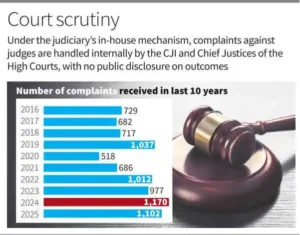
The Law Minister informed Parliament that the Chief Justice of India’s office received 8,630 complaints against sitting judges of the Supreme Court and High Courts between 2016 and 2025. The issue raises concerns about judicial accountability and transparency.
Nature of Complaints
- Allegations included corruption, sexual misconduct, and serious impropriety.
- Complaints were received against both High Court and Supreme Court judges.
Handling Mechanism
- Under the inhouse procedure, the CJI and Chief Justices of High Courts are authorised to receive and act on complaints.
- Complaints filed via CPGRAMS or other channels are forwarded to the CJI or respective High Court Chief Justices.
- The Minister did not clarify what action was taken on these complaints.
Accountability Concerns
- MPs raised questions about whether there is a system to track complaints and ensure accountability.
- The government has not announced any new guidelines for documentation or monitoring of complaints.
- Lack of transparency in followup action raises concerns about judicial credibility.
Conclusion
Between 2016 and 2025, over 8,600 complaints were filed against judges, highlighting the need for stronger monitoring and accountability mechanisms. While the inhouse procedure exists, the absence of clear data on action taken underscores the importance of reforms to ensure judicial integrity and public trust.
SUPREME COURT ON SPECTRUM OWNERSHIP
TOPIC: (GS2) POLITY: THE HINDU
The Supreme Court ruled that telecom service providers (TSPs) do not own spectrum, clarifying it is a scarce natural resource vested in the Union of India and cannot be treated as an asset under insolvency or liquidation proceedings.
Court’s Ruling
- Spectrum is a finite public resource, owned by the people of India, with legal title vested in the Union government.
- TSPs only receive a conditional, revocable licence to use spectrum, not ownership rights.
- Spectrum cannot be listed as an “asset” for insolvency resolution under the Insolvency and Bankruptcy Code (IBC).
Nature of Spectrum Rights
- Recognition of spectrum in financial statements as an intangible asset does not mean ownership.
- Licence grants only a limited privilege, subject to statutory rules, licence conditions, and public interest.
- Relationship between Union and TSPs is sovereign licensor–licensee, not creditor–debtor.
Case Background
- Involved corporate debtors like Aircel Limited, Aircel Cellular, and Dishnet Wireless, which defaulted on licence fee payments.
- Lenders, including State Bank of India, sought insolvency resolution under IBC.
- The Department of Telecommunications (DoT) demanded dues before spectrum transfer.
- Supreme Court upheld DoT’s position, rejecting the idea that spectrum could be sold under IBC.
Key Clarifications
- DoT dues are not “operational debts” under IBC; they arise from sovereign privilege, not commercial transactions.
- IBC cannot override telecom laws or restructure spectrum rights.
- TRAI and DoT retain exclusive authority over spectrum administration.
Telecom spectrum
What is Telecom Spectrum?
- Spectrum refers to the range of electromagnetic radio frequencies used for transmitting voice, data, and video signals.
- It is a natural, finite resource owned by the Union of India and held in trust for the public.
- Telecom companies do not own spectrum; they get licensed rights to use specific frequency bands for a limited period.
How Spectrum is Used
- Mobile Communication – Enables mobile phone calls, SMS, and internet services.
- Data Transmission – Supports 4G, 5G, and upcoming 6G networks for high-speed internet.
- Broadcasting – Used in radio, television, and satellite communication.
- Navigation & Defence – Critical for GPS, radar, and secure military communication.
- IoT & Smart Devices – Connects smart appliances, autonomous vehicles, and industrial automation.
Allocation and Regulation
- Managed by the Department of Telecommunications (DoT) and regulated by TRAI (Telecom Regulatory Authority of India).
- Spectrum is allocated through auctions to telecom service providers.
- Usage is subject to licence conditions, fees, and public interest requirements.
Importance
- Spectrum is the backbone of the digital economy, enabling connectivity for billions of users.
- Efficient use ensures better network quality, coverage, and affordability.
- Mismanagement or scarcity can lead to call drops, slow internet, and higher costs.
Conclusion
The Supreme Court’s verdict reinforces that spectrum is a national resource held in trust by the Union government, not a tradable asset of telecom companies. This ensures public interest, regulatory control, and financial discipline in the telecom sector, while preventing misuse of insolvency laws to bypass statutory dues.
INDIA AI APPLICATIONS STACK
TOPIC: (GS3) SCIENCE AND TECHNOLOGY: THE HINDU
The Economic Survey 2026 highlighted the idea of an India AI Applications Stack, stressing that AI’s success should be measured by its social impact in health, agriculture, and education, rather than just computing power.
Concept of India AI Applications Stack
- AI adoption must align with human welfare and inclusion.
- Focus is on grassroots applications that improve everyday life.
- Government can act as an ecosystem orchestrator, creating demand and setting standards for responsible AI use.
AI in Healthcare
- Niramai – AIbased thermal imaging for early breast cancer detection; portable and affordable for rural areas.
- Qure.ai – Rapid analysis of Xrays and CT scans, detecting 35+ conditions; crucial where radiologists are scarce.
- AISteth – AIpowered stethoscope converting sounds into visual waveforms; 93% accuracy in detecting cardiac/respiratory issues.
AI in Agriculture
- Neoperk – Instant soil health analysis using spectroscopy; optimises fertiliser use and reduces costs.
- CottonAce (Wadhwani AI) – Mobile app for pest identification and pesticide advice; helps cotton farmers fight pink bollworm.
- Niqo Robotics – Precision spraying robots; cut pesticide use by 60–90%.
- Cropin – AI platform for farm monitoring, credit analytics, and climatesmart farming.
AI in Education
- PadhaiWithAI – Personalised learning platform; improved math pass rates in government schools within six weeks.
- Rocket Learning’s Appu – AI companion via WhatsApp; supports early childhood literacy and numeracy.
- Belagavi Smart City eBooks – Adaptive AIenabled eBooks; boosted reading speed by 12% in two weeks.
Government’s Role
- Enable procurement of domestic AI solutions across departments.
- Establish benchmarks and standards for AI use in health, agriculture, and education.
- Build a national governance framework harmonised with global standards (e.g., GDPR).
Conclusion
India’s AI journey is shifting from modelbuilding to applicationdriven impact. By scaling innovations in healthcare, farming, and education, and integrating them into an India AI Applications Stack, the country can achieve inclusive growth domestically and position itself as a global leader in socially impactful AI solutions.
AIR-SHIPS BASED HIGH-ALTITUDE PSEUDO-SATELLITE (AS-HAPS)
TOPIC: (GS3) SCIENCE AND TECHNOLOGY: THE HINDU
The Defence Acquisition Council has approved procurement of Air-Ships Based High-Altitude Pseudo-Satellite (AS-HAPS) for the Indian Air Force, marking a step towards indigenous high-altitude surveillance capability.

What are HAPS?
- Solar-powered unmanned aerial vehicles operating in the stratosphere at 18–20 km altitude.
- Stay airborne for months or years using solar energy and batteries.
- Provide satellite-like functions at lower cost, hence called “pseudo satellites.”
Features of AS-HAPS
- Hover persistently over specific areas for real-time monitoring.
- Equipped with HD optical/infrared cameras and advanced sensors.
- Suitable for border surveillance, target tracking, maritime monitoring, navigation, and missile detection.
- Operate nearly twice the altitude of commercial aircraft.
India’s Progress
- Developed by National Aerospace Laboratories (NAL), Bengaluru.
- In Feb 2024, NAL tested a scaled prototype at Challakere Aeronautical Test Range, Karnataka.
- Prototype: 23 kg, 12 m wingspan, flew for 8.5 hours at 3 km altitude.
- Performance met or exceeded expectations, paving way for full-scale development.
Strategic Importance
- Provides continuous surveillance without costly rocket launches.
- Enhances border security and maritime domain awareness.
- Supports disaster management and communication networks.
- Reduces dependence on foreign satellites and strengthens self-reliance in defence technology.
Conclusion
With indigenous development underway, it will significantly boost the Indian Air Force’s monitoring and strategic capabilities, aligning with the vision of Atmanirbhar Bharat in defence technology.

BUDGET SESSION 2026
TOPIC: (GS2) POLITY: THE HINDU
The first phase of the Budget Session 2026 concluded and will reconvene on March 9 and continue till April 2.
Budget Session in India
- The Budget Session is one of the three sessions of Parliament (others: Monsoon & Winter).
- It usually begins in January/February and is divided into two parts with a recess in between.
- The President’s Address marks the start, followed by debates and the Motion of Thanks.
- The Union Budget is presented, discussed, and referred to Standing Committees.
- The second part focuses on passing the Budget and Finance Bill, along with other legislations.
Starting a Parliament Session
- President’s Role – Under Article 85, the President summons each House of Parliament.
- Frequency – There must not be a gap of more than six months between two sessions.
- Types of Sessions –
- Budget Session (Jan/Feb – April/May)
- Monsoon Session (July – September)
- Winter Session (Nov – Dec)
- Inaugural Address – The President’s Address at the beginning of the first session each year and at the start of the Budget Session sets the government’s agenda.
- Motion of Thanks – After the President’s Address, both Houses discuss and vote on a Motion of Thanks.
Important Constitutional Provisions Related to Parliament
- Article 79 – Parliament consists of the President, Lok Sabha, and Rajya Sabha.
- Article 85 – President summons and prorogues sessions, and dissolves Lok Sabha.
- Article 86 – President can address either House or both Houses together.
- Article 87 – President’s Address at the start of the first session each year and the Budget Session.
- Article 108 – Joint sitting of both Houses in case of deadlock (called by the President).
- Article 110 – Defines a Money Bill.
- Article 112 – Annual Financial Statement (Union Budget).
- Article 118 – Each House makes its own rules of procedure.
- Article 123 – President can issue Ordinances when Parliament is not in session.
Conclusion
The first leg of the Budget Session 2026 was marked more by political confrontation than legislative work, with only one Bill cleared. The second phase in March will be crucial for budgetary approvals and pending debates.