

Daily Current affairs 17 February 2026

Daily Current Affairs 17-February-2026

Share this Post

BUDGET 2026 – FINANCIAL SECTOR REFORM AND BANK BURDEN

TOPIC: (GS3) ECONOMY: THE HINDU

Budget 2026 introduced measures to deepen India’s corporate bond market and diversify financial risks, recognising that banks alone cannot continue to bear the burden of long-term financing.

Background

  • India’s financial system is bank-centric, unlike mature economies where markets absorb risks.
  • Banks currently carry 60–65% of corporate debt, compared to 30% in the U.S. and 40% in Europe.
  • This mismatch has made banks vulnerable, requiring repeated government recapitalisation.

Key Announcements in Budget 2026

  • Market-making framework for corporate bonds.
  • Introduction of total-return swaps and bond-index derivatives.
  • Establishment of an Infrastructure Risk Guarantee Fund for partial credit guarantees.
  • Recycling CPSE real estate assets through dedicated REITs.

Structural Issues

  • Shallow Corporate Bond Market – Only 15–16% of GDP, far below U.S. (80%), Germany (55–60%), and China (45–50%).
  • Ownership Concentration – Limited to institutional investors; households and foreign investors play a marginal role.
  • Liquidity Constraints – Most issuance through private placements, weak secondary market.
  • Bank Vulnerability – Banks fund long-term projects with short-term deposits, creating maturity mismatch.

Consequences

  • Recapitalisation Costs – Since 2017, government injected ₹3.2 lakh crore into public sector banks.
  • Opportunity Cost – Capital locked in long-term loans reduces credit availability for SMEs and exporters.
  • Weak Monetary Transmission – Burdened banks fail to adjust lending rates smoothly to policy changes.

Challenges

  • Risk Concentration – Credit risk remains with banks due to underdeveloped markets.
  • Investor Base – Limited participation from households and foreign investors.
  • Policy Dependence – Reliance on government recapitalisation creates fiscal strain.

Way Forward

  • Deepen Corporate Bond Market – Encourage wider participation, improve secondary market liquidity.
  • Diversify Risk – Use instruments like swaps, derivatives, and REITs to spread exposure.
  • Strengthen Institutional Investors – Expand role of pension funds, insurance companies, and sovereign wealth funds.
  • Support SMEs – Free bank capital for small firms by shifting long-term financing to markets.
  • Enhance Transparency – Clear standards and regulatory oversight to build investor confidence.

Conclusion

Budget 2026 signals a shift from a bank-heavy system to market-based financing, aiming to reduce systemic risk and strengthen resilience. Success will depend on how effectively India can develop its corporate bond market and diversify financial risk away from banks.

INDIA’S FEDERALISM – NEED FOR STRUCTURAL RESET

TOPIC: (GS2) POLITY: THE HINDU

The Tamil Nadu High-Level Committee on Union-State Relations (2025) chaired by Justice Kurian Joseph submitted its first report in February 2026, highlighting the need to recalibrate India’s federal structure to restore State autonomy.

Federalism

  • Federalism is a system of government where power is divided between a central authority (Union) and regional units (States).
  • Division of Powers: The Constitution clearly separates subjects into Union List, State List, and Concurrent List.
  • States are independent in their own sphere but cannot override Union powers in national matters.
  • Supremacy of Constitution: The Constitution is the highest authority that defines and limits powers.
  • Cooperative Federalism: Union and States often work together on common issues like health, education, and infrastructure.

Indian Context:

  • India is called a “quasi-federal” state because it has a federal structure but with a strong central bias.
  • India’s Constitution is federal in form but unitary in spirit, with strong centralising features inherited from the Government of India Act, 1935.
  • Centralisation was initially justified due to Partition, integration of princely States, and national unity concerns.
  • Over time, this tendency has hardened into habit, reducing State autonomy.
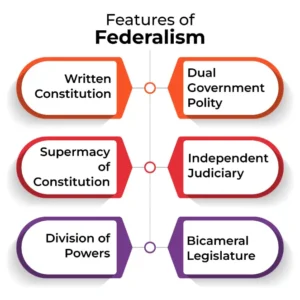
Features of FederalismFeatures of Federalism

Importance of Decentralisation

  • Policies are more effective when designed closest to the people.
  • States can experiment with programmes at smaller scale, reducing risks and allowing successful models to spread nationally.
  • Examples: Tamil Nadu’s noon meal scheme, Kerala’s health and literacy initiatives, Maharashtra’s employment guarantee programme.
  • Over-centralisation suppresses innovation and diversity.

Issues in Current Federalism

  • Centralising Bias – Union dominates through amendments, expansive legislation, and centrally sponsored schemes.
  • Duplication of Functions – Large ministries in New Delhi replicate State responsibilities.
  • Judicial Position – In S.R. Bommai vs Union of India (1994), SC declared federalism part of the Basic Structure, yet erosion continues.
  • Illusion of Strength – Weakening States does not strengthen the Union; it undermines governance capacity.

Challenges

  • Overreach by Union – Excessive control in Concurrent List subjects like health and education.
  • Financial Dependence – Conditional transfers and rigid templates reduce fiscal autonomy.
  • Capacity Argument – Claim that States lack administrative strength, which perpetuates dependence.
  • Erosion of Trust – Governors’ role, language policy, and uniform solutions often undermine State confidence.

Way Forward

  • Right-size the Union – Focus only on genuinely national responsibilities (defence, foreign affairs, macro-economy).
  • Restore State Autonomy – Empower States in health, education, agriculture, and local governance.
  • Strengthen Fiscal Federalism – More untied transfers, flexible schemes, and fair GST arrangements.
  • Institutional Reforms – Implement recommendations of Rajamannar, Sarkaria, and Punchhi Commissions.
  • Promote Cooperative Federalism – Encourage dialogue and partnership rather than hierarchy.

Conclusion

India’s unity today rests on firm foundations, not fragile anxieties of the past. A structural reset of federalism is essential to align authority with responsibility, strengthen governance capacity, and ensure that both Union and States function as equal partners in nation-building.

EUROPE’S STRATEGIC AUTONOMY

TOPIC: (GS2) INTERNATIONAL RELATIONS: THE HINDU

At the Munich Security Conference 2026, European leaders called for greater military autonomy amid concerns over declining U.S. security commitments, highlighting strains in transatlantic relations.

Background

  • Europe’s federal security framework has long relied on the U.S. as guarantor since World War II.
  • Recent remarks by leaders like Germany’s Chancellor Friedrich Merz and France’s President Emmanuel Macron stressed the need for Europe to reduce dependence on Washington.
  • U.S. officials, while promising cooperation, linked alliances more to cultural identity than strategic interests, reflecting ideological shifts.

Challenges Facing Europe

  • War in Ukraine – Ongoing conflict for four years; sanctions and arms support have not yielded decisive battlefield results.
  • Dependence on U.S. Security – NATO’s imbalance is unsustainable as U.S. far-right politics question commitments.
  • Rise of Far-Right in Europe – Challenges EU’s inclusivity and democratic model, fuelling internal instability.
  • Global Order Breakdown – As noted by leaders, the rules-based order is weakening, leaving Europe squeezed between crises.

Implications

  • Security Risks – U.S. disengagement undermines NATO’s collective defence principle.
  • Political Strains – U.S. rhetoric on “civilizational erasure” pushes Europe into cultural conflicts.
  • Economic & Diplomatic Pressure – Europe must balance sanctions on Russia with energy and trade realities.
  • Internal Divisions – Public resentment against political elites strengthens far-right movements.

Way Forward

  • Strategic Autonomy – Build independent military capacity while remaining a pillar within NATO.
  • Engage Beyond the West – Strengthen ties with Asia, Africa, and Latin America to rebuild global order.
  • Resolve Ukraine Conflict – Work towards ending war and establishing a pragmatic relationship with Russia.
  • Address Domestic Discontent – Tackle socio-economic grievances to counter far-right populism.
  • Promote Inclusive EU Vision – Reinforce democratic values and unity against divisive politics.

Conclusion

Europe stands at a crossroads: continued reliance on the U.S. risks fragility, while greater autonomy and wider global engagement can strengthen its role in the emerging world order. Peace in Ukraine, rebuilding trust at home, and diversifying partnerships abroad will be key to Europe’s stability and influence.

INDIA’S PATH TO NET ZERO

TOPIC: (GS3) ENVIRONMENT: THE HINDU

The Ministry of Steel’s task forces have prepared a roadmap for green steel adoption, highlighting fiscal support, procurement reforms, and certification mechanisms to accelerate India’s decarbonisation journey towards net-zero by 2070.

Steel in Emissions

  • Steel industry contributes over 30% of India’s industrial CO₂ emissions, making it one of the largest polluting sectors.
  • India is the second-largest steel producer globally, with annual output crossing 125 million tonnes (2024).
  • Transitioning to low-carbon steel is critical for achieving India’s net-zero target by 2070.

Key Statistics

  • Steel accounts for 18% of costs in large infrastructure projects.
  • Even with a 30% premium on green steel, overall project cost rises only by 5.5%.
  • If 20% of projects adopt green steel, the increase is just 1.1% in public works budgets.
  • India imports over 50 million tonnes of coking coal annually, exposing it to global price volatility.
  • Transitioning to green steel can help India avoid EU carbon border tariffs and strengthen trade competitiveness.

Global Lessons

  • Japan’s Green Purchasing Framework – Combines demand mandates with fiscal incentives.
  • California’s Buy Clean Model – Uses strict carbon benchmarks and verified disclosures.
  • India has introduced a Green Steel Taxonomy with a 3–5 star rating system to classify steel by emission intensity.

Challenges

  • Verification Gap – No reliable system to distinguish certified green steel from conventional products.
  • Administrative Hurdles – Procurement rules focus on lowest price, not sustainability.
  • Market Readiness – Industry hesitant without clear demand signals and fiscal support.

Way Forward

  • Digital Verification – Embed Green Star ratings into QR codes and accreditation systems.
  • Procurement Reform – Shift focus from lowest cost to “value for money” including sustainability.
  • Codify Standards – Include low-carbon steel in Schedule of Rates for public works.
  • Align Incentives – Link Production Linked Incentives and green hydrogen missions with procurement tenders.
  • Pilot Projects – Use Indian Railways and other large buyers as anchor customers.
  • Progressive Standards – Move from 3-star to 4- and 5-star benchmarks after 2030.

Government Initiatives

  • The Ministry of Steel has constituted 14 task forces to chart decarbonisation pathways.
  • These task forces cover areas like:
    • Green hydrogen adoption in steelmaking.
    • Energy efficiency improvements in blast furnaces.
    • Carbon capture and utilisation (CCU) technologies.
    • Circular economy measures such as scrap recycling.

Conclusion

India has a window of opportunity: technology exists, costs are manageable, and global pressure is rising. By combining fiscal support, procurement reforms, and certification systems, India can scale green steel production, strengthen industrial resilience, and advance towards its net-zero 2070 goal.

INDIA VS BANGLADESH IN EU TEXTILE EXPORTS

TOPIC: (GS3) ECONOMY: THE HINDU

India has signed a Free Trade Agreement (FTA) with the EU, giving its textile exports duty-free access. Meanwhile, Bangladesh will lose its LDC trade benefits by 2029, raising questions about India’s ability to regain market share in EU textiles.

Current Scenario

  • India’s Position – Exports to EU are concentrated in yarns and fabrics, not finished garments.
  • Bangladesh’s Advantage – Dominates knitted/crocheted garments (T-shirts, sweaters) and woven garments (shirts, trousers, jackets).
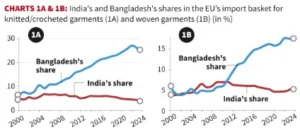
  • India’s share in EU knitted garment imports fell from 6.5% (2009) to 4.4% (2023), while Bangladesh rose to 26% (2023).
  • India’s woven garment exports declined from $3.5 billion to $2.9 billion.
Free Trade Agreement (FTA)

Reasons for India’s Weakness

  • Higher Unit Prices – Indian garments cost more due to higher production costs, less integrated supply chains, and logistical inefficiencies.
  • Tariff Disadvantage – India faced 12% MFN tariffs, while Bangladesh enjoyed duty-free access under the EU’s Everything But Arms (EBA) scheme.
  • Fragmented Policy Support – Bangladesh consistently promoted garments, while India’s approach was less coordinated.
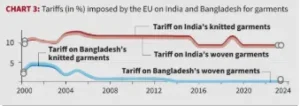
India vs Bangladesh in EU Textile Exports

Upcoming Changes

  • Bangladesh’s LDC Graduation (2029) – Will lose EBA benefits; may enter EU’s GSP+ scheme, but stricter rules of origin could hurt its competitiveness.
  • India–EU FTA – Grants India duty-free access, subject to double-stage processing.
    • India’s vertically integrated textile industry can meet these rules easily.
  • Opportunity Window – India’s tariff disadvantage narrows, while Bangladesh faces stricter compliance.

Challenges for India

  • Cost Competitiveness – Must reduce production costs to compete in mass-market apparel.
  • Supply Chain Efficiency – Need better integration and logistics.
  • Industrial Policy Gaps – Lack of consistent long-term support compared to Bangladesh.
  • Employment Crisis – Textile sector is a major employer but has failed to generate new jobs.

Way Forward

  • Leverage FTA – Use duty-free access to expand garment exports, not just yarn/fabric.
  • Boost Competitiveness – Improve infrastructure, reduce logistics costs, and streamline compliance.
  • Industrial Strategy – Adopt coherent policies like Bangladesh’s garment focus.
  • Learn from Vietnam – EU-Vietnam FTA (2020) boosted apparel exports; India can replicate this success.
  • Employment Generation – Reviving textiles can address India’s job creation challenge.

Conclusion

India now has a rare opportunity: Bangladesh’s loss of trade preferences and India’s new EU FTA create a level playing field. With cost-competitive production, vertical integration, and strong policy support, India can regain ground in EU textile exports and strengthen both its economy and employment base.

DENOTIFIED TRIBES AND DEMAND FOR SEPARATE CLASSIFICATION

TOPIC: (GS2) POLITY: THE HINDU

Leaders of Denotified, Nomadic, and Semi-Nomadic Tribes (DNTs) have demanded a separate classification in the Census 2027, arguing that current inclusion in SC, ST, and OBC lists does not adequately address their unique historical stigma and backwardness.

Who are the DNTs?

  • Colonial rulers classified certain communities as “criminal tribes” under the Criminal Tribes Act (CTA), 1871.
  • They were labelled as “hereditary criminals” and subjected to surveillance and restrictions.
  • The Act was repealed in 1952, and these groups were “denotified,” hence called Denotified Tribes (DNTs).
  • However, many States introduced Habitual Offenders Acts, continuing discrimination against these communities.

History of Enumeration

  • DNTs were last specifically counted in the 1931 Census.
  • Post-Independence, they were absorbed into SC, ST, and OBC lists.
  • Commissions like Ayyangar (1949), Renke Commission (2008), and Idate Commission (2017) highlighted the need for proper identification.
  • The Idate Commission identified nearly 1,200 DNT communities, with 268 left unclassified.

SEED Scheme Issues

  • The Social Justice Ministry’s SEED scheme (for livelihood, education, housing, health) had a budget of ₹200 crore.
  • Only a fraction was spent due to lack of DNT certification for beneficiaries.
  • Certificates are issued only in select districts of a few States, leaving most communities excluded.

Why Demand Separate Classification?

  • Stigma persists – Even after denotification, laws and social prejudice continue to target DNTs.
  • Uneven backwardness – Some communities uplifted, but many remain socially and economically marginalised.
  • Administrative hurdles – Without a separate category, uniform certification is impossible.
  • Recognition of unique history – Leaders argue colonial “criminal” label was unjust and must be officially acknowledged.
  • Sub-classification – Needed to ensure equitable distribution of benefits among diverse DNT groups.

Challenges

  • Lack of accurate Census data on DNTs.
  • Overlap with SC, ST, and OBC categories complicates policy design.
  • Continued social stigma and discrimination.
  • Weak implementation of welfare schemes due to poor identification.

Way Forward

  • Separate Census Column – Enumerate DNTs distinctly in 2027 Census.
  • Permanent National Commission – As recommended by Idate Commission, to oversee welfare and rights.
  • Uniform Certification System – Issue DNT certificates across all States.
  • Targeted Policies – Sub-classification within DNTs to address varying levels of backwardness.
  • Awareness & Inclusion – Recognise historical injustices and integrate DNTs into mainstream society.

Conclusion

DNTs remain among the most marginalised and stigmatised groups in India. A separate constitutional classification and proper enumeration are essential to ensure justice, targeted welfare, and recognition of their unique historical experience.

DISTRICT COOLING, A TOOL FOR CLIMATE-FRIENDLY URBAN PLANNING

TOPIC: (GS3) ENVIRONMENT: THE HINDU

With rising heatwaves and growing urban cooling demand, experts highlight district cooling systems as a sustainable solution to reduce electricity use, emissions, and urban heat stress in Indian cities.

What is District Cooling?

  • A centralised cooling system that supplies chilled water through underground pipes to multiple buildings.
  • Works like a shared utility: one large plant cools water, circulates it, and buildings draw “cooling as a service.”
  • Customers pay a connection charge, fixed demand charge, and consumption charge.

district cooling systems

Efficiency and Environmental Gains

  • Large chillers operate twice as efficiently as individual building units.
  • Cuts electricity use for cooling by 30–50% and peak demand by 20–30%.
  • Reduces greenhouse gas emissions by 15–40%.
  • Cuts refrigerant use in buildings by up to 80%, lowering leak risks.
  • Helps mitigate urban heat-island effect, lowering local temperatures by 1–2°C.
  • Water use is minimal; plants can use treated sewage or wastewater.

Link to National Cooling Action Plan

  • Supports India’s energy security by reducing peak load during heatwaves.
  • Aligns with Kigali commitments to phase down harmful refrigerants.
  • Improves reliability of cooling for IT parks, hospitals, airports, and data centres.
  • Frees up rooftops and indoor space, aiding urban land optimisation.

Suitable Locations in India

  • Works best in dense, predictable cooling demand zones.
  • Potential sites: Navi Mumbai, Hyderabad’s financial district, Ahmedabad’s GIFT City, Bengaluru IT hubs.
  • GIFT City pilot shows potential savings of 6,100 MW power, 7,850 GWh annually, and 6.6 million tonnes CO₂ avoided.

Business Case

  • Customers save 20–40% in operating costs over project life.
  • Developers save 5–10% in project cost and gain 1–2% extra usable space.
  • Reliability above 99.9%, crucial for hospitals and data centres.
  • Utilities benefit from flattened peak demand, reducing need for new plants.

Challenges

  • Fixed demand charges may feel high if capacity is overestimated.
  • Requires good building design and right-sizing contracts.
  • Needs coordination among urban authorities, regulators, and private players.

Way Forward

  • Urban planning should earmark cooling zones and corridors.
  • Municipal bodies must set clear concession rules and service standards.
  • Regulators should recognise district cooling as a demand-side resource.
  • PPP models and technical guidelines from central agencies can support rollout.
  • Pilot projects in Indian Railways, airports, and smart cities can scale adoption.

Conclusion

District cooling offers India a climate-smart, cost-efficient, and reliable solution to rising urban cooling needs. With proper governance and integration into city planning, it can transform cooling from a climate vulnerability into a pillar of sustainable urban infrastructure.

NGT CLEARANCE OF GREAT NICOBAR ISLAND PROJECT

TOPIC: (GS3) ENVIRONMENT: THE HINDU

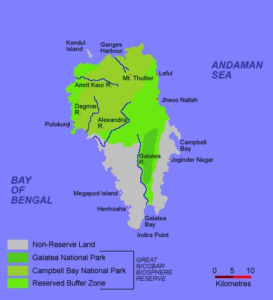
The National Green Tribunal (NGT) has cleared the ₹92,000-crore Great Nicobar Island mega-infrastructure project, stating that adequate environmental safeguards are in place and no grounds exist to interfere with its clearance.

  • Proposed development includes: Transshipment port, Airport, Power plant, Township
  • Environmental clearance (EC) was granted in 2022. Project considered of strategic and national importance.
National Green Tribunal (NGT)                                

NGT’s Observations

  • Found no error in the High-Powered Committee (HPC) terms of reference.
  • Directed strict compliance with EC conditions.
  • Stressed a balanced approach: strategic development must align with ICRZ Notification, 2019.
  • Environment Ministry tasked with: Protecting coral reefs. Ensuring shoreline stability. Preparing an implementation plan for coral regeneration.

Concerns Raised by Applicants

  • Alleged inadequate examination of ecological issues (coral reefs, turtle nesting sites).
  • Claimed EIA was limited to one season, not three as required.
  • Objected to project location in ecologically sensitive zones.
  • Local communities (Nicobarese, Shompen) argued: Their consent was not lawfully taken. Forest rights not settled before project approval.

Challenges

  • Ecological risks – coral reef damage, turtle nesting disruption, shoreline erosion.
  • Community rights – concerns of indigenous groups over displacement and forest land use.
  • Transparency – limited public disclosure of HPC findings.
  • Legal hurdles – forest clearance aspects under challenge in Calcutta High Court.

Way Forward

  • Ensure scientific monitoring of coral reefs and shoreline changes.
  • Strengthen community consultation and settle forest rights before implementation.
  • Adopt sustainable construction practices to minimise ecological damage.
  • Maintain transparency and accountability in environmental safeguards.
  • Balance strategic needs with ecological protection to avoid long-term damage.

National Green Tribunal (NGT)

Constituted in 2010 under the National Green Tribunal Act, 2010. Provides a specialised forum for effective and speedy disposal of cases relating to environmental protection, conservation of forests, and natural resources.

Jurisdiction:

    • Deals with cases under laws like the Environment Protection Act (1986), Forest Conservation Act (1980), Air Act (1981), Water Act (1974), and Biological Diversity Act (2002).
    • Can hear appeals against orders of authorities under these laws.

Composition:

    • Headed by a Chairperson (retired Supreme Court Judge or Chief Justice of High Court).
    • Includes Judicial Members and Expert Members with knowledge in environmental science, forestry, ecology, etc.

Powers:

    • Has powers of a civil court.
    • Can provide relief, compensation, and restitution of damaged environment.
    • Decisions are binding and appealable only in the Supreme Court.

Principles Applied:

    • Polluter Pays Principle – those who pollute must bear the cost of managing pollution.
    • Precautionary Principle – preventive measures must be taken even if scientific certainty is lacking.
    • Sustainable Development – balance between development and environmental protection.

Benches:

    • Principal Bench: New Delhi.
    • Regional Benches: Bhopal, Pune, Kolkata, Chennai.

Conclusion

Effective safeguards, transparent monitoring, and respect for indigenous rights will be crucial to ensure that development does not compromise environmental sustainability and social justice.

Write a Review

Your email address will not be published. Required fields are marked *