
Daily Current Affairs 19-December-2025

Share this Post

RURAL LIFELINE & THE DIRECTIVE PRINCIPLES

TOPIC: (GS2) INDIAN POLITY: THE HINDU

The Union government has introduced a draft Bill to replace the MGNREGA, altering its core features like demand-driven work and Centre’s funding responsibility. Critics argue that the proposed changes dilute the constitutional spirit of the right to work under the Directive Principles.

MGNREGA & the Constitution

  • Article 41 (Directive Principles) asks the State to ensure the right to work within its capacity.
  • During Constituent Assembly debates, this right was placed in DPSPs (not Fundamental Rights) due to opposition from pro-capitalist groups.
  • Dr. B.R. Ambedkar called DPSPs instruments for achieving economic democracy.
  • MGNREGA (2005) became a partial realisation of this right by guaranteeing employment.

Role of Political Context

  • MGNREGA was enacted in 2005 when the UPA government depended on Left parties for support.
  • Left parties played a key role in shaping it as a rights-based, universal and demand-driven law.
  • Parliament passed the law unanimously, reflecting broad political consensus.

Key Features of the Existing MGNREGA

  • Guarantees 100 days of wage employment per rural household per year.
  • Demand-driven: work must be provided when demanded by households.
  • Universal access for all adult rural residents willing to do manual work.
  • Equal wages for men and women.
  • Centre bears full wage cost; States contribute about 10%.
  • Decentralised planning through Panchayats based on local needs.
  • Acts as a fallback option when agricultural or other work is unavailable.
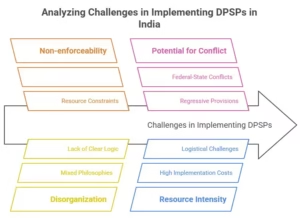
Implementing DPSPs in India

Major Changes Proposed in the Draft Bill

  • Replaces demand-driven nature with fixed financial allocations set by the Centre.
  • No legal obligation on Centre if funds are exhausted.
  • States’ cost share raised to 40%, worsening State finances.
  • Strong centralisation: project design, audits and monitoring controlled by Centre.
  • Undermines federalism and local self-government.

Impact on Rural Workers

  • Ban on work during peak agricultural season weakens workers’ bargaining power.
  • Helps large landowners by forcing labourers to accept lower farm wages.
  • Women workers suffer more due to existing wage discrimination.
  • Mandatory Aadhaar linkage and digital attendance exclude genuine workers due to poor connectivity.

Social Justice Concerns

  • Adivasis form ~8.6% of population but 18% of MGNREGA workers.
  • Scheduled Castes account for about 19% of workers.
  • Thus, dilution of MGNREGA directly affects constitutionally protected groups.
  • Representation of these groups in advisory bodies is removed in the draft Bill.

Funding & Performance Issues

  • Worker demand rose to 8–9 crore, but spending stayed below 0.2% of GDP.
  • In 2024-25, nearly 1 crore workers demanded work but were denied.
  • Average employment per household is below 50 days, far less than promised 100 days.
  • Large wage arrears persist, showing administrative neglect.

DPSPS  (DIRECTIVE PRINCIPLES OF STATE POLICY)

Meaning

  • DPSPs are guidelines given to the State in the Indian Constitution.
  • They tell the government how to govern the country for people’s welfare.
  • They aim to create a just, fair and welfare State.

Constitutional Provisions of DPSPs

  • Mentioned in Part IV of the Indian Constitution.
  • Covered under Articles 36 to 51.
  • Article 37: DPSPs are not enforceable by courts, but fundamental in governance.
  • Inspired mainly by the Irish Constitution.

Main Aims of DPSPs

  • Promote social and economic justice.
  • Reduce inequality in income and wealth.
  • Ensure welfare of weaker sections.
  • Establish a welfare state, not just a police state.

Conclusion

MGNREGA reflects the constitutional vision of social and economic justice. Weakening it not only harms rural livelihoods but also erodes federalism, social equity and the Directive Principles that guide India’s welfare state.

A BOLD STEP AMID AN AMBITIOUS NUCLEAR ENERGY TARGET

TOPIC: (GS3) SCIENCE AND TECHNOLOGY: THE HINDU

Parliament has passed the SHANTI Bill, 2025, setting a target of 100 GW nuclear power capacity by mid-century. The Bill merges existing nuclear laws to support clean energy transition and India’s long-term development goals.

Energy, Development and HDI

  • Human development rises with higher energy consumption.
  • The Human Development Index (HDI) measures progress using income, education and health.
  • Studies show a strong link between HDI and per capita energy use.
  • To reach an HDI of 0.9, India needs very high and reliable energy availability.

India’s Energy Requirement

  • Estimates suggest India must generate around 24,000 TWh per year to reach advanced HDI levels.
  • About 60% of this energy will be electricity; the rest will be used to produce green hydrogen.
  • Hydrogen is essential to decarbonise sectors like steel, fertilisers and chemicals.
  • Current generation (2023–24) is only ~1,950 TWh, showing a large future gap.
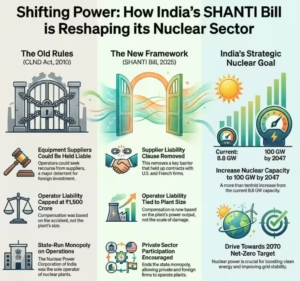
Shanti Bill                          

Challenges in Energy Transition

  • India must increase energy supply and decarbonise at the same time.
  • Electricity’s share in final energy consumption is only ~22% and must rise sharply.
  • Fossil fuels still dominate India’s energy mix, increasing emissions.
  • Clean sources must replace coal, oil and gas in the long run.

Limits of Renewable Energy

  • Hydropower and wind have limited potential due to geography.
  • Solar power needs large land areas, difficult in a densely populated country.
  • Solar and wind are intermittent, depending on weather and time.
  • Large-scale electricity storage for seasonal variation is very expensive.

Why Nuclear Energy is Critical

  • Nuclear power provides continuous baseload electricity.
  • It is low-carbon, reliable and suitable for long-term energy security.
  • Nuclear complements renewables by ensuring stable supply.
  • Without nuclear expansion, India may remain dependent on fossil fuels.

India’s Nuclear Capabilities

  • India has developed indigenous PHWR technology (up to 700 MW units).
  • Most of the nuclear supply chain is domestic; only uranium is imported.
  • NPCIL has strong experience in design, construction and operation.
  • India also has systems for spent fuel reprocessing and waste management.
  • A dedicated nuclear regulator has existed since the 1980s.

Shanti Bill, 2025

  • Full name: Sustainable Harnessing and Advancement of Nuclear Energy for Transforming India.
  • Combines the Atomic Energy Act (1962) and Nuclear Liability Act (2010).
  • Strengthens the legal framework for nuclear expansion.
  • Clearly fixes safety and security responsibility on plant operators.
  • Supports the target of 100 GW nuclear capacity by mid-century.

Conclusion

To achieve high human development and climate goals, India needs large-scale clean and reliable energy. Nuclear power, backed by the SHANTI Bill, is a bold and necessary step towards becoming a developed, low-carbon economy.

RUPEE DEPRECIATION AND TRADE DEFICIT

TOPIC: (GS3) ECONOMY: THE HINDU

India’s merchandise exports recorded a sharp rise in November 2025, helping narrow the trade deficit. However, analysts warn that this improvement may be short-term, driven by rupee depreciation and exporters absorbing high U.S. tariffs.

Recent Trade Performance

  • Merchandise exports rose 19.4% to $38.1 billion in November 2025.
  • This is the highest November export value in the last decade.
  • Exports to the United States increased 22.6% year-on-year to nearly $7 billion.
  • Month-on-month exports to the U.S. also showed healthy growth.
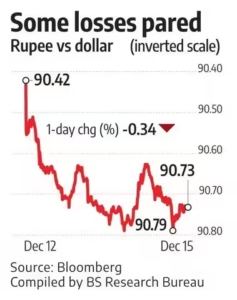
Rupee Depreciation and Trade Deficit

Role of the Depreciating Rupee

  • A weaker rupee makes Indian goods cheaper in global markets.
  • This has partly offset the impact of high U.S. tariffs on Indian exports.
  • Exporters are using currency advantage to retain customers.
  • However, currency depreciation alone cannot neutralise large tariff gaps with competing countries.

Hidden Stress Behind Export Growth

  • Exporters, especially MSMEs in labour-intensive sectors, are absorbing tariff costs.
  • This strategy is not sustainable in the long run.
  • Firms fear losing buyers if prices are raised immediately.
  • Reports suggest a drop in export orders from January, signalling future slowdown.
  • Supply chains take time to adjust to new trade conditions.

Imports and Trade Deficit

  • Merchandise imports fell 1.9% to $62.7 billion in November 2025.
  • Lower imports helped shrink the trade deficit.
  • However, reduced imports may indicate weak domestic demand.
  • India still depends heavily on imports for many critical inputs.
  • Sudden import decline is therefore not fully positive.

Domestic Demand Concerns

  • Import slowdown came soon after GST rate cuts, raising concerns.
  • Weak demand can affect manufacturing, jobs and growth.
  • Government must closely monitor demand indicators.

Government Response

  • An Export Promotion Mission has been outlined.
  • Detailed schemes are yet to be notified and must be fast-tracked.
  • Exporters need liquidity support more than payment moratoriums.
  • A credit guarantee scheme, similar to COVID-era support, could help MSMEs.

External Uncertainty

  • The tariff issue depends on U.S. policy decisions, beyond India’s control.
  • While the government expects a quick resolution, uncertainty remains.

WHAT IS TRADE DEFICIT?

A trade deficit happens when a country imports more goods and services than it exports. It shows that money is going out of the country to buy foreign goods.

How is Trade Deficit Calculated?

  • Formula:
    Trade Deficit = Total Imports – Total Exports
  • If imports > exports → Trade Deficit
  • If exports > imports → Trade Surplus

Major Contributors to India’s Trade Deficit

  • Crude Oil Imports (Biggest Factor): India imports over 85% of its crude oil needs., Oil price rise directly increases import bill.
  • Gold and Precious Metals: High domestic demand for gold jewellery and investment.
  • Electronics and Machinery: Mobile phones, semiconductors, medical equipment. Limited domestic manufacturing capacity.
  • Fertilisers and Chemicals: Imported due to insufficient domestic production. Price volatility affects trade balance.

Conclusion

The recent export surge and lower trade deficit offer temporary comfort, supported by a weak rupee. However, persistent tariffs, falling orders and weak demand suggest risks ahead. India must prepare for prolonged stress while hoping for external relief.

IS THE ARTIFICIAL INTELLIGENCE BOOM A BUBBLE?

TOPIC: (GS3) SCIENCE AND TECHNOLOGY: THE HINDU

Global spending on Artificial Intelligence is rising rapidly and is expected to cross $500 billion by 2026. This has sparked debate on whether AI growth reflects real technological progress or excessive investor hype similar to past tech bubbles.

Rapid Rise of AI

  • AI investment has grown sharply after the launch of ChatGPT in 2022.
  • AI tools are now widely used in search engines, recommendations, translation and automation.
  • High valuations of AI firms have raised fears of a market bubble.

What Does “AI Bubble” Mean?

  • A bubble occurs when expectations and investments grow faster than real returns.
  • Critics point to weak monetisation and limited profits for many AI users.
  • Supporters argue that every major technology passes through hype before maturity.

Lessons from the Dot-Com Era

  • The dot-com boom saw many companies fail financially.
  • However, it laid the foundation for today’s Internet economy.
  • Similarly, many AI startups may fail, but the core technology will survive and improve.
  • Financial failure does not mean technological failure.

Current State of AI Technology

  • AI already works well in narrow tasks like speech recognition, translation and spam filtering.
  • Productivity gains are visible in software, design and customer support.
  • Truly autonomous and human-like AI systems are still under development.
  • Reliability, safety, factual accuracy and trust remain key challenges.

Mismatch Between Science and Markets

  • Markets expect quick and large profits, but AI research needs time.
  • Earlier belief that simply scaling models improves performance is now questioned.
  • Future progress may need new methods, not just bigger models.
  • Benefits may accumulate slowly but steadily, like search engines did.

Underestimated Areas of AI Impact

  • Biggest gains may come in science and research, not consumer apps.
  • AI can accelerate drug discovery, protein research, material science and mathematics.
  • These areas need long-term investment with delayed returns.

Risk of an “AI Winter”

  • Past AI booms (1960s, 1980s) were followed by funding cuts when promises failed.
  • Excessive hype today could again lead to reduced funding.
  • Balanced investment strategy is needed:
    • Short-term applications
    • Long-term scientific research

Economic and Financial Concerns

  • Spending on AI chips and data centres is around 0.5% of global GDP.
  • This may be justified as computing power improves AI performance.
  • The main risk is not losses to investors, but systemic financial instability, which currently seems limited.

Conclusion

The AI boom shows signs of both hype and real transformation. Some investments will fail, but AI as a technology will continue to grow and reshape economies. Rather than fearing a bubble, the focus should be on long-term innovation, safety and avoiding systemic risks.

INSIDE THE DHRUV64 MICROPROCESSOR

TOPIC: (GS3) SCIENCE AND TECHNOLOGY: THE HINDU

The Ministry of Electronics and Information Technology (MeitY) launched DHRUV64, a fully indigenous microprocessor developed in India. It is seen as an important step towards self-reliance in semiconductor and processor technologies.

What is DHRUV64?

  • DHRUV64 is an indigenous 64-bit microprocessor.
  • Developed by C-DAC (Centre for Development of Advanced Computing).
  • Built under MeitY’s Microprocessor Development Programme.
  • Designed as a general-purpose processor for electronics and industrial systems.
  • Key specifications:
    • 64-bit architecture
    • Dual-core processor
    • Clock speed of around 1 GHz

Why Does India Need Indigenous Processors?

  • India is a large consumer of chips but depends heavily on imports.
  • Processors are critical for telecom, power, defence, transport and industry.
  • Control over processor design improves: Security and Supply-chain resilience
  • Indigenous chips reduce strategic dependence on foreign technology.

What Do DHRUV64’s Specifications Indicate?

  • 64-bit design allows it to run modern operating systems.
  • Performance is not cutting-edge compared to smartphones or laptops.
  • Suitable for:
    • Industrial automation
    • Telecom equipment
    • Routers and control systems
    • Automotive electronics
  • Focus is on reliability and stability, not peak performance.

India’s Processor Ecosystem

  • DHRUV64 is part of a broader indigenous processor family, including:
    • SHAKTI – IIT Madras
    • AJIT – IIT Bombay
    • VIKRAM – ISRO–SCL
    • THEJAS32 / THEJAS64 – C-DAC
  • These chips target strategic, industrial, space and research needs.
  • Success depends on creating a strong software, hardware and developer ecosystem.

What is DIR-V Programme?

  • Digital India RISC-V (DIR-V) initiative aims to build Indian RISC-V processors.
  • RISC-V is an open instruction set architecture with:
    • No licence fees
    • High customisation flexibility
  • Encourages domestic innovation and lowers entry barriers.
  • DHRUV64 is the third processor under DIR-V.
  • Fabrication details of DHRUV64 have not been disclosed, raising supply-chain questions.

What Information Is Missing About DHRUV64?

  • No clear performance benchmarks or power efficiency data.
  • Memory architecture, I/O features and cache details are not specified.
  • Foundry location and fabrication process are unclear.
  • “Fully indigenous” claim lacks clarity on IP ownership and toolchains.
  • No roadmap for developer boards, OS support or security certifications.
  • Limited information on future adoption by government or industry.

Government Schemes Supporting Chip Development

  • Chips to Startup Programme (₹250 crore): training and prototyping support.
  • Design Linked Incentive (DLI) Scheme: encourages chip design startups.
  • INUP-i2i Initiative: access to nanofabrication facilities.
  • India Semiconductor Mission: ₹1.6 lakh crore investment across States.

Conclusion

DHRUV64 marks progress in India’s processor journey, but technical clarity, ecosystem support and manufacturing transparency will decide its success. The long-term goal is to make Indian chips commercially viable and globally competitive, not just symbolic.

HOW INDIA IS SEPARATING CLEAN CARS FROM POLLUTING ONES

TOPIC: (GS3) ENVIRONMENT: THE HINDU

Amid severe air pollution, Delhi has tightened vehicle pollution rules, restricting entry of non-BS-VI vehicles from outside the city. Fuel sale is now linked to a valid Pollution Under Control Certificate (PUCC) to curb emissions from older vehicles.

What Are Bharat Stage (BS) Emission Norms?

  • Bharat Stage norms are legal standards to control vehicle emissions in India.
  • Framed by MoEFCC and implemented by CPCB.
  • Aligned broadly with European (Euro) emission standards.
  • Apply to new vehicles manufactured and sold in India.

Evolution of BS Norms in India

  • BS-I: Nationwide – 2000
  • BS-II: Delhi – 2001; nationwide – 2005
  • BS-III: Nationwide – 2010
  • BS-IV: Nationwide – 2017
  • BS-VI: Implemented directly in April 2020, skipping BS-V
  • Each stage introduced stricter pollution limits.

Pollutants Regulated

BS norms limit emissions of:

  • Carbon Monoxide (CO)
  • Hydrocarbons (HC)
  • Nitrogen Oxides (NOx)
  • Particulate Matter (PM)
    These pollutants are linked to smog, respiratory and heart diseases.

Key Features of BS-VI Norms

  • Use of cleaner low-sulphur fuel.
  • Advanced technologies such as:
    • Diesel Particulate Filters (DPF)
    • Selective Catalytic Reduction (SCR)
    • On-Board Diagnostics (OBD)
  • Stricter testing methods closer to real driving conditions.

Why Delhi Sees Mixed-Standard Vehicles

  • Delhi adopted stricter norms earlier than the rest of India due to chronic pollution.
  • Vehicles from other states with older BS standards still enter Delhi.
  • This leads to mixed emission categories on city roads.

Why Older Vehicles Pollute More

  • Lack modern emission-control systems.
  • Diesel vehicles emit high NOx and fine particulate matter.
  • Release volatile organic compounds forming secondary pollutants.
  • Emit black carbon, worsening health impacts and climate warming.

Scale of the Problem in Delhi-NCR

  • Around 37% of vehicles comply only with BS-I, II or III norms.
  • These vehicles are major contributors to Delhi’s air quality crisis.

BS-VI vs BS-IV: Major Changes

  • Petrol vehicles: NOx reduced by ~25%.
  • Diesel vehicles: NOx cut by ~68%, PM reduced by ~82%
  • Cleaner fuel enables better performance of emission controls.

Recent Enforcement Measures

  • Non-BS-VI vehicles from outside Delhi barred from entry.
  • Fuel sold only to vehicles with valid PUCC.
  • Fines: ₹20,000 for non-compliant vehicles, ₹10,000 for BS-VI vehicles without PUCC

Conclusion

BS-VI norms are a crucial step towards cleaner air and better public health. Strict enforcement, along with phasing out older vehicles, is essential to address urban air pollution, especially in cities like Delhi.

SECURITIES MARKETS CODE BILL, 2025

TOPIC: (GS3) ECONOMY: THE HINDU

The Union Finance Minister has introduced the Securities Markets Code Bill, 2025 in the Lok Sabha. The Bill aims to modernise and unify India’s securities laws and has been sent to the Standing Committee on Finance for examination.

About India’s Securities Market

  • Plays a key role in mobilising savings for productive investment.
  • Highly technology-driven and interconnected ecosystem.
  • Regulated mainly by the Securities and Exchange Board of India (SEBI).
  • Requires strong regulation to ensure market integrity and investor trust.

Objective of the Securities Markets Code Bill

  • To simplify, consolidate and modernise securities laws.
  • Reduce overlaps, outdated provisions and regulatory complexity.
  • Promote investor protection, ease of doing business and innovation.
  • Shift towards a principle-based regulatory framework.
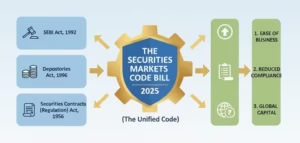
The Securities Markets Code Bill 2025

Consolidation of Existing Laws

  • The Bill replaces three major Acts:
  • SEBI Act, 1992 – Created SEBI as the market regulator.
  • Securities Contracts (Regulation) Act, 1956 – Regulates stock exchanges and trading.
  • Depositories Act, 1996 – Enabled dematerialised holding and transfer of securities.
  • Benefit: One uniform law instead of multiple overlapping statutes.

Strengthening the SEBI Board

  • Board size increased from 9 to 15 members.
  • Composition includes:
    • Chairperson
    • Central Government nominees
    • RBI nominee
    • More whole-time members
  • Aim: Better institutional capacity and governance.

Decriminalisation of Minor Offences

  • Procedural and technical violations shifted to civil penalties.
  • Criminal action limited to serious offences like insider trading.
  • Reduces fear of criminalisation and improves compliance culture.

Classification of Violations

  • Category I: Fraudulent and unfair practices – civil penalties only.
  • Category II: Market abuse affecting public interest – civil and criminal action possible.
  • Introduces clear legal categorisation.

Time Limit on Inspections

  • No regulatory inspection after 8 years from the violation.
  • Ensures legal certainty and closure for market participants.

Conflict of Interest and Accountability

  • Mandatory disclosure of personal and family interests by SEBI members.
  • Compulsory recusal in case of conflict.
  • SEBI empowered to remove members for violations.
  • Enhances ethical governance and transparency.

Investor Protection Measures

  • Mandatory Investor Charter.
  • Strengthened grievance redressal system.
  • Market intermediaries required to follow similar standards.
  • Boosts retail investor confidence.

Delegation and Regulatory Coordination

  • SEBI can delegate certain functions to:
    • Market Infrastructure Institutions (MIIs)
    • Self-Regulatory Organisations (SROs)
  • Encourages market innovation and efficiency.

Concerns and Way Forward

  • Fear of excessive concentration of power in SEBI.
  • Need for strong checks and balances.
  • Transparent and consultative rule-making essential.
  • Capacity building needed for effective enforcement.

Conclusion

The Securities Markets Code Bill, 2025 is a landmark reform to make India’s capital markets simpler, stronger and future-ready. Its success will depend on parliamentary oversight, regulatory accountability and balanced implementation.

CARBON-BASED FILTER FOR PFAS REMOVAL FROM GROUNDWATER

TOPIC: (GS3) ENVIRONMENT: THE HINDU

A 2025 field study has shown that an engineered carbon material can be injected underground to remove PFAS from contaminated groundwater. The method offers a cost-effective and long-term solution for polluted sites.
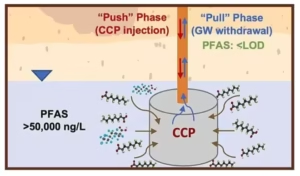
Carbon Based Filter For PFAS Removal

What are PFAS?

  • Per- and Polyfluoroalkyl Substances (PFAS) are synthetic chemicals.
  • Known as “Forever Chemicals” due to extreme persistence in nature.
  • Over 4,700 PFAS compounds exist.
  • Widely used since the 1950s in: Non-stick cookware, Waterproof textiles, Food packaging, Firefighting foams
  • Strong carbon–fluorine bonds make them resistant to breakdown.
  • Commonly contaminate groundwater near industrial and military sites.

Why PFAS are a Concern

  • Persist for decades in soil and water.
  • Accumulate in the human body.
  • Linked to health risks such as cancer, hormone disruption and immune problems.
  • Difficult and expensive to remove using conventional methods.

What is Carbon-based PFAS Remediation?

  • A new in-situ (underground) groundwater treatment method.
  • Uses a specially engineered ultra-fine carbon material.
  • Known as Colloidal Carbon Product (CCP).
  • Carbon particles adsorb and trap PFAS molecules, preventing their movement.

How Does the Technology Work?

  • CCP is injected underground into contaminated zones.
  • Forms a permeable treatment barrier within groundwater.
  • A “push–pull” method is used:
    • Push: Inject carbon material
    • Pull: Extract groundwater later for testing
  • PFAS stick to carbon and remain immobilised.

Significance of the Technology

  • Non-invasive compared to surface treatment plants.
  • Suitable for large contaminated sites.
  • Lower operational costs over time.
  • Promising solution for global groundwater pollution challenges.

Conclusion

Carbon-based in-situ filtration offers a practical breakthrough in tackling PFAS contamination. With further scaling and regulation, it can become a key tool in protecting groundwater and public health.


Write a Review

Your email address will not be published. Required fields are marked *