
INDIA AND THE GLOBAL GOVERNANCE OF ARTIFICIAL INTELLIGENCE
TOPIC: (GS3) SCIENCE AND TECHNOLOGY: THE HINDU
India is set to host the AI Impact Summit in February 2026, aiming to promote inclusive and ethical AI governance, at a time when global efforts are fragmented and contested.
India’s Opportunity in Global AI Leadership
- With AI reshaping economies and societies, India has a unique chance to shape global AI policy that reflects equity, safety, and access, especially for the Global South.
- In contrast to the divisions seen at recent summits (like Paris 2025), India can act as a bridge-builder among conflicting powers.
India’s Democratic Approach to AI Governance
- Inclusive National Consultations: The Ministry of Electronics and IT invited public input via the MyGov platform, engaging students, startups, researchers, and civil society.
- The focus: AI for development, equity, and sustainability.
Proposals India Can Champion at the Summit
- Public Pledges & Scorecards: Governments, companies, and institutions could commit to one impactful AI goal (e.g., using AI to spread health information in local languages or free AI courses for rural students).
- Empowering the Global South: Ensure diverse participation from developing countries. Propose an “AI for Billions Fund” to support language datasets, fellowships, and cloud access.
- AI Safety Collaboration: Create a shared framework for stress testing high-risk AI models. Launch an open-source toolkit for evaluating bias, robustness, and safety.
- Middle Path on Regulation: Advocate a voluntary AI Code of Conduct, balancing innovation and safeguards. Encourage transparency, such as sharing risk assessments and usage data.
- Preventing Global Fragmentation: Avoid a divided AI ecosystem. Ensure the summit promotes shared values and global cooperation.
Conclusion
India cannot build a global AI body alone but can connect existing efforts. If it turns this summit into a platform for progress, India can emerge as a moral and strategic leader in the AI era.
Detailed Article ➡️ Read More
REFORMING INDIA’S AVIATION SAFETY SYSTEM
TOPIC: (GS2) GOVERNANCE: THE HINDU
The preliminary report by the Aircraft Accident Investigation Bureau (AAIB) on the Air India Boeing 787 crash in Ahmedabad (June 12, 2025) has sparked concerns due to inconclusive findings and highlighted deeper systemic flaws in India’s aviation safety ecosystem.
Structural Issues in the Aviation Safety System
- Fragmented Responsibility
- Airlines manage aircraft and crew;
- Airports & air traffic are managed by AAI;
- DGCA regulates all stakeholders;
- MoCA oversees DGCA and AAI.
- Swiss Cheese Model of Accidents
- Accidents arise from multiple small failures across systems—when they align, disasters occur.
Judiciary’s Role and PILs
- Over 15 PILs filed to address aviation risks ignored by regulators.
- Bombay High Court’s intervention in 2016 saved lives by stopping unsafe construction near Mumbai airport.
- Judiciary needs to become more proactive and less reliant on the State’s technical inputs.
Obstacle Hazards Around Airports
- Post-2008, regulatory oversight weakened.
- Buildings approved near airports violate height restrictions and interfere with radars & communications.
- Navi Mumbai airport starts with a displaced threshold, limiting runway use from Day 1.
Core Safety Concerns
- Aircraft Maintenance: DGCA allows tasks to be delegated to under-qualified technicians. Duty limits for Aircraft Maintenance Engineers remain unimplemented.
- Flight Crew Fatigue: Flight duty limits are violated, causing mental and physical fatigue. Pilots are denied mobility, increasing pressure and regulatory breaches.
- ATC Staff Shortage: Severe shortage of air traffic controllers (ATCOs) with no licensing reforms. Duty limits for ATCOs ignored, despite recommendations after Mangaluru crash.
- Whistle-blower Suppression: Individuals reporting violations face transfers, demotions, or termination, silencing safety concerns.
Conclusion
Aviation accidents are not isolated incidents, but consequences of systemic neglect and poor oversight. Judiciary must reassess compensation norms and enforce greater accountability.
Detailed Article ➡️ Read More
TOURISM SECTOR AND ECONOMIC GOALS
TOPIC: (GS3) ECONOMY: THE HINDU
The Union Minister for Culture and Tourism announced the government’s aim to raise tourism’s share in India’s GDP to 10% by 2047. This is part of India’s vision to become a developed economy by 2047, focusing on tourism-led growth.
Present Status of Tourism in India
- Currently, tourism contributes around 5–6% to India’s economy.
- India is a $4 trillion economy, targeted to reach $32 trillion by 2047.
- In 2023, India ranked 14th globally in terms of tourism receipts.
- India earned about 1.8% of global tourism receipts last year.
- The sector is expected to grow at a 24% Compound Annual Growth Rate (CAGR).
Types of Tourism in India
- Spiritual Tourism: Pilgrimage sites in every state reflect India’s religious diversity.
- Cultural Tourism: Fairs, festivals, and historical sites like Pushkar Fair, Taj Mahotsav, and Surajkund Mela attract visitors.
- Beach Tourism: Coastal states like Goa, Kerala, and islands like Andaman & Nicobar offer scenic beaches.
- Wildlife Tourism: National parks and sanctuaries like Ranthambore and Kaziranga draw wildlife lovers.
- Adventure Tourism: Activities in regions like Ladakh, Himachal, Sikkim, and the Himalayas are popular.
- Medical Tourism: India is a hub for affordable and quality healthcare, making it a medical tourism destination.
Challenges
- Weak Infrastructure: Roads, transport, and amenities remain poor in many tourist locations.
- Environmental Stress: Over-tourism causes pollution and ecological damage.
- Seasonal Fluctuations: Tourism sees uneven demand across seasons.
- Lack of Standard Quality: Inconsistency in service across hotels and operators.
- Insufficient Promotion: Lesser-known tourist spots remain under-marketed.
- Cultural Sensitivity Issues: Balancing preservation with visitor inflow is difficult.
Major Government Measures
- 50 Iconic Sites Development: Launched under 2025 budget with state partnerships.
- Swadesh Darshan Scheme: Focus on developing themed tourism circuits.
- PRASHAD Scheme: Upgrades infrastructure at major pilgrimage sites.
- Medical Value Travel (Heal in India): Promotes healthcare and wellness tourism.
- Atithi Devo Bhava Campaign: Enhances hospitality through training and awareness.
- E-Visa Facility & Reforms: Easier visa access and waivers for select countries.
- Support for Homestays & Jobs: MUDRA loans and performance incentives for states.
Conclusion
India aims to position tourism as a key economic pillar by 2047 through infrastructure development, employment creation, and focus on spiritual, medical, and sustainable tourism. The government’s vision aligns with the global shift towards responsible and diverse travel experiences
Detailed Article ➡️ Read More
GLOBAL WETLAND OUTLOOK 2025
TOPIC: (GS3) ENVIRONMENT: THE HINDU
The Ramsar Convention on Wetlands recently published the Global Wetland Outlook 2025. The report highlights the rapid decline and threats to global wetlands and calls for urgent conservation efforts.
About the Report
- Released by the Scientific and Technical Review Panel (STRP) of the Convention on Wetlands.
- Gives a global update on the condition, trends, value, and policy responses related to wetlands.
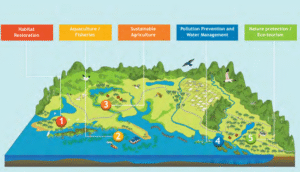
- Reviews 11 major wetland types such as mangroves, peatlands, rivers, coral reefs, marshes, tidal flats, and lakes.
Main Findings
- 22% of wetlands have been lost since 1970, which equals around 411 million hectares.
- Wetlands are vanishing at an average rate of 0.52% per year, varying by wetland type.
- Recent declines are more severe in Latin America, Africa, and the Caribbean, while invasive species and drought impact wetlands in Europe and North America.
- Urban growth, industries, and infrastructure projects are key reasons for the decline in developing regions.
Value and Investment
- The remaining wetlands (1,425 million ha) provide services worth up to $39 trillion annually.
- Managing existing wetlands until 2050 could offer returns of over $205 trillion.
- Restoring wetlands is expensive — costs may range from $1,000 to $70,000 per hectare annually.
- Only 0.25% of global GDP is spent on biodiversity, showing a major shortfall in funding.
Suggestions
- Increase public and private investment using platforms like the Kunming-Montreal Global Biodiversity Framework (GBF).
- Wetlands must be seen as nature-based solutions for climate and ecological stability.
- Strong policies, public awareness, and political commitment are crucial.
Wetlands in India
- India has around 4.6% of its area as wetlands.
- It has 91 Ramsar sites, the highest in South Asia.
- Includes Himalayan lakes, river floodplains, coastal lagoons, and mangroves.
Wetlands contribution
- Wetlands provide four types of ecosystem services – provisioning (like food and water), regulating (like climate and water purification), cultural (like recreation and spiritual value), and supporting (like habitat and soil formation).
- Wetlands’ value is often underestimated, but ecosystem service valuation helps highlight their crucial benefits for human well-being and environmental sustainability.
- A pluralistic approach is needed to understand wetland values, considering different worldviews and goals like stewardship, prosperity, and harmony with nature, as emphasized by IPBES.
Detailed Article ➡️ Read More
INDIA–UAE STRATEGIC TIES IN ENERGY AND TECHNOLOGY
TOPIC: (GS2) INTERNATIONAL RELATIONS: THE HINDU
India and the UAE are expanding their partnership beyond trade, focusing on clean energy, nuclear power, and emerging technologies. This reflects a shift toward long-term, future-ready collaboration with mutual strategic benefits.
Strengthening Economic Partnership
- Trade Crossed $100 Billion mark, reaching the target five years earlier.
- The Comprehensive Economic Partnership Agreement (CEPA) and Virtual Trade Corridor boosted exports and connectivity.
- UAE is India’s 3rd largest trade partner, after China and the U.S.
- UAE’s investment in India is $23 billion, with $4.5 billion added in 2024.
- Digital Integration: India’s UPI is being linked with UAE’s Aani, Jaywan card is built on India’s RuPay system.
Key Areas of Strategic Cooperation
- Nuclear and Clean Energy: UAE generates 25% of its power from nuclear, aims to double it by 2030. India is a technical partner in the Barakah Nuclear Plant.
- Technology and Defense: Indian firms contribute to defense expos and joint production (e.g. drones, Tejas parts). Regular military drills: Desert Flag, Desert Cyclone, and India–France–UAE exercises.
- Education and Innovation: IIT Abu Dhabi, IIM Ahmedabad–Dubai, and IIFT Dubai promote educational exchange. Collaboration in space tech, AI, and precision medicine.
- Critical Minerals & Hydrogen: MoU signed in 2024 to secure supplies of lithium, cobalt, and rare earths. Joint green hydrogen production goal: 5 MMT (India) and 1.4 MMT (UAE) by 2030.
Connectivity & Geopolitical Cooperation
- IMEEC (India–Middle East–Europe Economic Corridor) supports cargo, energy, and digital exchange.
- I2U2 (India, Israel, UAE, US) plans include food parks and 60 GW of renewable energy.
- UAE’s CEPA network offers access to global markets and African outreach via Bharat–Africa Setu.
Challenges Ahead
- Geopolitics: UAE’s ties with China and funding to Pakistan raise concerns.
- Trade Issues: Overdependence on a few sectors; misuse of gold and silver trade channels.
- Labor Rights: Indian workers in UAE face issues under the Kafala system.
- Lack of Dialogue Platform: No dedicated 2+2 dialogue or institutional framework yet.
- Export Barriers: Halal certification norms affect Indian food exports.
Conclusion
India–UAE ties are evolving into a multi-dimensional partnership rooted in innovation, clean energy, and regional leadership. With shared goals, both countries aim to become global hubs for technology and trade.
Detailed Article ➡️ Read More
KERALA: BIODIVERSITY DISCOVERY LEADER IN INDIA
TOPIC: (GS3) ENVIRONMENT: THE HINDU
The Zoological Survey of India (ZSI) released the Animal Discoveries 2024 report. Kerala topped the list with the highest number of new animal and plant species recorded in the country.
Key Highlights of the Report
- In 2024, 683 new faunal species and subspecies were discovered in India (compared to 641 in 2023).
- Out of these, 459 were new to science, while 224 were recorded for the first time in India.
- Kerala led with 101 species, followed by Karnataka (82), Arunachal Pradesh (72), and Tamil Nadu (63).
- Andaman & Nicobar Islands recorded 43 faunal entries, including 14 new species and 29 new records.
Notable Discoveries
- A new snake species from Himachal Pradesh was named Anguiculus dicaprioi after actor Leonardo DiCaprio.
- Other findings included 37 reptiles, 5 amphibians, and 2 new genera.
- The Botanical Survey of India (BSI) listed 433 new plant taxa, with Kerala contributing 58 plant discoveries.
Why Kerala Leads
- Diverse habitats like Western Ghats, rainforests, and wetlands provide ideal research conditions.
- Use of DNA barcoding, regular field surveys, and scientific taxonomy supported discovery efforts.
India’s Biodiversity Hotspots
- India hosts four global hotspots: Himalayas, Indo-Burma, Western Ghats, Sundaland
- These areas are rich in unique species, vital for climate control, water conservation, and local livelihoods.
Major Threats
- Deforestation, habitat loss, invasive species, and climate change.
- Mining and infrastructure projects also impact fragile ecosystems.
Conservation Efforts
- Protected areas like national parks and reserves.
- Laws like the Wildlife Protection Act (1972) and Biological Diversity Act (2002).
- Participation in global biodiversity pacts and promotion of community-based protection models.
Detailed Article ➡️ Read More
INDIA’S FIRST INDIGENOUS DIVING SUPPORT VESSEL
TOPIC: (GS3) DEFENCE: THE HINDU
INS Nistar, India’s first indigenously designed Diving Support Vessel (DSV), was commissioned into the Indian Navy on July 18, 2025, at Visakhapatnam. This marks a major step towards self-reliance in naval rescue and diving operations.

Background of INS Nistar
- The name “INS Nistar” was earlier used for a Soviet-origin submarine rescue ship inducted in 1971 and decommissioned in 1989.
- The new INS Nistar is the first DSV designed and built in India with over 80% indigenous content.
Features and Capabilities
- Built by Hindustan Shipyard Limited, it is the first of two such vessels.
- Designed for deep-sea diving, salvage, and submarine rescue missions.
- Equipped with cutting-edge tools like:
- Remotely Operated Vehicles (ROVs)
- Hyperbaric Life Boats
- Diving Chambers for saturation diving up to 300 meters depth
- Acts as a “mother ship” for Deep Submergence Rescue Vehicles (DSRV).
- Length: 118 meters; Displacement: 10,000+ tonnes
- Includes a 15-ton subsea crane, helicopter deck, and advanced medical facilities including ICU and hyperbaric care.
Strategic Importance
- Enhances India’s capability for submarine rescue operations—a rare capability among global navies.
- Reinforces India’s role as the “First Responder” and regional security partner.
- Strengthens Make in India and the Aatmanirbhar Bharat initiative.
- Part of the larger effort where all 57 upcoming warships are being built domestically.
Conclusion:
INS Nistar symbolizes India’s growing self-reliance in maritime defence technology and positions the Navy as a key player in regional underwater rescue and support operations.

Detailed Article ➡️ Read More
EUROPEAN COMMISSION'S AGE VERIFICATION APP
TOPIC: (GS2) INTERNATIONAL RELATIONS: THE HINDU
The European Commission has introduced a prototype age verification app under the Digital Services Act (DSA) to protect minors from harmful online content. The move has sparked a debate over balancing child safety and adult user privacy.
Background & Objective
- The EU is tightening online regulations for major platforms like e-commerce sites, social media, and adult content websites.
- The goal is to protect minors from digital risks such as exposure to explicit material, cyberbullying, and online predators.
Features of the Age Verification App
- Developed under the Digital Services Act.
- Aims to verify a user’s age without revealing other personal details.
- Built using the same technology as the European Digital Identity Wallet (eID), to be launched by 2026.
- Participating countries in the pilot phase: France, Denmark, Greece, Italy, and Spain.
- Uses zero-knowledge proof technology to maintain user privacy — only confirms age without exposing identity.
Privacy Concerns Raised
- Critics fear the app might compromise user anonymity and track browsing activity.
- Risk of data breaches, with repeated age verification exposing sensitive personal information.
- Concerns that adult users might be forced to share personal data to access certain content.
European Commission’s Response
- Claims the system ensures privacy: users prove they are 18+ without revealing exact age or identity.
- Open-source model: app’s code and architecture are available for public review.
- No browsing history or identity data can be reconstructed by platforms.
Opposition from Adult Content Industry
- Pornhub’s parent company, Aylo, argues age checks should happen at the device level (e.g., by Apple or Google) rather than on individual websites.
- Warns that users might turn to unregulated platforms, risking exposure to illegal content.
- Temporarily blocked access in France to protest against mandatory age checks.
Way Forward
- France is actively pushing for age checks and is considering banning social media for users under 15.
- Final rules and wider EU implementation expected after legal and technical refinements.
Conclusion:
The age verification initiative represents a major step in EU digital policy, aiming to safeguard children while navigating complex privacy and enforcement challenges.