
ELEPHANT TRAIN COLLISIONS IN INDIA
TOPIC: (GS3) ENVIRONMENT: THE HINDU
Seven elephants were recently killed after being hit by the Delhi-bound Rajdhani Express in Assam’s Hojai district, highlighting the urgent need for stronger mitigation measures against elephant–train accidents.
Background of issue:
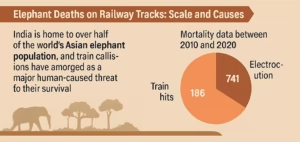
- India hosts more than half of the global Asian elephant population.
- Train collisions are a major human-induced threat to their survival.
- Between 2010–2020, 1,160 elephants died due to unnatural causes. Electrocution: 741 deaths. Train accidents: 186 deaths.
- Railway infrastructure indirectly contributes to multiple causes of mortality.
Impact of Linear Transport Infrastructure (LTI)
- Railways, highways, and canals fragment habitats.
- Restrict access to food and water, increasing stress and vulnerability.
- Long-term survival of herds is negatively affected.
Behavioural Factors
- Most collisions occur at night.
- Male elephants are more prone, especially during crop-raiding seasons.
- Seasonal movement patterns increase exposure to railway tracks.
Preventive Measures – Crossings and Route Planning
- IUCN (2023) handbook stresses avoiding elephant corridors during infrastructure planning.
- Wildlife crossings reduce mortality by up to 98%.
- Types: Underpasses (beneath bridges/flyovers). Overpasses (green bridges/tunnels).
- For elephants, crossings must be open and spacious (minimum 6–7 m height).
- Placement guided by GPS telemetry and camera traps to identify hotspots.
Technology-Based Solutions
- Early-warning systems alert train operators in advance.
- Locomotive-based systems: FLIR cameras detect obstructions up to 750 m.
- Ground-based systems: cameras, acoustic, and seismic sensors at crossing points.
- AI and machine learning improve accuracy, reducing false alarms.
Indian Railways’ Initiatives
- Pilot projects using AI-based monitoring launched in 2023 (Northeast Frontier Railway).
- Extended to Kerala–Tamil Nadu border in 2024.
- Early results show promising outcomes, but adoption remains limited.
Conclusion:
Elephant–train collisions in India highlight the urgent need for habitat-sensitive infrastructure and advanced warning systems. Long-term solutions must prioritize ecological planning alongside technological innovation to ensure elephant conservation.
DATA EXCLUSIVITY AND INDIA’S GENERIC DRUG INDUSTRY
TOPIC: (GS2) INDIAN POLITY: THE HINDU
The Union government is examining whether to introduce data exclusivity in the pharmaceutical sector, amid trade talks and investment considerations.
What is Data Exclusivity?
- When a new drug is developed, companies submit clinical trial data to prove safety and effectiveness.
- Data exclusivity gives the innovator exclusive rights over this data for a fixed period.
- During this time, regulators cannot use the same data to approve generic versions, even if the patent has expired.
- Generic companies must either: Wait until exclusivity ends, or Conduct fresh clinical trials, which are costly and time-consuming.
- It is different from patents: Patents protect the invention. Data exclusivity protects the test data used for approval.
India’s Pharma Model and Role of Generics
- India is a global leader in generic medicines. Nearly 90% of Indian pharma firms focus on generics, not new drug discovery.
- This model ensures Low-cost medicines for Indian patients and exports to developing countries India’s image as the “pharmacy of the Global South”
- Currently, Indian law does not recognise data exclusivity, allowing quick generic entry after patent expiry.
Government’s Current Position
- Inter-ministerial discussions are ongoing involving Commerce Ministry, DPIIT, Health Ministry, and Pharma Department.
- The issue is linked to trade negotiations, especially with EFTA countries, and attracting foreign investment.
- However, the Health Ministry has stated that it has no formal proposal to introduce data exclusivity, showing lack of consensus.
Impact on Access to Medicines
- Possible consequences include, Delayed availability of generics and Higher drug prices due to extended monopolies
- Data exclusivity may protect even off-patent drugs, indirectly extending monopoly beyond the 20-year patent term.
Implications for Generic Drug Industry
- Indian generic firms may face Higher costs due to mandatory clinical trials, Reduced competitiveness in global markets
- Tools like compulsory licensing and patent challenges may lose effectiveness if regulatory approval itself is blocked.
Concerns Around Drug Regulation
- CDSCO has hinted that existing rules create an unequal field between innovators and generics.
- Public health experts fear of Patent evergreening, Unnecessary trials and Delayed entry of affordable medicines
Conclusion
While data exclusivity may attract investment, it risks weakening India’s generic-driven pharma strength and limiting access to affordable medicines. A cautious, public-health-first approach is essential.
PUTIN’S VISIT TO INDIA AND ITS STRATEGIC IMPLICATIONS
TOPIC: (GS2) INTERNATIONAL RELATIONS: THE HINDU
Russian President Vladimir Putin visited India on December 4–5 for the 23rd India–Russia Annual Summit, marking his first visit since the Ukraine war.
Background of India–Russia Relations
- India and Russia share a long-standing strategic partnership rooted in mutual trust, defence cooperation, and diplomatic support.
- The 1971 India–Soviet Treaty of Peace, Friendship and Cooperation transformed South Asia’s strategic balance and enabled India’s decisive role in the creation of Bangladesh.
- Russia has consistently supported India on security matters, particularly when Western countries adopted a pro-Pakistan stance.
- Since the Gorbachev era and especially under President Putin, bilateral relations have steadily deepened through regular summits and close political engagement.
Impact of the Russia–Ukraine War
- The Russia–Ukraine conflict posed a major test for India–Russia relations.
- India adopted a neutral position, refusing to condemn Russia or join Western sanctions.
- This approach led to friction with the U.S. and Europe but reinforced India’s foreign policy principle of strategic autonomy.
Outcomes of the 23rd India–Russia Annual Summit
- The Joint Statement reaffirmed the Special and Privileged Strategic Partnership between the two countries.
- Both sides reiterated mutual respect for each other’s core national interests and long-term cooperation.
- The summit highlighted new areas of collaboration such as connectivity, transport corridors, technology, and industrial cooperation.
- Specific emphasis was placed on the Northern Sea Route through the Arctic and the Chennai–Vladivostok Eastern Maritime Corridor.
Notable Absence of Defence Cooperation
- Defence cooperation, traditionally the backbone of India–Russia relations, was largely absent from the Joint Statement.
- This silence may reflect a deliberate diplomatic choice to avoid controversy in the current global climate.
- It also raises questions about whether India is gradually rebalancing its defence relationships.
Russia’s Role in India’s Defence Preparedness
- Russia remains India’s most reliable and historically significant defence supplier.
- Major defence platforms such as the S-400 air defence system, BrahMos missile, Sukhoi Su-30 MKI aircraft, T-90 tanks, and transport helicopters form the core of India’s military strength.
- These systems proved their effectiveness during Operation Sindoor in May 2025.
- Joint manufacturing and defence technology collaboration between India and Russia have further strengthened defence ties.
Strategic Concerns with the West
- India has diversified defence procurement to include France and Israel, but Russian support remains critical.
- The U.S. decision to approve major upgrades for Pakistan’s F-16 fleet raises doubts about Western reliability as a strategic partner.
- Excessive dependence on Western suppliers could undermine India’s long-term security interests.
Conclusion
Putin’s visit demonstrated that India–Russia relations remain strong despite geopolitical turbulence.
While defence cooperation received less public emphasis, the partnership continues to be strategically significant.
RIGHT TO DISCONNECT BILL
TOPIC: (GS2) INDIAN POLITY: THE HINDU
The Right to Disconnect Bill was recently introduced as a private member’s bill in Parliament, aiming to protect employees from work-related digital communication beyond office hours.
Background
- Introduced amid India’s labour law reforms under four consolidated labour codes.
- Seeks to regulate after-hours work communication in the digital age.
- Reflects the need to rethink labour laws in a tech-driven work environment.
Key Provisions
- Grants employees the right to ignore work-related calls, emails, or messages after official working hours.
- Aims to reduce stress and improve work-life balance.
- Does not clearly define what constitutes “work” in a digital context.
Legal Ambiguities
- The Bill does not align with the Occupational Safety, Health and Working Conditions Code, 2020.
- Fails to clarify whether digital engagement after hours qualifies as “work” under current labour laws.
- Operates more as a behavioural guideline than a legally enforceable labour standard.
Global Comparisons
- European Union: Defines work based on employer control, including standby and on-call time.
- France: Uses collective bargaining to integrate digital communication into work-rest schedules.
- Germany: Enforces strict rules on working hours and rest periods.
- These examples show how other countries treat availability under employer control as working time.
Constitutional Angle
- The Bill hints at a link with Article 21 (Right to Life and Personal Liberty), which includes the right to personal autonomy.
- However, it does not explicitly establish this connection or explain how the right is protected constitutionally.
Concerns and Way Forward
- Unclear if the right is a mandatory labour standard or can be altered by contract.
- Needs integration with existing labour codes to be effective.
- Should define digital labour and its legal status clearly.
- Marks the start of a broader debate on digital rights and workplace autonomy in India.
Conclusion:
The Right to Disconnect Bill highlights the growing clash between digital work and personal autonomy. Its gaps show the need to integrate digital labour into India’s legal framework to truly protect workers’ rights.
CSR AS CORPORATE OBLIGATION
TOPIC: (GS2) INDIAN POLITY: THE HINDU
On December 19, the Supreme Court ruled that corporate environmental responsibility falls within the scope of Corporate Social Responsibility (CSR) under the Companies Act, strengthening conservation efforts for the Great Indian Bustard.
Background of the Case
- The Supreme Court has been monitoring the deaths of Great Indian Bustards due to overhead transmission lines since 2021.
- Earlier orders restricted power lines across 99,000 sq. km and required feasibility studies for undergrounding.
- In 2024, an expert committee was set up to balance species protection with renewable energy expansion.
Key Points of the Judgment
- CSR is now treated as an enforceable duty under the Companies Act.
- Spending CSR funds on environmental and wildlife protection is seen as fulfilling Article 51A(g) (duty to protect environment).
- Strengthens the legal basis for demanding corporate financing for grassland restoration, chick breeding, and species recovery projects.
Limitations of the Verdict
- The judgment does not specify which companies must contribute, how much, or when.
- Penalties for non-compliance remain under existing CSR provisions.
- Mapping habitats of bustards remains a challenge as they move across regions.
- Effectiveness depends on government and utility execution of undergrounding and rerouting projects.
Shift in Approach
- Moves from a large-area restriction (2021 order) to priority habitat zones.
- Reduces conflict with renewable energy projects.
- Focuses on detailed habitat and infrastructure planning.
What are CSR Funds?
- Corporate Social Responsibility (CSR) refers to mandatory spending by certain companies on social and environmental projects.
- Governed by Section 135 of the Companies Act, 2013.
- Companies with net worth of ₹500 crore, turnover of ₹1,000 crore, or net profit of ₹5 crore must spend 2% of average net profits of the last three years on CSR activities.
- Activities include education, health, environment, rural development, and conservation projects.
- Companies must form a CSR committee, disclose spending in annual reports, and face penalties for non-compliance.
Significance
- The judgment integrates environmental protection into CSR obligations.
- Provides a legal pathway for financing wildlife conservation and habitat restoration.
- Marks a step toward aligning corporate responsibility with constitutional duties.
Conclusion:
The Supreme Court has elevated CSR from voluntary charity to a legal obligation for environmental protection. Its success will depend on effective implementation and whether corporate funds translate into real conservation outcomes.
VB-G RAM G ACT, 2025 VS MGNREGA
TOPIC: (GS2) INDIAN POLITY: THE HINDU
The Viksit Bharat – Guarantee for Rozgar and Ajeevika Mission (Gramin) Act, 2025 received Presidential assent, formally replacing the Mahatma Gandhi National Rural Employment Guarantee Act (MGNREGA), 2005. This marks a major shift in India’s rural employment policy framework.
Background
- MGNREGA (2005): Guaranteed 100 days of wage employment per rural household, demand-driven, rights-based, and implemented through Panchayati Raj institutions.
- VB-G RAM G Act (2025): Introduced to align rural employment with the national vision of Viksit Bharat @2047, promising modernization and convergence with other development schemes.
Features of VB-G RAM G Act
- Guaranteed Work: 125 days of wage employment per household annually (up from 100 days under MGNREGA).
- Funding Model: Centre-State cost sharing at 60:40, unlike MGNREGA where the Centre bore 90% of costs.
- Normative Allocation: Funds distributed based on “objective parameters” decided by the Union government, making it command-driven rather than demand-driven.
- Seasonal Restriction: No employment for 60 days during peak agricultural season, potentially worsening inequalities.
- Planning: Introduction of Viksit Gram Panchayat Plans for decentralized planning, but with strong central oversight.
- Employment Days Reality: While 125 days are promised, past funding constraints meant households averaged only ~50 days of work annually, raising doubts about feasibility.
Achievements of MGNREGA
- Increased rural incomes and reduced poverty.
- Women’s participation consistently above 55%, promoting gender parity.
- Reduced reliance on moneylenders by 21%.
- Created durable assets like water conservation structures.
- Strengthened Panchayati Raj institutions and local governance.
- Recognized globally as a “stellar example” of rural development by the World Bank in 2014.
Concerns with VB-G RAM G Act
- Dilution of Rights: MGNREGA guaranteed work as a legal right; VB-G RAM G shifts to a centrally sponsored scheme.
- Reduced Local Autonomy: Panchayats lose control over planning and implementation.
- Financial Burden on States: States must bear 40% of costs, limiting their ability to meet demand.
- Risk of Political Bias: Normative allocation may lead to favoritism in fund distribution.
- Exclusionary Clauses: Seasonal restrictions deny work when rural households most need income.
- Corruption Risks: No new safeguards against leakages or misuse of funds.
Conclusion
The VB-G RAM G Act, 2025 promises modernization and increased workdays but undermines the rights-based, demand-driven nature of MGNREGA. By shifting financial responsibility to states and centralizing control, it risks weakening rural livelihood security and eroding local governance.
RIGHT TO A HEALTHY ENVIRONMENT
TOPIC: (GS3) ENVIRONMENT: THE HINDU
Severe air pollution in Delhi and NCR has reignited debates on the Right to a Healthy Environment as part of the Right to Life under Article 21 of the Constitution. Recent government measures like hybrid schooling and work-from-home directives have been criticized as inadequate, highlighting the urgent need for stronger legal and policy interventions.
Constitutional Basis of Environmental Rights
- Article 21: Right to life includes the right to live with dignity, which courts have interpreted to cover the right to a clean and healthy environment.
- Article 48A: Directive Principle obliges the State to protect and improve the environment.
- Article 51A(g): Fundamental Duty of citizens to safeguard natural resources.
- Judicial precedents like MC Mehta v. Union of India and Subhash Kumar v. State of Bihar expanded Article 21 to include environmental protection.
Judicial Interpretations
- Olga Tellis Case (1985): Linked livelihood to the right to life.
- MC Mehta Cases: Established principles of “polluter pays” and “precautionary principle.”
- Vellore Citizens Welfare Forum (1996): Sustainable development recognized as part of constitutional law.
- Right to Clean Air: Courts have repeatedly held that clean air is essential for life and health.
Current Context – Delhi NCR Pollution
- Air Quality Index (AQI): Frequently crosses hazardous levels.
- Government Measures: Hybrid schooling, work-from-home advisories, restrictions on construction and vehicular movement.
- Criticism: These are temporary fixes, not structural solutions.
- Health Hazards: Respiratory diseases, cardiovascular risks, reduced life expectancy.
International Perspective
- UN Human Rights Council (2021): Recognized the right to a clean, healthy, and sustainable environment as a human right.
- Stockholm Declaration (1972): First global recognition of environmental rights.
- Paris Agreement (2015): Linked climate action to human rights.
- Many countries (France, Portugal, South Africa) explicitly recognize environmental rights in their constitutions.
Challenges in India
- Weak Enforcement: Despite strong judicial pronouncements, implementation is poor.
- Fragmented Governance: Multiple agencies with overlapping responsibilities.
- Economic Pressures: Industrial growth and urbanization often prioritized over environmental safeguards.
- Public Awareness: Limited citizen participation in environmental governance.
- Technological Gaps: Monitoring and data collection remain inadequate.
Policy Framework
- Environment Protection Act, 1986 – umbrella legislation.
- Air Act, 1981 and Water Act, 1974 – sectoral laws.
- National Green Tribunal (NGT): Provides speedy environmental justice.
- National Clean Air Programme (NCAP): Targets 20–30% reduction in PM2.5 and PM10 by 2024.
- Limitations: Lack of binding targets, weak penalties, poor coordination.
Role of State Responsibility
- The State must ensure preventive and remedial measures.
- Duty to balance development and environment.
- Accountability mechanisms needed for failure to protect citizens from pollution.
- Stronger public health integration with environmental policy.
Way Forward
- Legal Recognition: Explicitly recognize the right to a healthy environment as a fundamental right.
- Strengthen Institutions: Empower NGT and pollution control boards.
- Technology Use: Satellite monitoring, AI-based pollution tracking.
- Public Participation: Encourage citizen-led audits and community monitoring.
- Corporate Responsibility: Enforce CSR obligations for environmental protection.
- Education: Integrate environmental literacy in school curricula.
- International Cooperation: Learn from best practices in EU and other nations.
Conclusion
The Right to a Healthy Environment is inseparable from the Right to Life. Rising pollution levels in Delhi NCR highlight the gap between judicial recognition and actual enforcement. Unless the State, corporations, and citizens act collectively, constitutional guarantees will remain symbolic.
DOPPLER WEATHER RADAR
TOPIC: (GS3) ENVIRONMENT: THE HINDU
The Minister of State for Earth Sciences recently announced that India currently operates 47 Doppler Weather Radars (DWRs) to monitor atmospheric conditions and improve forecasting accuracy.
Doppler Weather Radar
- A Doppler radar is a specialized system that applies the Doppler effect to measure both the velocity and position of distant objects.
- Unlike conventional radars, it can detect not only where a target is located but also how it is moving, making it crucial for weather observation.

Working of Doppler Weather Radars
- The radar antenna emits radio waves into the atmosphere.
- When these waves encounter raindrops or other particles, the energy scatters, with part of it returning to the radar.
- The size of the object determines the strength of the reflected signal.
- By calculating the time taken for the signal to return, meteorologists can identify precipitation, its distance, and movement.
- This enables weather departments to visualize rainfall patterns and track storm systems in real time.
Types of Radar Bands
- S-band: Suitable for long-range weather surveillance.
- C-band: Commonly used for cyclone monitoring.
- X-band: Effective for detecting thunderstorms and lightning. These frequency bands are widely deployed by the India Meteorological Department (IMD).
Applications
- Coverage extends up to 500 km, allowing monitoring of large weather systems.
- Helps track cloud bands, rainfall intensity, and storm movement.
- Plays a vital role in cyclone prediction, flood warnings, and disaster preparedness.