
The Women’s Reservation Act, 2023 was passed by Parliament to reserve one-third of seats in the Lok Sabha and State Assemblies for women.
Background of the Act
- The Act reserves 33% of seats in Lok Sabha and State Assemblies for women.
- It excludes the Rajya Sabha and State Legislative Councils, limiting its scope to directly elected lower houses.
- The law was celebrated as a milestone for gender justice but has built-in delays.
Constitutional and Procedural Barriers
- Implementation requires two steps: completion of the 2027 Census and a delimitation exercise based on its data.
- Census data verification and publication may take 12–18 months.
- Past Delimitation Commissions have taken 3–6 years to complete their work.
- Therefore, reservation cannot be applied in the 2029 elections and will likely begin only in 2034.
Political Logic Behind Delay
- Immediate reservation would displace about 181 male MPs in the current 543-seat Lok Sabha.
- Linking reservation to delimitation allows expansion of seats (possibly 800–888 seats) so that one-third can be reserved for women without removing incumbents.
- This approach reduces political resistance but postpones women’s representation.
Historical Context
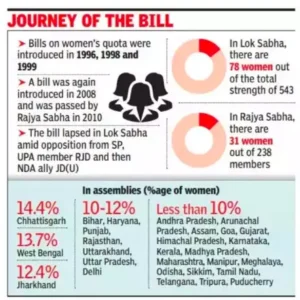
- The Women’s Reservation Bill was first introduced in 1996 and faced repeated delays.
- It passed the Rajya Sabha in 2010 but never came to vote in the Lok Sabha.
- The 2023 Act finally became law but continues the long wait for implementation.
Challenges and Gaps
- Excludes Upper Houses, leaving women underrepresented in those bodies.
- Provides no sub-quota for OBC women, though SC/ST women are included.
- Rotation of reserved constituencies lacks clarity, creating uncertainty for candidates.
- Reservation is tied to the north-south seat distribution debate, which could further delay delimitation.
Way Forward
- Delink Reservation from Delimitation: Parliament can amend the Constitution to allow immediate implementation in the 2029 elections itself.
- Expand Lok Sabha Seats Incrementally: The House can be expanded by adding additional seats exclusively for women before full delimitation.
- Address Design Gaps in the Act: Extend reservation to Rajya Sabha and Legislative Councils. Provide sub-quota for OBC women to ensure inclusivity.
Conclusion
The Women’s Reservation Act is a landmark step, but its delayed implementation undermines its purpose. Representation delayed is effectively representation denied. Parliament must act decisively to ensure that women’s political participation becomes a constitutional reality now, not in 2034.
India has moved beyond its image as the “world’s back office.” By 2026, Global Capability Centres (GCCs) in India have become strategic hubs for multinational corporations, driving innovation, research, and global leadership functions.
Evolution of GCCs
- GCCs began as cost-saving centres handling routine IT and business processes.
- Over time, they evolved into end-to-end product ownership hubs.
- The current phase, GCC 4.0, focuses on advanced R&D, global strategy, and intellectual property creation.
- Nearly 58% of GCCs in India are investing in Agentic AI, moving from experimentation to enterprise-scale deployment.
Benefits for Companies
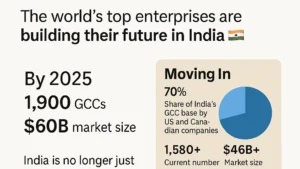
- India hosts over 1,800 GCCs, employing nearly two million professionals.
- Provides access to a large, multi-skilled talent pool unmatched globally.
- Enables faster innovation cycles through a follow-the-sun model.
- GCCs act as Centres of Excellence (CoEs) for finance, HR, legal, and technology.
- They manage entire product lifecycles, from design to deployment, often surpassing headquarters in technical depth.
Benefits for India
- Generates high-value employment with better pay and intellectual stimulation compared to traditional service jobs.
- Promotes regional development in Tier-II and Tier-III cities such as Coimbatore, Indore, and Kochi.
- Reduces pressure on metros like Bengaluru and Hyderabad.
- Boosts local economies through growth in real estate, infrastructure, and retail.
Challenges Ahead
- Talent gap: Demand for niche skills in AI security, cloud architecture, and quantum technologies exceeds supply.
- Cybersecurity risks: GCCs face rising state-sponsored cyber-attacks, with India handling 13.7% of global incidents.
- Fiscal uncertainty: OECD’s Global Minimum Tax (15%) and India’s 24% markup for R&D under Safe Harbour rules create unpredictability.
- Geopolitical risks: US tariff volatility and reshoring policies may slow GCC expansion.
- Digital sovereignty concerns in western nations could restrict data operations in India.
Way Forward
- Policy Support and Simplification: Implement a Single-Window Clearance system for GCCs.
- Skill Development and Industry-Academia Collaboration: Strengthen partnerships between universities and industry to upskill workforce in deep tech areas.
- Balanced Regional Growth and Security Framework: Offer capital subsidies to encourage GCC expansion in Tier-II and Tier-III cities. Enhance cybersecurity infrastructure to protect intellectual property and sensitive data.
Conclusion
With proactive policymaking, skill development, and strong cybersecurity, India can sustain its position as a global innovation hub and ensure that GCCs remain engines of growth for both corporations and the nation.
India has introduced a new Consumer Price Index (CPI) base year 2024, reorganising the consumption basket into 12 categories. This provides a clearer picture of inflation, especially in services-intensive States such as Telangana, Kerala, Tamil Nadu, Rajasthan, and Karnataka.
Background of CPI Revision
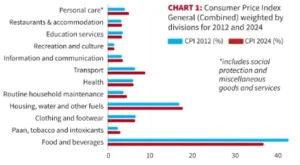
- Earlier CPI grouped consumption into six broad categories, with services like health, education, and transport merged together.
- The revised CPI now has 12 categories, aligned with COICOP 2018 classification.
- Food weight has reduced, while housing and services carry greater importance, reflecting modern spending patterns.
Concept of CPI and Inflation
- CPI measures the price level compared to a fixed base year.
- Example: If a basket cost ₹100 in 2024, and ₹104.46 in 2026, CPI is 104.46.
- Inflation rate shows the pace of price rise compared to the previous year, not the base year.
- Thus, CPI shows how expensive life has become, while inflation shows how fast prices are rising.
State-Level Inflation Trends
- Top five States with highest inflation in January 2026: Telangana (5%), Kerala (3.67%), Tamil Nadu (3.36%), Rajasthan (3.17%), Karnataka.
- In services-heavy States, rising costs of housing, health, education, transport, and personal care drive inflation.
- Rajasthan’s higher inflation reflects inclusion of rural housing and utilities, which were understated earlier.
Importance for RBI
- Food prices fluctuate quickly, but service prices remain high for longer.
- The new CPI helps RBI distinguish between temporary food shocks and persistent service inflation.
- This clarity is crucial for monetary policy and interest rate decisions.
Way Forward
- Strengthen Data Collection and Transparency: Ensure regular updates of household consumption surveys to keep CPI weights relevant.
- Enhance Policy Coordination: Use CPI insights to design targeted policies for controlling service inflation, especially in housing, health, and education.
- Promote Public Awareness and Research: Simplify CPI communication for citizens to understand inflation trends.
- Encourage academic and policy research on regional inflation differences to guide State-level interventions.
Recent advances in Artificial Intelligence (AI), especially large language models like GPT-4, have sparked comparisons with the human brain. While both operate at similar scales, their design principles differ significantly.
Evolution of AI Systems
- Early neural networks were limited by lack of hardware and data.
- Breakthroughs came with GPUs and new architectures:
- Convolutional Neural Networks (CNNs) for images.
- Recurrent Neural Networks (RNNs) for sequences.
- Transformers with attention mechanisms for dynamic input weighting.
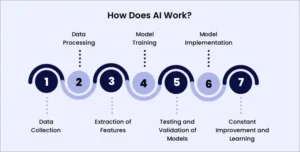
- GPT models predict the next word but at scale capture grammar, facts, reasoning, and creativity.
Scale Comparison
- GPT-3 had 175 billion parameters; newer models reach trillions.
- Human brain has about 100 trillion synapses.
- Despite similar scale, their functioning principles differ.
How AI Works
- Operates in a feed-forward manner: input flows through layers to output.
- Efficient for parallel training across GPUs.
- Requires huge datasets and megawatts of energy.
- Memory and computation are separate processes.
How the Brain Works
- Relies on dense feedback loops; perception shaped by context and prior knowledge.
- Uses selective attention via neurotransmitters (acetylcholine, norepinephrine, dopamine).
- Neurons communicate through spikes, consuming minimal energy when inactive.
- Memory and computation are co-located at synapses.
- Operates on just 20 watts of power, far more efficient than AI.
Biological vs. Artificial Neurons
- Artificial neurons are simple mathematical units.
- Biological neurons are complex biochemical systems with branching dendrites.
- Deep networks approximate what fewer biological neurons achieve naturally.
Emerging Convergence
- GPT-4 introduced mixture-of-experts, activating only specialised portions of the network, similar to brain modularity.
- Neuromorphic chips mimic spike-based signalling to reduce energy use.
- AI researchers are exploring richer training methods beyond next-word prediction.
Way Forward
- Biology-Inspired AI: Incorporate feedback-rich, sparse, and energy-efficient designs inspired by the brain.
- Efficient Hardware Development: Invest in neuromorphic chips and event-driven architectures to reduce energy costs.
- Balanced Perspective: Recognise that AI need not replicate the brain; it can evolve differently while still augmenting human cognition.
Conclusion
AI systems and the human brain are similar in scale but different in design. The brain achieves efficiency through feedback, sparsity, and biochemical complexity, while AI relies on brute-force computation and vast data.
India and the U.S. are conducting the 16th edition of Exercise Vajra Prahar 2026 at the Special Forces Training School, Bakloh (Himachal Pradesh) to strengthen defence cooperation and joint readiness.
Vajra Prahar
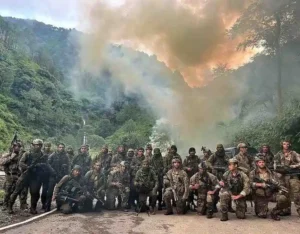
- A bilateral Special Forces exercise between the Indian Army and U.S. Army.
- Conducted annually to enhance interoperability and operational coordination.
- The 2026 edition marks the 16th round of the exercise.
Objectives
- Deepen defence cooperation between India and the U.S.
- Exchange advanced tactics, techniques, and procedures (TTPs).
- Improve joint operational readiness in realistic combat scenarios.
Focus Areas in 2026
- Counter-terrorism operations.
- Precision strikes and intelligence-driven missions.
- Joint planning under simulated battlefield conditions.
- Training in special operations techniques for modern warfare.
Significance
- Strengthens strategic partnership between India and the U.S. in defence.
- Enhances capability of Special Forces to operate together in diverse environments.
- Builds mutual trust and prepares forces for global security challenges.
Conclusion
Exercise Vajra Prahar 2026 highlights the growing India-U.S. defence cooperation. By focusing on advanced special operations and counter-terror strategies, it enhances interoperability and prepares both armies for modern security threats.