

Table of Contents
ToggleDOUBLE ENGINE SARKAR, FEDERALISM AND CONSTITUTIONAL CONCERNS
TOPIC: (GS2) POLITY: THE HINDU
The phrase “double-engine sarkar” has become a popular election slogan. However, it raises serious questions about India’s federal structure, resource distribution, and constitutional fairness.
What is Federalism?
- Federalism means division of powers between the Union and State governments.
- India’s Constitution provides for cooperative federalism, where both levels of government are partners, not competitors.
- Resources collected through national taxation belong to the Union of India, not to any ruling party.
Issues Raised
Fiscal Federalism
- States fear biased allocation of funds if not politically aligned with the Centre.
- Concerns over cesses and surcharges that bypass the divisible pool, reducing States’ share.
- Southern States argue that using recent population data penalises them for controlling population growth.
Governor’s Role
- Governors in some States have delayed assent to Bills, stalling elected legislatures.
- Supreme Court rulings (Punjab case 2023, Tamil Nadu case 2025) clarified that inaction is unconstitutional.
Delhi Example
- Frequent disputes between the elected government and the Lieutenant-Governor show how federal machinery can be used to politically obstruct governance.
Historical Context
- Earlier misuse of Article 356 to dismiss State governments was curbed by the S.R. Bommai judgment.
- Today, the challenge is subtler: governments remain in office, but development may depend on political alignment.
Way Forward
- Strengthen Finance Commission: Make recommendations more binding to ensure rule-based fiscal transfers.
- Statutory Timelines for Governors: Fix a 3-month limit for action on Bills; beyond that, assent deemed granted.
- Revitalise Inter-State Councils: Use Article 263 forums for genuine cooperative federalism, not ceremonial meetings.
- Equal Treatment of States: Development must be citizen-centric, not party-centric; every State deserves its fair share.
Examples
- Positive Federalism: GST Council decisions taken jointly by Union and States.
- Negative Federalism: Delays in fund transfers and Governor’s inaction in Tamil Nadu and Kerala.
Conclusion
The “double-engine” slogan may sound appealing, but it risks corroding the constitutional promise of equal citizenship. India’s federal democracy needs strong institutions, impartial fiscal transfers, to drive development.
DIGITAL EXILE AND ARBITRARY CENSORSHIP IN INDIA
TOPIC: (GS2) POLITY: THE HINDU
Recently, social media accounts of activists and journalists were blocked for criticising government policies, raising concerns about arbitrary censorship and weakened free speech safeguards in India’s digital governance.
What is Censorship?
- Censorship refers to the suppression or restriction of speech, expression, or information by authorities.
- In the digital era, it includes blocking websites, social media posts, or entire accounts.
- While intended to protect public order, excessive censorship can undermine democracy and fundamental rights.
Key Issues
- Rising Blocking Orders: From 2014 to 2021, blocked URLs/posts rose from 470 to 9,800. Entire accounts are now being removed, amounting to digital exile.
- Use of Emergency Powers: IT Rules invoked to block content like the BBC documentary (2023). Definition of “public order” expanded, enabling wider censorship.
- Weak Safeguards: Section 69A of the IT Act was upheld in Shreya Singhal (2015) due to procedural safeguards. In practice, Rule 16 of Blocking Rules (2009) is used to keep orders confidential, denying affected parties the chance to challenge them.
- Judicial and Institutional Concerns: Review committees under IT Rules are executive-controlled and have never overturned a blocking order. Courts (e.g., Karnataka HC vs Twitter, 2021–22) have upheld government actions, further emboldening censorship.
Effects of Censorship
- Democratic Deficit: Restricts free speech and weakens accountability.
- Chilling Effect: Citizens and media self-censor to avoid penalties.
- Loss of Trust: Arbitrary blocking erodes confidence in governance.
- Global Image: Raises concerns about India’s commitment to liberal democracy.
Way Forward
- Transparency: Publish blocking orders with clear reasons.
- Judicial Oversight: Strengthen independent review mechanisms beyond executive control.
- Proportionality: Ensure restrictions are narrowly tailored to genuine threats.
- Digital Rights Framework: Create statutory safeguards balancing security and free speech.
- Global Best Practices: Learn from EU’s Digital Services Act and U.S. free speech jurisprudence.
Conclusion
India’s digital governance is shifting from cooperative regulation to arbitrary censorship. Protecting free speech while ensuring national security requires transparent, and judicially reviewed mechanisms.
COMPULSORY VOTING AND FEASIBILITY IN INDIA
TOPIC: (GS2) POLITY: THE HINDU
The Supreme Court recently raised questions about making voting mandatory in India. This comes as the Election Commission announced Assembly polls in five States for April–May 2026.
Present Right to Vote in India
- Article 326: Grants every citizen above 18 years the right to vote, subject to disqualifications.
- Representation of the People Act, 1950 & 1951: Defines eligibility and voting rights.
- The Supreme Court has held that the right to vote is a statutory right, not a fundamental right.
Arguments For Compulsory Voting
- Higher Turnout: Ensures broader participation, making democracy more representative.
- Civic Duty: Strengthens democratic culture by treating voting as a responsibility.
- Global Examples: Countries like Australia, Brazil, Argentina impose fines or restrictions for non-voting, leading to turnout above 90%.
- Reduces Apathy: Prevents candidates from winning with support of only a small fraction of voters.
Arguments Against Compulsory Voting
- Freedom of Expression: Forcing citizens to vote may violate Article 19(1) (freedom of speech and expression).
- Practical Difficulties: India’s large population makes enforcement of penalties unrealistic.
- Harsh Measures: Denying services or imposing fines on non-voters could be socially unjust.
- Law Commission (255th Report, 2015): Concluded compulsory voting is neither desirable nor feasible in India.
- Dinesh Goswami Committee (1990): Favoured awareness campaigns over compulsion.
Way Forward
- Awareness Campaigns: Use social media and community outreach to build enthusiasm.
- Ease of Access: Ensure polling day is a statutory holiday; provide special buses/trains for migrant workers.
- Remote Voting: Explore secure technology for migrant and overseas voters.
- Incentives, not Penalties: Encourage participation through recognition programs rather than fines.
- Youth Engagement: Target first-time voters with campaigns in colleges and universities.
Conclusion
Compulsory voting may boost turnout but risks violating freedom of choice. India’s focus should be on awareness, accessibility, and innovation to strengthen democracy without coercion.
RICE AND WHEAT PROCUREMENT
TOPIC: (GS3) ECONOMY: THE HINDU
A Parliamentary Standing Committee on Consumer Affairs, Food and Public Distribution, reported that actual procurement of rice and wheat has consistently fallen short of estimates and targets in several States.
Procurement Statistics (Recent Years)
- Since 2022–23, procurement of rice and wheat has been less than 30% of total production.
- Wheat procurement:
- 76.71% of estimate (2023–24)
- 71.35% of estimate (2024–25)
- 87.29% of estimate (2025–26)
- Rice procurement: consistently below targets since 2022–23.
- Example (2024–25 Kharif season):
- Andhra Pradesh: 25.6 lakh tonnes vs target 35 lakh tonnes.
- Karnataka: 0.003 lakh tonnes vs target 5.29 lakh tonnes.
- Punjab: 116.13 lakh tonnes vs target 124 lakh tonnes.
State Contributions
- Punjab and Haryana: traditionally contribute the largest share of wheat and rice procurement for the central pool.
- Uttar Pradesh, Bihar, Gujarat: procurement consistently below targets.
- Southern States (AP, Karnataka) also show shortfalls in rice procurement.
Why Procurement is Necessary
- Ensures food security through the Public Distribution System (PDS).
- Provides price support to farmers via Minimum Support Price (MSP).
- Maintains buffer stocks for emergencies and welfare schemes.
- Stabilises market prices and prevents distress sales.
Why Farmers Depend on Government Procurement
- MSP assurance protects farmers from volatile market prices.
- Private traders may offer lower rates, making government procurement more reliable.
- Procurement centres provide ready buyers, reducing uncertainty.
- Helps small and marginal farmers who lack bargaining power in open markets.
Factors Influencing Procurement
- Production Variability: Differences between estimated and actual crop output directly affect procurement levels.
- Market Surplus & Price Trends: Availability of surplus produce and prevailing market prices influence farmer decisions to sell to government agencies.
- Effectiveness of Minimum Support Price (MSP): If MSP is attractive compared to open market rates, farmers prefer selling to procurement centres; otherwise, they shift to private buyers.
- Demand–Supply Dynamics: Overall demand for food grains and supply conditions in domestic and international markets impact procurement volumes.
- Role of Private Traders: Active participation of private traders often diverts produce away from government procurement channels.
Challenges Identified
- Fluctuations in production vs estimates.
- Farmers selling to private traders when market price > MSP.
- Storage and logistics constraints in some States. Weak real-time monitoring of crop arrivals.
Way Forward
- Review estimation methods for procurement requirements. Strengthen coordination between Centre and States.
- Introduce digital monitoring systems for production and arrivals. Diversify procurement beyond traditional States to balance regional gaps.
- Expand storage and transport infrastructure. Improve awareness of MSP among farmers.
Conclusion
A mix of better planning, stronger State coordination, and modern monitoring tools is essential to make procurement more realistic, responsive, and effective.
INDIA’S DUAL DEPENDENCE ON WEST ASIA FOR UREA
TOPIC: (GS3) ECONOMY: THE HINDU
The ongoing West Asia conflict has disrupted LNG cargoes through the Strait of Hormuz, threatening India’s domestic urea production and import supply chains.
What is Urea?
- Urea is a nitrogen-rich fertilizer, widely used in India’s agriculture.
- It is produced from ammonia, which requires natural gas (LNG) as feedstock.
- India consumes nearly 387 lakh metric tonnes (2025), making it the most used fertilizer in the country.
India’s Dependence
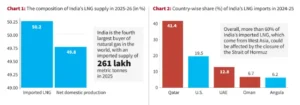
- India imports over 50% of its natural gas, with 40% tied to Qatar and other Gulf suppliers.
- More than 60% of LNG imports pass through the Strait of Hormuz, now a conflict zone.
- In 2025, India imported 2,300 lakh tonnes of urea, with 71% from West Asia (Oman, Saudi Arabia, Qatar, UAE).
- Domestic production (~306 lakh tonnes) does not meet demand, hence reliance on imports continues.
Government Response
- Issued the Natural Gas (Supply Regulation) Order, 2026, prioritising fertilizer sector in gas allocation.
- Urea reserves raised to 61.51 lakh tonnes ahead of Kharif sowing season.
Challenges
- Geopolitical risk: Closure of Strait of Hormuz disrupts LNG and urea supply.
- Import dependence: Heavy reliance on West Asia makes India vulnerable.
- Energy intensity: Urea production requires large amounts of natural gas, linking fertilizer security to global energy markets.
India’s Initiatives to Reduce Import Dependence
- Diversification of supply: Exploring LNG contracts with countries beyond West Asia (e.g., Australia, Russia, U.S.).
- Alternative feedstocks: Some plants still use naphtha/fuel oil, though less eco-friendly.
- Promotion of balanced fertilization: Encouraging use of DAP, potash, bio-fertilizers, and nano-urea to reduce overdependence on urea.
- Nano Urea by IFFCO: Liquid nano-urea reduces consumption per hectare, lowering import needs.
- Organic and sustainable farming: Expanding organic manure, compost, and green manures to cut chemical fertilizer demand.
- Self-reliance push: New urea plants under “Make in India” and revival of closed fertilizer units.
Conclusion
India’s fertilizer security is tightly linked to West Asian LNG and urea imports, making it vulnerable to geopolitical shocks. Long-term resilience requires diversification of energy sources and boosting domestic production capacity.
INDIA’S GAS GRID AND LESSONS FROM THE PAST
TOPIC: (GS3) ECONOMY: THE HINDU
The West Asia war has disrupted LNG supplies through the Strait of Hormuz, threatening India’s energy security.
Background
- In 1955, Syed Husain Zaheer (CSIR scientist) proposed a cross-country gas grid using coal gasification.
- Suggested a Town Gas Supply Scheme for Hyderabad, piping gas from Singareni coalfields.
- Nehru supported the idea, but policymakers dismissed it as “infeasible.”
- Wars of 1962 and 1965, funding delays, and lack of industrial support stalled the project.
Oil Shock of 1973 – Missed Opportunity
- OPEC’s oil embargo exposed India’s dependence on imported petroleum.
- Indira Gandhi admitted that ignoring Zaheer’s plan was a mistake: coal gasification could have reduced strain.
- Eventually, pilot plants were set up, leading to Integrated Gasification Combined Cycle (IGCC) research with BHEL in 1985.
National Coal Gasification Mission (2021)
- Target: Gasify 100 million tonnes of coal by 2030.
- Investment: ₹85,000 crore committed.
- New company formed: Bharat Coal Gasification & Chemicals Ltd (2024) by Coal India and BHEL.
- Aim: Reduce reliance on imported natural gas, methanol, ammonia, fertilizers.
- Seen as part of India’s clean coal technology and energy independence strategy.
Challenges
- Delayed adoption: India lost decades of research advantage.
- High costs: Gasification plants require heavy investment and advanced technology.
- Environmental concerns: Coal-based energy must align with climate commitments.
- Industrial linkages: Past projects lacked strong industry partnerships.
Way Forward
- Accelerate Mission 2030: Ensure timely implementation of coal gasification plants.
- Diversify energy sources: Reduce dependence on West Asia by expanding domestic coal-based gas.
- R&D investment: Strengthen CSIR and industry collaboration for advanced clean coal technologies.
- Climate balance: Integrate gasification with carbon capture and renewable energy.
- Strategic reserves: Build buffer stocks of LNG and coal-based substitutes to withstand global shocks.
Conclusion
India’s failure to build a national gas grid in the 1950s shows how short-term policy choices can weaken long-term energy security. The current crisis highlights the need to revive coal gasification, diversify energy sources, and invest in innovation to achieve true energy independence.
GLOBAL TERRORISM INDEX (GTI) 2026
TOPIC: (GS2) INTERNATIONAL RELATIONS: THE HINDU
The Global Terrorism Index 2026, released by the Institute for Economics and Peace (IEP), ranked Pakistan as the most impacted country by terrorism for the first time, while India stood at 13th.
About GTI
- Published by IEP, a Sydney-based think tank.
- Covers 163 countries, representing nearly the entire global population.
- Methodology: Countries scored 0–10 (0 = no impact, 10 = highest impact).
- Provides composite scores and rankings based on terrorism’s impact.
Key Highlights – 2026
- Global decline: Terror deaths fell by 28%, incidents by 22%.
- Regional focus: Six of the top 10 most affected countries are in Sub-Saharan Africa.
- Top ranks: Pakistan (Rank 1, Score 8.57), followed by Burkina Faso, Syria, Mali, Niger.
- India: Ranked 13th with a score of ~6.41.
- Major groups: Islamic State (IS), JNIM, Tehrik-e-Taliban Pakistan (TTP), al-Shabaab.
India’s Past Performance
- 2023: Rank 13
- 2024: Rank 14
- 2025: Rank 14 (Score 6.41)
- 2026: Rank 13 again, showing persistent threats despite global decline.
India’s Position
- Challenges: Cross-border terrorism from Pakistan, insurgency in Jammu & Kashmir, and left-wing extremism.
- Improvements: Decline in Maoist violence, better intelligence coordination.
- Concern: India’s rank remains stagnant, unlike global downward trends.
Way Forward
- Modernize intelligence and surveillance systems. Use technology (AI, drones, cyber tools) for monitoring.
- Strengthen regional cooperation through SAARC/BIMSTEC. Address radicalization via education and community engagement.
- Push for UN reforms and highlight Pakistan’s role in sponsoring terrorism.
Conclusion
India’s consistent placement in the top 15 of GTI underscores the need for robust counter-terrorism strategies, regional partnerships, and global advocacy.
TRUMP’S SECTION 301 WEAPON – WTO AND INDIA’S CONCERNS
TOPIC: (GS2) INTERNATIONAL RELATIONS: THE HINDU
The U.S. administration recently invoked Section 122 of the Trade Act (1974) to impose a temporary 10% surcharge on imports, citing a “balance of payments crisis.”
Background
- Section 122 allows temporary import surcharges during a balance of payments crisis. However, WTO rules permit only import restrictions, not tariffs, in such cases.
- Section 301 empowers the U.S. Trade Representative to investigate foreign trade practices and impose unilateral tariffs if deemed discriminatory or unfair.
- WTO members argue this violates multilateral trade rules since the U.S. acts as judge in its own cause.
Key Issues
- Unilateral Tariffs: Trump administration used Section 301 against China (2017), imposing tariffs up to 25%.
- A WTO panel (2020) ruled these tariffs violated U.S. commitments, but the U.S. blocked the WTO Appellate Body, preventing enforcement.
- Global Trade Impact: Section 301 acts like a “big stick” — even the threat of action pressures countries to comply.
- India’s Position: India is listed in both new Section 301 proceedings: Alleged excess manufacturing capacity. Alleged failure to block forced-labor goods.
- India has not signed a reciprocal trade agreement yet, but negotiations may be influenced by U.S. pressure.
Effects of Section 301 Actions
- Weakens WTO system by bypassing multilateral rules.
- Creates uncertainty for global businesses and supply chains.
- Pressures developing countries like India to accept unfair trade terms.
- Erodes trust in international economic law.
Way Forward for India
- Active Participation: Indian businesses must submit evidence in Section 301 proceedings to counter false claims.
- Coalition Building: Work with EU, Japan, and other WTO members to revive multilateral rules.
- Strengthen WTO: Push for restoration of the Appellate Body to ensure enforceable dispute settlement.
- Balanced Negotiations: Ensure any U.S.–India trade agreement is mutually beneficial, not one-sided.
Conclusion
Section 301 has turned into a unilateral weapon undermining WTO’s credibility. For India, the challenge is to resist pressure, safeguard trade interests, and strengthen multilateralism through alliances and rule-based frameworks.