
REDRAWING THE ARAVALLIS
TOPIC: (GS3) ENVIRONMENT: THE HINDU
The Supreme Court approved a new definition of the Aravalli Hills (Nov 2025) based on local elevation, triggering criticism from environmental experts.
Importance of the Aravalli Range
- One of the oldest mountain ranges in the world, stretching across Gujarat, Rajasthan, Haryana and Delhi.
- Acts as a natural barrier against desertification, supports groundwater recharge, biodiversity, and moderates climate in north-west India.
- Ecologically crucial for Delhi–NCR air quality and water security.
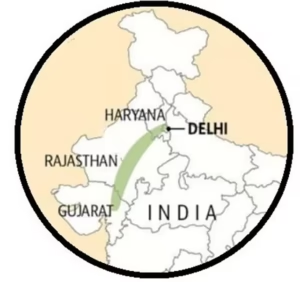
New Definition of Aravalli Hills
- Approved definition includes Landforms rising at least 100 metres above the local surrounding terrain. Their slopes and adjoining areas.
- Elevation will be measured from the local profile, not from a uniform baseline.
Why This Matters
- Using a local profile may exclude genuine hills if nearby land is already elevated.
- Critics argue this could reduce the officially recognised Aravalli footprint.
What Remains Protected
- Areas already notified under other laws continue to enjoy protection:
- Tiger reserves, national parks, wildlife sanctuaries
- Eco-sensitive zones and wetlands
- Compensatory afforestation areas
- Mining or development here remains restricted unless permitted by law.
Limits of Protection
- Such protections are not permanent and can be altered.
- Example: Attempt to dilute Sariska Tiger Reserve boundaries was stopped only after Supreme Court intervention.
- Areas Likely to be Excluded: The new rule departs from the Forest Survey of India (FSI) method, which used Minimum elevation (115 m in Rajasthan) + Slope of at least 3 degrees
- Rajasthan, which hosts nearly two-thirds of the Aravallis, faces the largest exclusions.
- Districts Dropped: Several districts earlier recognised as Aravalli regions are now excluded, such as: Sawai Madhopur (near Ranthambhore) Chittorgarh (Aravalli outcrop with UNESCO fort)
Scale of Exclusion
- Under the FSI method, Aravallis covered about 40,000 sq km in Rajasthan.
- Applying the new 100-metre benchmark could exclude over 99% of these identified hill areas, drastically shrinking the recognised range.
Mining and Government’s Stand
- Government claims mining is allowed in only 0.19% of the Aravalli area.
- Critics argue this figure is misleading as it refers to entire districts, not the actual hill range.
- Concerns remain over illegal mining, future expansion, and cumulative environmental damage.
ARAVALLI RANGE
Oldest Fold Mountain Range in India and among the oldest in the world (Pre-Cambrian age).
- Extends in a south-west to north-east direction across north-western India.
- Length: about 690 km.
- States covered: Gujarat, Rajasthan, Haryana, Delhi.
Origin & Geological Structure
- Formed due to tectonic activity during the Proterozoic era.
- Highly eroded and discontinuous due to long geological history.
- Composed mainly of igneous and metamorphic rocks (gneiss, schist, quartzite).
- Rich in minerals: copper, zinc, lead, marble, limestone.
Highest Peaks
- Guru Shikhar (Mount Abu, Rajasthan) – 1,722 m (highest peak).
Regional Importance
- Acts as a climatic divide:
- East: comparatively more rainfall
- West: arid and semi-arid conditions (Thar Desert side)
- Prevents eastward spread of the Thar Desert.
- Influences the path of the south-west monsoon winds.
Conclusion:
The Supreme Court’s redefinition of the Aravalli Hills risks shrinking their protected footprint and weakening ecological safeguards. Preserving the integrity of this ancient range is vital for biodiversity, climate resilience, and sustainable development in north-west India.
INDIA–NEW ZEALAND FREE TRADE AGREEMENT
TOPIC: (GS3) ECONOMY: THE HINDU
India and New Zealand have successfully concluded negotiations on a Free Trade Agreement (FTA), which will be formally signed in the first half of 2026.
Background
- India and New Zealand established diplomatic relations in 1952, and their ties are rooted in Commonwealth membership, democratic governance, and common law traditions.
- Sporting connections, especially cricket, hockey, and mountaineering, along with tourism, have strengthened goodwill between the two societies.
- The Indian-origin population in New Zealand is approximately 292,000, and Hindi is the fifth most spoken language in the country.
Strategic Framework
- New Zealand identified India as a priority partner through initiatives such as “Opening Doors to India” (2011) and the NZ Inc. India Strategy.
- This partnership was further deepened by the “India–NZ 2025: Investing in the Relationship” strategy, which envisioned stronger cooperation across political, economic, and people-centric domains.
Trade and Economic Relations
- New Zealand is India’s 11th largest two-way trading partner. In 2023–24, the total trade between India and New Zealand was valued at US$ 1.75 billion.
- India’s major exports to New Zealand include pharmaceuticals, precious metals and gems, textiles, motor vehicles, and non-knitted apparel.
- India’s imports from New Zealand mainly consist of logs, forestry products, wool, and edible fruits and nuts.
- Key sectors of cooperation include education, tourism, dairy, food processing, pharmaceuticals, renewable energy, and critical minerals.
Defence and Maritime Cooperation
- Defence ties are expanding steadily with regular naval visits and port calls by Indian Navy ships.
- High-level exchanges between naval leadership have strengthened cooperation.
- Both countries collaborate under Combined Task Force-150, where Indian Navy personnel contribute while New Zealand has taken leadership roles.
- These engagements support maritime security and stability in the Indo-Pacific region.
Education and Research Partnerships
- India is the second-largest source of international students in New Zealand, with nearly 8,000 students enrolled.
- Collaboration includes the New Zealand Centre at IIT Delhi and joint research projects in cancer, robotics, cybersecurity, waste management, and medical technology.
- Education cooperation agreements have also been signed with GIFT City and IIM Ahmedabad.
FTA Highlights
- New Zealand will invest $20 billion in India over the next 15 years as part of the agreement.
- A dedicated annex on health and traditional medicine has been included, which is New Zealand’s first such agreement with any country.
- Tariff liberalisation will cover 95% of New Zealand’s exports, with 57% becoming duty-free from day one, rising to 82% upon full implementation.
- India has safeguarded sensitive sectors such as dairy, onions, sugar, spices, edible oils, rubber, rice, wheat, and soya, which will not face tariff concessions.
Conclusion
The India–New Zealand FTA is a landmark agreement that strengthens economic, strategic, and cultural ties between the two nations. By balancing market access with protection of sensitive sectors, the deal promises growth in trade, investment, jobs, and mobility, while deepening cooperation beyond commerce into defence, education, and people-to-people relations.
CHILD TRAFFICKING IN INDIA
TOPIC: (GS2) INDIAN POLITY: THE HINDU
The Supreme Court, in a December 19 judgment, described child trafficking as a “deeply disturbing reality” in India. It upheld the conviction of traffickers in a Bengaluru case and issued guidelines for handling such cases with sensitivity.
Nature of the Problem
- Child trafficking is one of the worst forms of modern slavery.
- Organised cartels operate at multiple levels—recruiting, transporting, harbouring, and exploiting minors.
- Victims are often subjected to sexual exploitation, forced labour, and other abuses.
Supreme Court Observations
- The offence violates dignity, bodily integrity, and constitutional protection against exploitation.
- A minor victim of sex trafficking is not an accomplice; her testimony must be treated as that of an injured witness.
- Courts must show sensitivity and not dismiss testimony due to minor inconsistencies.
Current Situation in India
- Between 2018 and 2022, India recorded 10,659 cases of human trafficking.
- Conviction rate remains alarmingly low at 4.8%, reflecting weak enforcement.
- Existing laws like the Immoral Traffic (Prevention) Act are in place but implementation is inadequate.
Challenges
- Weak anti-trafficking units and lack of dedicated manpower.
- Delay in passing a comprehensive anti-trafficking Bill.
- Rehabilitation remains limited to compensation, without long-term support.
- Digital platforms have created new avenues for trafficking, making it harder to track.
Way Forward
- Strengthen anti-trafficking units with resources and accountability. Pass a robust anti-trafficking law to cover modern forms of exploitation.
- Keep children in school till 14 years as mandated by the Right to Education Act, reducing vulnerability.
- Use technology to monitor trafficking networks and enhance coordination between agencies.
- Civil society must work alongside government to spread awareness and provide community-level protection.
Supreme Court Observations
- Child trafficking violates dignity, bodily integrity and Article 21 (Right to Life).
- Victims, especially minors, are not accomplices but injured witnesses.
- Courts must show sensitivity while recording testimony:
- Minor contradictions should not discredit victims.
- Trauma affects memory and narration.
Conclusion:
Child trafficking undermines constitutional guarantees of dignity and protection. The Supreme Court’s strong observations must translate into action, with governments, law enforcement, and civil society working together to end exploitation and safeguard children’s future.
THE UPSKILLING GAP FOR WOMEN BY AI
TOPIC: (GS3) SCIENCE AND TECHNOLOGY: THE HINDU
India’s 2024 Time Use Survey highlights that working women spend nearly 10 hours less per week on self-development compared to men. This gap raises concerns about women’s ability to adapt to an AI-driven economy where continuous upskilling is essential.
Women’s Work Burden
- Around 40% of Indian women are part of the labour force.
- Women spend 9.6 hours daily on combined paid and unpaid work, compared to men’s 8.6 hours.
- A large share of women’s time is consumed by unpaid caregiving, household chores, and voluntary work.
- During prime working ages (25–39 years), women’s total work hours exceed 70 hours per week, reflecting the “double shift.”
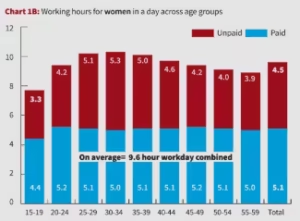
Gender Imbalance in Time Use
- Men devote over 80% of their work hours to paid employment, while women spend nearly half on unpaid tasks.
- Women sleep 2–2.5 hours less per week than men during prime working years.
- Women spend 10–12 hours less per week on self-development activities such as skill-building, learning, and personal well-being.
Economic Impact
- Women contribute only 17% of India’s GDP, not due to lack of effort but because unpaid labour is invisible in national accounts.
- Household responsibilities are the main reason cited by women outside the labour market.
- Rising female participation is often in unpaid family work or low-paid self-employment, limiting economic empowerment.
- AI-driven automation could disproportionately affect women’s jobs, while performance metrics may penalise caregivers with time constraints.
Policy and Structural Solutions
- Redesign workplaces and technology around women’s time constraints.
- Use time-use data to free women’s hours from unpaid work and redirect them to remunerative activities.
- Expand gender budget allocations for time-saving infrastructure: affordable childcare, elder care, piped water, clean energy, and safe transport.
- Provide lifelong, flexible upskilling opportunities tailored to women’s mobility and digital access.
- Scale initiatives like the India AI Mission and AI Careers for Women to strengthen vocational and digital skills.
Conclusion
Women’s invisible labour and time poverty limit their ability to benefit from AI-driven opportunities. Unless policies value and free women’s time while ensuring access to flexible upskilling, India’s vision of Viksit Bharat 2047 will remain incomplete.
EXPORT CONCENTRATION AND ITS IMPLICATIONS IN INDIA
TOPIC: (GS3) ECONOMY: THE HINDU
Latest RBI State-wise export data shows that India’s exports are increasingly dominated by a small group of States, raising concerns about regional imbalance.
Uneven Distribution of Exports
- India’s export growth is not evenly spread, as five States—Maharashtra, Gujarat, Tamil Nadu, Karnataka, and Uttar Pradesh—contribute nearly 70% of total exports.
- This concentration has increased over time, indicating that export activity is becoming more clustered rather than geographically diversified.
- National-level export figures hide the widening gap between export-performing States and lagging regions.
Emergence of a Core–Periphery Structure
- Coastal western and southern States are increasingly integrated into global supply chains due to better ports, infrastructure, and industrial ecosystems.
- Northern and eastern hinterland States are gradually getting disconnected from export-driven growth.
- Instead of backward regions catching up, regional inequality is becoming structurally entrenched.
Changing Nature of Global Trade
- Global merchandise trade growth has slowed significantly, limiting opportunities for new entrants.
- International investors now prefer economies with high economic complexity, advanced logistics, and technological depth rather than just cheap labour.
- This shift reduces the scope for labour-intensive manufacturing, which earlier helped countries industrialise.
Capital-Intensive Export Growth
- Export expansion in India is increasingly driven by automation and high capital investment.
- ASI data shows that capital formation is rising faster than employment, indicating capital deepening.
- The increase in fixed capital per worker means fewer jobs are created per unit of output.
Weak Link Between Exports and Employment
- Manufacturing’s share in total employment has remained stagnant at around 12%, even during periods of strong export growth.
- High-growth export sectors such as electronics and petrochemicals are highly automated and region-specific.
- As a result, export growth is generating value without generating large-scale employment.
Financial and Credit Imbalances
- Export-oriented States show high Credit–Deposit ratios, indicating effective recycling of local savings into local industries.
- Hinterland States have low Credit–Deposit ratios, meaning their savings are often invested in developed regions.
- This financial imbalance further restricts industrial growth in poorer States.
Exports Reflect Capacity, Not Transformation
- Exports are increasingly an outcome of existing industrial strength and institutional capacity, rather than a tool for development.
- States that already possess infrastructure, skilled labour, and financial depth are able to export more.
- Relying solely on export growth as a measure of development can therefore be misleading and exclusionary.
India’s Initiatives to Develop Every State as an Export Hub
- Districts as Export Hubs (DEH) Initiative aims to identify at least one export-potential product in every district and promote local exports.
- One District One Product (ODOP) encourages States to specialise in unique local products such as agricultural produce, handicrafts, and MSME goods for exports.
- Foreign Trade Policy (FTP) 2023 focuses on decentralised export promotion by empowering States and districts as active partners in trade growth.
- State Export Promotion Committees have been set up to prepare State-specific export action plans aligned with national trade goals.
Conclusion
India’s export story highlights a structural shift where growth is capital-driven, regionally concentrated, and weakly linked to employment. Addressing this challenge requires strengthening human capital, financial inclusion, and infrastructure in lagging States, rather than focusing only on export numbers.
KUTTANAD WETLAND AGRICULTURAL SYSTEM
TOPIC: (GS3) ENVIRONMENT: THE HINDU
Recent soil testing in the Kuttanad paddy fields of Kerala revealed rising aluminium levels, raising concerns about soil health and crop productivity in this globally recognised agricultural heritage system.
About Kuttanad Wetland Agricultural System
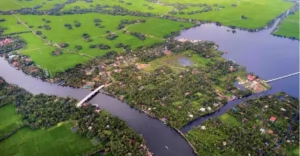
- Kuttanad is the only region in India where rice is cultivated below sea level.
- The system is a mosaic of three distinct landscapes:
- Wetlands used for paddy cultivation and fishing.
- Garden lands for coconut, tubers, and food crops.
- Water bodies for inland fishing and shell collection.
- It represents a traditional, community-managed farming practice adapted to wetland ecology.
Recognition
- The Kuttanad Below Sea-level Farming System is recognised as part of the Globally Important Agricultural Heritage Systems (GIAHS) by the Food and Agriculture Organization (FAO).
- This recognition highlights its cultural, ecological, and economic significance.
Impact of Aluminium on Soil and Crops
- Aluminium becomes toxic when soil pH falls below 5.
- Excess aluminium damages plant roots, reducing their ability to absorb essential nutrients like phosphorus, calcium, potassium, and magnesium.
- This leads to poor crop growth and declining yields, threatening food security in the region.
About Globally Important Agricultural Heritage Systems (GIAHS)
- Launched by FAO in 2002 at the World Summit for Sustainable Development.
- Aims to balance conservation, sustainable adaptation, and socio-economic development.
- India’s recognised GIAHS sites include:
- Koraput region (Odisha): Known for subsistence paddy farming on highland slopes.
- Kuttanad system (Kerala): Unique below-sea-level rice cultivation.
- Saffron Park (Kashmir): Traditional saffron-based agro-pastoral system.
Conclusion:
The rising aluminium concentration in Kuttanad soils poses a serious challenge to its globally valued farming system. Protecting soil health and ensuring sustainable practices are essential to preserve this heritage landscape and its contribution to food security.
GHOSTPAIRING
TOPIC: (GS3) SCIENCE AND TECHNOLOGY: THE HINDU
The Indian Computer Emergency Response Team (CERT-In) has recently warned about a new cyber threat called GhostPairing, which targets WhatsApp users and allows hackers to secretly take control of accounts.
About GhostPairing
- GhostPairing is a WhatsApp-specific cyber attack where hackers connect their device to a victim’s account.
- It gives attackers near-complete access to messages, contacts, and account activity without the victim’s knowledge.
- Unlike older methods, it does not require passwords or SIM card swaps.

Modus Operandi
- Victims receive a message from a familiar contact saying: “Hi, check this photo.”
- The message contains a fake link with a Facebook-style preview.
- Clicking the link redirects to a fraudulent Facebook viewer that asks users to “verify” to see the content.
- Victims are tricked into entering their phone number and pairing code.
- Once entered, hackers gain full access to the WhatsApp account.
Risks and Implications
- Hackers can read private chats, impersonate victims, and misuse accounts for fraud.
- The attack highlights growing social engineering threats in India’s digital ecosystem.
- CERT-In’s advisory stresses the need for awareness and caution while clicking unknown links or sharing codes.
Conclusion:
GhostPairing shows how cybercriminals exploit trust and social engineering to bypass security. Stronger digital hygiene, user awareness, and timely reporting are essential to safeguard WhatsApp accounts and prevent such attacks.
MARS ATMOSPHERE AND VOLATILE EVOLUTION (MAVEN) MISSION
TOPIC: (GS3) SCIENCE AND TECHNOLOGY: THE HINDU
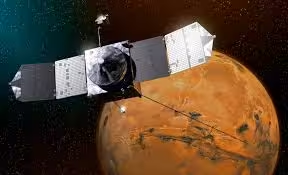
NASA recently reported loss of contact with the MAVEN spacecraft, which has been orbiting Mars for over a decade to study how the planet’s atmosphere escapes into space.
About MAVEN Mission
- MAVEN is the first mission dedicated to studying the upper atmosphere of Mars.
- It is part of NASA’s Mars Exploration Program, aimed at understanding the planet’s habitability and climate changes.
- The mission investigates how the loss of atmospheric gases to space influenced Mars’s transition from a warm, wet planet to the cold, dry world we see today.
Launch and Orbit
- Launched in November 2013 and reached Mars in September 2014.
- Orbits Mars every 3.5 hours, coming as close as 150 km to the surface.
Scientific Instruments
- Solar Wind Package: Studies how solar wind interacts with Mars’s ionosphere, stripping away its atmosphere due to the absence of a magnetic field.
- Ultraviolet Spectrometer: Examines the composition and behaviour of the upper atmosphere.
- Mass Spectrometer: Analyses the chemical makeup of atmospheric particles.
Key Findings
- MAVEN discovered that Mars has lost nearly two-thirds of its early atmosphere to space.
- This loss explains why Mars shifted from a potentially habitable environment to its current barren state.
Conclusion:
MAVEN has been central to understanding Mars’s atmospheric evolution. The recent communication loss underscores the importance of maintaining long-term planetary missions to unravel the mysteries of habitability beyond Earth.