

Recently, the tragic death of three adolescent girls in Ghaziabad highlighted the growing and neglected crisis of child and adolescent mental health in India, worsened by early vulnerabilities and the unregulated digital environment.
Rising Mental Health Concerns
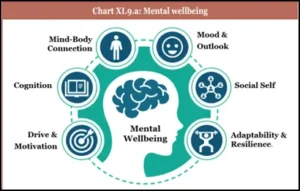
- Mental health challenges are no longer limited to adults; anxiety, depression, ADHD, and behavioural issues are increasingly seen in younger children.
- Early trauma, neglect, and chronic stress disrupt emotional development, resurfacing during adolescence.
- Comorbidities are common — e.g., ADHD with anxiety, depression with compulsive digital use.
Extent of the Problem
- National surveys suggest 7–10% of adolescents have diagnosable mental health conditions.
- 5–7% of school-aged children show ADHD symptoms.
- India faces an acute shortage of specialists — fewer than 10,000 psychiatrists, with only a small fraction trained in child psychiatry.
- Families often navigate fragmented care without adequate support.
Digital Environment and Screen Exposure
- Over 800 million Indians, including children, use smartphones and low-cost internet.
- Excessive screen use leads to sleep disruption, irritability, social withdrawal, and internet addiction.
- WHO guidelines caution against prolonged screen exposure due to its impact on attention, emotional regulation, and wellbeing.
- While not causing neurodevelopmental disorders, excessive digital use worsens existing symptoms and delays diagnosis.
Role of Families and Communities
- Parents are the first mental health buffer, observing early changes in mood, sleep, or behaviour.
- Trauma-informed parenting and listening without judgement can improve outcomes.
- Support groups for parents and adolescents reduce isolation and build resilience.
Schools as a Weak Link
- Academic performance dominates priorities, while emotional wellbeing is neglected.
- Stress, competition, and rankings overshadow mental health initiatives.
- Teachers and paediatricians often miss early signs due to lack of structured training.
Way Forward
- Strengthen School-Based Interventions: Introduce routine screening, train teachers and counsellors, and integrate mental wellbeing into daily learning.
- Expand Mental Health Infrastructure: Increase funding, train child specialists, and improve referral pathways through programmes like Ayushman Bharat and tele-mental health.
- Promote Healthy Digital Practices: Establish clear guidelines on screen use, regulate adolescent social media exposure, and encourage balanced offline engagement.
Conclusion
India’s adolescent mental health crisis is a public health imperative. Addressing it requires coordinated action across families, schools, healthcare systems, and policy frameworks. Childhood must be seen as a stage for wellbeing, resilience, and connection, not just academic competitiveness.
Recently, at India Energy Week 2026, Prime Minister Narendra Modi highlighted India’s push towards energy independence, with green hydrogen and its derivative green ammonia emerging as key drivers of the transition.
What is Green Ammonia?
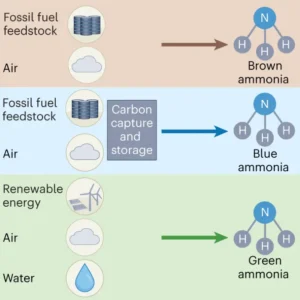
- Hydrogen produced by splitting water into hydrogen and oxygen through electrolysis powered by renewable energy (solar, wind, hydro).
- Clean Energy Source: Unlike grey hydrogen (from fossil fuels), green hydrogen has near-zero carbon emissions.
- Role in Energy Transition: Helps reduce dependence on fossil fuels and supports global climate goals.
Global Context
- EU’s H2Global auction for green ammonia under its hydrogen import strategy.
- South Korea’s CHPS tender for clean ammonia procurement.
- India’s SECI auction under the SIGHT programme has set new benchmarks in cost competitiveness.
India’s Green Ammonia Auction (SECI – SIGHT Programme)
- Tender Process: Initiated in June 2024 under SECI for supply to fertilizer plants.
- Market Certainty: Offered 10-year fixed-price offtake agreements, ensuring stability for producers and buyers.
- Price Discovery: Green ammonia prices discovered in the range of ₹49–65/kg.
- Support Mechanisms: Subsidies granted in the initial years to reduce production costs and support scale-up.
- Logistics Advantage: Delivery points identified near coastal fertilizer plants, facilitating transport through shipping.
- Reduced dependence on volatile global gas markets and enhanced supply chain resilience.
Significance
- Contracts cover nearly 30% of India’s ammonia imports, reducing dependence on volatile global gas markets.
- Provides price predictability and shields against currency risks and geopolitical pressures.
- Positions India as a global leader in clean ammonia markets due to low renewable energy costs, strong logistics, and robust contract design.
Challenges
- Risk allocation, payment security, and pricing clarity required multiple revisions during tendering.
- Need for stable regulations on grid access, banking, and certification.
- Long-term viability depends on technical due diligence, hybrid renewable integration, and transparent monitoring frameworks.
Way Forward
- Strengthen Policy Support: Harmonised regulations, safety standards, and global certification alignment.
- Enhance Financing Models: Long-tenor blended finance, extended offtake agreements, and risk-mitigation instruments to attract private capital.
- Scale-Up Infrastructure: Invest in renewable energy, storage, and logistics to sustain large-scale green ammonia production and delivery.
The independence of the Election Commission (EC) has come under debate following controversies over voter list revisions and the 2023 Act on appointment of Election Commissioners, which replaced the earlier 1991 Act.
Constitutional Basis
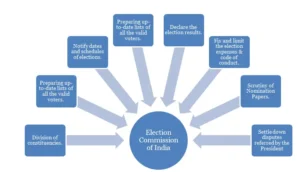
- Article 324: Provides for a permanent EC with powers of superintendence, direction, and control of elections.
- Adult Franchise (Article 326): Right to vote is the bedrock of democracy; any irregularity undermines its sanctity.
- Removal Safeguards:
- CEC can be removed only like a Supreme Court judge (Article 124(4)) — on grounds of misbehaviour or incapacity.
- Other Commissioners can be removed by the President on advice of the CEC.
- Conditions of Service: Cannot be varied to the disadvantage of the CEC during tenure.
Appointment Controversy
- 2023 Act: Selection committee includes PM, a Union Minister, and Leader of Opposition.
- Supreme Court (Anoop Baranwal case, 2023): Had directed inclusion of the Chief Justice of India in the committee.
- Exclusion of CJI in the 2023 Act raised concerns about executive dominance.
- Act challenged in Jaya Thakur vs Union of India (2024); hearing scheduled for March 2026.
Safeguards for Independence
- Multi-member Commission: Made permanent in 1993; validated in T.N. Seshan vs Union of India (1995).
- Removal Procedure:
- Requires motion signed by 100 Lok Sabha members or 50 Rajya Sabha members.
- Three-member inquiry committee (CJI/SC judge, HC Chief Justice, and a jurist).
- Ensures natural justice and fair hearing.
- Judicial Oversight: Supreme Court rulings (e.g., Vineet Narain case, 1997) balance executive power and EC independence.
Challenges
- Allegations of voter list manipulation during SIR, especially targeting minorities.
- Perception of bias and politicisation of EC decisions.
- Executive influence in appointments under the 2023 Act.
- Opposition’s move to remove the CEC unlikely to succeed due to ruling majority.
Way Forward
- Strengthen Appointment Process: Ensure inclusion of judiciary in selection committee to safeguard neutrality.
- Enhance Transparency: Make voter list revisions and EC decisions more open to public scrutiny.
- Depoliticise Institutions: Respect constitutional bodies across party lines to maintain credibility of democracy.
Conclusion
The independence of the Election Commission is central to free and fair elections, part of the Basic Structure of the Constitution. Any dilution of safeguards risks undermining public trust in democracy.
WhatsApp informed the Supreme Court that it does not share user data with its parent company Meta, and will comply with NCLAT directions on user consent by March 2026.
Background of the Case
- CCI Findings (2021): WhatsApp’s “take-it-or-leave-it” privacy policy forced users to share data with Meta. Found to be an abuse of market dominance.
- NCLAT Ruling (2025): Upheld the penalty but emphasized user choice and consent. Non-essential data collection (like advertising) requires express and revocable consent.
- Supreme Court Proceedings (2026): Bench cautioned against violation of the right to privacy.
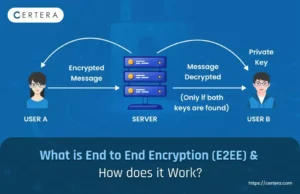
- Compared unauthorized data sharing to a “decent way of committing theft.” WhatsApp submitted affidavit explaining end-to-end encryption technology.
Importance of Citizen Privacy
- Fundamental Right: Privacy recognized as part of Article 21 (Right to Life and Personal Liberty) in Puttaswamy vs Union of India (2017).
- Protection Against Exploitation: Prevents misuse of personal data for commercial gain.
- Trust in Digital Platforms: Ensures users feel secure while using messaging and social media services.
- Democratic Safeguard: Protects citizens from surveillance and manipulation in political or economic contexts.
Challenges
- Market Dominance: Platforms with billions of users can impose unilateral policies.
- Consent Issues: Users often face “forced consent” to continue using essential services.
- Data Exploitation: Risk of personal data being used for targeted advertising and profiling.
- Regulatory Gaps: Enforcement of the Digital Personal Data Protection Act, 2023 is still evolving.
- Competition Concerns: Data-sharing practices can distort markets and harm consumer choice.
Way Forward
- Strengthen Legal Safeguards: Ensure strict enforcement of the DPDP Act, 2023. Mandate clear, informed, and revocable consent for data use.
- Enhance Transparency: Platforms must disclose how data is collected, stored, and shared. Independent audits of privacy practices should be encouraged.
- Balance Privacy and Competition: Regulators must address both privacy violations and market exploitation. Promote fair competition by preventing monopolistic control over user data.
Conclusion
Protecting citizen privacy is not only a constitutional mandate but also essential for consumer trust and democratic integrity. Strong enforcement, transparency, and user-centric policies are crucial to ensure that digital platforms operate responsibly in India’s rapidly growing digital economy.
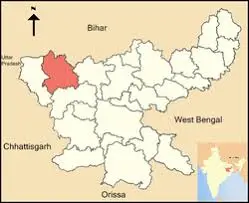
The South Division of Palamu Tiger Reserve has launched a new initiative called “Vanjeevi Didi” in 17 villages to train educated women as PTR ambassadors.
About Palamu Tiger Reserve
- Location: Situated on the Chhotanagpur plateau in Jharkhand.
- Part of: Forms a section of Betla National Park.
- Historical Significance:
- Among the first nine tiger reserves created under Project Tiger.
- First reserve globally where a tiger census using pugmark count was conducted (1932, under J.W. Nicholson).
Physical Features
- Terrain: Undulating landscape with valleys, hills, and plains.
- Rivers: North Koyal, Auranga, and Burha (only perennial river).
- Geology: Gneiss formations with granite and limestone.
- Minerals: Rich in bauxite and coal deposits.
Vegetation & Wildlife
- Vegetation: Moist and dry deciduous forests.
- Flora: Dominated by Sal trees and bamboo.
- Fauna:
- Tigers, Asiatic elephants, leopards, grey wolves, wild dogs.
- Other species: Gaur, sloth bear, four-horned antelope.
Importance
- The programme aims to involve local communities, especially women, in conservation and awareness.
- Ecological Role: Protects biodiversity of eastern India’s dry deciduous forests.
- Community Involvement: New initiatives like Vanjeevi Didi enhance local participation in conservation.
- Tourism Potential: Offers opportunities for eco-tourism and awareness about wildlife protection.
Conclusion
Palamu Tiger Reserve is not only a critical tiger habitat but also a site of historical importance in wildlife census. With community-driven initiatives like Vanjeevi Didi, it is moving towards inclusive conservation and sustainable development