Table of Contents
TogglePM MODI’S VISIT TO ISRAEL
TOPIC: (GS2) INTERNATIONAL RELATIONS: THE HINDU
Prime Minister Narendra Modi is on a two-day visit to Israel (Feb 25–26, 2026), his second after the historic 2017 trip.
Strategic and Security Cooperation
- Defence Partnership
- India is Israel’s largest defence customer (34% of exports between 2020–24).
- Cooperation has moved from imports to joint development (e.g., Barak-8 missile defence system).
- Focus areas: anti-drone systems, missile defence, and advanced surveillance technologies.
- Possible procurement/co-production of Iron Beam (laser-based defence system).
- Technology Collaboration
- Israeli firms partnering with Indian defence companies for sensor-based threat detection.
- Vision for futuristic defence technologies signed in 2022, deepened in 2025.
Science, Technology, and Innovation
- Agriculture: Over 35 Centres of Excellence in India for high-density production of fruits, vegetables, and beekeeping.
- Water Management: Collaboration with Haryana (2022) and Rajasthan (2024) on integrated water resource management.
- AI and Innovation: Future cooperation expected in Artificial Intelligence and modern tech applications.
Economic and Trade Cooperation
- Trade: Bilateral trade reached $3.75 billion (FY 2024–25). Dominated by diamonds, petroleum, and chemicals.
- Agreements: Bilateral Investment Agreement (2025). Terms of Reference for India–Israel FTA signed in Nov 2025.
- Israel keen on Indian participation in infrastructure projects and skilled manpower mobility.
Regional and Strategic Context
- India-Middle East-Europe Economic Corridor (IMEC): Announced at G-20 Summit (2023); stalled due to Gaza conflict. Renewed urgency for secure alternative to Suez Canal route.
- Gaza Peace Process: India attended recent peace summit as observer; role in stabilization may be discussed.
- Regional Balance: Israel proposes a “hexagon of alliances” including India; India’s response will be closely watched.
Challenges
- Ongoing Iran–US tensions and military buildup in Persian Gulf.
- Fragile Gaza ceasefire and regional fault lines pulling UAE and Saudi Arabia into opposing blocs.
- Balancing ties with Israel while maintaining strong relations with Arab nations.
Way Forward
- Strengthen Defence Cooperation: Focus on co-production, technology transfer, and futuristic systems.
- Expand Economic Ties: Push forward the FTA, diversify trade, and enhance infrastructure collaboration.
- Balanced Diplomacy: Continue de-hyphenated approach — engaging Israel while maintaining constructive ties with Palestine and Arab states.
Conclusion
PM Modi’s visit to Israel is more than routine diplomacy. It reflects India’s intent to deepen strategic and economic ties, while carefully balancing regional dynamics. The outcomes could shape India’s role in West Asia and its position in global security and trade frameworks.
INDIA’S TRADE STRATEGY IN A MULTIPOLAR WORLD
TOPIC: (GS2) INTERNATIONAL RELATIONS: THE HINDU
India recently signed the India–EU Free Trade Agreement (Jan 2026) after nearly two decades of negotiations.
India’s Trade Strategy
Foreign Trade Policy (2023): Target: $2 trillion exports by 2030. Framework emphasizes strategic autonomy while engaging major powers.
- Export Growth: Total exports (goods + services) reached $825.25 billion in 2025, a 6.05% annual increase.
- FTA Expansion: Coverage of FTAs projected to reach 71% of export basket by 2026 (up from 22% in 2019).
- Shift from regional trade deals to comprehensive agreements with advanced economies.
Major Agreements
- India–EU FTA (Jan 2026)
- Tariff reduction/elimination on 90% of goods.
- Boosts Indian exports in textiles, leather, pharmaceuticals, chemicals, marine products.
- Enhances competitiveness against Bangladesh and Vietnam.
- Promotes digital trade, regulatory cooperation, and investor confidence.
- India–U.S. Interim Framework (Feb 2026)
- Progressive tariff reduction across sectors.
- Focus on rare earths and semiconductors.
- Supports India’s ambition in electronics and high-tech manufacturing.
Strategic Dimensions
- Market Diversification: Access to lucrative markets in EU, U.S., Australia, UAE, U.K. Reduces dependence on any single geography.
- Supply Chain Integration: FTAs ease movement of intermediate goods. Strengthens competitiveness in technology, electronics, pharmaceuticals, services.
- Diplomatic Leverage: Trade agreements enhance India’s global influence. Positions India as a key voice in shaping trade norms and standards.
Challenges
- Balancing domestic industry protection with global integration.
- Managing competition from low-cost exporters (e.g., Bangladesh, Vietnam).
- Ensuring implementation of FTAs benefits MSMEs and labour-intensive sectors.
Way Forward
- Strengthen Domestic Manufacturing: Continue PLI schemes and infrastructure expansion.
- Promote Services & Digital Trade: Leverage India’s IT and innovation strengths.
- Balanced Diplomacy: Use trade as a tool for both economic growth and strategic influence.
Conclusion
India’s evolving trade strategy reflects its ambition to become a global economic powerhouse in a multipolar world. By expanding FTAs, India is positioning itself as a leading force in global commerce while safeguarding strategic autonomy.
SUPREME COURT AND COW VIGILANTISM CASE
TOPIC: (GS2) POLITY: THE HINDU
On February 23, 2026, the Supreme Court observed that its 2018 guidelines to curb cow vigilantism were “unmanageable” and declined to enforce them.
Background
- 2018 Judgment (Dipak Misra Bench)
- Issued directives to Centre and States to prevent lynching and mob violence in the name of cow protection.
- Stressed that lynching “must be curbed and crippled” and that the state has a sacrosanct duty to protect citizens.
- Current Position (2026)
- CJI Surya Kant stated that each case should be dealt with individually.
- Citizens can seek legal remedies if rights are infringed.
- Court refused contempt action against States despite allegations of voter roll manipulation and vigilante empowerment.
Key Concerns
- Judicial Retreat: Court distancing itself from monitoring implementation of its own guidelines.
- State Complicity: In several States, vigilantes have been given quasi-policing powers.
- Rule of Law: Police often overlook or encourage mob violence, undermining constitutional safeguards.
- Majoritarian Politics: Vigilantism receives political backing, weakening protection for minorities.
Importance of Citizen Privacy & Rights
- Right to Life and Liberty (Article 21): Protection against mob violence is a constitutional guarantee.
- Right to Vote (Article 326): Any irregularity in voter rolls or intimidation undermines democracy.
- Judicial Oversight: Courts must act as guardians of fundamental rights when executive fails.
Challenges
- Implementation Gap: States ignoring Supreme Court directives.
- Politicisation: Vigilantism often receives tacit support from ruling parties.
- Weak Policing: Law enforcement either inactive or complicit.
- Judicial Diffidence: Courts reluctant to enforce accountability.
Way Forward
- Strict Enforcement: Supreme Court must ensure compliance with its own guidelines.
- Police Reform: Strengthen accountability mechanisms to curb mob violence.
- Depoliticisation: End political patronage of vigilante groups.
- Awareness & Community Action: Promote social harmony and discourage mob justice.
Conclusion
The Supreme Court’s reluctance to enforce its 2018 directives on cow vigilantism signals a serious setback to rule of law. Upholding fairness, justice, and accountability is essential for the credibility of Indian democracy.
IMPACT OF RUSSIA UKRAINE WAR ON DOMESTIC ECONOMIES
TOPIC: (GS3) ECONOMY: THE HINDU
The Russia–Ukraine war, which began in February 2022, has entered its fourth year, causing severe economic and social costs.
Economic Impact on Russia
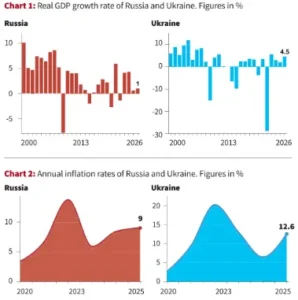
- Sanctions Effect: EU and U.S. sanctions slowed growth — less than 1% in 2025, projected 1% in 2026.
- Inflation: Surged to 14% in 2022, moderated to 5% in 2023, but rose again to 9% in 2025.
- Food Prices:
- Bread prices up 13% in 2026 compared to last year; over 50% higher than five years ago.
- Rice prices up 40% compared to 2022.
- Defence Spending: Accounts for nearly 30% of total expenditure, often disguised under other budget heads.
Economic Impact on Ukraine
- A joint report (World Bank, EU, UN, Ukraine) estimates Ukraine’s reconstruction cost at $558 billion, nearly three times its GDP in 2025.
- GDP Collapse: Contracted by 30% in 2022; modest recovery projected at 4.5% in 2026.
- Debt Burden: Gross government debt at 109% of GDP (2025).
- Food Prices:
- Wheat and maize prices up 15% since 2022.
- Wheat flour rose from 12,633 UAH/tonne (2022) to 14,700 UAH/tonne (2026).
- Defence Spending:
- Consistently more than 50% of national expenditure since 2022.
- Defence share of GDP rose to 26% by 2025.
- Social spending on education, healthcare, and welfare cut by more than half compared to 2021.
Human Cost
- Casualties:
- Russia: 1.2 million killed, wounded, or missing (2022–25).
- Ukraine: 5–6 lakh casualties in the same period.
- Civilian Burden: Rising food prices, reduced social services, and economic instability.
Challenges
- Persistent inflation and food insecurity.
- Budget deficits due to high defence spending.
- Sanctions and isolation limiting Russia’s global trade.
- Ukraine’s dependence on aid and reconstruction financing.
Way Forward
- Economic Diversification: Reduce reliance on defence spending, strengthen agriculture and industry.
- International Support: Aid and reconstruction financing for Ukraine; calibrated sanctions for Russia.
- Food Security Measures: Stabilize essential commodity prices through subsidies and imports.
- Peace Negotiations: Long-term stability depends on ending hostilities and rebuilding trust.
Conclusion
The Russia–Ukraine war has inflicted severe economic and social damage on both nations. Rising food prices, shrinking social spending, and mounting debt highlight the domestic costs of prolonged conflict. Sustainable peace and reconstruction are essential to restore stability in the region.
THE EVOLVING NATURE OF TRADE AGREEMENTS
TOPIC: (GS3) ECONOMY: THE HINDU
The U.S. under President Donald Trump has introduced a new type of trade deal called Agreements on Reciprocal Trade (ARTs).
Categories of Trade Agreements
Multilateral Agreements (WTO/GATT Framework)
- Originated with GATT (1947) and institutionalized by the WTO (1995).
- Based on the Most-Favoured-Nation (MFN) principle, ensuring equal treatment for all members.
- Expanded scope to include goods, services, intellectual property, and dispute settlement mechanisms.
- Provides developing countries with bargaining power through the one-country-one-vote system.
Preferential Trade Agreements (FTAs and Customs Unions)
- Recognized under Article XXIV of GATT as exceptions to MFN.
- Free Trade Areas (FTAs): Must cover “substantially all trade” between members.
- Customs Unions (CUs): Require both “substantially all trade” coverage and a common external trade policy.
- Became popular after the 1980s, with large agreements like RCEP.
- Many are WTO-plus, including rules on labour, environment, and investment protection.
- Criticized for imposing additional obligations on developing nations but remain subject to WTO scrutiny.
Agreements on Reciprocal Trade (ARTs)
- Introduced by the Trump administration, outside WTO/GATT framework.
- Legally questionable as they are not notified to WTO.
- Imposed under threat of unilateral tariffs, coercing partner countries.
- Contain one-sided provisions favouring U.S. interests:
- Example: U.S.–Bangladesh ART requires Bangladesh to adopt restrictive measures if the U.S. does so.
- Example: U.S.–El Salvador ART restricts data sovereignty by banning customs duties on electronic transactions.
- Lack transparency and global scrutiny, undermining multilateral trade norms.
Challenges
- Weakening of Multilateralism: Agreements on Reciprocal Trade (ARTs) bypass the principles of the WTO. They undermine the global system of non-discriminatory trade established under GATT and WTO.
- Legal Uncertainty: ARTs are not covered under GATT provisions such as Article XXIV. Their lack of institutional linkage with WTO makes them legally questionable.
- Unequal Bargaining Power: Smaller and developing economies are pressured into accepting one-sided terms.
- Threats to Digital Sovereignty: ARTs impose restrictions on partner countries’ control over electronic commerce.
Way Forward
- Strengthen WTO Oversight: Ensure that all trade agreements are notified to the WTO.
- Collective Resistance by Developing Nations: Countries should coordinate and resist coercive ARTs. Building alliances can help protect their trade interests.
- Promote Balanced FTAs: Encourage agreements that integrate fairly into global value chains.
- FTAs should benefit both developed and developing economies without imposing unfair obligations.
- Safeguard Digital and Policy Autonomy: Nations must protect their right to regulate electronic commerce. Trade negotiations should preserve sovereignty in digital and data-related policies.
Conclusion
For India and other developing nations, protecting strategic autonomy, fair trade practices, and digital sovereignty is essential to ensure trade agreements remain instruments of cooperation rather than coercion.
DPDP ACT AND RTI ACT CONTROVERSY
TOPIC: (GS2) POLITY: THE HINDU
The Supreme Court has referred petitions challenging the amendment to the RTI Act (via Section 44(3) of the DPDP Act, 2023) to a Constitution Bench.
Background
- The amendment gives a blanket exemption to personal information, raising concerns about transparency and accountability.
- RTI Act, 2005: Ensures citizens’ right to access information from public authorities.
- Section 8(1)(j) (original): Allowed denial of personal information unless disclosure served a larger public interest.
- DPDP Act, 2023: Passed to protect personal data after Puttaswamy (2017) judgment recognized privacy as a fundamental right.
- Amendment: Section 44(3) of DPDP Act modifies RTI Act, removing the “public interest” exception and giving blanket protection to personal information.
Issues and Controversy
- Erosion of Transparency: Citizens may be denied access to information about public officials’ assets, liabilities, or spending records.
- Conflict of Rights: Privacy (Article 21) vs. Right to Information (Articles 19 & 21). Earlier balance allowed disclosure if public interest outweighed privacy concerns.
- Blanket Exemption Problem: Even procurement records, audit reports, or public spending could be rejected as “personal information.” Weakens accountability of government institutions.
Importance of RTI
- Strengthened citizen empowerment and democratic accountability.
- Helped uncover corruption and irregularities in public offices.
- Integral to fundamental rights of free speech and liberty.
Way Forward
- Judicial Guidelines: Supreme Court may define what qualifies as “personal information.” Ensure proportional balance between privacy and transparency.
- Repeal or Modify Amendment: Restore earlier RTI provision allowing disclosure in larger public interest.
- Balanced Approach: Protect genuine privacy concerns but prevent misuse of exemption to hide corruption.
- Adopt safeguards ensuring transparency in matters of public spending and official accountability.
Conclusion
The DPDP Act’s amendment to the RTI Act risks diluting transparency by shielding personal information without exception. A balanced framework protecting privacy while allowing disclosure in public interest is essential to uphold both citizens’ right to know and right to privacy.
HPV VACCINATION DRIVE IN INDIA
TOPIC: (GS2) SOCIAL JUSTICE AND HEALTH: THE HINDU
The Government of India has announced a free HPV vaccination programme to be rolled out at designated public health facilities.
What is HPV?
- Human Papillomavirus (HPV) is a group of viruses, some of which cause infections that can lead to cervical cancer.
- HPV spreads through sexual contact and is a major risk factor for cervical cancer.
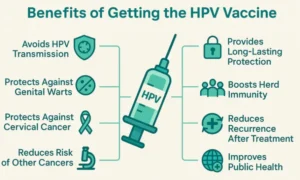
- Vaccination prevents HPV infection before it progresses to cancer.
Why is HPV Vaccination Necessary?
- Cervical Cancer Burden: Nearly 80,000 new cases annually in India.
- Preventable Disease: Vaccination and early screening can significantly reduce incidence.
- Effectiveness: HPV vaccines show 93–100% protection against cancer-causing HPV types.
- Safety Record: Non-live vaccine, does not cause infection; over 500 million doses administered globally since 2006.
Disease Burden in India
- Cervical cancer is the second most common cancer among women in India.
- Causes significant health, social, and economic burden on families.
- Limited awareness and screening contribute to high incidence and mortality.
Global Context
- Over 90 countries have adopted single-dose HPV vaccination schedules.
- This improves affordability, coverage, and accessibility.
Conclusion
The free HPV vaccination programme is a landmark public health initiative. By preventing HPV infections, India can drastically reduce cervical cancer cases, save thousands of lives, and strengthen women’s health outcomes.
PSLV FAILURES AND ISRO PROBE COMMITTEE
TOPIC: (GS3) SCIENCE AND TECHNOLOGY: THE HINDU
ISRO has constituted a national-level expert committee to investigate repeated failures of the Polar Satellite Launch Vehicle (PSLV), including the recent PSLV-C62 mission (Jan 2026).
Background
- PSLV-C62 Failure (Jan 2026): The rocket failed after its third stage did not ignite, leading to the loss of 16 satellites.
- PSLV-C61 Failure (May 2025): A similar third-stage ignition failure destroyed the EOS-09 satellite.
- Traditionally, ISRO’s Failure Analysis Committees investigate technical causes, but this new panel will also probe manufacturing, procurement, and assembly processes.
- The involvement of the National Security Adviser highlights the strategic importance of PSLV missions.
Technical Causes
- Third Stage Ignition Failure: In both missions, the PS3 stage (third stage) failed to ignite properly.
- Uncontrolled Roll and Flight Path Deviation: In PSLV-C62, disturbances in the rocket’s roll rates caused uncontrolled spinning. This deviation from the flight path made satellite deployment impossible.
- Recurring Stage-Specific Issues: The near-identical failures in C61 and C62 point to systemic flaws in the third-stage design, integration, or quality control
Challenges
- Recurring Technical Failures: Similar stage ignition problems in consecutive missions suggest deeper systemic flaws.
- Organizational Weaknesses: Possible lapses in procurement, quality control, and coordination across teams.
- Accountability Issues: With private companies now part of India’s space ecosystem, responsibility for failures is harder to fix.
- Transparency Concerns: Unlike earlier practice, failure reports have not been made public, reducing trust in ISRO’s processes.
- Strategic Setback: PSLV is India’s most reliable launcher; repeated failures affect credibility and delay key missions.
Way Forward
- Strengthen quality control and independent audits in manufacturing and procurement.
- Establish a clear accountability framework for both public and private partners.
- Ensure transparent reporting of failure analysis to maintain public confidence.
- Diversify launch options by accelerating development of SSLV and GSLV Mk-III.
- Introduce systemic reforms in organizational processes to prevent recurrence.
Conclusion
The PSLV failures underline the need for structural reforms in ISRO’s processes beyond technical fixes. Ensuring accountability, transparency, and robust quality checks will be vital to sustain India’s reputation as a reliable space power and safeguard its strategic missions.