
POLICY CONSTRAINTS TO MANUFACTURING IN INDIA
TOPIC: (GS3) ECONOMY: THE HINDU
India’s slow manufacturing growth highlighting structural weaknesses, wage policies, and competitiveness issues. This has raised concerns about whether India can build a strong industrial base to support jobs and exports.
India’s Manufacturing Performance
- Manufacturing contributes about 16–17% of India’s GDP, but its share has remained stagnant while services dominate with nearly 55%.
- Industrial growth exists in pockets, yet it has not generated largescale jobs or technological upgrading, unlike East Asian economies.
- Absorption of lowskilled labour from agriculture is limited, leading to informal employment and underemployment.
- Latest figures (Q2 FY 2025–26) show manufacturing GVA at ₹7.87 lakh crore (constant prices), up 9.1% yearonyear, but the sector still lags in scale and sophistication compared to global peers.
Role of Public Sector Wages
- High government salaries attracted workers away from manufacturing, raising economywide wages.
- Manufacturing firms with lower productivity struggled to match these wages, reducing competitiveness.
- Higher public sector incomes increased demand and prices, making domestic goods less competitive against imports.
- Over time, this wage dynamic discouraged industrial expansion and scaling up.
Dutch Disease Analogy
- Traditionally, Dutch disease refers to resource booms raising wages and hurting manufacturing exports.
- In India, the expansion of highwage government services created similar effects.
- Domestic prices rose, real exchange rates appreciated, and imports became cheaper.
- This weakened demand for locally produced goods and reduced incentives for manufacturing growth.
Technology and Productivity Constraints
- Economic theory suggests high wages can push firms to innovate and adopt laboursaving technologies.
- In India, firms did not invest enough in technology or capitalintensive production.
- Reliance on cheap labour limited productivity growth and prevented movement up the value chain.
- As a result, manufacturing could not sustain higher wages or compete globally.
Uneven Growth and Rising Inequality
- Services grew strongly, but wage growth for many workers remained weak.
- Entrylevel wages in IT and platform services stagnated despite sectoral expansion.
- Many startups relied on labour reserves rather than genuine innovation.
- This pattern contributed to rising inequality and limited mass employment creation.
Policy Implications
- India risks premature deindustrialisation, where services dominate before manufacturing matures.
- This limits job creation for semiskilled workers and constrains export diversification.
- Policy must focus on raising productivity, encouraging technology adoption, and aligning wages with productivity.
- Investments in skills, infrastructure, and industrial clusters are essential to revive manufacturing as a driver of inclusive growth.
Conclusion
India’s manufacturing stagnation reflects deeper structural and policy challenges. Without decisive reforms in productivity, technology, and wage alignment, India risks missing the opportunity to build a strong industrial base. Reviving manufacturing is critical for inclusive growth, employment generation, and longterm economic resilience.
BUREAU OF PORT SECURITY
TOPIC: (GS3) SEQURITY: THE HINDU
The Union government has set up the Bureau of Port Security (BoPS) as a statutory body under the Merchant Shipping Act, 2025 to improve maritime and port security. This marks India’s first dedicated regulator for port safety and coastal security.
About India’s coastline
- India’s coastline stretches over 7,500 km and supports a fastgrowing maritime economy. With 12 major ports and more than 200 nonmajor ports.
- While this growth has boosted trade and logistics, it has also increased risks of smuggling, terrorism, cyberattacks, and illegal migration, making secure ports a national priority.
Need for a Dedicated Authority
- Earlier, port security was divided among the Navy, Coast Guard, CISF, state maritime police, and port authorities.
- This fragmented system led to gaps in coordination, duplication of work, and uneven enforcement of standards.
- The government recognised the need for a nodal regulator, similar to the Bureau of Civil Aviation Security, to oversee maritime security.
Mandate and Structure of BoPS
- Constituted under Section 13 of the Merchant Shipping Act, 2025.
- Functions under the Ministry of Ports, Shipping and Waterways.
- Focuses on regulatory oversight, compliance, and coordination rather than direct operations.
- Covers both major and nonmajor ports, ensuring uniform standards across the country.
Key Functions
- Addresses threats such as terrorism, arms and drug trafficking, human trafficking, piracy, and poaching.
- Ensures compliance with the International Ship and Port Facility Security (ISPS) Code.
- Special focus on cybersecurity, protecting digital port infrastructure in coordination with national cyber agencies.
Role of CISF
- CISF designated as the recognised security organisation under BoPS.
- Responsible for preparing standardised security plans, conducting assessments, and training private security agencies.
- Security measures will be riskbased, balancing safety with ease of doing business.
Maritime Growth and Strategic
- Cargo handled at ports rose from 974 million tonnes in 2014 to nearly 1,600 million tonnes in 2025.
- Ship turnaround time has halved, coastal shipping has doubled, and inland waterway cargo has grown eightfold.
- BoPS supports Maritime India Vision 2030, which aims for worldclass port infrastructure, green shipping, and secure maritime trade.
Concerns and Criticism
- Some coastal states fear increased Union control over nonmajor ports, raising federalism concerns.
- Wide inspection powers under new port laws have drawn criticism, though these relate to broader legislation rather than BoPS directly.
Conclusion
The Bureau of Port Security is a major step toward integrated coastal security and safe maritime trade. By standardising security, addressing cyber threats, and coordinating multiple agencies, BoPS strengthens India’s maritime governance. However, balancing central oversight with state concerns will be crucial for its longterm success.
KARBI ANGLONG VIOLENCE AND ETHNIC TENSIONS
TOPIC: (GS2) INDIAN POLITY: THE HINDU
Violence in West Karbi Anglong district of Assam has led to deaths, injuries, arson, and suspension of internet services. The unrest is linked to disputes over encroachment on grazing reserve lands under the Karbi Anglong Autonomous Council (KAAC).
Trigger of Violence
- Karbi Anglong, a Sixth Schedule tribal district in Assam, has long faced tensions over land rights and autonomy.
- Nine Karbi protesters staged a hunger strike demanding eviction of alleged encroachers from Professional Grazing Reserve (PGR) and Village Grazing Reserve (VGR) lands.
- These lands, reserved since colonial times for livestock grazing, are vital for tribal livelihoods.
- When protesters were shifted to Guwahati for medical care, locals believed they were arrested, sparking stonepelting, arson, and escalation of violence.
Background of the Dispute
- Sixth Schedule Autonomy: Karbi Anglong and West Karbi Anglong are governed by KAAC, which controls land, forests, and local governance to protect tribal identity.
- Insurgency Legacy: Since the 1980s, Karbi insurgent groups demanded a separate state, later moderated to greater autonomy. This history has deepened mistrust of outsiders.
The Land Question – PGR and VGR
- Encroachment Allegations: Tribal groups claim largescale illegal settlement on grazing lands.
- Settler Claims: Nontribal communities (Biharis, Bengalis, Nepalis) argue they have lived there for decades and seek regularisation.
- Examples: KAAC identified nearly 1,983 families encroaching in Hawaipur mouza and 103 families in Phuloni circle.
- Political Flashpoint: A memorandum by a Bihari Nonia organisation to the President demanding legalisation of settlers was seen by Karbi groups as undermining Sixth Schedule protections.
Legal Constraints on Evictions
- KAAC issued eviction notices but action was halted due to a PIL in Gauhati High Court.
- Authorities cited contempt of court risks if evictions were carried out during judicial review.
Challenges and Way Forward
- Customary vs Settler Claims: Need for transparent rehabilitation or relocation policy for longsettled nontribals.
- Weak Sixth Schedule Enforcement: Strengthen KAAC’s capacity to manage land and resolve disputes.
- Judicial Delays: Ensure timebound resolution of landrelated PILs.
- Community Mistrust: Build dialogue between tribal bodies, settlers, and administration.
- Risk of Ethnic Polarisation: Introduce early warning systems and community policing to prevent escalation.
Schedule 5 – Tribal Areas in Other States
- Purpose: Provides special provisions for the administration and control of Scheduled Areas and Scheduled Tribes in states other than the NorthEast.
- Who governs: The Governor of the State has special powers to make regulations for peace and good governance in these areas.
- Role of President: The President of India declares which areas are “Scheduled Areas.”
- States covered: Andhra Pradesh, Telangana, Chhattisgarh, Jharkhand, Madhya Pradesh, Odisha, Rajasthan, Gujarat, Maharashtra, Himachal Pradesh
- Key features:
- Protection of tribal land and resources.
- Restriction on transfer of tribal land to nontribals.
- Special Tribal Advisory Councils to advise on welfare and development.
Schedule 6 – Tribal Areas in NorthEast India
- Purpose: Provides greater autonomy to certain tribal areas in the NorthEast through Autonomous District Councils (ADCs).
- Who governs: Councils have powers to make laws on land, forest, water, agriculture, village administration, and social customs.
- States covered: Assam, Meghalaya, Tripura, Mizoram
- Key features:
- Autonomous District Councils elected by tribal communities.
- Councils can levy taxes, regulate land, and manage local resources.
- Governor has supervisory powers but councils enjoy significant selfrule.
- Aim is to protect tribal culture, traditions, and ensure selfgovernance.
Conclusion
The Karbi Anglong violence highlights the sensitive interplay of tribal autonomy, land rights, and demographic pressures in Sixth Schedule areas. Without legal clarity, inclusive governance, and participatory conflict resolution, such disputes may recur, threatening peace and internal security in Northeast India.
TUNNEL SAFETY GUIDELINES LESSONS FROM THE SILKYARA COLLAPSE
TOPIC: (GS2) INDIAN POLITY: THE HINDU
The collapse of the Silkyara Bend–Barkot Tunnel in Uttarakhand on November 12, 2023, which trapped 41 workers for 17 days, exposed serious gaps in tunnel planning and safety. In response, the Ministry of Road Transport and Highways (MoRTH) has issued new guidelines to strengthen tunnel safety, especially in Himalayan and border projects.
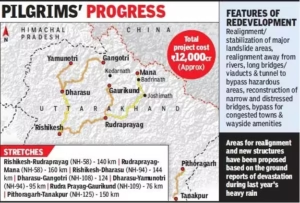
Silkyara Bend–Barkot Tunnel
- Tunnels are vital for connectivity in mountainous, snowbound, and border regions.
- With India’s highway expansion under projects like Char Dham, tunnelling activity has increased, raising risks of geological instability and safety failures.
- The Silkyara incident has become a turning point for adopting riskbased engineering and stronger safety standards.
Key Provisions of the New Guidelines
Strengthening Planning and Risk Assessment
- Detailed Project Reports (DPRs) must be scientific and datadriven, not mere formalities.
- Mandatory Geotechnical Baseline Report (GBR) and risk register to identify hazards and mitigation measures.
- Risk allocation principle: responsibility lies with the party best equipped to manage it.
- Transparency ensured by sharing GBR and risk register with bidders.
Geological Realities and Design Challenges
- Tunnel design must account for ground behaviour, which acts as a natural support system.
- Special conditions to be assessed include squeezing/swelling ground, rock bursts, shallow cover zones, tunnels under streams, hot water ingress, and toxic gases.
- Poor geological investigations often lead to delays, cost escalation, and safety failures.
Tunnelling Technologies
- NATM (New Austrian Tunnelling Method): Flexible “designasyougo” approach, suitable for complex rock conditions.
- TBM (Tunnel Boring Machine): Effective in uniform geology but requires vigilance against roof collapse and water ingress.
Collapse Risk Zoning and Safety Infrastructure
- Tunnels to be classified into risk zones.
- Highrisk tunnels must have escape pipes, mobile rescue containers, fixed rescue shelters, and survival capacity for at least 24 hours.
Emergency Response and Human Capacity
- Shift managers to be trained as first responders.
- Emergency Response Plan (ERP) to be prepared in advance and updated weekly.
India’s Tunnel Infrastructure Snapshot
- 42 tunnels (60.37 km) completed in 27 projects.
- 57 tunnels (93.96 km) under construction in 37 projects.
- 3 tunnels (9.68 km) approved at a cost of ₹1,962 crore.
- A major 6lane project in Maharashtra with 2 tunnels costing ₹4,501 crore has been cleared.
Challenges and Way Forward
- Weak DPR quality requires institutionalised scientific methods.
- Complex Himalayan geology demands realtime monitoring.
- Emergency preparedness must be strengthened with regular safety audits.
- Clear role definition needed during rescues for district administration, construction agencies, NDRF/SDRF, and Armed Forces.
- Guidelines should serve as a model for other sectors like metros and hydropower.
Conclusion
The Silkyara collapse highlighted the urgent need for riskbased engineering and stronger safety governance. MoRTH’s new guidelines emphasise geological realism, accountability, and human safety. Effective implementation will be critical to ensure that India’s push for strategic connectivity and infrastructure growth does not compromise lives or sustainability.
INDIA’S FDI TRENDS AND U.S. TARIFF IMPACT
TOPIC: (GS3) ECONOMY: THE HINDU
India’s net foreign direct investment (FDI) turned negative for three consecutive months in 2025 after the U.S. announced steep tariffs on Indian goods. This has raised concerns about the fragility of India’s investment attractiveness despite recent structural reforms.
India’s FDI Performance in 2025
- Net FDI was positive in April–July 2025, totalling $10.7 billion, more than triple the previous year’s level.
- After U.S. tariffs in August, net FDI turned negative: outflows exceeded inflows by $622 million in August, $1.7 billion in September, and $1.5 billion in October.
- By October 2025, cumulative net FDI stood at $6.2 billion, still higher than 2024 but showing a clear downward trend.
- Gross inflows also fell in August and October compared to the previous year, contrasting with strong growth earlier in the year.
Drivers of Outflows
- Indian companies are increasingly investing abroad, reflecting their growing global competitiveness.
- However, this raises questions about why firms are not expanding domestically when India’s economy still has unmet demand and supply gaps.
- Outflows are not just profit repatriation but indicate deeper structural issues in the domestic investment environment.
Policy Measures Taken by Government
- 2019 corporate tax cuts reduced rates to attract investment.
- Production Linked Incentives (PLI) schemes encouraged manufacturing expansion.
- Incometax and GST cuts were aimed at boosting demand.
- These reforms were welcomed by industry but have not fully secured India’s image as a stable investment destination.
Impact of U.S. Tariffs
- The U.S. imposed tariffs of 25% in July 2025, later raised to 50%, triggering investor withdrawals.
- The Reserve Bank of India noted that uncertainty over the U.S. trade deal also pushed foreign portfolio investors to exit Indian equities.
- This shows India’s vulnerability to external shocks despite domestic reforms.
Key Lessons
- Headlines of “fastestgrowing economy” or “largest market” are not enough to sustain investor confidence.
- India needs deep structural reforms in infrastructure, regulatory stability, and ease of doing business.
- Building resilience against external shocks is essential to cement India’s attractiveness as an investment hub.
FDI AND FPI:
- Foreign Direct Investment (FDI): If a foreign investor holds 10% or more of the postissue paidup equity capital of an Indian company, it is treated as FDI. This threshold indicates a lasting interest and some degree of control.
- Foreign Portfolio Investment (FPI): If the foreign investor’s holding is less than 10% of the postissue paidup equity capital, it is treated as FPI. These are typically shortterm investments in shares, bonds, or mutual funds without management control.
Conclusion
India’s FDI trends in 2025 highlight the fragile nature of its investment appeal. While reforms have improved competitiveness, external pressures like U.S. tariffs can quickly reverse gains. Strengthening structural foundations and ensuring policy stability are crucial for India to become a truly reliable global investment destination.
THE URBAN FUTURE WITH CITIES AS DYNAMIC ECOSYSTEMS
TOPIC: (GS3) ECONOMY: THE HINDU
Urban experts have highlighted that India’s city planning often overlooks diversity and inclusion, focusing more on infrastructure than on people. The debate has gained attention after recent discussions on how linguistic and cultural exclusion weakens urban resilience.
The Invisible Tax of Exclusion
- Migrants face pressure to assimilate, with language becoming the primary barrier to integration.
- Failure to meet linguistic expectations creates an “invisible tax” in the form of economic and social disadvantages.
- Accessing jobs, housing, healthcare, and government benefits becomes difficult when systems are monolingual.
- This exclusion pushes many into the informal economy, where exploitation is higher and opportunities for upward mobility are limited.
- Ironically, cities depend on migrant labour and taxes but deny them equal access to opportunities.
Flaws in Current Urban Planning
- Urban infrastructure is often designed for established residents, making new entrants invisible.
- Smart city projects benefit those with language skills and proper documentation, leaving others behind.
- Lack of culturally diverse governance means planning committees fail to reflect the cosmopolitan reality of cities.
- Schools, transport hubs, and public spaces often ignore the needs of diverse demographic groups.
Designing Cities for All
- Cities must be seen as dynamic ecosystems, not static blueprints.
- Planning should anticipate friction between established communities and new residents.
- Cultural sensitisation training for publicfacing staff can improve efficiency and uphold democratic rights.
- Inclusive governance must recognise diversity and design policies that welcome future growth and regeneration.
The Missing Link – Empathy
- Infrastructure alone cannot make cities inclusive; the human element of belonging is essential.
- Empathy is the true measure of successful urban design, ensuring comfort, security, and validated belonging.
- A sustainable urban future requires designing cities for all inhabitants — past, present, and future.
Conclusion
India’s urban future depends on inclusive planning that values diversity and belonging. Cities must move beyond infrastructurecentric models to embrace cultural sensitivity, linguistic inclusion, and empathetic governance. Only then can urban spaces become resilient ecosystems that serve all residents equally.
INDIAN ARMY RELAXES SOCIAL MEDIA POLICY
TOPIC: (GS2) INDIAN POLITY: THE HINDU
The Indian Army has revised its social media guidelines, allowing personnel to passively access platforms like Instagram and X for viewing content, while continuing to prohibit active participation to safeguard operational security.
Features of the Revised Policy
- Personnel can access platforms such as Instagram, X, YouTube, and Quora only for viewing or monitoring content.
- Active engagement — posting, commenting, sharing, reacting, or messaging — remains strictly prohibited.
- LinkedIn may be used for professional purposes like uploading résumés or exploring employment opportunities.
- Communication apps such as WhatsApp, Signal, Skype, and Telegram can be used only for unclassified information with known individuals.
- Strict caution against using cracked software, torrent sites, VPNs, proxies, or anonymous chat rooms.
- Cloud storage services may be used only with extreme care to avoid data breaches.
Background
- In July 2020, the Army ordered deletion of Facebook, Instagram, and 89 mobile applications due to security concerns.
- Many of these apps had links to China and were also banned by the Union government.
- The new policy reflects a shift from blanket bans to controlled, riskbased usage.
Rationale Behind the Policy
- To ensure soldiers remain updated with information trends without compromising security.
- To prevent leakage of sensitive operational details through posts or comments.
- To balance professional networking needs with national security safeguards.
Constitutional Provisions – Freedom of Speech and Armed Forces
- Article 19(1)(a): Grants citizens freedom of speech and expression.
- Article 33: Parliament can restrict or modify fundamental rights of armed forces to ensure discipline and security.
- Armed Forces Personnel: Their rights are limited compared to civilians, especially regarding free speech, association, and privacy, to protect national interest.
- Thus, restrictions on social media use are constitutionally valid under Article 33.
Conclusion
The revised guidelines mark a pragmatic balance between security and limited digital access. By permitting passive participation, the Army ensures personnel remain informed while preventing risks of information leaks. The move reflects evolving cyber realities, but discipline and caution remain central to safeguarding national security.
RABIES THE CRUEL AND EXPENSIVE DISEASE OF INDIA’S POOR
TOPIC: (GS3) SCIENCE AND TECHNOLOGY: THE HINDU
India continues to account for nearly onethird of global rabies deaths, with around 20,000 fatalities every year. The Supreme Court in November 2025 directed states to sterilise and vaccinate stray dogs and move them to shelters, highlighting the seriousness of the crisis.
About Rabies
- Fatal but Preventable: Rabies is a deadly viral disease spread mainly through dog bites, but it can be prevented if treated quickly.
- India’s Burden: India records about 20,000 deaths every year, the highest in the world, mostly among poor and vulnerable groups.
- Treatment Challenge: PostExposure Prophylaxis (PEP) with vaccines and rabies immunoglobulin (RIG) is lifesaving, but these are often costly, scarce, or unavailable in many public hospitals.
- Children at Risk: Nearly 40% of rabies cases occur in children under 15 years, making awareness, vaccination, and stray dog management crucial.
Scale of the Problem
- Rabies causes about 59,000 deaths globally each year, and India contributes nearly onethird of these deaths.
- India has an estimated 80 million freeroaming dogs and records nearly 20 million dog bites annually.
- Rabies is endemic in India, with dogs serving as the main reservoir of the virus.
Symptoms and Transmission
- Rabies is a neurotropic virus that travels through nerves to the spinal cord and brain.
- Symptoms include paralysis, hydrophobia, hallucinations, and cardiorespiratory failure.
- Once symptoms appear, death is inevitable unless the victim has received vaccination beforehand.
Who is Most at Risk
- Daily wage workers, waste collectors, farmers, and rural populations living near stray dogs are highly vulnerable.
- Children under 15 years of age account for nearly 40% of rabies cases in India.
- Marginalised communities face barriers in accessing timely treatment and preventive care.
Challenges
- India faces a shortage of ARV and RIG, with demand exceeding production capacity.
- Many public hospitals lack doctors or supplies, forcing families to depend on private care or local quacks.
- The high cost of RIG, ranging between ₹5,000 and ₹20,000, makes treatment unaffordable for poor families.
- Weak dog control measures such as Catch–Neuter–Vaccinate–Release have not shown proven success.
Recent Developments
- Two novel rabies monoclonal antibodies (RmAbs) have been developed in India, offering a cheaper alternative to RIG.
- The Supreme Court ordered removal of stray dogs from public spaces, along with sterilisation and vaccination drives.
Way Forward
- Ensure availability of ARV and RIG at all public health centres across the country.
- Promote awareness about wound washing and the need for immediate medical care after animal bites.
- Build shelters for stray dogs and strengthen sterilisation and vaccination programmes.
- Encourage the use of indigenous, affordable drugs like RmAbs once they are fully approved.
Conclusion
Rabies remains a cruel and preventable disease that disproportionately affects India’s poor. Tackling it requires a combination of public health preparedness, affordable treatment, awareness campaigns, and effective stray dog management. Only then can India reduce its global burden and protect vulnerable communities.